|
Sculpture, article and photo by RUSSELL BRUTSCHE
Brave New Santa Cruz
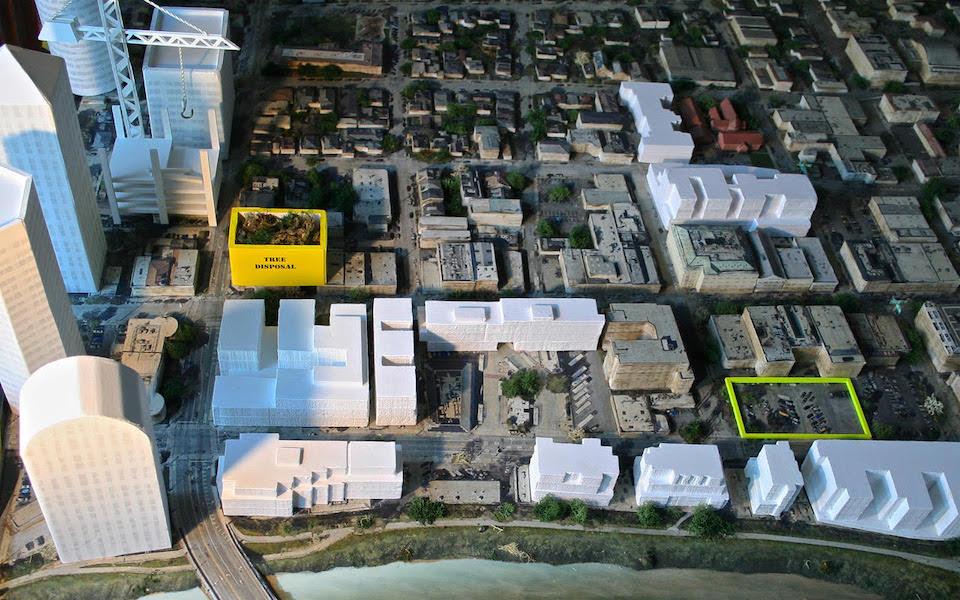
Morning shadows stretch across a city under siege, as high-rise sentinels usher in a brave new Santa Cruz. The new south-of-Laurel buildings on the left, dwarf even the now-in-construction Laurel-Front-Pacific project, not to mention the in-the-plans Cruz Hotel, Riverfront Complex, 530 Front St., Library, and housing on Calvary Church property.
Lot 7, highlighted in yellow in the lower right behind Pizza My Heart and Del Mar Theater, hangs in the balance as well. Note the yellow “Tree Disposal” temporary box, left-center.
Although the heights of several buildings in lower right are exaggerated with “artistic license,” the ones behind the crane, on the left, are actual proportionately correct representations, measured according to the city staff's proposals in commercial usage heights of 14’ to 15’ per story. The one under construction is Mayor Fred Keeley’s 12-story counter proposal, also represented in typical commercial story heights.
The actual model in the photo, which is far more impressive, was viewable at an art, music and poetry show held at the Resource Center for Nonviolence March 31 and April 1. You may be able to see at an upcoming First Friday. Stay tuned.
| |
|
Showdown at the Coastal Commission
BY REGGIE MEISLER - SANTA CRUZ CARES
Thank you to everyone who signed the letter of support for the Coastal Commission in fighting against City Manager Matt Huffaker's illegal attempt to restripe parking spaces throughout the coastal zone. It seems that, for now at least, restriping is on pause and another threat to our neighbors living in vehicles is taking center stage -- the Oversized Vehicle Ordinance (OVO).
We need your help if we are going to finally defeat this terrible ordinance. Please ask yourself, do you relate to any of the following:
1. You have lived on Delaware Ave., Shaffer Rd., Natural Bridges Dr., or Mission St. Ext. in a vehicle and experienced harassment from the city-- particularly if you've been towed, or threatened with a tow order, and have also not been offered safe parking or any other outreach services.
2. You live, have lived, or work near Delaware Ave., Shaffer Rd., Natural Bridges Dr., or Mission St. Ext. and are supportive of folks who park there (For instance: Hardcore Compost, UCSC Institute of the Arts & Sciences, you live in the De Anza Mobile Home Park off Shaffer Rd., etc).
3. You are not unhoused, but a family member, friend, or service worker, who has intimate knowledge of a person's experience living in their vehicle in that area and can speak for them in a supportive way, and against the harmful effects of OVO and other forms of city harassment.
4. You are an advocate with a unique background, you work at an established nonprofit, you work as city or county staff, or are part of some other well-known institution that is considered to be "mainstream," and can openly use this connection to strengthen your voice against the OVO and the city's harassment of the unhoused.
If you relate to any of the following demographics, or you don't, but still want to help, you will be crucial in helping argue against the City of Santa Cruz at next month's Coastal Commission hearing on OVO, May 10-12.
Please contact santacruzcares@gmail.com by May 9th and let us know if you or someone you know is willing to write a short email or speak to the Commission over Zoom.
| |
|
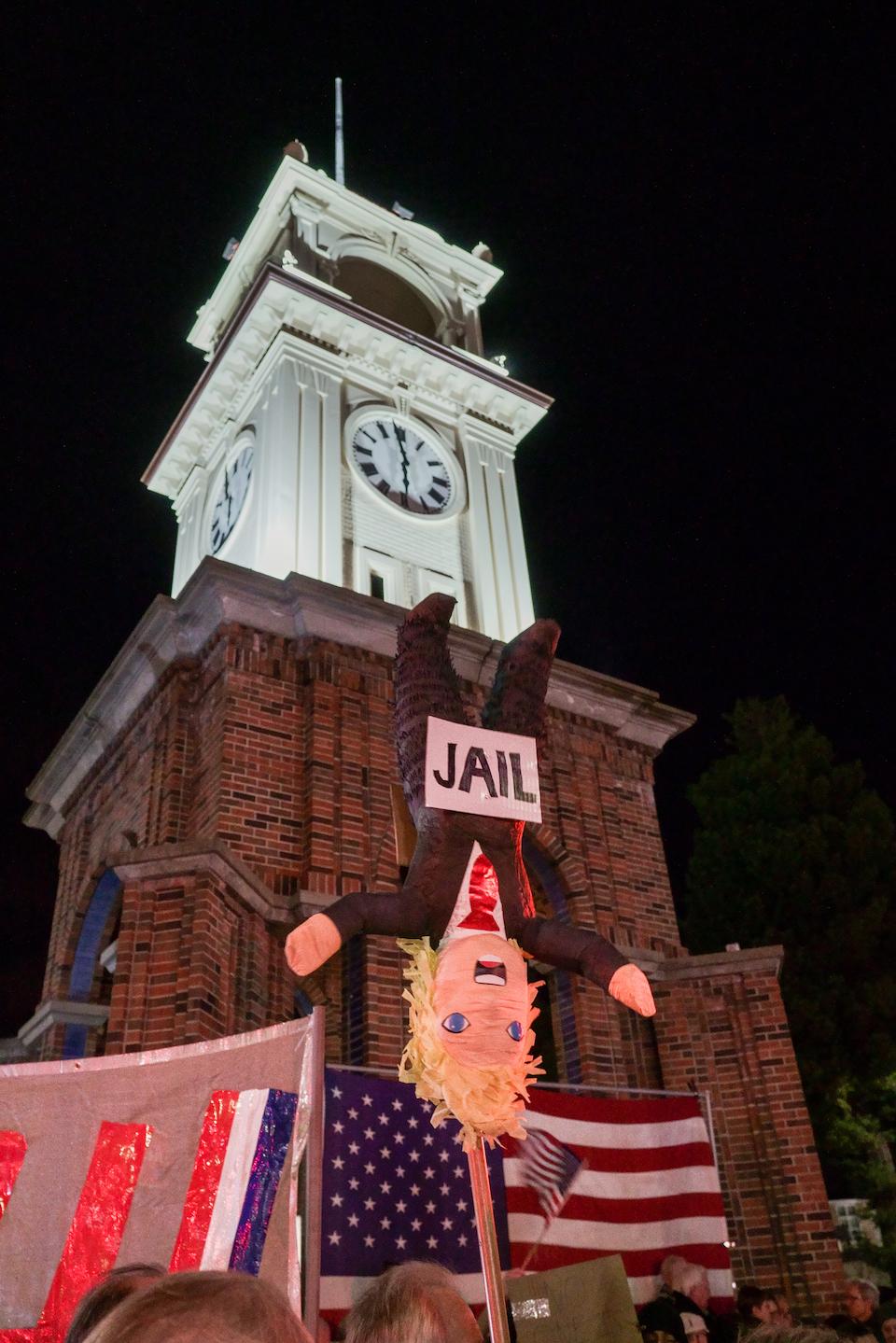
Photo by JON SILVER
Back by Popular Demand - Go Alvin! Go Fani! Go Jack!
| |
|
Stories of Resistance
By RCNV STAFF
Stories of Resistance is a free event held Apr. 12 at 2pm at the Resource Center for Nonviolence, 612 Ocean St. in Santa Cruz. It is sponsored by the RCNV and designed to lift up movement memories in Santa Cruz County and inspire future activism. In the last 50 years, local activists have conducted many actions and campaigns resisting colonialism, violence, racism, exploitation of people and the environment. Story telling about personal and political impacts, racial dynamics encountered, and learnings for future organizing will help us transform our society and ourselves.
We are delighted to welcome Bella Bonner and Joy Flynn, two local Black Lives Matter organizers. Join us to witness Bella and Joy engage in a call and response between their two movements. Joy Flynn initiated the first Black Lives Matter protest in downtown Santa Cruz May 30 and 31, 2020, right after George Floyd was murdered by police in Minneapolis, May 25, 2020. Bella Bonner organized the largest Black Lives Matter march on West Cliff June 3, 2020 the first Black Lives Matter protest in Capitola on Aug. 5, 2020 and a paddle out as part of global Black Lives Matter uprisings in the wake of the police murder of George Floyd. We will be learning their methods for organizing, key takeaways, how the community is impacted, and learn from their perspectives on where we go from here.
Esabella Bonner is a long-time Santa Cruz resident, entrepreneur, visionary, and award winning changemaker/activist working to help bridge our local community. In 2020, Bella followed her gut and organized one of the largest social protest gatherings Santa Cruz County has ever seen with over 5,000 people in attendance. While this was the first protest she organized, it was a great success and opened up a world of movement work to her. She then went and organized the community to make space for black and brown people at various paddle outs as a part of protests on the water in Santa Cruz to support BLM. This led Bella to creating Black Surf Santa Cruz where she is the founder and executive director for the award winning organization which aims to promote physical, spiritual, and communal wellness and healing through surfing, recreation, education, and advocacy for our local community.
Joy Flynn organized the first peaceful action in response to the public execution of George Floyd in an effort to uplift and bring visibility to the siloed Black community, raise awareness about our experience and need for change in Santa Cruz. As a result of her action Joy worked with former Mayor now County Supervisor Justin Cummings and former SC Police Chief Andy Mills on police policy change around accountability, use of technology, use of force to name a few. She worked with the city of Watsonville on police reform and with the city of Capitola on uncovering bias, and as community advisor for the county’s Criminal Justice Council. Joy has worked on other initiatives such as health inequalities, working with other members of the Black community and with former Supervisor John Leopold to have racism declared a public health crisis. In response Supervisor Leopold created the CARESJ (Commission on Anti-Racism, Equity & Social Justice) where Joy was appointed and still serves today. Joy has been recognized both locally and nationally for her work. In 2021 Joy received the Officer Jim Howes award for outstanding service to the City of Santa Cruz and was recognized nationally after winning our regional Jefferson Award.
Now board emeritus for Second Harvest Food Bank, Joy is passionate about addressing issues around poverty, food access inequalities. Joy currently serves as an advisor for BHMI (Black Health Matters Initiative) and is a member of the board of directors for PCS (Pacific Collegiate School) where she helps to bring an equity lens and works on the Diversity Committee. As a single mother Joy loves raising her two teen-aged children in the same area she was raised. Joy is honored to build and serve her community and help make it a safe and thriving place to live, work and play.
Click Here to Reserve a Free Ticket
| |
|
Photo by SARAH RINGLER
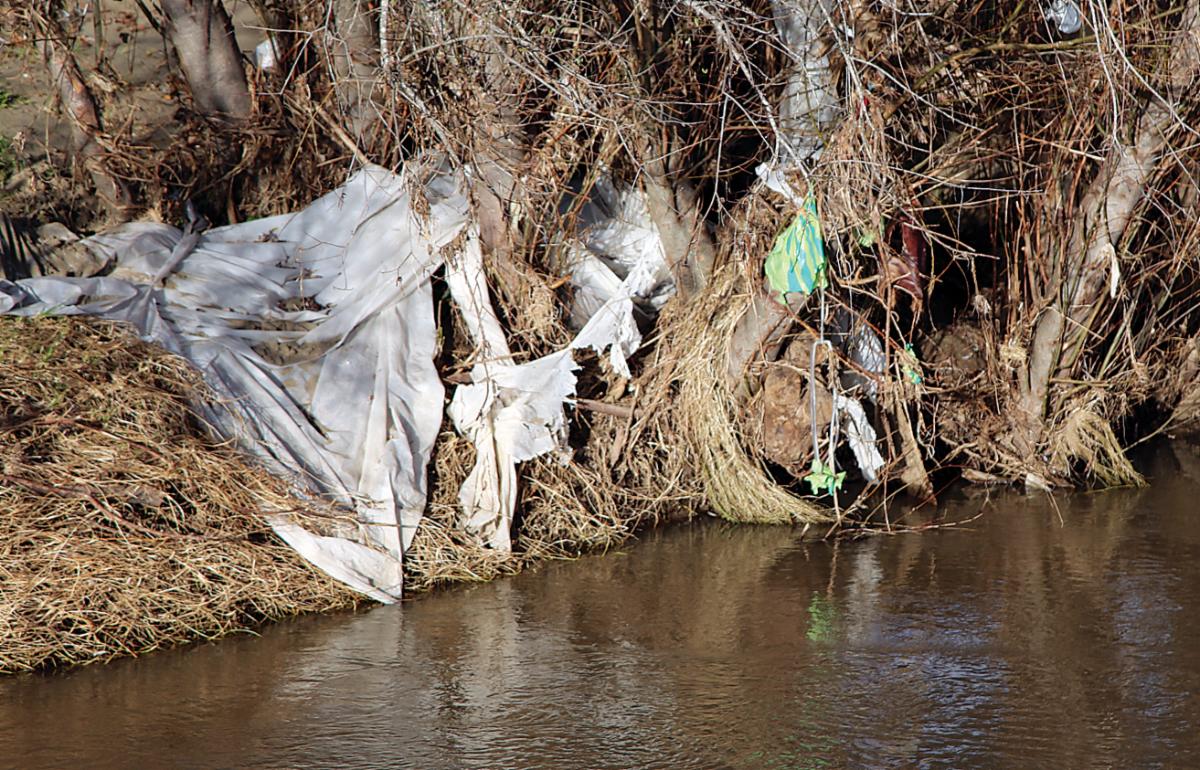
Agricultural plastic combines with other debris to block Salsipuedes Creek in this photo taken in February.
| |
|
Storms Are To Be Expected
By SARAH RINGLER
Almost 3 ½ months after a surprise heavy rainfall flooded the homes, businesses and fields in the southeast section of Watsonville, residents are still frustrated. That frustration was vented at a special Tuesday meeting called by the Watsonville City Council to respond to allegations of malfunctioning pumps and unmaintained culverts and retention ponds. About 60 people attended and many people spoke revealing other issues as well.
A surprisingly gigantic storm – aka Atmospheric River -- with an incorrect prediction from the National Weather Service has been blamed for the flooding in the Santa Cruz County area. However, these storms have happened before and resulted in major flooding. Those historic events are recorded and embedded in data on rivers and creeks in the area. There are things that should have been done to mitigate what turned into a human disaster, not only in southeast Watsonville but in Pajaro and other places in the state.
Immediately, there needs to be an assessment of the mud that was spread over this entire area. Poisonous agricultural chemicals, human and animal waste and other debris can be unhealthy as the city knows when it directed all residents not to wash dried mud that was coating their yards, sidewalks and streets into the storm drains after the floods. One woman at the meeting reported finding syringes in her backyard. The city later came through and scooped up what they could. There is still residue on our driveways and gardens. We need to know if it's dangerous.
An emergency response and evacuation plan need to be created. Many of the residents in this area live in 55 and older housing and are in their 70s, 80s and 90s. Some are disabled and live alone. Several older people complained that they called 911 only to be told there was nothing that could be done. A woman on Argos Circle who called said the dispatcher told her, “We can’t help you.” Another person said they we hung up on. Another woman on Argos Circle broke her leg trying to escape through knee-deep water. Some people reported that no one came by to check on them until four days later.
A main part of an emergency response has to be communication. At this meeting, we were told there had already been a meeting on this issue in February. No one I talked to had heard about it. Even though not everyone has computers, or can use them, most have phones. On Tuesday, after the New Year’s Eve flood, people were dispatched to make contact with the residents in our area and handed out mandatory evacuation notices. Although labor intensive, it was effective. Ironically, there was no need to evacuate those days as the weather was mild. For three nights, Jan. 3-5, we stayed - at our own expense - at the Best Western Rose Garden in downtown Watsonville. We came home during the days to work. The following Monday, Jan. 9, streets flooded again. Evacuation orders came the next day but we stayed. Our place was ok.
There needs to be accountability for the maintenance of flood reduction mitigations like pumps, culverts, catch basins, retention ponds, gate valves on culverts, equipment and cleaning out debris in creeks and rivers. Jurisdiction needs to be clarified and responsibilities need to be enforced. Plastic sheeting used to contain fumigants before strawberries are planted line the waterways like moss but unlike moss, get caught up in the limbs of trees and form tangled dams. See the above photo. Andy Gonzales, who lives on Atri Court, about 50 feet from the pump house that encloses a pump that is designed to remove water out of the neighborhood into Salsipuedes Creek, has been publicly very vocal that the pumps had worked earlier on New Year’s Eve then quit around 9pm. (City Counsil had been assured that the pumps were working.) Residents on Village Way questioned why the drainage canal below the street wasn’t kept clear and water ended up flooding onto the streets and into houses. Also, the shallow catch basin on Nugent’s Ranch breached over East Lake Ave. instead of flowing through a blackberry vine covered culvert under the road to the drainage canal. Keeping waterways clear does not mean cementing the canals. It must be done in consideration of the fish, wildlife and ecosystems that also depend on them.
Watsonville City Council has promised that another community meeting will be held.
Contact your county supervisor HERE. Contact Watsonville City Council HERE.
| |
|
Photo by TARMO HANNULA
A sparrow considers sharing his onion bagel.
| |
|
Santa Cruz County Covid-19 Report
By SARAH RINGLER
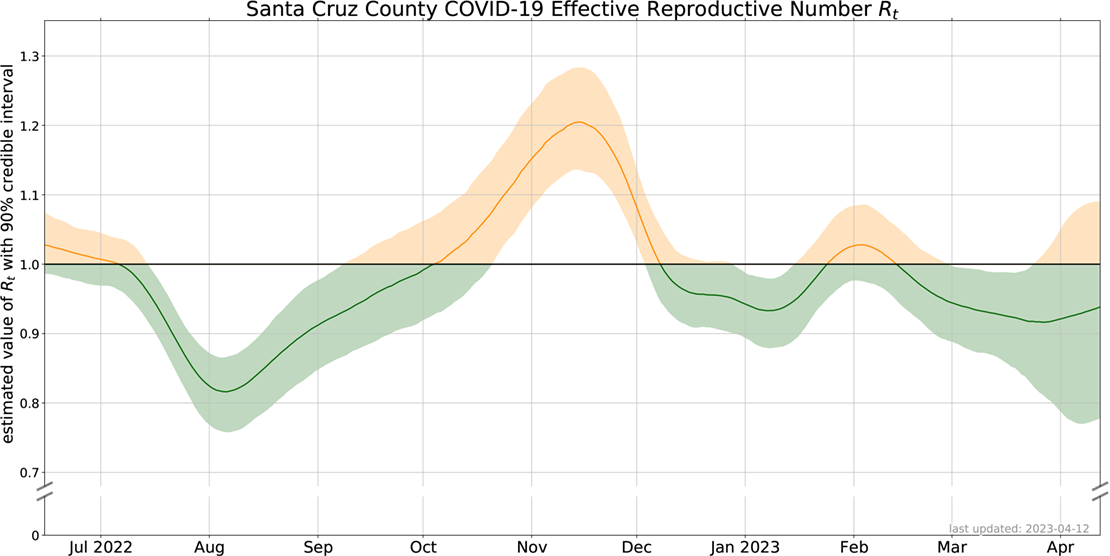
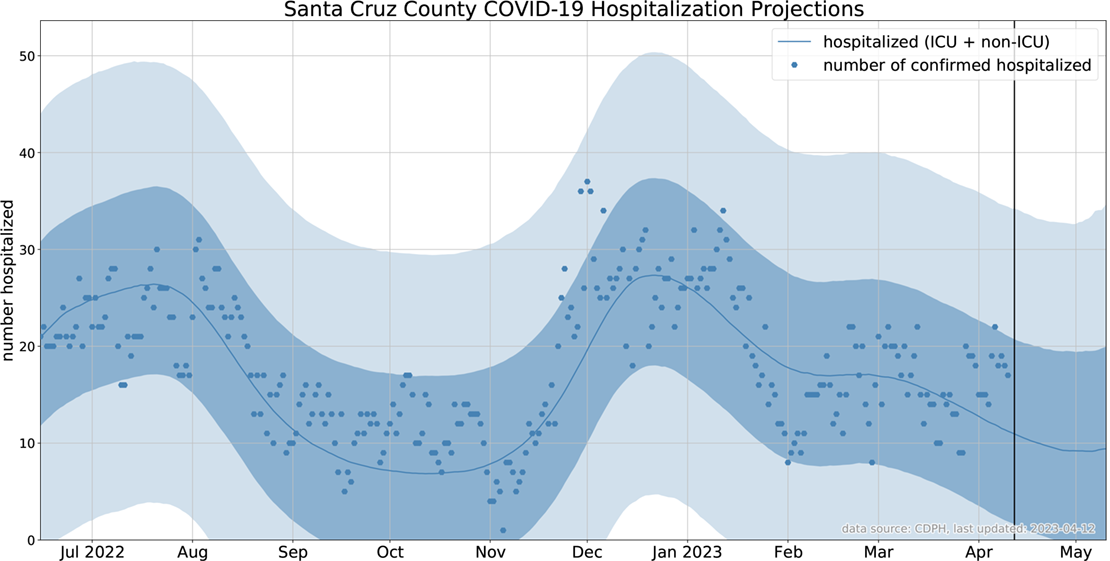
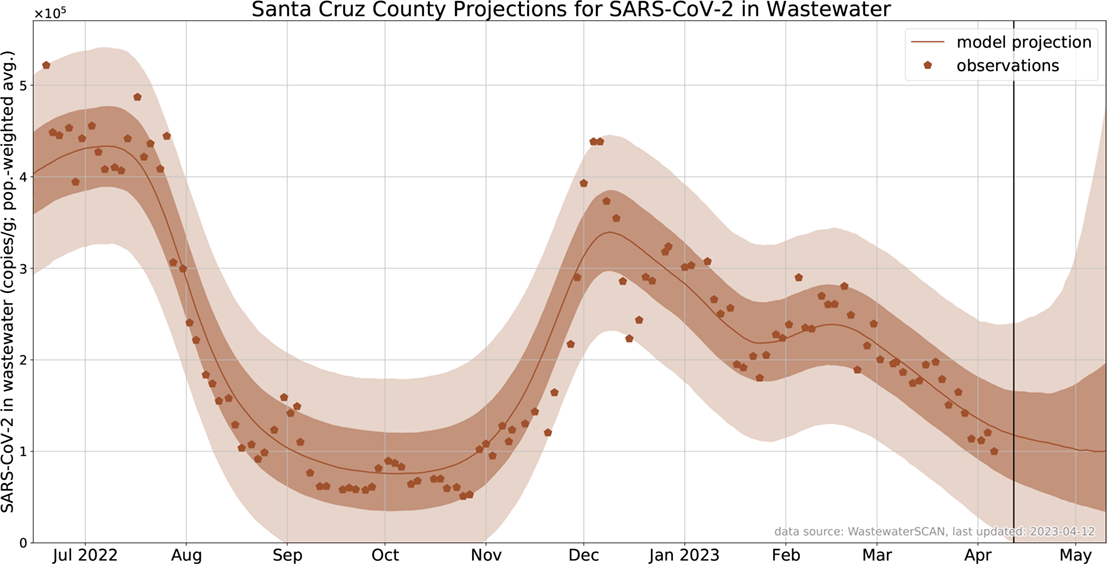
The Santa Cruz County Health Department regularly releases data on the current status of Covid-19 in the county. There have been no new deaths in the county since Dec. 15.
The second graph below, updated Apr. 12, shows the Rt Number. Numbers above one show the spread of the virus is increasing. Below one means the spread is decreasing. To view the distribution of cases around the county, look here.
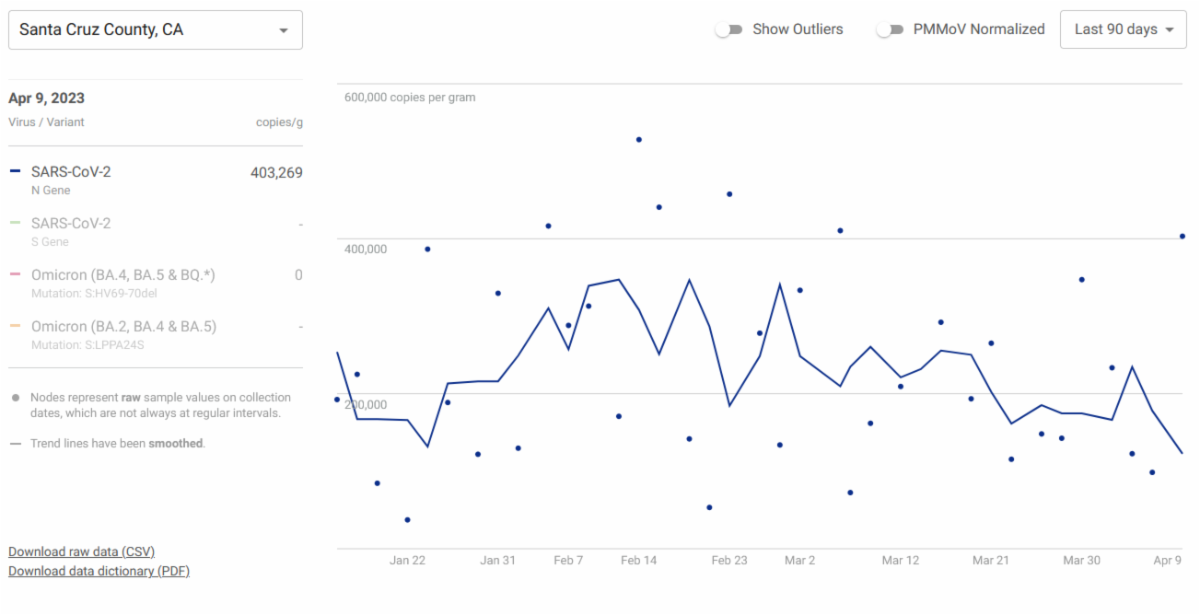
The Health Department is collecting data for Covid and Mpox from wastewater at the City Influent, for the city of Santa Cruz, and from the Lode Street pump stations for the county. See webpage HERE. The first and fourth charts below shows county data from Apr. 9 and Apr. 12 respectively. The fourth chart below shows wastewater projections.
The third graph below shows hospitalizations as of Apr. 12. Click to see more information on hospitalizations HERE.
The vaccination data for the county is divided into three categories. As of Apr. 7, Primary Series recipients are still at 77.2%, Primary Series and Boosted are at 68.9%, and Bivalent Boosters, are at 34%.
This webpage also has a link where you can get a digital copy and scannable QR code of your vaccination record. Keep track of your four-digit code because that is your access to the site.
To order free at-home COVID-19 test kits, go HERE. You can make an appointment for a Rapid Antigen Test HERE.
| |
|
Deaths by age/276:
25-34 - 5/276
35-44 - 8/276
45-54 - 10/276
55-59 - 4/276
60-64 - 15/276
65-74 - 49/276
75-84 - 64/276
85+ - 121/276
Deaths by gender:
Female - 136/276
Male - 140/276
| |  |
|
Deaths by vaccination status:
vaccinated - 39/276
unvaccinated - 237/276
Deaths by ethnicity:
White - 163/276
Latinx - 90/276
Black - 3/276
Asian - 16/276
American Native - 1/276
Unknown - 0
| | |
|
Photo by TARMO HANNULA
Fashion Street - Live music on the streets of Palm Springs this February.
| |
|
Labor History Calendar - April 14-20, 2023
a.k.a Know Your History Lest We Forget
April 14, 1930: Over 100 Mexican and Filipino farmworkers arrested for union activity, 8 convicted of criminal syndicalism in the Imperial Valley, CA.
April 14, 1939: John Steinbeck’s “The Grapes of Wrath” published.
April 15, 1915: IWW union Agricultural Workers Organization formed in Kansas, MO.
April 15, 1996: Portuguese dockers begin solidarity boycott of Liverpool shipping.
April 16, 1912: British labor newspaper Daily Herald founded.
April 16, 1968: Memphis sanitation strike begins.
April 17, 1905: US Supreme Court overturn New Jersey 9-hour law.
April 17, 1961: Bay of Pigs invasion.
April 18, 1908: IWW poem, “We Have Fed You All For A Thousand Years: first published.
April 18, 1912: West Virginia coal miners strike, defend themselves against the National Guard.
April 19, 1943: Warsaw Ghetto uprising.
April 20, 1914: Miners’ wives and children massacred at Ludlow by company guards and the Colorado National Guard.
Labor History Calendar has been published yearly by the Hungarian Literature Fund since 1985.
| |
 | |
Photo by TARMO HANNULA
The Scent of Cinnamon
By SARAH RINGLER
What does the scent of cinnamon bring to mind? The carefully harvested and processed inner bark of the Cinnamomum verum tree used to be expensive and its origins were unknown to Europeans in the Middle Ages. In 1248 during the Crusades, Sieur de Joinville, upon visiting Egypt with the French king, was told that the bark was scooped up in nets at the source of the Nile River. The Greek historian Herodotus believed that it came from Arabia and told of giant cinnamon birds that collected the sticks and used them to make nests.
Cinnamon is native to what is today, the coast of the Bay of Bengal from Burma — now Myanmar, to Bangladesh, then south to Sri Lanka, and then to the Malabar Coast in the Indian Ocean. Early on, merchants realized its value and concealed its origin to maintain their profits. Indonesian sailors would bring the bark to East Africa and traders would bring it north to Alexandria, Egypt, on the Mediterranean Sea. There is evidence of cinnamon from Egypt in 2000 BCE. Venice maintained the monopoly on the European market. The Portuguese landed on Sri Lanka, built a fort in 1518 and took over the European cinnamon market for the next 100 years. Sri Lanka still produces most of the world's cinnamon. Other species of cinnamon are produced in Indonesia and China.
This cinnamon bread makes a very decorative eight-pointed star shape. I have tried to explain it the best I can through words but it might be easier to watch at Steve’s Kitchen on www.youtube.com/user/SteveOwensKitchen. Steve Owens is an accomplished and creative cook. Look for "Nutella Braided Tear and Share Bread." I have changed the Nutella filling to cinnamon.
Cinnamon Braided Tear and Share Bread
Dough:
1 pound flour or 3 cups
1/3 cup sugar
2 teaspoons bakers yeast
pinch salt
1 ounce or 2 tablespoons unsalted butter
¾ cup warm milk
2 eggs yolks – save the whites for brushing bread before baking
Spread
½ cup melted butter
¾ cup brown sugar approximately
Cinnamon
2/3 cup chopped walnuts - optional
Mix yeast with ¼ cup of the warm milk with a pinch of sugar added. When yeast has bubbled and risen, add to a mixing bowl. Add the rest of the warm milk, egg yolks, rest of sugar, melted butter and salt. Add one cup flour and beat vigorously. Gradually add more flour until you have a solid mass. Remove from the bowl and knead for about 10 minutes with additional flour until the flour no longer sticks to the board the dough puffs back up when you stick your finger in it.
Form dough into a dome by tucking edges underneath so you have a smooth surface. Let it rise in a buttered bowl covered with plastic wrap of a damp towel in a warm place for 2 hours.
Punch the dough down and fold over four times. Cut into 4 parts. Roll one part into a 10- inch diameter circle. Place it on parchment paper on a baking sheet. Put a 10-inch plate on top and mark where the edges of the plate sit on the dough.
Spread melted butter inside the 10-inch diameter of the plate. Sprinkle with brown sugar, walnuts and cinnamon.
Roll out the next 2 parts, cover with sugar, butter, walnuts and cinnamon and stack on top of first circle. Roll out the 4th circle and cover all 3. Lay the same plate over the stack and cut down with a sharp knife until you have a perfect circle.
Lay a 2½ inch diameter glass over the center of the circle. Without cutting into the center circle, cut into 16 equal slices radiating off the center circle starting with half, then quarter, then eighths and then sixteenths. Take two sections that are next to each other. Hold one with your right hand the other with your left. Twist each section 2 turns in opposite directions and then connect them together vertically. Do this 8 times. Remove the glass from the top. Cover and set aside for ½ hour.
Preheat over to 350 degrees. Brush the dough with lightly beaten egg white. When the oven is ready, bake for 30 minutes.
| |
Send your story, poetry or art here: Please submit a story, poem or photo of your art that you think would be of interest to the people of Santa Cruz County. Try and keep the word count to around 400. Also, there should be suggested actions if this is a political issue. Submit to coluyaki@gmail.com
If you are enjoying the Serf City Times, forward it on to others. We need readers, artists, photographers and writers.
Thanks, Sarah Ringler
| |
|
Welcome to Serf City Times Our county has problems and many people feel left out. Housing affordability, racism and low wages are the most obvious factors. However, many groups and individuals in Santa Cruz County work tirelessly to make our county a better place for everyone. These people work on the environment, housing, economic justice, health, criminal justice, disability rights, immigrant rights, racial justice, transportation, workers’ rights, education reform, gender issues, equity issues, electoral politics and more. Often, one group doesn’t know what another is doing. The Serf City Times is dedicated to serving as a clearinghouse for those issues by letting you know what is going on, what actions you can take and how you can support these groups.This is a self-funded enterprise and all work is volunteer.
Copyright © 2023 Sarah Ringler - All rights reserved
| | | | |