Volume 4, Issue 47, May 31, 2024 View as Webpage

Robert Norse Questions Housing Matters 

BY SARAH RINGLER


The 77 Wonders band added smooth vibes as they performed at the Duck Pond for Soupstock last Saturday.

PHOTO BY TARMO HANNULA


Robert Norse has been active in homeless issues for many decades. He has been tireless in objecting to the mistreatment of people who cannot afford housing in Santa Cruz and have been forced to live outside. Most are locals; 75%-89% lived in the county when they became homeless according to the 2022 and 2023 Point-In-Time Counts conducted by counties over the country under the US Government's Housing and Urban Development. He has fought against the destruction of camps where people have gathered to feel safe by police at the request of city government. He advocates for services that can truly help people find a place to live.


At the celebration of 44 years of Food Not Bombs, Soupstock, that was held last weekend at the Duck Pond in San Lorenzo Park, he issued a written list of questions directed to Phil Kramer, Chief Executive Office of Housing Matters. 


In Norse's open and brash style, here are some of his questions: 


"How many Housing Matters clients are in stable housing and at what cost?


"When will Housing Matters admit it has no “pathway to housing” but a revolving door to the street for most?


"What percentage of Housing Matters funding actually gets diverted to buildings & salaries?


"How long will the community fund poverty pimpery and greedy grant-grabbing by funding services like Housing Matters which since 2015 have ignored the needs of the many?"


I decided to check up myself on Housing Matters. Using their webpage and 2023 Annual Report for Housing Matters this is what I found. I will present this to Mr. Kramer and print his response next week.


Housing Matters is a non-profit that was formed more than 30 years ago by community and faith-based groups. It is the largest organization addressing homelessness in the county with a revenue of $11.9M in 2023 that it received primarily from donations, 46%, and government grants, 46%.


Listed on their website, Housing Matters has an executive team of four, an administration team of 15, a program team of 87-95 what they call "professionals," and 13 Board of Directors. Their total expenses for 2023 were approximately $13M with approximately $7M in personnel expenses, $3M in client services, $1.3M in office and administrative expenses, and $1.8M in facilities expenses. 


They offer hot showers, restrooms open all day, every day, and mail services for those who don’t have an address. They also have three emergency shelter programs at their Coral Street campus providing beds for 180 people, accounting for half of the shelter beds in the county. They also have programs that support helping families, veterans and people with disabling condition get housing. They have also opened seven units of housing at Casa Azul with 120 unit in development. Phil Kramer is their Chief Executive Office.


In this year’s 2023 Annual Report for Housing Matters it was reported that their revenue increased from $6.2M in 2021 to $11.9M in 2023. The report states “This financial growth has enabled us to expand our dedicated team from 59 to 95 professionals in that same time period. The revenue and staff growth of Housing Matters allows us to scale our programs to support people living unhoused in our community.”


The report continues, “The team has helped 335 people find stable housing to date this year and we are on track to grow that to 400 by the year end. A nearly 30% increase in move-ins over last year!” 


How effective is Housing Matters at providing housing, the primary need for unhoused people? Charity Navigator, a reputable website that rates non-profits and charities generally considers that an effective charity spends 70% of its revenue on program. Housing Matters spends only 23% on client services but spends 54% on personnel, 10% in office and administrative expenses, and 14% on facilities.


Housing Matters seems heavy on staffing. With the expansion of its “professionals,” to 95 last year, they helped 335 people find stable housing. Even with the prediction cited above that the number would be 400 by the end of the year, that works out to about four people per year for each “professional.” Staffing does not seem like the most effective expense in trying to get people into housing. 


Robert Norse has more questions that will be addressed in the future. He holds meetings of HUFF (Homeless United for Friendship & Freedom) every Thursday 1:30-3:30pm at the Sub Rosa Café, 703 Pacific next to the Bike Church. 

Japanese Cultural Fair 2024

BY SARAH RINGLER

The Japanese Cultural Fair will be held Saturday, June 8 from 11-6pm at Mission Plaza Park in Santa Cruz. The purpose of the fair, according to The Bridge the newsletter for the Watsonville-Santa Cruz Japanese American Citizens League flyer, is "to increase awareness and understanding of Japanese culture and through exposure and education improve mutual understanding among neighbors of the Pacific Rim and enrich the community of Santa Cruz."


The food, crafts and performances are first class and well worth the visit.

Moving Trains

BY JUDY GITTELSON


Studio Judy G is pleased to present, All Aboard, an exhibition broadcasting the magnificence of trains. Artwork created by more than a dozen world renown and local artists will capture any train enthusiast's interest and rev up the engines of the unschooled. If you have ever been delighted by trains, or train curious, this show is for you.


All Aboard exhibits the possibility of a new Santa Cruz passenger train. Our tracks are in place and will run from Pajaro to Santa Cruz along the stunning scenic coast. Our branch line will connect with the State rail system - Amtrak to transport people up and down the West Coast. Residents and visitors will be able to easily travel carfree around our county and connect to the entire United States. 


The public wants trains. There is a well formed anti-train group – and their goal is to remove the tracks and eliminate public passenger trains forever. 


"Watsonville residents voted overwhelmingly against Measure D (to tear out the tracks), in fact the highest percentage in the county. They’ve expressed the need for sustainable multi-modal transportation and Zero Emissions Rail & Trail, specifically. They just want to alleviate the gridlock they face everyday in traffic." - Felipe Hernandez, Fourth District Supervisor for Santa Cruz County 


Studio Judy G will host two remarkable All Aboard artists in residence. In June, Helen Dang, scientist, artist, and map maker. In July, Stephen Mallon, photographer of Moving Freight


A portion of sales will be contributed to Coast Futura and Friends of Rail and Trail, promoting clean rail transit. 


Reception for the Artists

Sunday, June 9, 2-5 pm

Studio Judy G

430 Main Street

Watsonville


Bird Nests & Palm Sundays

BY WOODY REHANEK


Palm Sunday...when Jesus rode a donkey

triumphantly into Jerusalem as people

waved palm fronds & shouted Hosannas...


In Baja, our house is roofed with dried

overlapping palm fronds: a simple,

elegant palapa roof. The open-ceiling

design lets you lay in bed while your

mind wanders into the structured

intricacies of a palm-frond dream world.


A few years ago, when we were replacing

the palapa roof, empty bird nests would 

fall out of the stacks of palm fronds:

elaborate fiber pouches made by canarios

palmeros, "palm canaries," the local name

for the orioles that nest in Loreto's palms.


The nest pouches had textures like Loofas

used for bathing, so I packed a dozen

in my luggage for the flight to San 

Francisco — where the customs officials 

were bemused & bewildered. Bird nests 

were not on their restricted-import lists.

It was a head-scratcher. They decided

to confiscate them anyway.

************


Photo by TARMO HANNULA 

A young great-horned owl keeps a wary eye on visitors to Natural Bridges State Park in early May.

Santa Cruz County Covid-19 Report - Rt rises above 1 Third Week in a Row

By SARAH RINGLER


The California Department of Public Health and Santa Cruz County Health Department regularly release data on the current status of Covid-19 in the county as well as information on influenza, Respiratory Syncytial Virus (RSV), and Mpox. Since cases of Covid are still appearing, and there are still vulnerable people, I will continue reporting the graphs below.


At-home Covid-19 test kits are currently available at the Watsonville Public Library, Main St.


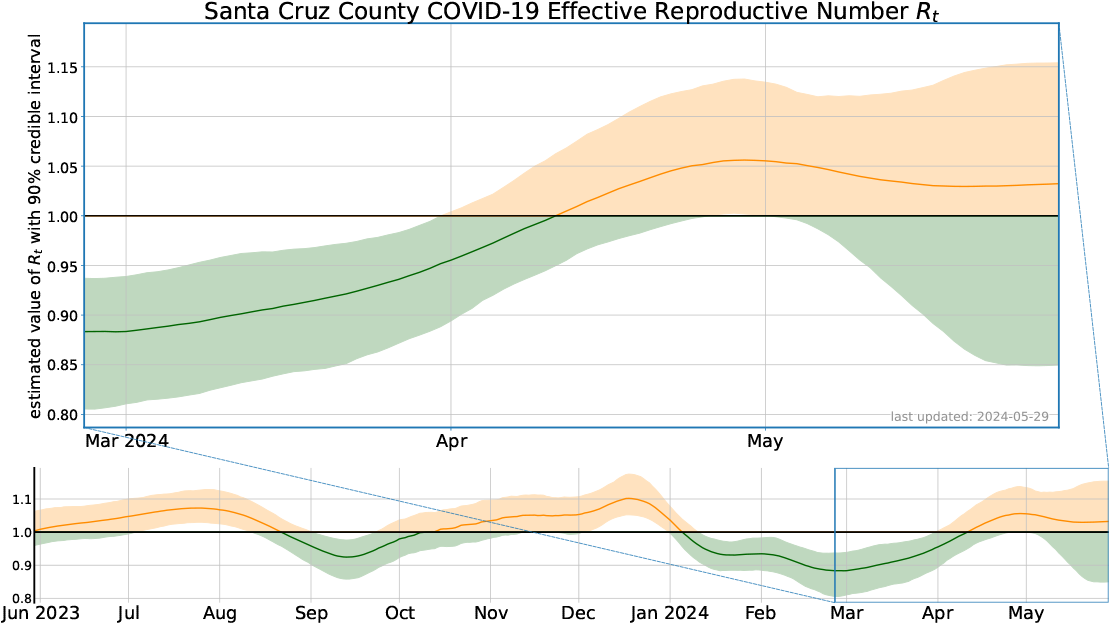
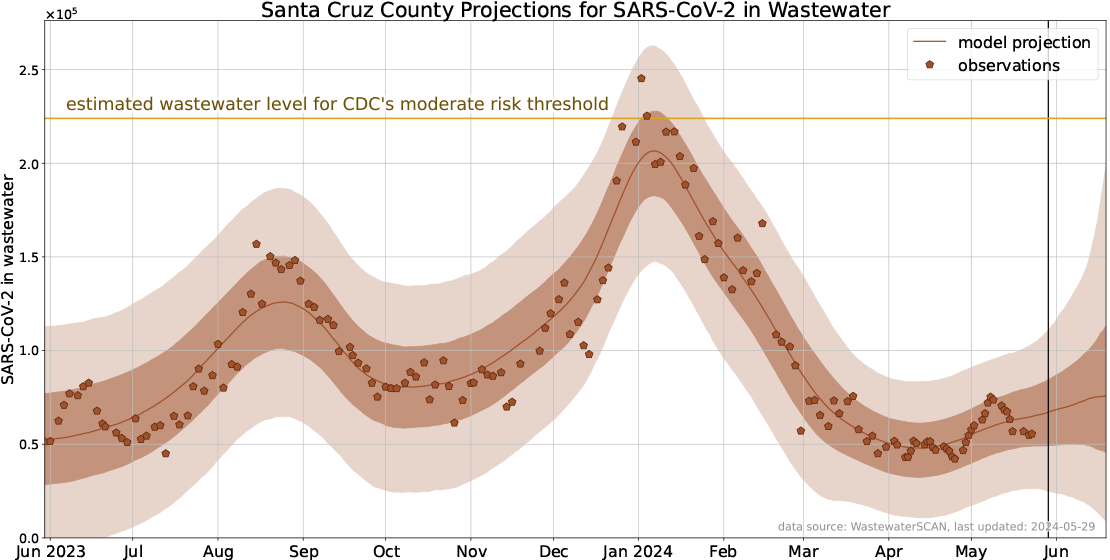
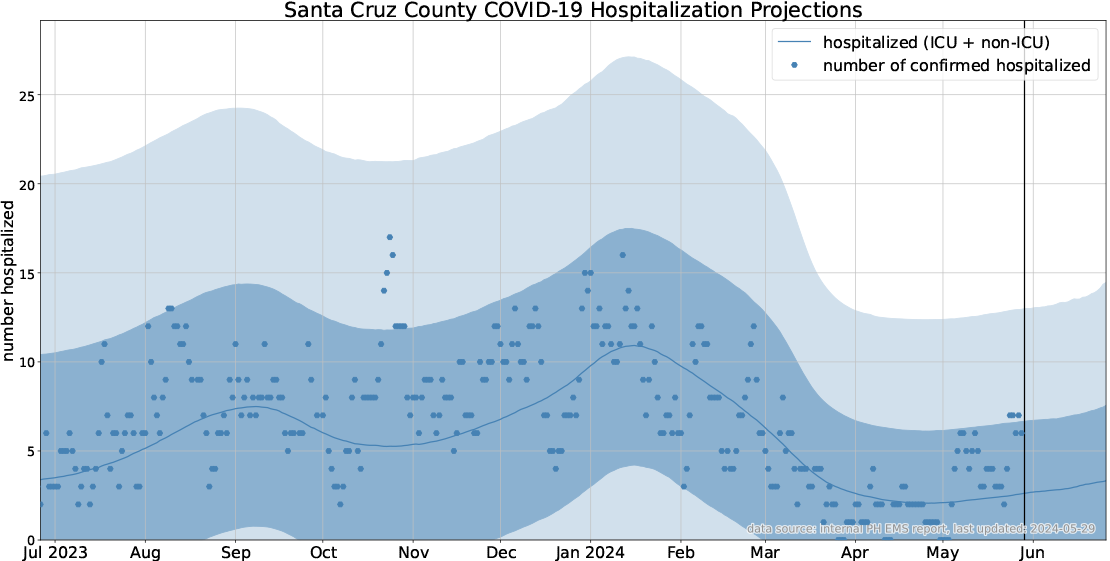
The three graphs below were updated on May 29.


The first graph is the Effective Reproductive Number. When the line rises above one, it shows that the spread of the virus is increasing. Below one means the spread is decreasing. 


The second graph below shows data that the Health Department collects for Covid from wastewater at the City Influent, for the city of Santa Cruz, and from the Lode Street pump stations for the county.


The third graph below shows hospitalizations.

Photo TARMO HANNULA

Fashion Street - Freeway sign along Highway 101.

Labor History Calendar - May 31- June 6, 2024

a.k.a Know Our History Lest We Forget


May 31, 1819: Walt Whitman born, poet.

May 31, 1921: Sacco and Vanzetti trial begins.

May 31, 1925: Living Theater co-founder and Wobbly Julian Beck born.

June 1, 1903: 3,500 immigrant miners begin Clifton-Monrenci, AZ copper strike.

June 1, 1922: National rail strike.

June 1, 1985: Vancouver unemployed demand free bus service.

June 2, 1916: IWW Mesabi Range strike.

June 2, 1924: Supreme Court overturns law restricting child labor.

June 2, 2006: 80,000 march in support of striking teachers in Oaxaca, Mexico.

June 3, 1824: 500 women win first US textile strike at 8 factories in Pawtucket.

June 3, 1919: Vancouver BC general strike begins in sympathy with Winnipeg general strike. 

June 3, 1933: IWW hop pickers in 50% pay hike in Yakima, WA.

June 3, 1952: US Steel strike begins.

June 4, 1974: Occupied Regent Knitting factory reopens under workers’ self-management and lasts 8 years in Saint-Jeromeme, Quebec.

June 4, 1989: Tiananmen Square massacre. 

June 5, 1933: 800 or more Mexican pickers strike San Gabriel Valley berry fields.

June 5, 1995: 2,500 peasants shut down Mexico stock market for two hours.

June 5, 2013: Bangladesh police fire on garment workers seeking back pay.

June 5, 2013: Turkish strikes hit repression.


Labor History Calendar has been published yearly by the Hungarian Literature Fund since 1985.


"You Americans don't take off your hats when you come to my headquarters, do you?"


- Pancho Villa


Photo by TARMO HANNULA

Gado-gado  

By SARAH RINGLER 


Gado-Gado is an Indonesian dish that has become a mainstay for many vegetarian eaters. This recipe is from a 1977 copy of Mollie Katzen’s, “Moosewood Cookbook.” Over the years, 5 million copies have sold. The Moosewood Restaurant, from which the recipes evolved, is in Ithaca, New York. It opened in 1972 and is still operating today.


Gado-gado is a vegetable dish that has fresh and steamed vegetables over and under a peanut sauce. It is a one-dish meal. Use any combination of cooked and raw vegetable you want. Medium-firm tofu squares sautéed in sesame oil, soy sauce and sesame seeds are a nice addition. It can be served with rice


3-4 cups cooked basmati rice - optional


Steamed or cooked toppings:

Shredded cabbage

Cooked, pealed and cubed Japanese yams

Sliced carrots

Celery slices

Broccoli spears

Green beans

Sautéed firm tofu, 8 ounces or more

Sesame oil

Sesame seeds

Chopped hard boiled egg - optional


To sauté the tofu, first wash and dry the fresh tofu. Let it sit on a clean dishtowel to dry out. Cut into 1-inch square pieces. Heat about 1 to 2 tablespoons peanut or corn oil in a fry pan over medium heat. Add the tofu squares tossing as they become golden on all sides. Sprinkle with a little salt and a tablespoon of sesame oil. Do not overcook. You want a little golden crust on the outside but still tender inside. Sprinkle on sesame seeds or furikake. Put aside and keep warm.


Fresh toppings for rice:

Mung bean sprouts

Raisins

Sunflower seeds

Apples cut into bite size pieces

Toasted sesame seed oil

Furikake - a Japanese topping made of seeds, seaweed and herbs


Sauce:

1 cup chopped onions

2 medium crushed garlic cloves

1 cup peanut butter

1 tablespoon honey

¼ teaspoons cayenne pepper or more to taste

juice of one lemon

1-2 teaspoons freshly grated ginger root

1 bay leaf

1 tablespoon cider vinegar

3 cups vegetable stock or water

salt to taste

dash of tamari

2 tablespoons butter


In saucepan, melt the butter and cook the onions, garlic, bay leaf and ginger. When the onion becomes translucent, add the remaining ingredients. Mix thoroughly. Simmer on the lowest possible heat for 30 minutes.

Send your story, poetry or art here: Please submit a story, poem or photo of your art that you think would be of interest to the people of Santa Cruz County. Try and keep the word count to around 400. Also, there should be suggested actions if this is a political issue. Submit to coluyaki@gmail.com


Send comments to coluyaki@gmail.com


If you are enjoying the Serf City Times, forward it on to others.


Subscribe, contact or find back issues at the website https://serf-city-times.constantcontactsites.com


Thanks, Sarah Ringler