Volume 3, Issue 30, Jan. 27, 2023 View as Webpage

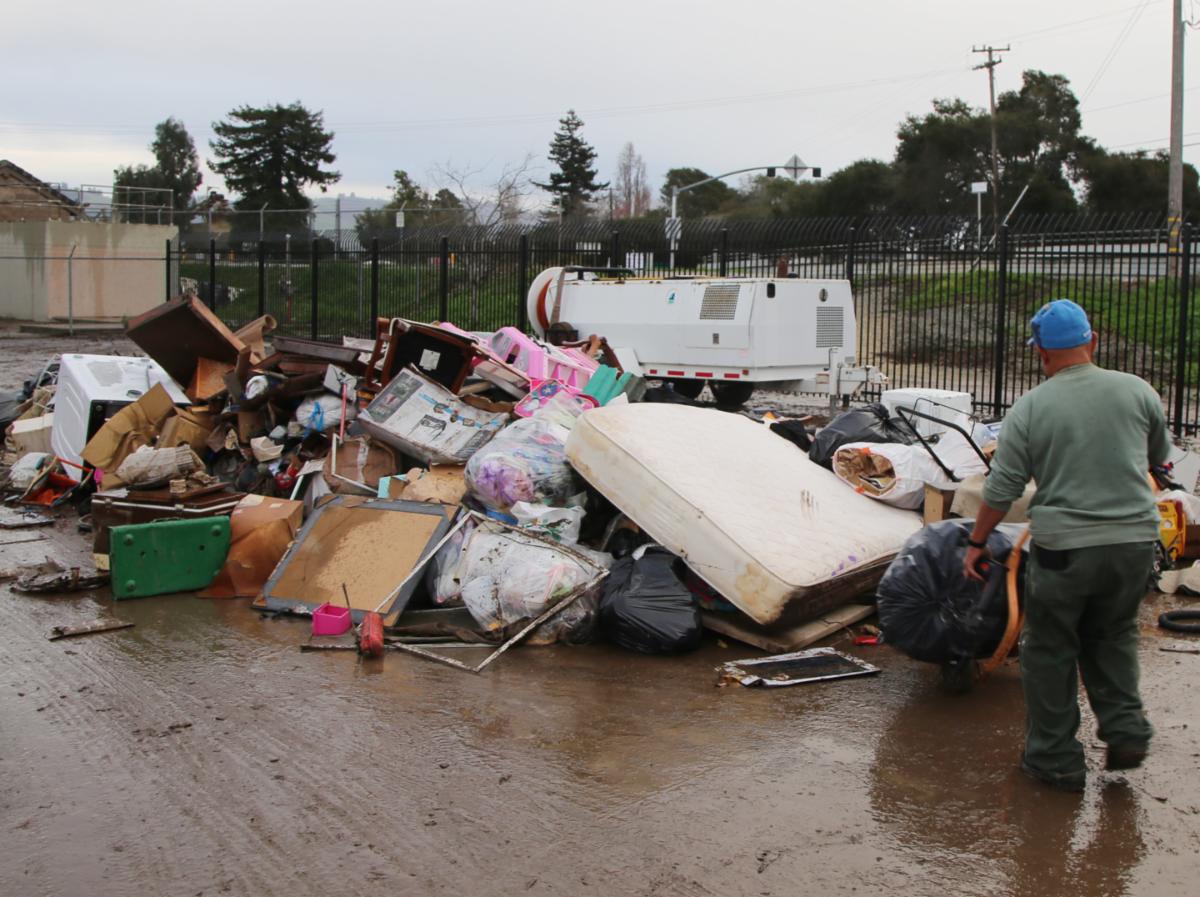
Photo by TARMO HANNULA

Biden on Holiday at the Beach


All over Santa Cruz County, 32,000 people were under evacuation orders with schools closed, damaged homes from fallen trees, flooded homes, roads and highways closed, people going without power for days, biohazard and toxic chemical run off and worries about safety of the food supply. President Joe Biden comes to town and visits the beach at Capitola. He did visit one neighborhood, a beach side drive of very high-end, mostly beach rental homes on Beach Drive in Rio Del Mar. Wearing his tinted aviator shades and standing by our rather handsome governor, it was almost a vacation promotion shot. 


The photogenic Capitola Venetian Hotel and nearby beach and restaurants are no stranger to flooding. Periodically, more often than floods, extremely high surf has swept into those places nearly destroying them yet there they are, open for business come summer. No one is displaced and loses their home.


We live in Watsonville, about two blocks from Salsipuedes Creek. With the Pajaro River running through the valley most of the town is near sea level. Our neighborhood is certifiably in the flood plain; we needed flood insurance to get our mortgage.  But even outside the neighborhood, most fireplugs in Watsonville are raised around ten inches above the pavement. 


We were visiting our friends in Santa Cruz New Year’s Eve when our neighbor called and told us we needed to come home. Once we got three blocks from our house, we had to drive through shallow rivers of water, about four to five inches deep. When we got home, water was half way up our driveway. Our slightly raised driveway kept water out of the house. When we got inside, all was well. We turned on the heater and the TV, and sat in comfort.


Others in our neighborhood were clearly not so lucky. Those who lived a few blocks away and a few feet lower than us had water come into their homes. Today, Red Cross and FEMA vehicles dot the neighborhood and there are large piles of debris, like in the photo above. 


As of last week, according to Jason Hoppin, public information officer for Santa Cruz County, 32,000 people had been under evacuation orders countywide. Jan. 2, 4,600 homes got mandatory evacuation notices in Watsonville, including us, with another 1,000 evacuated later in Pajaro. We spent three nights at the Best Western Rose Garden with complimentary breakfast, in downtown Watsonville. That was our holiday. 


The weather had calmed at that point but strongly returned the next Monday when again the water rose halfway up our driveway. We joined brigades of sandbaggers around the area but again, we were lucky. Today we have nice clusters of natural burlap sandbags added to our suburban outdoor landscape.


Earlier in the week County Public Works Director Matt Machado reported that so far 45 roads had been closed and building inspectors had issued 132 yellow tags to damaged homes and eight red tags for homes that are inhabitable. From just looking around our area of southeast Watsonville, I believe those numbers will climb. 

And on the Sixth of January….

By LARRY BENSKY


And so it came to pass that on the sixth of January, 2023, two years after the demonstration/riot/failed coup/ that caused millions of dollars in property damage, six deaths and countless injuries on Capitol Hill, hundreds of thousands of copies of six books, all of them titled “January 6 Report,” began to flood bookstores and delivery trucks around the world.


“The world” now is  very different from “the world” on which “bombshell” books based on Washington hearings landed previously: Pearl Harbor, Organized Crime, Watergate, 9/11, Iran-Contra and the Robert Bork and Clarence Thomas hearings, among others.


The major difference being that you no longer have to have a physical copy of books that were rushed into print about those historic events.  You can now read  book length versions on- a screen.  And, while the books each cost around $25 each  to buy, the virtual texts are free, if you have a reliable internet connection.. 


The other main difference is that in the January 6 tomes, only a total of  27 pages, out of 734 in the Celadon/Macmillan edition, are original.  The other 707 pages are public property. This compares to the  first similar event, the 1951 Kefauver “Committee to Investigate  Organized Crime”  book, where  transcripts totalled 11,000 pages.  I brought home with me from Washington, where I anchored radio broadcasts of the Iran-Contra hearings, at least twenty books whose total pages I never counted.


But as unwary purchasers of the five “January 6 Report” books now being published  will quickly discover,  the current shorter books are nevertheless no more accessible than their historical predecessors.


For “January 6,” there are  nine prose sections written by Committee staff.  These comprise barely 200 pages.  Most of what’s in  them has been preceded by a 255 page “Executive Summary.”  The other  three-quarters  of these heavy tomes are footnotes and citations.  In other words, a waste of paper, and your money,  if you buy what you think is a readable book.


The other major problem with the “Final Report” is that it’s dull.  Such  spark as came in the televised hearings is missing.  Print is never as dramatic as live presentations, of course.  And these particular visual presentations were assembled from both live witnesses and-edited tapes  by a television executive with decades of doing such work for major networks.  Nevertheless, the hearings lacked “setting, character, and plot,” says  Harvard Professor and New Yorker critic Jill Lepore  (“The American Beast,” New Yorker, January 26, 2023). For example, “there is very little suffering” in the  book length report, Lepore notes.  And not much in those professionally, and expensively, produced  televised sessions. 


But there was, in fact much suffering on January 6th .  In the Capitol building , people were slipping in blood, howling in rage and pain,  People desperately trying to reach their families or their offices  shouted and sobbed into poorly functioning cell phones that had never been adapted to work in the thick walls and twisting corridors that had often been remodeled..Terrified members of Congress and their staffs, and poorly prepared and commanded police, suffered through what many  felt were the last moments of their lives. 


No matter how much or how little you may choose to read in the January 6 report books, or how much or how little you may have chosen to watch  the thirty hours of live televised hearings,  you’ll probably have come away with the feeling that the whole sick, sordid, violent mess was the fault of one man.  Donald Trump.   


The idea on the part of the Committee’s guiding mentalities, Congress members  Bennie Thompson,  Adam Schiff,  Liz Cheney and Zoe Lofgren, was that Trump was responsible and guilty for what went on. And that if that idea was hammered home enough, he would forevermore remain an ex-President, with no hope of regaining his previous,  or any other, post, in  government,, 


But it would be premature, and foolish, to conclude that such an end has been assured.   Trump went into the hearings with a 42% national approval rate.  As they ended  ended with a burst of attention  to the report’s publication, he was at just under 40% .  An insignificant decline.  And one which leaves the always establishment media, led by the New York Times, writing oceans of babble about how Trump’s fiefdom, the Republican Party, can be restructured and reformed into a ”responsible” government entity.  Something that would seem to be impossible  to be  accomplished when more than half the Republican  elected officials, in Washington and statehouses, believe, without evidence that, as Trump continues to state,  the last elections were “stolen.”.


It is often remarked that political fortunes can change quickly.  And that popular based movements can develop rapidly as well.  So probably one should evaluate “The January 6 Committee Report” on its predictive implications, rather than its well documented, if narrowly focused, analyses..


Philadelphia, Portland, Seattle, Rochester N.Y. and Chalottesville are among the many U.S. cities where groups which came together to storm the Capitol on January 6 had been active.. Their members are among the 900 people already convicted of various crimes in connection with January 6.  But they also continue to have loosely organized and sporadically  inter-communicative presences, thanks to cynical unregulated opportunists with supposedly “liberating” virtual communications operations like Elon Musk and Marc Zuckerberg. 


People in these groups live in communities with police and sheriffs departments, district  attorneys, city attorneys, and F.B.I. offices.  But you will search in vain in the “January 6 Committtee Report” for any evidence that prior to that date  coordinated communication was done or is now recommended to be done among these law enforcement offices to monitor people who may be arming themselves, circulating false information, maintaining secret funding accounts and threatening  and harassing elected officials, from school boards  and city councils to state legislators 


Not until page 500 of the “January 6 Committee Report’s 724 pages do we encounter significant focus on much other than President Trump and his minions..  The report picks up the story of the Proud Boys, the Oath Keepers, and Q Anon when there were already thousands, perhaps tens of thousands, of people influenced  by them and smaller groups.  A grand total of five pages (with 25 pages of footnotes) is devoted to the background, ideology, and previous activities of violence-prone groups. Most importantly the interaction of such groups with law enforcement, the military, and churches is entirely absent. The equivalent would have been to conduct the Watergate Hearings without discussing Republicans.  Or the events of 9/11 without reference to Middle East governments.  Or the Iran-Contra scandal without analysis of the Reagan White House..


This is not a call for “unleashing” law enforcement. History has shown that when restraints, minimal  as they usually are, disappear or are weakened, the oppressed are further oppressed And the greedy benefit  further from the pain of the needy. (Think Native Americans and African-Americans as prime examples ) 


Can one nevertheless have hope, if not faith, that those in a position to do so will now take January 6 , 2021,  as a big, flashing warning sign?  


Larry Bensky can be reached at  LBensky@igc.org

The photo above is from Jon Silver's 2022 trip to the National Museum of African History and Culture at the Smithsonian in Washington D.C.

Youth Day Jan. 28

By NAACP SANTA CRUZ COUNTY


The Santa Cruz Resource Center for Nonviolence will once again collaborate with the NAACP of Santa Cruz County to invite the community to join us on Youth Day. This year's theme is "Daring to Dream: The Radical Imagination of a New Generation." The event will be held at the RCNV at 612 Ocean St., noon-4pm. It is free, open to the public and will feature musical and dance performances from youth organizations from around the county. Youth Day is a great way to meet and learn about many of these organizations. 


Children, youth, and their families are welcome. Click here for information and to register youth organizations for Youth Day or email NAACP Santa Cruz County.

Photo by TARMO HANNULA 

Very attractive mallards discuss how the world is quacking up.

Santa Cruz County Covid-19 Report 

By SARAH RINGLER


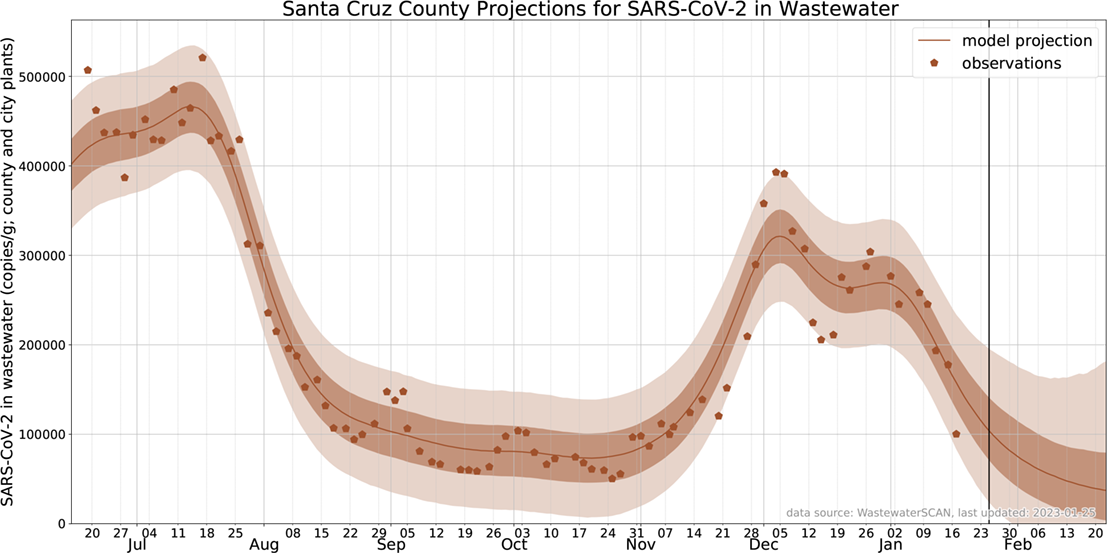
The Santa Cruz County Health Department regularly releases data on the current status of Covid-19 in the county. There were no new deaths in the county over the past week.


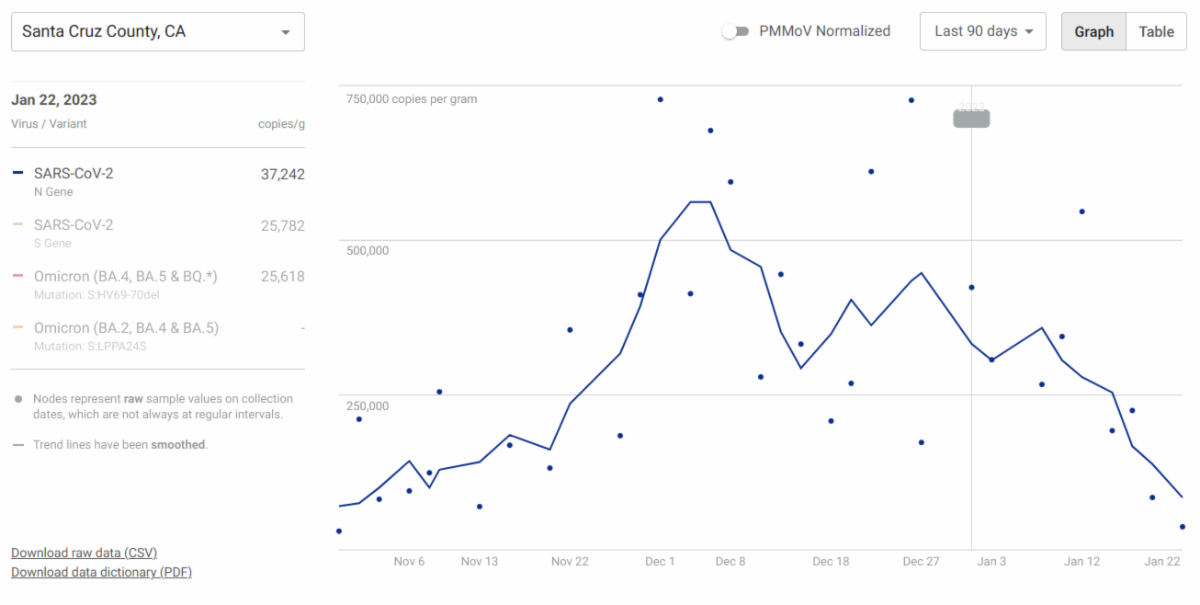
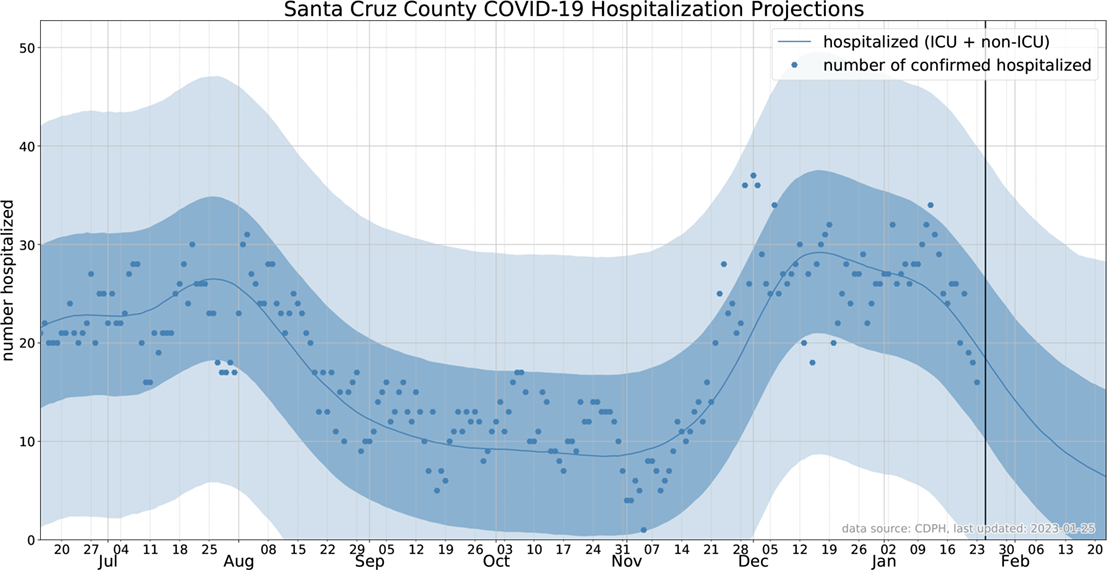
Because of the availability of home testing I don't report on changes in the active cases in the county. The Health Department is now collecting data for Covid and Mpox from wastewater at the City Influent, for the city of Santa Cruz, and from the Lode Street pump stations for the county. See webpage HERE. The first chart below shows the latest county data. The fourth chart below shows wastewater projections.


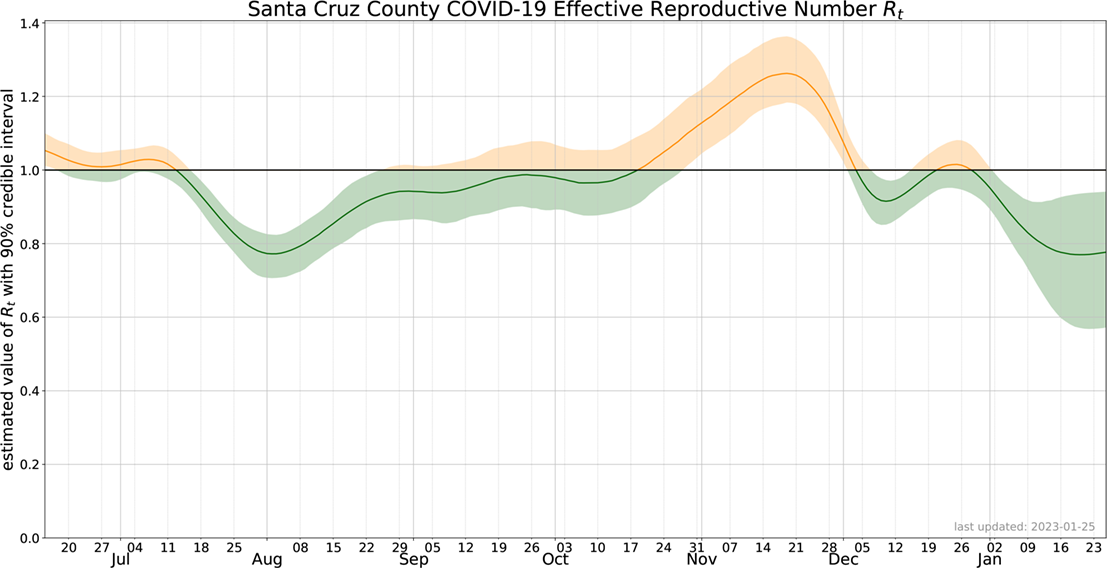
The county's Effective Reproductive Number is way below one. See the second chart below. Numbers above one show the spread of the virus is increasing. Below one means the spread is decreasing. The chart, released from the California Department of Public Health below shows several predictions from different agencies. For information, click here.


The third graph below shows hospitalizations. Click to see more information on hospitalizations HERE.


Here are details on the county's vaccination data. Vaccination data has not changed in months and doesn't include the boosters.


This webpage also has a link where you can get a digital copy and scannable QR code of your vaccination record. Keep track of your four-digit code because that is your access to the site.


To get information on COVID-19 testing locations around the county visit this site. You can make an appointment for a Rapid Antigen Test here.

1/27/23 

Deaths by age/276:

25-34 - 5/276

35-44 - 8/276

45-54 - 10/276

55-59 - 4/276

60-64 - 15/276

65-74 - 49/276

75-84 - 64/276

85+ - 121/276


Deaths by gender:

Female - 136/276 

Male - 140/276 

Deaths by vaccination status: 

vaccinated - 39/276

unvaccinated - 237/276


Deaths by ethnicity:

White - 163/276 

Latinx - 90/276

Black - 3/276

Asian - 16/276

American Native - 1/276

Unknown - 0

Photo by TARMO HANNULA

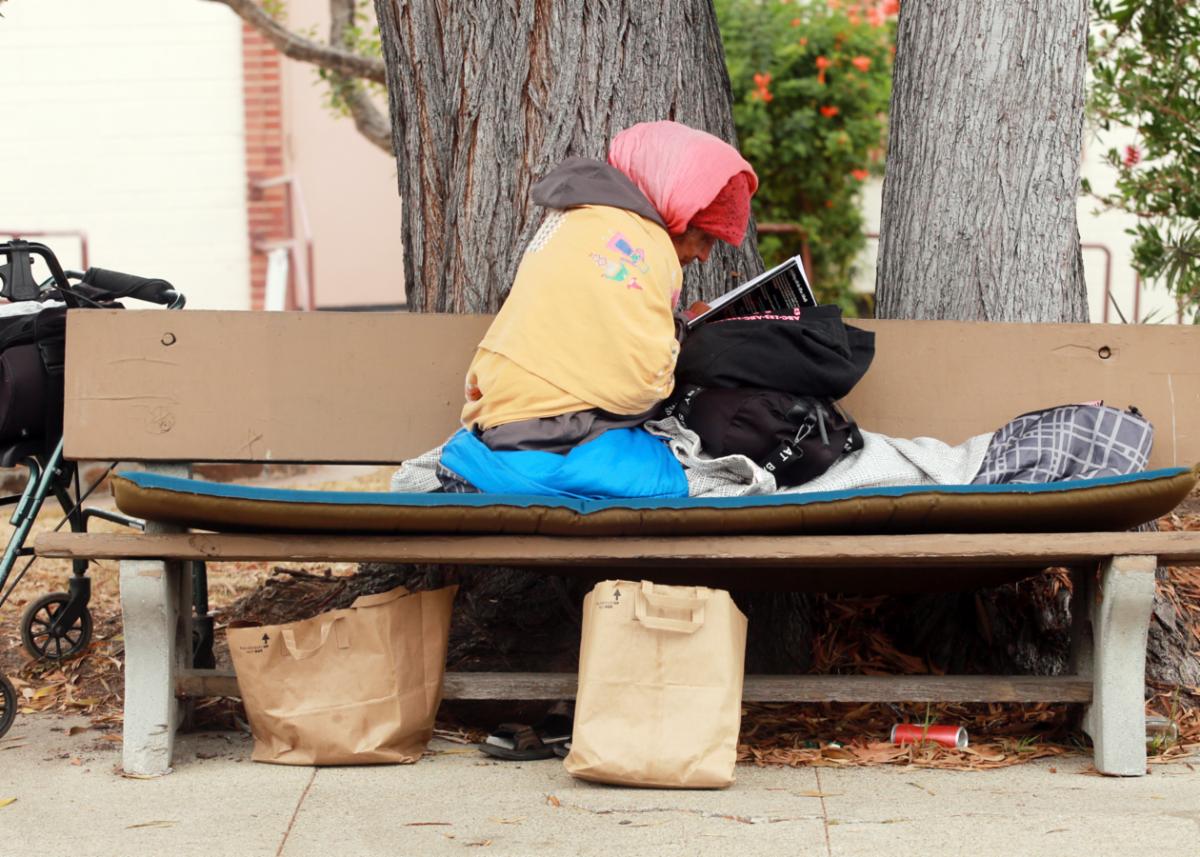
Fashion Street - Woman reads in bed on a bench in downtown Santa Cruz.

Labor History Calendar - Jan. 20-26, 2023

a.k.a Know Your History Lest We Forget


Jan. 20, 1932: El Salvador government murders 30,000 peasants to end uprising.

Jan. 20, 1986: Motor blockade closes struck Hormel plant.

Jan. 20, 1997: International dock strike backs Liverpool dockers. 

Jan. 20, 2017: Neofacist shoots and nearly kills protesting Wobbly in Seattle.

Jan. 21, 1946: 750,000 steel workers walk out, largest strike in US history at that time.

Chinese New Year Jan. 22, 1849: Birth of Terrence Powderly, leader of the Knights of Labor. 

Jan. 22, 1905: Czarist troops kill 500, wound 3,000 in St. Petersburg Bloody Sunday.

Jan. 23, 1960: 5-week general strike against austerity ends in defeat in Belgium.

Jan. 24, 1911: Labor journalist Shusui Denjiro Kotoku and 11 others anarchists hanged in Japan.

Jan.25, 1851: Sojourner Truth addresses first Black Women’s Rights convention.

Jan. 25, 1926: 16,000 textile workers strike in Passaic, New Jersey.

Jan. 26, 1990: South African railroad workers win 12-week strike but 30 are killed.


Labor History Calendar has been published yearly by the Hungarian Literature Fund since 1985.


"In the cabaret of globalization, the state shows itself as a table dancer that strips off everything until it is left with only the minimum indispensable garments: the repressive force.” 


Subcomandante Marcos


Photo by TARMO HANNULA

The Recipe Remained

By SARAH RINGLER


Iceberg lettuce is the perfect base for this chicken salad. It's also a good use for leftover chicken, or sometimes I buy barbecued chicken from Safeway to save a step. 


I got this recipe from a Japanese-American woman I worked with at the Bagelry in downtown Santa Cruz in the 1980s. Like many Japanese-Americans who lived on the coast of California, her family suffered during World War II, when the American government, in another large fit of paranoia and need to show aggression, forced many of them into internment camps around the country. Her father had been an ambitious student in school only to have his plans for going to college detoured by being sent to one of the camps. He met his wife at the camps and when they were finally closed, he ended up working the rest of his work life in the produce section of a grocery store. 


Yoko always felt saddened whenever she heard people talking about family heirlooms. Before her father and his family were taken away, her grandmother had left some of the family’s keepsakes with a neighbor in Los Angeles with the understanding that they would be reclaimed when they returned. When they returned, the neighbor had moved and the keepsakes were gone. However, the memory of this family recipe remaines.


The rice stick or mei fun noodles and the sweetened pickled onions can be bought at Asian markets like the Oriental Store and Food to Go at 205 East Lake Ave. in Watsonville. This recipe makes enough for about four people. 


Japanese Chicken Salad


Base:

8 cups thinly sliced iceberg lettuce

2-3 cups shredded cooked chicken 

1/2-3/4 cup thinly sliced sweetened pickled onions

about 2 ounces mei-fun or rice stick noodles

2 cups corn or peanut oil


You will be deep-frying the mei fun noodles so set up an area in advance. I use a heavy saucepan. Nearby, I have a bowl with a strainer in it where I put the cooked noodles just after they come out of the oil. Next I cover a cookie sheet with paper towels for the final draining. 


The noodles puff up instantly so you need to devote your full attention to this task. Heat the oil to almost high heat. Watch carefully. When the oil looks shiny and hot - don't wait until it moves - put in a piece of noodle. It should instantly curl up and turn white and airy. Scoop out with a slotted spoon. Carefully add a small handful of noodles. Remove and continue to do small batches until you’re done. Take the saucepan with the oil off the burner and let it cool in a safe place. Leave fried noodles on the paper towel-covered cookie sheet until just before serving. I save the oil and reuse it a few more times until it is too dark. 


Wash, dry and thinly slice the iceberg lettuce. Put it in a large wide salad bowl. Tear the chicken into bite-size pieces and spread over the salad.

Next, slice the sweetened pickled onion and layer over the chicken. You can refrigerate until ready to serve.


Dressing


3-4 tablespoons sugar 

2 1/2 teaspoons salt

3/4 teaspoon pepper

3 tablespoons toasted sesame oil

4-5 tablespoons rice wine vinegar


Put these ingredients in a small bowl and mix thoroughly until the sugar and salt is dissolved. Taste and adjust. 


The last step just before serving is to put the crispy noodles on top of the sliced onions, pour the dressing over, toss and serve. 

Send your story, poetry or art here: Please submit a story, poem or photo of your art that you think would be of interest to the people of Santa Cruz County. Try and keep the word count to around 400. Also, there should be suggested actions if this is a political issue. Submit to coluyaki@gmail.com

Send comments to coluyaki@gmail.com

If you are enjoying the Serf City Times, forward it on to others. We need readers, artists, photographers and writers.

Subscribe, contact or find back issues at the website https:// serf-city-times.constantcontactsites.com
Thanks, Sarah Ringler

Welcome to Serf City Times Our county has problems and many people feel left out. Housing affordability, racism and low wages are the most obvious factors. However, many groups and individuals in Santa Cruz County work tirelessly to make our county a better place for everyone. These people work on the environment, housing, economic justice, health, criminal justice, disability rights, immigrant rights, racial justice, transportation, workers’ rights, education reform, gender issues, equity issues, electoral politics and more. Often, one group doesn’t know what another is doing. The Serf City Times is dedicated to serving as a clearinghouse for those issues by letting you know what is going on, what actions you can take and how you can support these groups.This is a self-funded enterprise and all work is volunteer. 

Copyright © 2022 Sarah Ringler - All rights reserved