|
4 great ideas to copy from Ontario hospitals
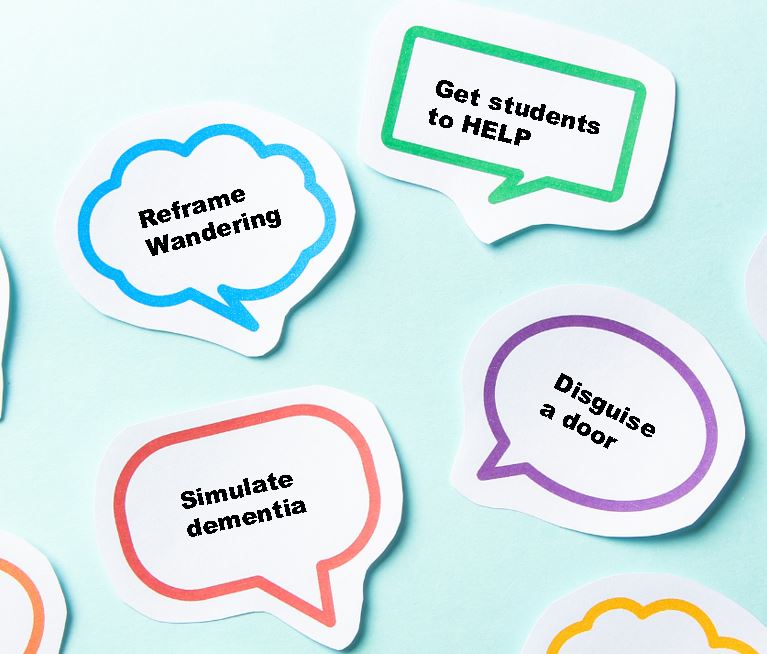
1. Reframe wandering - "Wandering' means to move aimlessly or without purpose; a term often used to describe a behaviour of people living with dementia. If you think about it, it's kind of a negative label for a behaviour that's healthy - moving! Some Ontario hospitals are choosing to use more positive and accurate descriptions, such as "moving within their environment".
2. Simulate dementia - Our perceptions of the experience of others is based on our own experiences and biases, which can lead to care that doesn't meet someone's needs. Ontario Shores Centre for Mental Health Sciences and Northumberland Hills Hospital are using simulation experiences to help nurses understand what it might feel like for someone with dementia to be hospitalized. The experience involves the use of an immersive virtual reality suit and placing the learner in an environment that replicates a busy acute care unit with care that is not dementia friendly, followed by a debriefing.
3. Disguise a door - Let's face it, there are a LOT of doors in hospitals, and this can lead to confusion for patients. When a particular door in a geriatric dementia unit at Ontario Shores Centre for Mental Health Sciences was unintentionally being used as a urinal they placed a door decal on it to make it look like a bookshelf, with the hypothesis of "who wants to urinate on books?" It was a small test of change with big success - no one urinated on the "books".
4. Get students to HELP - Many hospitals have struggled since the pandemic to rebuild one of their most valuable health human resources - volunteers. Peterborough Regional Health Centre and Northumberland Hills Hospital have started recruiting from high schools to rebuild their volunteer-led Hospital Elder Life Programs (HELP) to prevent delirium. As a bonus, there's a naturally occurring intergenerational connection between the teenagers and hospitalized older adults.
|