Hummingbird Messenger

December 2023

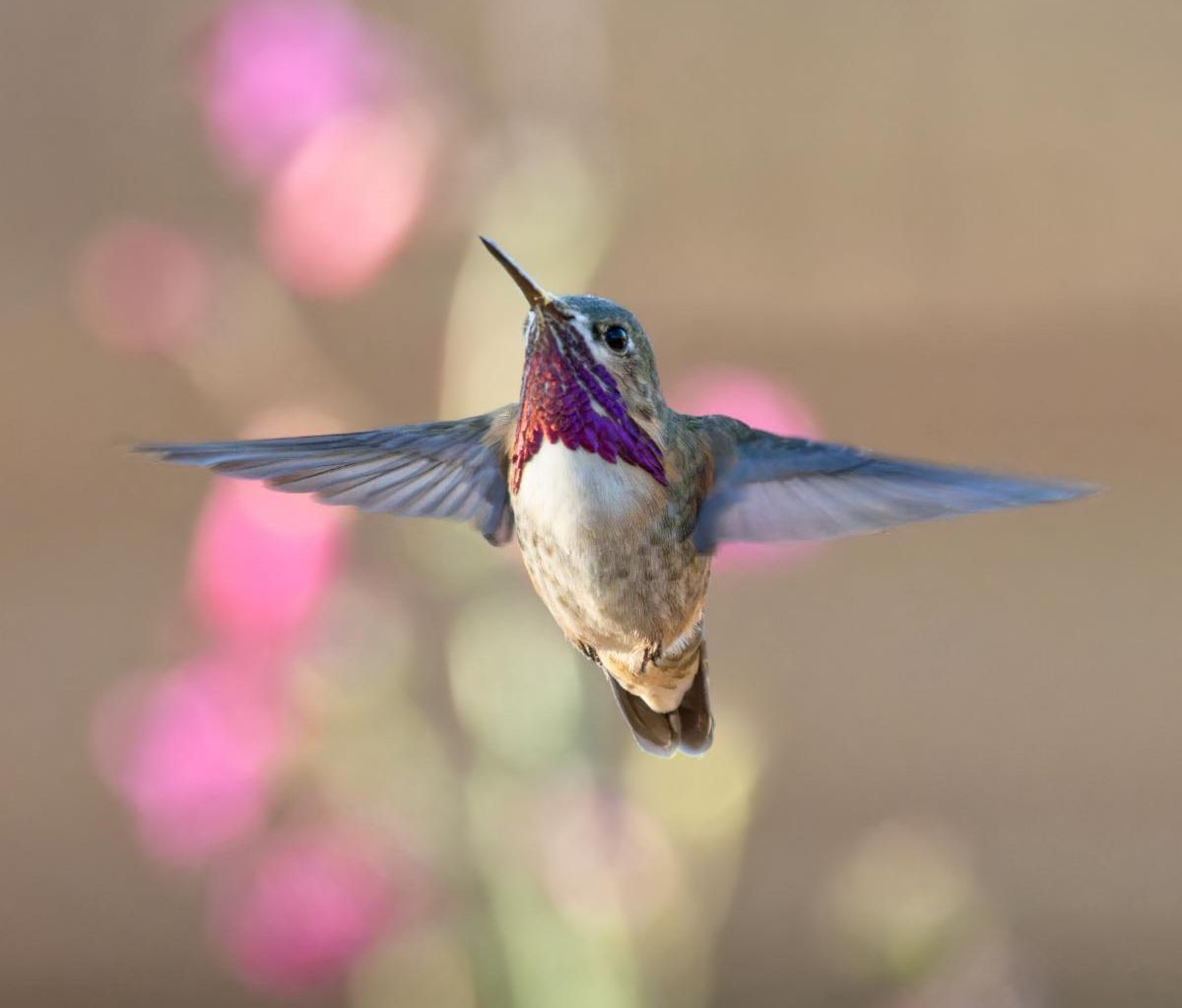
Gorgeous male Calliope hummingbird - Anthony Lujan

A Note from Alice

As we are deep into the holiday season, thinking of family and friends and enjoying winter festivities, I try to find at least a few quiet minutes each day to reflect on the beauty of nature and the joy I experience every time I see a hummingbird.

I am fortunate: I see hummingbirds year-round here in Sedona. We get a little bit of snow but overall our winters are mild. Yet even in cold, snowy regions some hummingbirds choose to stay the winter. It could be because they were too young or too weak to migrate, or for some reason their natural drive to migrate didn't kick in, or nature is signaling to some of them it is time to expand north. We just don't know. We have learned so much about hummingbirds — and yet there is still so much unknown.


In this issue of the Hummingbird Messenger, we hear from Kate McLaughlin, Project Director of The Alaska Hummingbird Project. Kate reports on what she is discovering about Anna's Hummingbirds wintering in Alaska — and the questions yet to be answered. We also have a story with ideas on how to support hummingbirds who are choosing to winter in very cold regions, and a link to a recap video of the HummViewer on Shark Tank.


Finally, but very important, I am asking you please take a moment to Celebrate Joy this season. Think of the smiles and happiness you feel when you see a hummingbird, and give to the non-profit International Hummingbird Society. We are working hard get useful information to you and to all hummingbird lovers. We are working to support projects aimed at preventing extinction of threatened species. And we need your support to continue our work. Please celebrate the joy of hummingbirds — click the button below to make a year-end contribution. Thank you!

Donate Here!

The Winter Hummingbird:

Anna’s in Alaska

By Kate McLaughlin

Project Director - The Alaska Hummingbird Project, Inc.

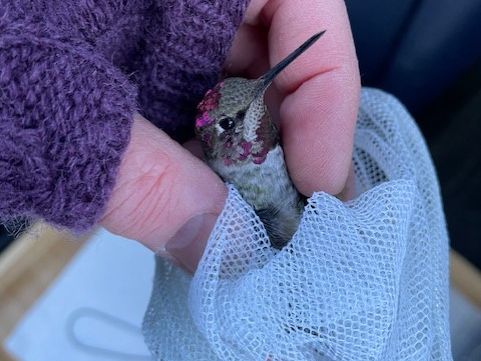
Kate McLaughlin holding a hatch year male Anna's hummingbird


It's 18°F, clear and sunny, with a gentle breeze, and ½ foot of new snow on the ground this November morning in Alaska — ideal conditions for trying to catch a hummingbird.


An immature male Anna's hummingbird has been keeping a watchful eye from a sheltered branch just off the corner of my banding host's porch. I move the heated hummingbird feeder, which the bird has been visiting, into my trap, set the trap door, and step away. Four minutes later, the small bird, sporting a few patches of fuchsia feathers on his head and neck, navigates through the opening to drink from the feeder. I quickly drop the trap door, catching my third Anna's hummingbird of 2023 in Cordova. This brings my total to eleven birds caught since 2015.


Anna’s hummingbirds have been found in increasing numbers along the Pacific NW coast since the beginning of the century. The species has rapidly expanded its range from the 1940s when it wouldn’t have been found north of Baja, California. Since the beginning of the 21st century, Anna’s are commonly found in British Columbia and southeastern Alaska, and they are still pushing northward.


The majority of the Annas I've caught in Alaska are immature birds, but none of them were young enough to be certain they were locally born. And while Cordova has documented Anna’s on several Christmas bird counts, not enough birds seem to be surviving through the winter to establish a breeding population here — yet.


If this hummingbird wasn’t born here, where did it come from? The common belief is that Anna’s are breeding in the Pacific Northwest in early spring and the immature birds are following the summer bloom 1000 kilometers north into southcentral Alaska.


Once in Alaska, Anna's may not migrate in the traditional sense of leaving for the winter and returning when the snow melts at all; rather, the birds seem to be moving altitudinally, spending the spring and summer in higher elevations feeding on alpine flowers and insects, and then moving to lower coastal habitats in the fall.


The hummingbird I am holding is now wearing a small aluminum band on his right leg. I open my hand and he zooms off into the frigid sunshine. Each banded bird I release is sent with the hope that it will be seen again, providing researchers with another piece of the life history puzzle of these amazingly tough and adaptive creatures.

 Kate McLaughlin, Project Director, The Alaska Hummingbird Project


The Alaska Hummingbird Project, Inc. is a small 501 (c) 3 scientific and educational non-profit that depends upon small grants and individual contributions to operate. Donations may be sent to: Alaska Hummingbird Project, Inc. PO Box 561, Cordova, Alaska 99574.

Great Gift Ideas for the Holidays

We've got you covered with Christmas and the holidays fast approaching! Shop our spectacular calendar with its vibrant pictures —gift a membership to a loved one (or treat yourself to one) — or take a look at other goods we have in our online shop such as books, apparel, and other miscellaneous items!

Calendar
Membership
Books
Apparel
Miscellaneous

Wintering Hummingbirds:

Food for Thought

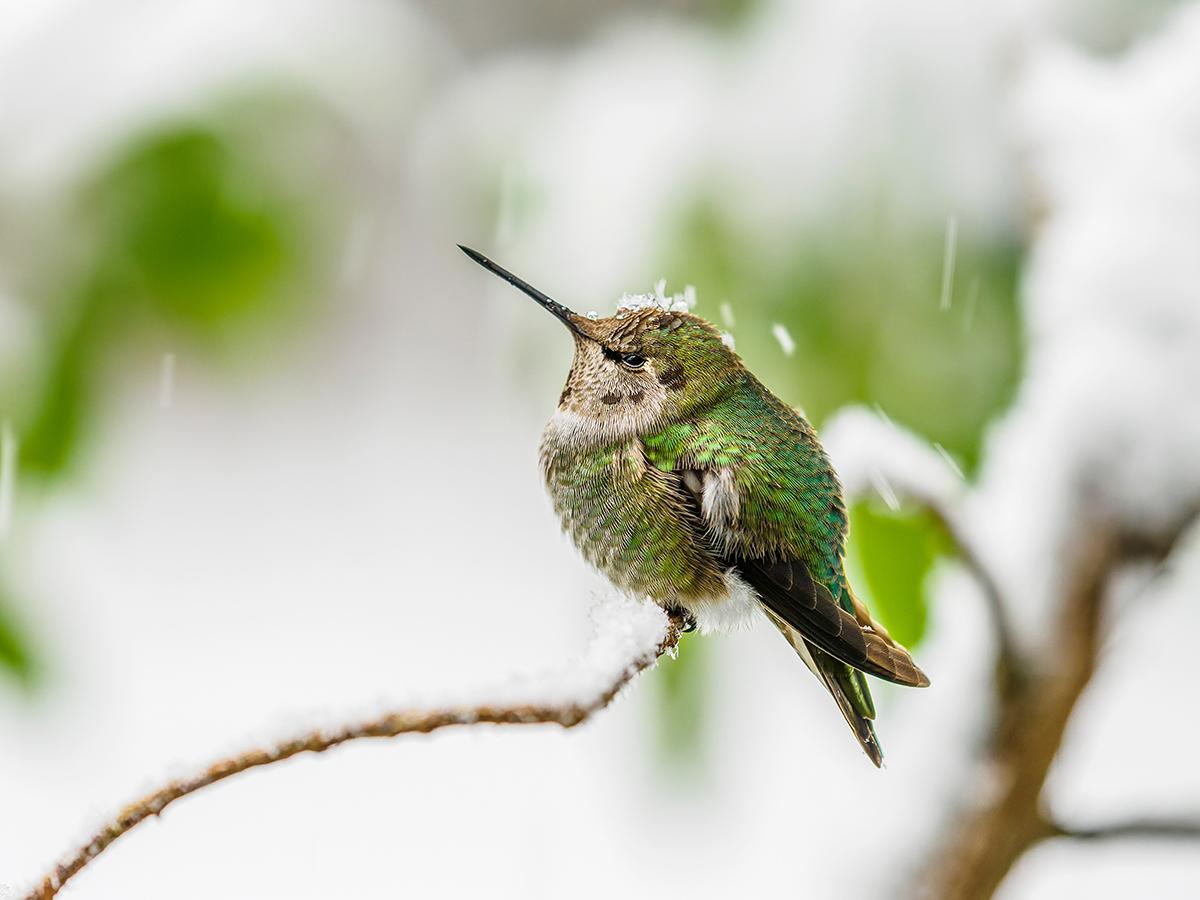
Anna's Hummingbird by Cliff LeSergent

Recently a couple in Montana called our office with a question. They have a wintering hummingbird in their yard. They were keeping the nectar flowing with a heated feeder, but how to ensure the hummer had protein when most insects are dead or hibernating in the cold Montana winter? They had taken the initiative to create a set up for raising fruit flies that the hummingbird could access, and they wanted to know if that was a good idea. We spoke with hummingbird expert Sheri Williamson, who as usual was full of useful information.  


Yes, fruit flies can be useful for hummingbirds who are overwintering in the frozen north. Although hummingbirds may eke by on pure sugar water, the extra strain on their system as they begin to molt and replace feathers requires more diverse nutrients and protein. Although it may seem hard to believe, there are insects around in the environment, even in the northern U.S. and southern Canada. They may be hibernating or hiding. Hummingbirds who have chosen not to migrate south can be very good at finding them. However, it requires substantial energy to find these bugs – it’s not like the summer months when they are everywhere. 


Placing a colony of fruit flies in your yard can be an extra kindness for hummingbirds wintering in very cold climates. Make sure that the growing medium you use is the type used for growing fruit flies for pets such as lizards and amphibians. That growing medium will have more nutrients than the growing medium used for fruit flies in science experiments. 


In addition, you can increase the sugar in your nectar mixture to 1 part sugar to 3 parts water (instead of 4 parts water, which is the recommended ratio for summer feeding). Many people with wintering hummingbirds also put out at least one heated hummingbird feeder so they don’t have to rise before dawn to put out non-frozen nectar.


A very important factor for birds in the cold north is staying warm. It takes a lot of energy for the tiny hummingbirds to stay warm, even though they do go into torpor and drop their body temperature at night. If your yard has dense trees that are sheltered from the wind, that can be helpful. If you want to try to find other ways to keep the area a little warmer during a cold snap you could try some kind of low wattage heat lamp – as long as you can ensure it is not a fire hazard! 


Note that these tips do not guarantee a bird's survival. There is no denying that winter is harsh and difficult to survive. Despite your best efforts, a hummingbird may not make it. Or it may (happily) move on and live long and well.

HummViewer Shark Tank Clip

Remember HummViewer — one of the exhibitors at the 2023 Sedona Hummingbird Festival? HummViewer allows you to see hummingbirds up close as they drink from flower ports attached to a clear plastic face mask. Recently HummViewer was featured as one of the craziest pitches of Shark Tank's season 14 — you can view their pitch in the video link below (their pitch begins at 16:30 minutes in). We have included a link to their website below the video.

HummViewer