|
22 August 2024 — Hard-Working Pigeons
Earlier this summer we shared the story of the ocean liner SS Washington, a vessel that strove to set the tone for American-built posh ocean liners, carried refugees fleeing Europe as World War II erupted, and endured a nail-biting predawn standoff with a German submarine. Judging from the feedback we received from that piece, what really left an impression were the pigeons—56 homing pigeons that were released to commemorate Washington’s maiden voyage in 1933, each carrying a message to the Signal Corps office in Fort Monmouth, NJ, to be telegraphed to recipients around the country. This led me to look for more information about homing pigeons and ships. And indeed, it turns out there are more pigeon stories to share.
|
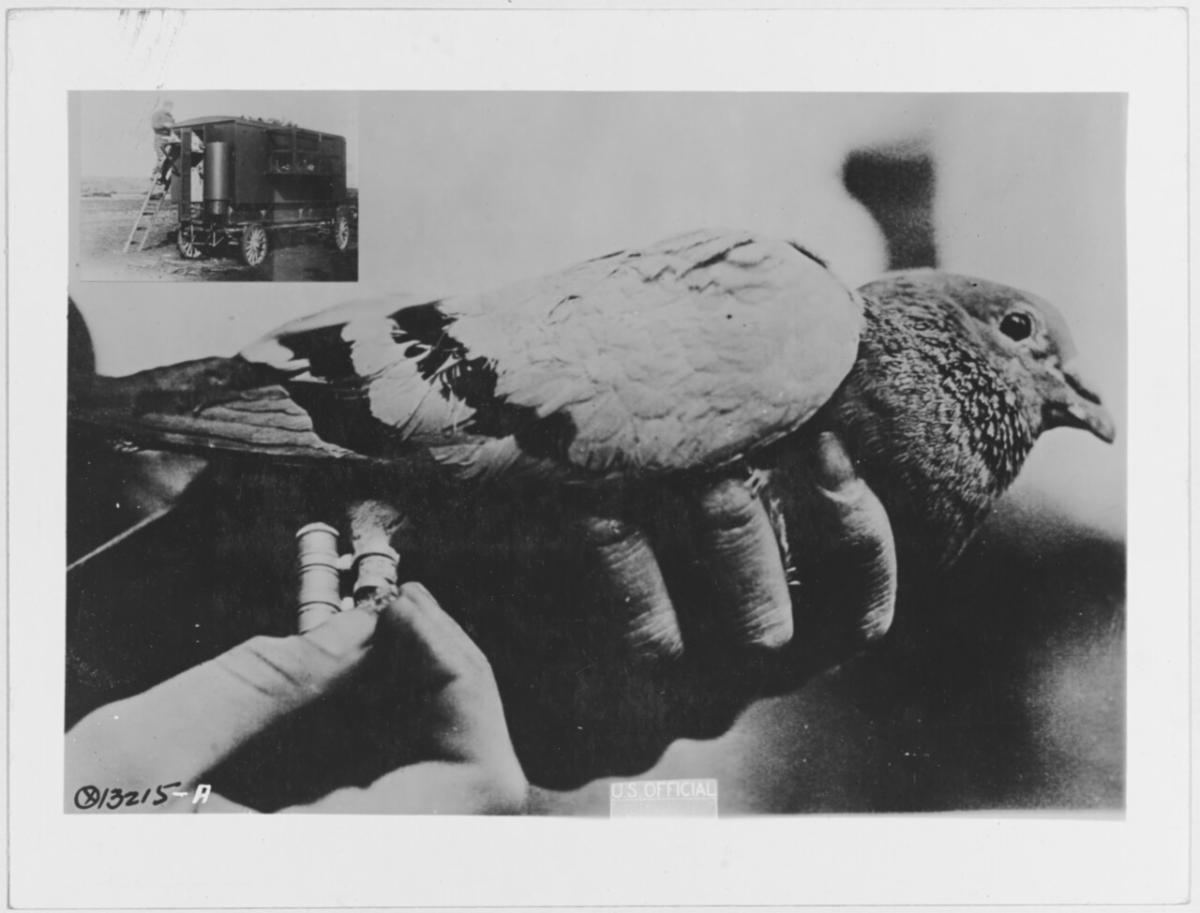
Clasping message to carrier pigeon, inset image of man with pigeon vehicle. US Naval Air Station, Brest, France. 1917–1919. Courtesy Naval History and Heritage Command | |
Professor Marion’s Experiment Takes Flight
French professor Henri Marion of the US Naval Academy was familiar with the Army’s experience using homing pigeons to carry messages from Havana over the water to Key West, so he decided to experiment with the birds for naval communications. In 1891 he built a pigeon loft in an Academy boathouse and acquired trained pigeons from the Army Signal Corps, which had abandoned the Key West pigeon effort. Marion trained his pigeons to fly between the loft and the Academy school ship, USS Constellation. The exercises gave way to a very practical test of concept when a seaman was killed aboard Constellation while she was twelve miles out; when two birds were sent carrying the news to the Academy requesting the screw tug Standish be sent to pick up the body, Standish arrived on the scene less than three hours later. The birds were quite useful in getting messages from ship to shore, less so for communication in the other direction, as their attachment to place was typically linked to the terrestrial lofts, but even that contribution was considered a valuable asset.
|
 | USS Langley (CV-1) at anchor with Vought VE-7 aircraft on deck, 1923. Photo: US Navy National Naval Aviation Museum | |
The US Navy established the US Naval Pigeon Messenger Service in 1896, installing lofts at Boston Navy Yard, Portsmouth Navy Yard, Naval Station Newport, Brooklyn Navy Yard, Key West, and Mare Island Navy Yard. Pigeons were used to carry messages for the fleet during the Spanish-American War, but by 1902 wireless telegraph was widespread enough aboard naval vessels that the pigeon service was disestablished and the birds were auctioned off. Pigeons were reintroduced, however, during World War I; naval aviators carried pigeons to use as backup in case their radios failed or if they had to make a forced landing, and the Navy created an enlisted rate for its pigeoneers: Quartermaster (Pigeon). These individuals attended specialist school for six to twelve months to learn how to care for and handle the birds. There was even a manual: Instructions on Reception, Care and Training of Homing Pigeons in Newly Installed Lofts at U.S. Navy Air Bases. Our navy’s first aircraft carrier, USS Langley, was equipped with a homing pigeon loft. Admiral Alfred Melville Pride’s memories of the attempt were published in the US Naval Institute’s Proceedings:
One beautiful morning, while in the Chesapeake Bay, anchored off Tangier Island, Commander “Squash” Griffin said to the pigeon quartermaster, “Let them all go.” The pigeon quartermaster demurred a little, but Squash said, “Go ahead, let them all go.” The pigeon quartermaster opened the coop and let all the pigeons out at once. They took off, heading for Norfolk, since they had been trained while the ship was in the Norfolk Navy Yard. All at once, we had no pigeons on the Langley. Pretty soon we got a dispatch from the Navy Yard. I don’t know how Norfolk knew they were ours, but they said, “Your pigeons are all back here. We haven’t got any appropriation for pigeon feed.”
Rear Admiral Jackson R. Tate had a darker summation of the end of the pigeon loft aboard the carrier (also published in the Proceedings): “The attempt to train pigeons to return to a ship was a great failure, but provided an excellent supply of squab for the mess.”
The Langley pigeon program was subsequently dropped.
| |
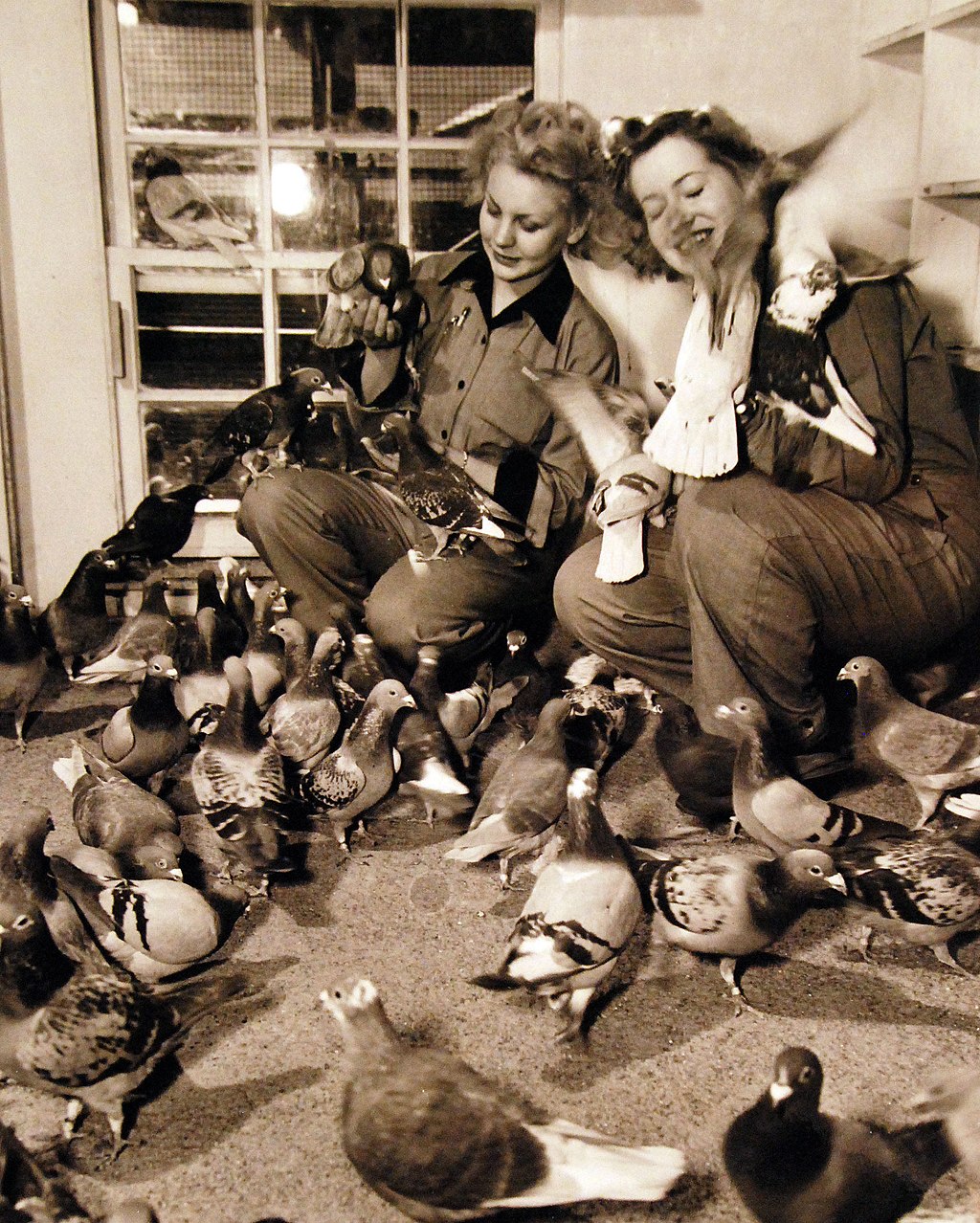
The two big requirements for being accepted into the pigeoneer program: being able to drive a car, and working well with animals. Photo: National Museum of the US Navy, Public domain, via Wikimedia Commons | In World War II, pigeons were again utilized by naval aircraft in instances of radio silence or backup communication. A new rating of Specialist (X) (PI) was adopted for the pigeoneers, and Women Accepted for Volunteer Emergency Service (WAVES) were eligible to serve in the position. The requirements: experience in working with birds or other animals, and the ability to drive a car (in order to retrieve birds that got lost during training). The pigeon service continued until it was phased out after the end of the war. | |
Of course, the actual pigeons of Project Sea Hunt didn’t even need those tiny binoculars! Photo: US Coast Guard | |
|
Project Sea Hunt
The relationship between pigeons and the sea services didn’t end there, however. In the late 1970s the US Coast Guard employed pigeons to look for orange life rafts in search-and rescue operations, this time taking advantage of their visual talents. As the rationale was described in an official report on the program, called Project Sea Hunt:
Search and rescue helicopter crews often must search vast expanses of the ocean looking for lost objects or personnel. Limited fields of view and optical problems such as sun glare make objects on the ocean surface difficult to see. Search effectiveness is reduced further by competing duties (i.e., flying and navigating the aircraft) and the loss of concentration with time. Additional sensor systems could offer significant assistance.
Experiments show that pigeons have a visual system capable of high search rates, and remain vigilant to complex visual tasks for many hours. Pigeons are highly adaptive, easy to train and to maintain, and have a life expectancy of more than 10 years.
A carrier pod was developed that could contain three pigeons on the underside of a helicopter—the trio of birds, facing outward in different directions, would have a 360° view of the water below. They were trained to peck on a key if they spotted an orange life raft floating on the water’s surface, which alerted the helicopter pilot of a rescue target, and earned the pigeon a snack. In test runs in the helicopter, the pigeon team had a 90 percent probability of detecting a target, versus the helicopter crew’s rate of 40 percent. The project was deemed a success and an audit in 1981 recommended the development of new pigeon pods to carry the vigilant feathered lookouts, but budget cuts put an end to it instead.
Extra Credit
“Project Sea Hunt”
Sea History Today is written by Shelley Reid, NMHS senior staff writer. Past issues can be read online by clicking here.
| | | | |