|
|
|
|
|
|
|
|
You'll find a lot happening on the SFC website's
News page this month! While we feature many news stories on our home page, you'll find even more on the News page. Visit the page to read about updates to
Government Extension Services, BCRC's
Beef Researcher Mentorship Program and to learn about
nominating an outstanding b
 eef researcher through the BCRC. If you scroll to the bottom of the
News page you'll also find Forage Programs and Funding Opportunities. Check back for updates as new programs are rolled out this spring!
Don't m
 iss your chance to give the SFC feedback by completing our survey! Visit:
https://www.surveymonkey.com/r/WFZRQXJ
or learn more on our
website.
This month's eNews features stories on barley for silage, fertilizing forage stands, perennial ryegrass seed yields, updates to Sask Crop Insurance forage programs and more.
If you have topics you'd like to have us share in our monthly eNews or on our website, get in touch with us. We'd love to hear from you! Follow us on
Facebook or Twitter
@saskforage to keep up to date on news and events.
Please fe
el free
to forward the eNews on to
others you think may be interested
i
n fora
ge and livestock industry updates -signing up is as
easy
as clicking the 'Join Our Mailing List!' on the left.
Your Forage and Livestock eNews
Editor,
|
|
|
|
Sask Crop Insurance makes important updates to forage insurance coverage
|
In early March, Saskatchewan Agriculture Minister Lyle Stewart announced changes to Saskatchewan Crop Insurance programs that will impact forage producers. These changes include:
Fire Insurance: added as a coverage feature for pasture under the Forage Insurance Rainfall Program;
Adjustments to Forage Insurance Rainfall Program to provide additional options;
Restoration benefit for
drowned out hay land; and
Modifications to the
Corn Heat Unit Program.
Additionally, there have been increases in compensation rates for predation of calves,as well as other changes to existing programs.
For more information on forage coverage options from SCIC, please visit: http://www.saskcropinsurance.com/ci/forage/
Changes, renewals or new applications for Crop Insurance contracts are due by
March 31, 2018 To see all deadlines, visit the
SCIC website.
Click here to view Ryder Lee, CEO of the Saskatchewan Cattlemen's Association describe highlights to the coverage offered by Saskatchewan Crop Insurance in 2018.
Top of Page
|
|
Fertilizing Mixed Forage Stands
|
By: Michele Simili da Silva, PhD - Mitacs Post-Doctoral fellow, Saskatchewan Forage Council/WBDC - U of S
Forage utilization is a fundamental aspect of beef cattle production in western Canada. Although commonly grown on low fertility soils, forages have a huge potential to improve the soil quality. This results in improved forage yield and can improve the economic returns of beef cattle production.
In the southern of part of the Canadian Prairies, Brown and Dark Brown soils are generally deficient in nitrogen (N) and in phosphorus (P), but rarely deficient in potassium (K) or sulphur (S). Black, Grey Wooded and Grey-Black transition soils are commonly deficient in N and P and are occasionally deficient in K and/or S, particularly on sandy soils for grass production.
Assessing the conditions of the forage stand is a very important step to be taken before deciding to fertilize as the availability of soil nutrients can greatly vary from field to field and is dependent on management, climatic conditions, soil type, and forage species. Soil testing is a quick and helpful tool recommended to identify deficiencies and address the particular needs for nutrients of the specific forages that are growing. With adequate moisture, application of fertilizer for annual forages can improve yield and with N application, typically increases the crude protein concentration of the forage as well.
The ability to fix atmospheric N for nodulated legumes, when properly inoculated and under suitable soil and climatic conditions, make them an economical source of N. Thus, growing a combination of grasses and legumes is thought to be an efficient management strategy to improve the yield and quality of forage stands while reducing the need for additional N from fertilizers. In pure stands perennial legumes, such as alfalfa, sweet clover, and vetches may fix 250-500 lb of nitrogen per acre.
Read the full article here.
Top of page
|
Managing for Top Perennial Ryegrass Seed Yields
|
Saskatchewan Forage Seed Development Commission (SFSDC)
By: Ray McVicar, executive director
The annual SFSDC Forage Seed Information Session was held in Saskatoon, SK on January 11, 2018. Dr. Dave Grafstrom, University of Minnesota began the session with an excellent presentation entitled, " Perennial Ryegrass Yields 2,000 lbs per acre by 2020: Reality or Pipedream!" Dave is from Roseau, Minnesota, about a 2 hour drive south of Winnipeg. He is a board member of the Minnesota Turf Seed Council and writes a weekly newsletter for their website (www.mnturfseed.org/index.html) during the growing season to update growers on current crop conditions, crop management, pest outbreaks and other issues.
Dr. Grafstrom's research work includes a number of perennial forages done at their research farm near Roseau. His discussion centred on general crop economics, ryegrass economics, theoretical perennial ryegrass seed yields, management strategies for high ryegrass yields, fertility, growth regulators, and diseases.
Current perennial ryegrass seed yields in northern Minnesota average 800 lbs per acre, but much higher yields are attained by the top growers. With 2018 input costs estimated at $381 per acre and gross returns at $480 per acre, there is a good profit to be made, but if yields were increased to say 1,200 lbs per acre, profit levels would be much better. So, yields drive profit.
Dr. Grafstrom recommended that to attain these higher yields, growers need to: utilize technology (GPS, auto steer, GIS mapping, satellite); engage their entire management team; do regular crop scouting; understand grass seed plant growth and development, growing degree day models and pest patterns; and control the controllables.
 |
|
|
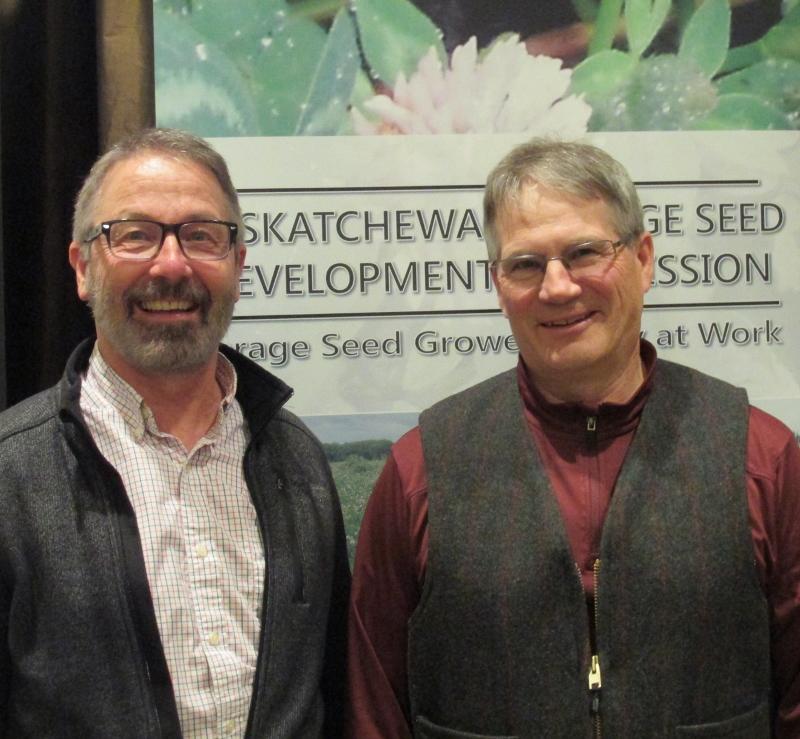
Terry Kowalchuk and Dave Grafstrom (right) at Forage Seed Information Session in Saskatoon, SK. January 11, 2018
Source: SFSDC
|
Controllables are: crop/variety selection; timing of crop inputs; nitrogen rates and timing; regular budget review; pay close attention to details; utilize all management resources; when to swath; and when to buy inputs.
Uncontrollables are: weather; commodity prices; input prices; government programs; interest rates; global economy; and agriculture policy.
In Minnesota, top growers are using growing degree day models to predict ryegrass growth, stages and pest outbreaks. This can determine herbicide timings, growth regulator schedules, fertilizer timings (fall, spring or split applications), and monitoring for pests (mildew, rust, grasshoppers).
Dr. Grafstrom went on to describe factors that affect perennial ryegrass yield: stand losses due to winterkill and not spreading heavy straw from previous crop; time of seeding (spring or fall); fertility; full straw load and controlling lodging; no rust control; weed control (including roguing areas with Group 1 resistant weeds); reducing cleaning losses; and harvest and storage.
To see Dave Grafstrom's presentation, please check out the SFSDC website at www.skforageseeddc.com and look under Resources - Production.
|
|
Canadian Roundtable for Sustainable Beef (CRSB) news
|
Read on for the latest information from the CRSB and the sustainable beef movement.
Certified Sustainable Beef
by: Debbie Furber, Canadian Cattlemen Magazine, January 2018
The Certified Sustainable Beef Framework released December 7 by the Canadian Roundtable for Sustainable Beef (CRSB) is the set of documents that Canadian beef producers and primary processors will be able to follow to prove their operations are sustainable, chart improvement through the years, and help consumers sort out questions about sustainability.
Backing up a relatively short step to November 2014, members of the Global Roundtable for Sustainable Beef, including the Canadian Cattlemen's Association (CCA), approved a set of global principles and criteria that would serve as a common platform for defining sustainable beef as a socially responsible, environmentally sound and economically viable product that prioritizes planet, people, animals and progress.
Read the full article here.
Canadain Beef Sustainability Acceleration Pilot
The Canadian Beef Sustainability Acceleration (CBSA) Pilot is an effort to create a certified sustainable Canadian beef supply chain. It will help Canada become the first country to deliver beef from certified sustainable sources, establishing Canadian beef as synonymous with sustainability in the global market.
By participating, you'll make a monumental, long-term investment in our industry. Your involvement will help strengthen consumer trust in our products and promote the vitality of our industry - and you could earn financial credits along the way. As consumers grow more discerning about where their food comes from, it's our responsibility to alleviate their concerns. Join us in our efforts to do right by our consumers, our livestock, our planet and future generations.
Learn more at the CBSA pilot website and check out how you can get involved.
Top of Page
|
|
Barley Varieties Grown for Silage for Beef and Dairy in Western Canada
|
By: Dr. Peiqiang Yu, Saskatchewan Ministry of Agriculture Strategic Research Chair in Feed R&D Program
At the Seventh Annual Dairy Information Day in 2018, our previous PhD student at U of S and current a PDF researcher at Lethbridge Research Centre, Nair J. together with Christensen, D., Yu, P., Beattie, A. D., McAllister, T., Damiran, D., Preston, N., Fuhr, L. and McKinnon, J. J. gave two consecutive interesting research talks on barley varieties for silage research in western Canada: Talk One: "A Nutritional Evaluation of Common Barley Varieties Grown for Silage by Beef and Dairy Producers in Western Canada" and Talk Two: "Effect of Barley Variety and Stage of Maturity at Harvest on Neutral Detergent Fiber Digestibility"
Here are key findings in Talk One: "Barley varieties grown for silage in western Canada are inherently different in terms of chemical composition and digestibility parameters; Potential benefits of greater neutral detergent fiber digestibility of CDC Cowboy could be negated by greater neutral detergent fiber (NDF) and lower starch content; There is potential for plant breeders to select barley varieties for enhanced nutrient and digestibility parameters".
Here are key findings in Talk Two: "NDF Digestibility (% of NDF basis) varied with advancing maturity as indicated by the Variety ×Maturity interaction. The Varieties had similar NDF Digestibility (% of NDF basis) at milk mid-dough stage, varied at early and hard dough stage;Greater lignification with advancing maturity decreases the NDF Digestibility; Similar NDF Digestibility for the varieties at mid-dough stage indicates that variety effect is minimum when harvested at mid-dough; Barley varieties vary in terms of changes in starch content and NDF digestibility with advancing maturity; Variety need to be considered in determining harvest maturity - CDC Cowboy at early-dough for dairy; - CDC Copeland - mid-dough; -
CDC Cowboy and Xena at hard-dough for beef".
This barley silage project was supported by Saskatchewan Agriculture Development Fund, Canadian Cattleman's Association, Saskatchewan Cattleman's Association, University of Saskatchewan, Dairy Smart Nutrition, Cumberland Valley Analytical Services, Beef and Dairy Producers.
The detailed research information can be found on web: http://www.saskmilk.ca/index.php/publications/dairy-info-day
Top of Page
|
New Holland Launches Biggest, Most Powerful Forage Harvester
|
New Holland Agriculture
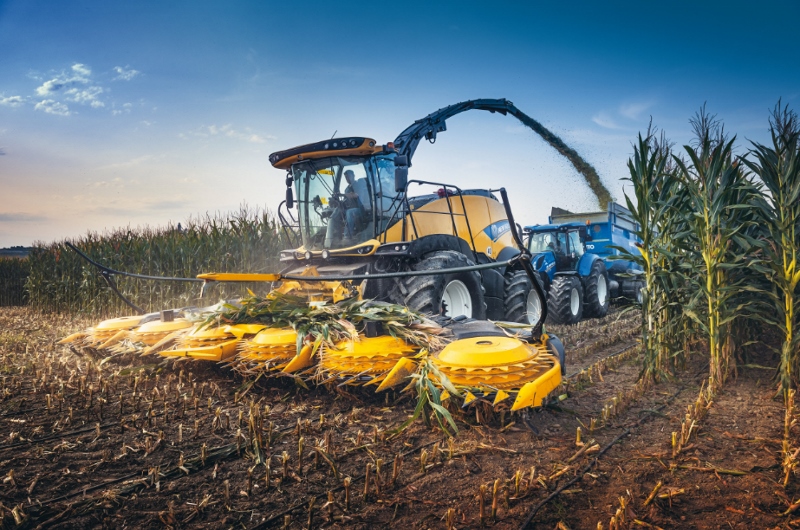 is pleased to expand its lineup of
Forag
e
Cruiser self-propelled forage harvest
ers with its new flagship model, the FR920. Featuring a new
FP
T Industrial V20 engine, the FR920 delivers a massive 911 horsepower and a productivity-bo
osting
44% torque rise to get through the tough spots. Available with a choice of three crop processor roll configurations, the FR920 covers the needs of every professional chopping operation.
Top of Page
|
Forages, soils and carbon
|
The forage industry is at the forefront of a movement to improve the environment while continuing to support a thriving agricultural industry. As carbon becomes an increasingly common topic in news stories and in government policy, there are those in Canadian agriculture who are offering practical solutions.
Grass guys developing a forage carbon offset protocol
by: Duncan Morrison, Canadian Cattlemen February 2018
Cedric MacLeod considers carbon sequestration through forages and grasslands and the soils they grow in as a long overdue, up-until-now-grossly-underplayed chit that Canada's grass and forage producers can finally throw down and claim proper ownership on.
"Our members grow forage, many run livestock and most plant annual crops too," says MacLeod, executive director of the Canadian Forage and Grasslands Association (CFGA). "Mostly, our producers choose to farm the way they do and are providing much more to Canada than simply cow bellies full of forages."
If it seems to you like MacLeod is a tad sparky, you'd be correct. The 40-year-old New Brunswicker has been at the helm of the CFGA for three years now and he knows the timing has never been better for forages and grasslands to burst through the Canadian ag hierarchy champagne tower once and for all as the largest agriculture land use sector in the nation. Add to that sense of timing and urgency with the fact that if the Tasmanian Devil of Warner Brothers cartoon fame was a person, it could be Cedric MacLeod, a whirlwind of old-fashioned spit and energy with a distinguished resumé of consultation and leadership on hay export, maritime beef and young farmer files that have all benefited from his master's degree in soil sciences from University of Manitoba. On top of the hectic work days, MacLeod juggles his own farm operations while enjoying family life with wife Alanda and toddler son Kalen.
Blain Hjertaas featured in Saskatchewan Cattlemen's Association YouTube videos:
Blain Hjertaas, of Redvers, Saskatchewan is a cattle producer and if you have seen him speak, you will know that he is passionate about the health of our grasslands and soils. Blain offers practical solutions to the carbon problem through better management of our grazing lands. The Saskatchewan Cattlemen's Assocation YouTube Channel features two videos of Blain:
Be sure to check them out!
|
Conference presentations now posted!
|
If you missed out on some conferences this winter, you can now catch up!
Presentations from the Saskatchewan Soil Conservation Association "Soil Health in a New Climate" conference are now posted at:
http://ssca.ca/conference
|
|
Saskatchewan Safety Council
|
|
|
|
Saskatchewan Forage Council Featured Project...
|
"The majority of the forages displayed variable performance across the four sites. These forage plots will be a useful reference for producers selecting forages to suit specific locations and conditions."
The project was supported by the Agricultural Demonstration of Practices and Technologies (ADOPT) initiative under the Canada-Saskatchewan Growing Forward 2 bi-lateral agreement.
To view the final project report,
click here.
To view the Saskatchewan Forage Council's completed projects, click here.
|
|
Upcoming Events
|
________________________________________________________________________________
Under our feet
March 23, 2018
Saskatoon, SK
SaskOrganics presents the latest research on soil health and weed management by Saskatchewan researchers and farmers. Event includes speakers, producer panel and trade show.
To learn more and purchase ticket,
click here.
_______________________________________________________________________________
Native Prairie Speaker Series - March
March 28, 2018
via Webinar
The March Series from SK-PCAP is titled: Enhancing Bird Habitat in a Semi-Urban Setting, presented by Renny Grilz, Meewasin Valley Authority. More info to come soon!
_______________________________________________________________________________
CRSB Semi-Annual Meeting
April 10-11, 2018
Regina, SK
The Canadian Roundtable for Sustainable Beef will hold Committee, Council and the Semi-Annual members' meeting to provide updates on CRSB activities, the Certified Sustainable Beef Framework, and discuss opportunities to advance sustainability in the Canadian beef industry. We've got an exciting tour lined up to round out the event.
To learn more and to register,
click here.
_______________________________________________________________________________
NPAW and Tour 2018
June 21-22, 2018
Beechy, SK
PCAP continues to plan the 20th Annual Native Prairie Appreciation Week 2018 (June 17th - 23rd). We plan to have the youth poster contest and a native prairie photo contest again, in addition to other activities The 17th Society for Range Management - Prairie Parkland Chapter - Annual Tour will be held in conjunction with Saskatchewan's 20th Annual Native Prairie Appreciation Week (NPAW) on June 21 and 22. This year's topic is Range Management with Limited Time and Resources.
View the poster and registration form here. For more information contact
srm.prairieparkland@gmail.com.
_______________________________________________________________________________
Soil Health Field Day
July 26, 2018
Wood Mountain, SK
Join Upland Organics for a soil health field day featuring speakers Jay Fuhrer, Soil Health Specialist with NRCS and Kevin Elmy of Friendly Acres Seed Farm. Event runs from 9AM-4PM and tickets are $25.
______________________________________________________________________________
Saskatchewan Pasture Tour
August 8, 2018
Macklin, SK
Save the date for the 2018 Saskatchewan Pasture Tour! This year's topics include cattle handling facilities, corn and swath grazing, native and tame pasture management, labour sourcing and more.
|
Saskatchewan Forage Council Membership
|
|
Be Sure Your Voice in the Forage Industry Counts!
- Incorporated under The Co-operatives Act, a membership fee for the SFC is a one-time cost of $25.00;
- The SFC has worked in the province on behalf of ALL forage industry stakeholders (and that's a very extensive and diverse group) for more than 20 years;
- If you are involved with production, management, protection, harvesting, storage, utilization or marketing of forage products, the SFC wants your involvement and input;
- The SFC is committed to placing a focus and awareness on the importance of forages in our province.
The SFC at a glance...

With a mandate to enhance the province's forage and grassland industry, the Saskatchewan Forage Council (SFC) strives to partner with all sectors of the industry - producers, industry organizations and companies, government and university.
Formed in 1988, our objectives are focused on the development and dissemination of information related to the production and utilization of all forage resources, prioritization of forage research and collaboration with governments to develop and implement effective policies and programs as they relate to forage production and marketing.
To learn more about becoming a member
Click Here
.
|
|
Forage and Livestock eNews
is published by the Saskatchewan Forage Council (SFC). Opinions and information are provided by the authors and publication does not imply endorsement by the SFC.
Financial support for the Forage and Livestock eNews
has been provided in part by one of our partners,
the Saskatchewan Forage Seed Development Commission.
We welcome questions about article submission or to find out more about sponsorship,
please contact the Saskatchewan Forage Council at:
Phone: 306.329.3116
|
The Saskatchewan Forage Council Gratefully Acknowledges
funding
for our
'Facilitating Forage Initiatives in Saskatchewan'
project
through the
Saskatchewan Cattlemen's Association
Industry Development Fund:
|
The Saskatchewan Forage Council recognizes our Annual Supporters:
Silver Sponsors:
Bronze Sponsors:

|
|
| |
|