Monterey Bay National Marine Sanctuary  Advisory Council
Diver Newsletter 
Diver
June 2018

In This Issue
Join Our Mailing List


Dear MBNMS,  

June diving is here and the sea nettles are gone, at least for now.  On the first weekend of June I was out diving at Aquarium Reef during a rising tide.  On Saturday the water got 10 degrees warmer as the day progressed.  But on Sunday the water became 10 degrees colder by our third dive.  There was a thermocline layer where the top was 58 and the bottom was 48, which was quite shocking on descent.
  
I was truly amazed at the outpouring of support for removing urchins at Ocean Cove Campground in Sonoma Memorial Day Weekend!  Over a hundred free divers and SCUBA divers helped collect urchins for the two day event.  (Note, crushing urchins in-situ is considered "wanton waste" and is illegal). As bad as the urchin situation is here in Monterey  , it is far worse on the north coast where the urchins have eaten down to bare rock and are going after the abalone.  Hopefully recreational and commercial diver efforts there will be successful in bringing back kelp.
  
In order to conduct a habitat assessment and the urchin population in Monterey and Carmel Bays we are initiating a study for all scuba divers to participate.  It is a simple method of reporting the condition at dive sites at the Citizen Science website.  Signup for free and join the G^2KR project.  There is even an android smart phone app that you can use while out on the water.  This will help scientists map the changing location and conditions of the near shore kelp forests.
  
The upcoming Advisory Council meeting in Cambria   will feature a vote on a Resolution to coordinate and collaborate with CDFW on controlled urchin removal efforts in the Sanctuary. Currently we are working with the Kelp Restoration Working Group to obtain drone camera technology to do near infrared sensing fly overs close to shore at the biannual peak and non-peak kelp periods in the GFNMS and MBNMS.
Come see us at our up coming SAC presentations: 

Aqua Tutus Dive Club - San Leandro -    Thursday, August 2nd @ 6:30 PM

Please keep up with the current Sanctuary Advisory Council agendas and if you see something of interest that you would like us to comment on, please send us an email.

 
Warm Regards & Dive Safe,
 
Brian and Keith
 
Prepared by Brian and Keith
Sanctuary Advisory Council Diving Representatives   


Blue Endeavors Dive Club
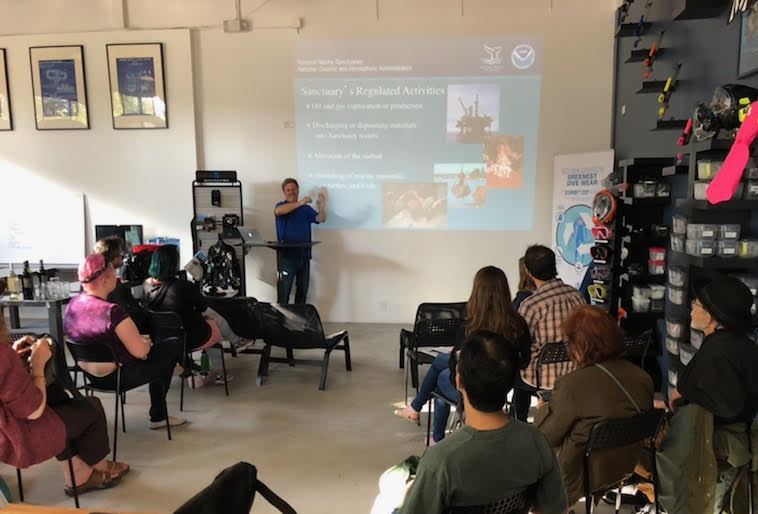
Sanctuary Advisory Member Keith Rootsaert visits Blue Endeavor Dive Club in Alameda.  Blue Endeavors is a non-profit club with a subscription service who's goal is diving with a citizen science emphasis.  In the future they hope to certify scientific divers in the AAUS program.
  
Vince Smith hosted the Sanctuary to speak to the Blue Endeavors membership about the MBNMS and the role it serves the diving community.  The presentation inspired a lively discussion on an emerging issues for divers - purple urchin barrens.
    
In addition to information on the Sanctuary, Keith raffled off SCUBA related prizes for the divers, courtesy of the Beach Hopper II.  Thank you to all that attended.
CSUMB hosts Sanctuary Overview and Discussion Meeting
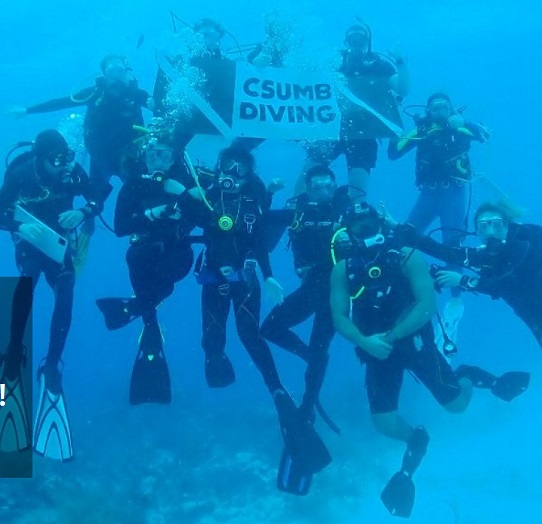
CSUMB hosted SAC Representative Brian Nelson at their May 9th at CSUMB pool facility. Frank Degnan, former SAC representative and CSUMB instructor invited his students and staff for a night of information and review. Topping the discussion was the management plan review and how to get more involved with MBNMS. Great questions for the group and the sharing of information and ideas.  
 
CSU Monterey Bay is an organizational member of the American Academy of Underwater Sciences (AAUS). All scientific diving (diving performed solely as a necessary part of a scientific, research, or educational activity) conducted under the auspices of CSUMB adheres to the standards set forth by the AAUS.
 
In addition to information on the Sanctuary, Brian raffled off SCUBA related prizes for the divers, courtesy of the Beach Hopper II.  Thank you to all that attended.
Beach COMBERS Receive Award for Outstanding Volunteer Service
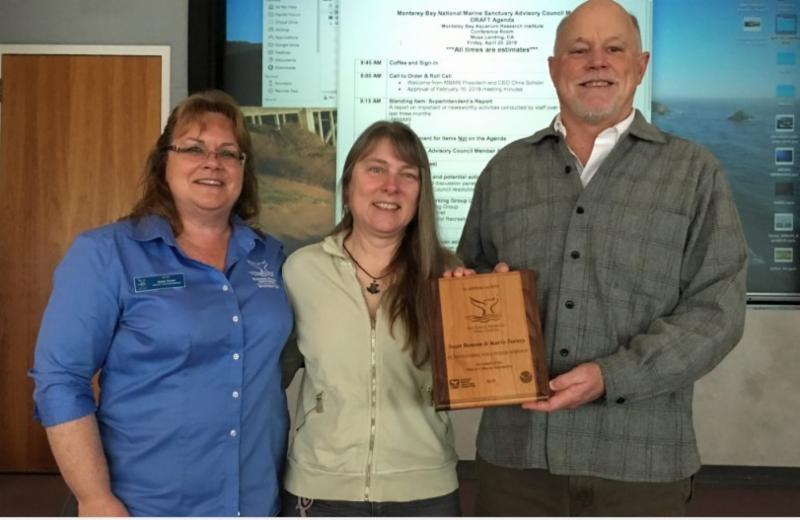
At the April 20th Monterey Bay National Marine Sanctuary (MBNMS) Advisory Council meeting, Scott Benson and Karin Forney received the National Marine Sanctuaries Volunteer Service Award for their contributions to the Beach COMBERS program.
  
Scott Benson developed the volunteer training course and methods for Beach COMBERS in 1997 with significant science and agency application advice from Dr. Karin Forney. Once the program was off and running and administered by NOAA's MBNMS, they naturally stayed on as volunteers. They have been monitoring the same 3-mile stretch of beach, monthly for 21 years, documenting beach cast birds and marine mammals.
  
Both Scott and Karin show a dedication to MBNMS and have been model volunteers for these past 21 years by walking their beach, without fail, each month.
Deep-sea Coral Scientists Develop Science Plan for West Coast
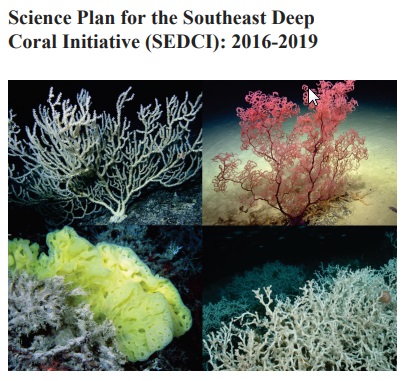
Scientists conducting research on deep-sea coral and sponge habitats on the west coast met in Santa Barbara April 16-17 to discuss research priorities for the next four years. The meeting was sponsored by the NOAA Deep Sea Coral Research and Technology Program (DSCRTP) to identify priority projects for their West Coast Initiative 2018-2021.
  
The ultimate end product to be borne out of this workshop will be the Science Plan for the West Coast Initiative; a document guiding the specific research, activities, products, and their applications planned through 2021. Academic and government scientists participated, including representatives from all five west coast sanctuaries. Collaborating with scientists in the west coast region will leverage resources, create efficiencies, and characterize deep-sea coral and sponge habitats.
Reef Check California
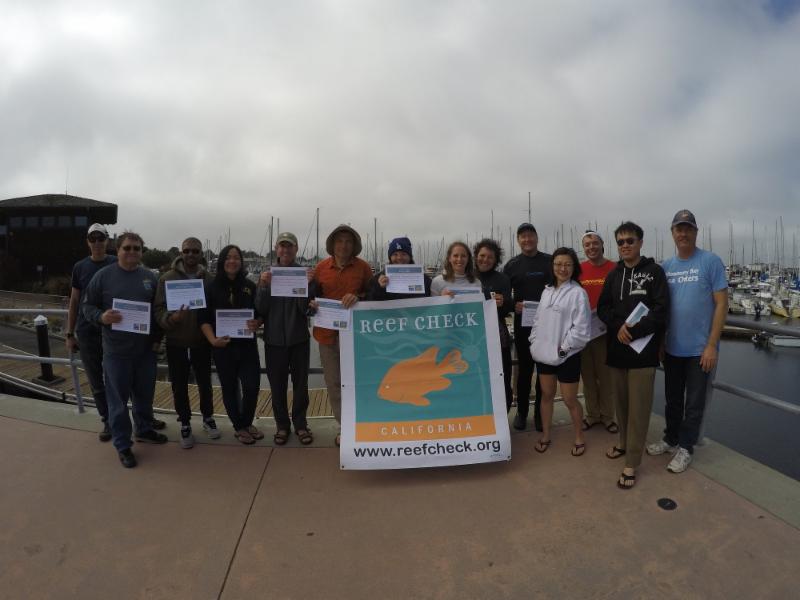
The Monterey Reef Check class completed training on June 3 and twelve new volunteer citizen scientist were certified to perform surveys.  The class entails two days in the classroom and the pool and two days on the Escapade ocean diving and being tested. 
  
These outstanding volunteers join the ranks of continuing surveyors who are recertified each year.  This year there have been 4 recertification events, a fish surveying practice day, and even a fun dive where random underwater activities were performed like walking without fins and underwater long division.  This program is a real challenge, but it is very rewarding.

The survey season is in full swing and some surveys have already been completed at Malpaso Creek, Breakwater, and Pt. Lobos.  Coming up soon is the epic 4-day live aboard on the Vision surveying sites from Big Sur to Morro Bay.
  
Moss Landing Marine Labs Weekly Seminars
MLML holds Weekly Public Seminars during the Academic Year in our Seminar Classroom at the  Main Lab . The MLML Student Body hosts speakers from a variety of marine science related disciplines to present their research.
Quick Links


2018 SAC Meeting Schedule 
 
June 15th              Cambria
August 17th            Marina
October 19th          Salinas
December 14th      Monterey

For more information:

Long Beach Dive Show
June 23rd and 24th
Why Should You Attend SCUBA SHOW?
Over 76,000 square feet of exhibit space, 300+ exhibitors, seminars and clinics, a giant pool, and more!

Dozens of Seminars and Classes Held Daily
Throughout the show we host seminars conducted by the world's foremost experts in diving.

Over $40,000 in Door Prizes to be Given Away
Dozens of lucky attendees will walk away from the show winners of great prizes!

Urchins continue to dominate parts of Monterey Bay
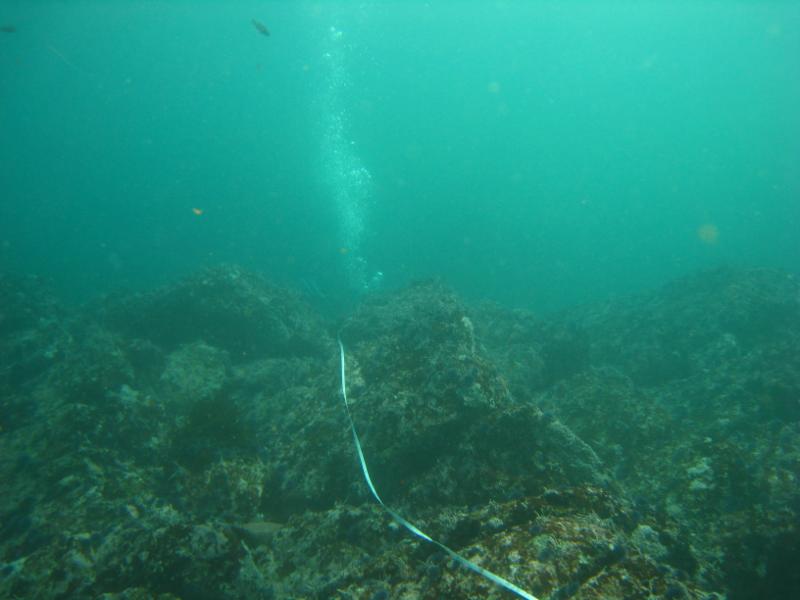
Sea urchins, and in particular purple urchins ( Strongylocentrotus purpuratus), have been increasingly conspicuous members of Monterey Bay kelp forests since 2014. In some cases, these urchins are converting the kelp forest into a very different community, one dominated by urchins and turf algae.
Dr. Jim Watanabe, a local kelp forest expert, dove on 30 June 2017 with his students at a site between Hopkins Marine Station and Lovers Point and found the area had become completely deforested by sea urchin grazing. "There's nothing but crustose corallines and patches of strawberry anemones left," Dr. Watanabe noted. MORE INFORMATION  
Kilauea eruptions: The way the wind blows, so go the gas and the ash
While images of crimson-colored lava erupting from Hawaii's Kilauea volcano continue to captivate the world, one of the greatest concerns is toxic sulfur dioxide gas emanating from every new fissure in the volcano.
  
Sulfur dioxide (SO2), which mixes with other air pollutants, can harm the eyes, skin and the respiratory system. At a minimum, it causes short-term breathing difficulties and is particularly hazardous for those with conditions like asthma or emphysema.
  
NOAA's HYSPLIT computer model helps forecasters estimate the concentration and movement of SO2 in the air - vital information needed by Hawaii's emergency responders to make evacuation and other public safety decisions. The model uses wind and other weather data to predict when a plume of toxic gas might drift over population centers. For more information:
  
Entanglement Response Team removes anchoring line entangling a gray whale off Olympic Peninsula
In Response teams from NOAA Fisheries' Large Whale Entanglement Response Network attempted to free a juvenile gray whale entangled in fishing gear about 20 miles off Washington's Olympic Peninsula on Wednesday afternoon, May 9, 2018.  The team removed some of the weighted fishing gear that had been entangling the whale for up to a month.
  
Jeff Pederson on the FV Harvester of Harvesters Catch first reported the entangled whale to the U.S. Coast Guard early Tuesday morning. The Coast Guard relayed the information to the Entangled Whale Hotline, (877-SOSWHALe or 877-767-9425) and NOAA Fisheries activated a response from teams based in Olympia and Seattle. MORE INFORMATION
  
G2KR
Counting Urchins is Exhausting
Kelp forests in Monterey have become urchin barrens.  Many factors caused this transformation:  Strong urchin recruitment, the warm water "blob", seastar wasting disease all contributed in what is called the "Perfect Storm".  These urchin barrens may persist for decades until a perturbance causes the system to move to return to a kelp dominant stable state.
  
The Giant Giant Kelp Restoration Project G2KR was established to recruit volunteer divers to work on condition assessments, studies and ultimately urchin removal efforts in Monterey and Carmel Bays.  If you are interested in helping to restore nearshore kelp forests please  sign up. 
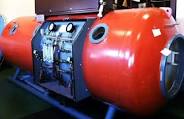
Pacific Grove Hyperbaric Chamber
Monterey Bay National Marine Sanctuary has become a premier diving destination, offering some of the most beautiful and pristine diving areas in the country. The City of Pacific Grove, on the Monterey Peninsula, has provided medical treatment to injured divers with its hyperbaric chamber since 1963.
  
While the City of Pacific Grove provides for many of the chamber's operation needs, diver donations support operations and offset needed repairs that occur from time to time. Please consider a donation to help this much needed, important resource for the dive community that enjoy the sanctuary.


Donate to the Pacific Grove Hyperbaric Chamber Fund 


    Donate Now! 


Donations for the chamber can be made online using a credit card or a PayPal account. The credit card transaction will be securely handled by PayPal and you do not need a PayPal account to make a credit card donation. At the end of the credit card transaction you will be presented with an option to print out a receipt for your donation.


Your tax-deductible donation to the Pacific Grove Hyperbaric Chamber Fund will go directly towards the facility and its operations.


Payment can also be made by check mailed to:

Monterey Bay Sanctuary Foundation
99 Pacific Street, Suite 455 E
Monterey, CA 93940

If you have any questions, please email  

info@mbnmsf.org


Prepared by Brian and Keith, Sanctuary Advisory Council Diving Representatives  


Know your Sanctuary
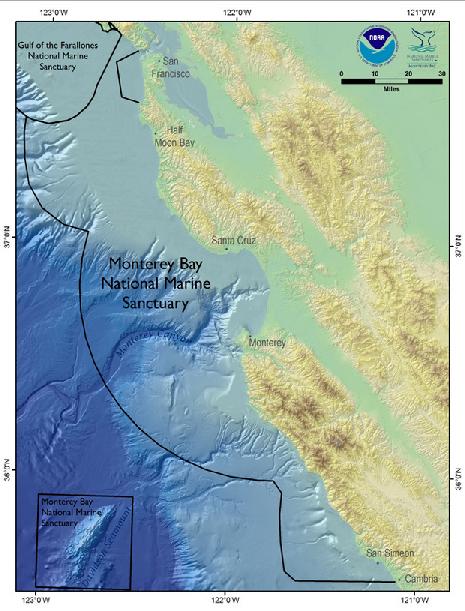
Monterey Bay National Marine Sanctuary

Monterey Bay National Marine Sanctuary (MBNMS) is a federally protected marine area offshore of California's central coast. Stretching from Marin to Cambria, MBNMS encompasses a shoreline length of 276 miles and 6,094 square miles of ocean.


It is home to one of the world's most diverse marine ecosystems, including numerous mammals, seabirds, fishes, invertebrates and plants in a remarkably productive coastal environment.


MBNMS was designated in 1992 for the purpose of resource protection, research, education, and public use of this national treasure. MBNMS is part of a system of 14 National Marine Sanctuaries and two marine national monuments, administered by the National Oceanic and Atmospheric Administration