Project Brainy
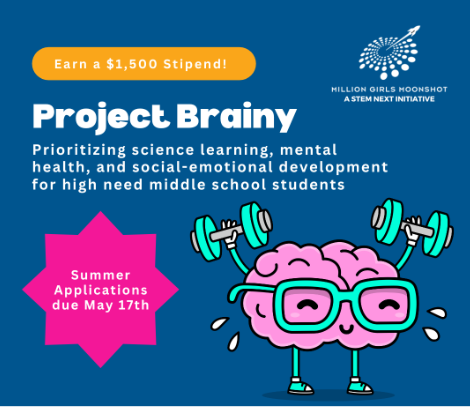
Project Brainy is a six-session neuroscience-based curriculum designed for out of school time (OST) programs. The curriculum enables middle-school students to build social-emotional skills, engage in interactive STEM learning and increase literacy. Summer and fall 2024 OST programs are invited to apply to participate in a research project to study the implementation of the curriculum. Selected programs will receive training and ongoing support on the curriculum and a $1,500 participation stipend.
|
|
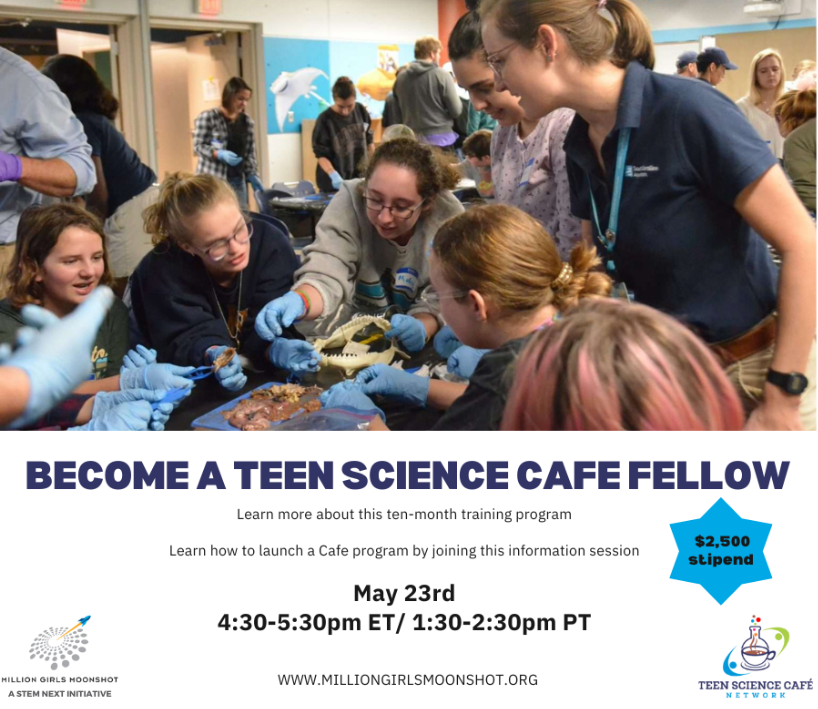
Teen Science Cafe Fellows- 2024-2025 Information Session
May 23rd 4:30-5:30pm
The Teen Science Cafe (TSC) Fellows initiative is a ten-month training program designed to help informal educators implement Teen Science Cafes in their community. Teen Science Cafe Fellows receive one-on-one support from TSC Guides to launch a cafe program and host three cafe events during the year. Fellows receive a $2,500 stipend to support their work!
|
|
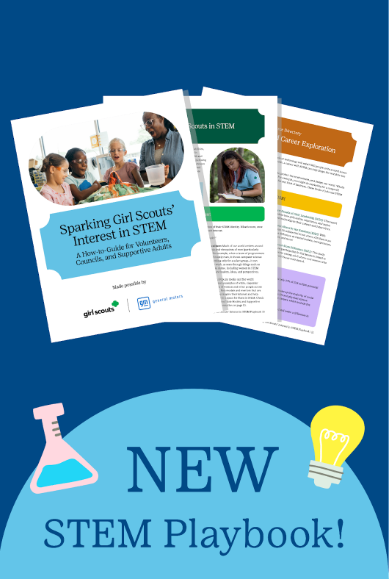
Girl Scouts New STEM Playbook!
The world of STEM is filled with endless opportunities to make a difference. From exploring computer coding and space exploration to building robots and solutions to problems such as climate change, girls are using STEM as a tool to change our world.
And you can help them make it all possible! Girl Scouts’ new STEM Playbook is designed for anyone looking to encourage a love of STEM in girls of all ages. Whether you’re involved with Girl Scouts or simply a supportive adult, the new STEM Playbook offers ideas, guidance, and access to resources and tools to grow girls' interest and skills in the field. Download the new STEM Playbook and discover new ideas to help girls build the future with STEM.
|
|
ACRES Coaching: Asking Purposeful Questions
Wednesdays: 5/8, 5/22, 6/5/2024 2:00 - 4:00 pm
Questions begin a path toward discovery, imagination, and STEM exploration. How can we help youth expand and clarify their thinking and develop their reasoning through the questions we ask them? This module is a great way to train staff on how to facilitate STEM learning. Experienced educators also love being part of a cohort as a way to connect with other educators across the country, to learn new lesson plans, and to reflect on practice. This is our introductory module and a prerequisite to other opportunities.
*The expectation is that you will be live at all three sessions and an active member of this coaching cohort. Recordings are not available if you are unable to attend.
Code: AC362PQ (Coach Hannah L)
|
|
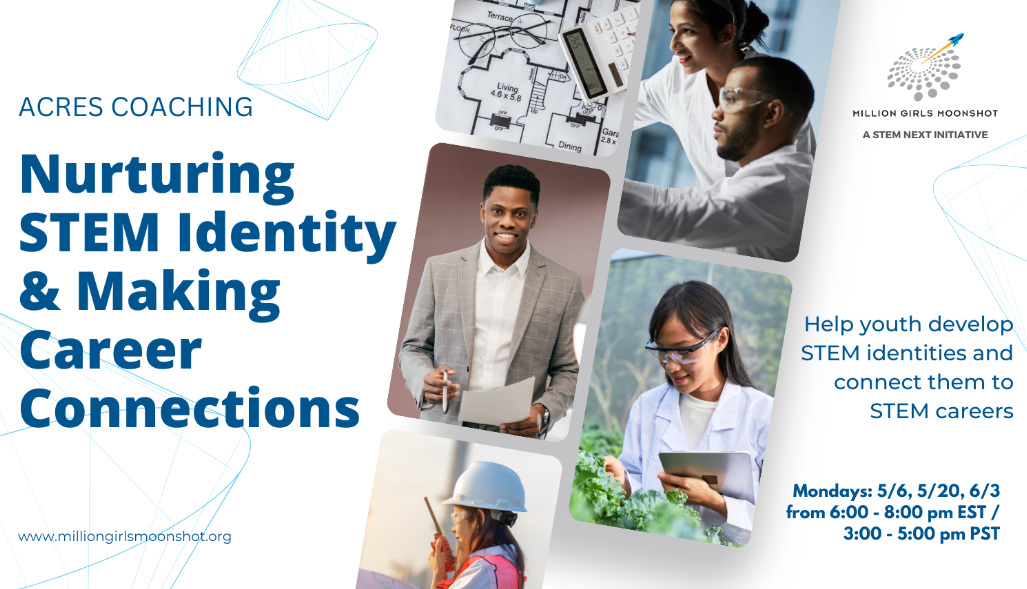
ACRES Coaching: Nurturing STEM Identity and Making Career Connections
Mondays: 5/6, 5/20, 6/3/2024 6:00 - 8:00 pm
How do you help youth recognize their connection to and role in STEM? How do you help youth learn about STEM careers? Participants experience several easy-to-implement strategies, including a photo elicitation activity that can help youth form STEM identities, and then learn how to conduct related activities with youth.
*The expectation is that you will be live at all three sessions and an active member of this coaching cohort. Recordings are not available if you are unable to attend.
Code: AC331ID (Coach Emma C)
|
|
Info Session about Micro-credentials and Digital Badging
Wednesday, May 8th 1:00 - 2:00 pm
ACRES (Afterschool Coaching for Reflective Educators in STEM) is excited to offer additional Information Sessions about STEM micro-credentials, which are competency-based, digital badges for afterschool and out-of-school professionals offered through the National Afterschool Association. These sessions are free, live, interactive, and one hour in length. You will learn about what Micro-credentials are and how to apply for them. PLEASE FILL OUT THIS FORM, choose the date that works best for you, and we'll reach out to you with the Zoom link. FMI contact acres@mmsa.org (Note: It isn’t necessary to attend more than one informational session as the content is consistent.)
|
|
Teens Lead in Computer Science
Wednesday, May 8th, 2024 Noon-1:00 pm
Teens can develop a wide variety of interests and skills, including leadership by working or volunteering in out-of-school time computer science programs. Learn more about how teen leaders use their skills to lead computer science experiences and build meaningful relationships and help young people see themselves as computer scientists. Teen leaders are essential components of many 4-H programs across the US. Join this virtual workshop to learn more about how the 4-H experiential learning model helps young people grow and develop through these experiences. This approach develops leadership and prepares young people to be the leaders, innovators and problem-solvers of our future.
|
|
-
Activity (engineering): How Does a Wind Meter Work? | Science Project On a windy day it is hard to keep your hat on! The power of the wind can even be strong enough to power large wind turbines to make electricity! In this experiment, find out how you can make your own instrument to measure the speed and power of the wind. How does it work?
-
Activity(engineering): Turn Milk into Plastic | STEM Activity Until about 1945, milk was commonly used to make many different plastic ornaments, including buttons, decorative buckles, beads and other jewelry, and many other items. Milk plastic (usually called casein plastic) was even used to make jewelry for Queen Mary of England! In this activity students will make their own casein plastic out of hot milk and vinegar.
-
Activity (Computer science): Can Humans Recognize ChatGPT's AI-Generated Text? | Science Project AI (artificial intelligence)-generated text is a hot topic for many reasons. Computers can now generate convincing paragraphs or even pages of text that look like they were written by a human. How do you know if a news article you are reading was written by a human or an AI? How does a teacher know if a student's essay was written by an AI? How do you know this text was not written by an AI? In this science project, you will conduct an experiment to see if volunteers can correctly identify whether different passages of text were written by a human or AI.
|
|
The Million Girls Moonshot aims to raise awareness of the following four research-based practices — Equity and Inclusion, Engineering Mindsets, Role Model, Mentors, and Families, and STEM Pathways and Transition — proven to remove barriers to access and quality STEM learning experiences. Resources, toolkits, blogs, and activities that elevate these four Transformative Practices can be found below and on the Million Girls Moonshot Toolkit
Equity and Inclusion
-
Access to STEM Framework: To improve the overall quality of out-of-school STEM programs, we need to address how program providers design and implement programming to increase access in STEM for youth who have been underrepresented in the STEM fields. Partnering with the National Girls Collaborative Project (NGCP) and national experts, we have developed an Access to STEM Framework — a guide for supporting program providers in this transformation. Download the Framework.
-
A Summary of Effective Gender Equitable Teaching Practices in Informal STEM Education Spaces: This article summarizes research on gender equitable practices for middle school girls in the last decade and addresses the disconnect between research and practice. The article focuses on ways to connect STEM experiences to girls’ lives, emphasizing the ways that STEM is collaborative and community-oriented, and providing opportunities for girls to interact with and learn from diverse role models.
-
Beyond Equity as Inclusion: Framework of “Rightful Presence” for Guiding Justice-Oriented Studies in Teaching and Learning: This article presents a framework to guide the study of teaching and learning in justice-oriented ways. This framework highlights the limitations of equity as inclusion, which does not adequately address the ways in which systemic injustices manifest in local classroom practice. Three tenets for guiding the use of this framework in teaching and learning are offered.
Engineering Mindsets
-
Engineering Mindset Overview: An engineering mindset refers to the attitudes and thinking skills associated with engineering — using a systematic engineering design process, considering real-world problems, applying math and science, and working in teams. The Moonshot focuses on 10 engineering practices. An overview of each practice follows, and subsequent briefs will explore each one individually.
-
New Girls STEAM Ahead with NASA (GSAWN) Resources: The Girls STEAM Ahead with NASA program, part of NASA's Universe of Learning, provides resources and experiences that enable girls, families, and lifelong learners to explore fundamental questions in astrophysics and discover the universe for themselves. New resources include the GSAWN Program Cookbook, stages of a star's Life Flipbook, a Stellar Life Cycle Bookmark and Bracelet, and Stellar Evolution Scavenger Hunt.
Role Models, Mentors, and Families
Role models, mentors, and family engagement in a young person’s STEM education leads to increased interest, greater self-confidence, and ultimately a stronger STEM identity. Developing a science-related identity increases the likelihood that students will work toward developing science literacy, or even pursue a career in a science or STEM-related field.
-
Article: How One Woman's Story Led to the Creation of Asian Pacific American Heritage Month The month of May was selected for two reasons: First, to commemorate the arrival of the first known Japanese immigrant to the U.S. on May 7, 1843; secondly, to honor the completion of the transcontinental railroad on May 10, 1869 — the building of which up to 20,000 Chinese workers participated in. But who’s idea was it to celebrate? And Why? Learn about a remarkable woman who advocated for this celebration.
-
Blog: Inspiring AAPI Scientists and Engineers - Asian American and Native Hawaiian/Pacific Islander Heritage Month | Science Buddies Blog This list contains only a few of the many inspiring AANHPI scientists and engineers who have made (and are making) important contributions to science, technology, engineering, and mathematics (STEM) For each scientist, we have included a short biographical note, a link to a hands-on science project or activity related to the scientist's area of study, a link to a relevant science career profile, and a link to a biography to help students learn more about individual scientists. Educators can use this career worksheet to guide student exploration and reflection about STEM careers.
-
Role models: Influential Asian Americans and Pacific Islanders in STEM | Washington D.C. & Maryland Area | Capitol Technology University May marks Asian American and Pacific Islander Heritage Month, and the Capitology blog is celebrating by highlighting some of the most influential modern day AAPI members involved in STEM. NASA has recognized a myriad of such members, all of whom deserve to be recognized and honored for their achievements. Links to resources are in the role model listing.
-
Videos: Asian American scientists in STEM classrooms: increasing inclusion and visibility Learn about Asian and Pacific Islander American scientists who have helped change the world, and the call for greater inclusion of their work in curriculum and textbooks. Videos, interviews, and links to other resources are included.
-
Role model visits SWE - The World's Largest Advocate for Women in Engineering The Society of Women Engineers has chapters across the country. Each chapter is committed to supporting learners and will find the right role model and facilitate in person or virtual visits. SWE also provides a variety of youth programs that range from in person activities to scholarships.
-
Videos: Celebrating AANHPI Heritage Month: Stories, Facts, History &… Growing up Asian: This series of short, highly engaging videos tells personal stories of Asians in America. What was it like to grow up with this identity?
-
Blog: Inspiring AAPI Scientists and Engineers - Asian American and Native Hawaiian/Pacific Islander Heritage Month This list contains only a few of the many inspiring AANHPI scientists and engineers who have made (and are making) important contributions to science, technology, engineering, and mathematics (STEM) For each scientist, we have included a short biographical note, a link to a hands-on science project or activity related to the scientist's area of study, a link to a relevant science career profile, and a link to a biography to help students learn more about individual scientists. Educators can use this career worksheet to guide student exploration and reflection about STEM careers.
-
Article: 8 Asian Americans and Pacific Islanders whose innovations have changed your life (really!) Stories of life changing inventions like the N95 respirator mask, HIV medications, and USB technologies that are all contributions of the AAPI community of STEM specialists.
-
Room to Read STEAM Powered Careers Collection: This collection features 10 STEM-themed books and lesson plans for youth grades 1-3, all available for free download in English and Spanish. The books feature diverse characters (and their animal friends) exploring various STEM fields, such as data science, marine biology, and nanotechnology, written by diverse scientists. Each book also features a real-life scientist and includes information about careers in the field of focus.
-
Incorporating the Stories of Women, People of Color, and LGBTQ+ Scientists Into the Physics Classroom: One way to increase accessibility to and participation in STEM is to point out the contributions of women and people of color throughout history. By focusing on diverse role models—which has been shown to reduce stereotype threat for students of these groups as well as implicit bias for all students—while also calling attention to ongoing diversity issues in STEM today, teachers can challenge conventional and outdated assumptions about a STEM stereotype.
Continuous STEM Learning Pathways
Research tells us that continuous engagement and exposure rather than limited one-time opportunities are needed to nurture the interest and motivation necessary for children to pursue STEM pathways long term. The Moonshot aims to understand and support transitions and handoffs that remove barriers for youth by connecting STEM learning across ages and settings, ensuring youth interest and motivation persists.
-
Possible Futures — Career Exploration Curriculum: Open source curriculum that complements and enriches both school and afterschool settings 1) expanding career awareness through authentic experiential learning opportunities; 2) encouraging students to explore their diverse interests, talents, and options; 3) enlivening STEM subjects by bringing in real-world and career contexts; 4) empowering students to develop vital employability skills; and 5) engaging students in making informed choices.
Below are some adaptations of the Possible Futures Career Exploration Curriculum specifically for afterschool and summer programs:
-
Career Literacy: Three units that combine the units Skills for Success and Lenses on the Future (from Possible Futures Career Exploration Curriculum). The units also provide a model for aligning Possible Futures with state Career Literacy Standards and the development of required individual student postsecondary plans.
-
Growing Myself: Twelve lessons that combine the Self unit from Lenses on the Future and the Growth Mindset unit from Skills for Success from the Possible Futures Career Exploration Curriculum.
|
|
Was this newsletter forwarded to you? Continue receiving STEM Connection by clicking the button below to subscribe. |
|
The Michigan Afterschool Partnership champions statewide access to quality and equitable Out-of-School Time programs to ensure that all children and youth succeed.
Michigan Afterschool Partnership Website
|
|
|
|
|
|
|