St. John Neumann Catholic Community
Staffed by Oblates of St. Francis de Sales
| |
|
Current Mass Times
Saturday: 5:00pm
Sunday:
7:30am, 9:30am, 11:30am, 2:00pm (español), 5:00pm
Monday-Friday: 9:00am
Monday, Wednesday, Friday 12:10pm
(Last 12:10pm Mass until September will be Friday, May 26)
Watch a livestreamed or recorded Mass
Confession
Saturday: 10:00am-10:30am (English)
Sunday: 3:00pm- 4:00pm (español)
Wednesday (During Holy Week): 6:30pm - 8:00pm
| |
|
Praying During the 40 Hours
Eucharistic Adoration
| |
|
by Fr. Don Heet, OSFS
Dear Parishioners,
Hopefully, all our parishioners know that, as part of the Diocese of Arlington’s three-year jubilee in anticipation of its 50th anniversary, St. John Neumann will be celebrating 40 hours of Eucharistic adoration, beginning with the 5:00 Mass on Sunday, May 14, and continuing through the 8:00 closing Mass on Tuesday, May 16. During these three days, we invite all parishioners to spend at least one hour of prayer in the presence of the Lord in the Blessed Sacrament.
With that invitation in mind, it’s not unusual for Catholics to wonder, how am I supposed to pray for a whole hour? What do I say? What do I do?
There is no prescribed way to pray in front of the blessed sacrament; there are several different forms of prayer you might consider. But whichever form attracts you, begin by quieting yourself. Take five minutes and let go of all the concerns you brought into the church. Consciously slow down your breathing and, as much as possible, let go of all the pressing needs and issues that flood your brain. Leave them at the door; they will still be there when you leave the church. Then call to mind that you are as much in the presence of the Lord Jesus as if you were present at the sermon on the mount, the Last Supper, beneath the cross, or with Mary and the disciples in the upper room on Easter Sunday night.
The first way of praying is the simplest and, for many, the most challenging. Simply being in the presence of the Lord and remaining there, focused as much as possible on the One in whose presence you remain, is a profound form of prayer. Call to mind you are kneeling – or sitting – in the presence of the Lord and Creator of the universe. It is a form of contemplation and a profound form of prayer.
Another way of raising our hearts and minds to God is to use the time before the Blessed Sacrament to bring all those people we promised to pray for before our Lord. Do it slowly; you are in no rush to list everyone you can think of. Instead, start with those you know who need your prayers and entrust each of them into the arms of the Lord, who loves them far more than we ever could and who knows what is best for them. Think about members of your family, people you work with, and people in need whom you have read about or seen on TV. Each of them is a beloved child of God, and God loves that we care enough to bring their needs before Him. Spending an hour praying for them is also a profound act of love for God.
Lectio Divina is a form of prayer I have come to appreciate over the past several years. It is a prayerful reading of scripture. You can use your favorite biblical passage or, as I often do, spend time praying the readings from the Mass of the Day. Take a verse and repeat it, letting its meaning percolate into your consciousness.
If you want a specific method, look at Lectio Divina: A Beginner’s Guide - Busted Halo; print it out and bring it. But really, there is no wrong way to pray the scriptures. Ultimately, ask the Lord, into whose presence you have come, to send his Spirit to help you to pray.
Many people have a set of preferred devotional prayers that they love to say, and they are most appropriate at an hour of eucharistic adoration. A number of them will also be available for you as you enter the church. One piece of advice is that you take it slowly. Don’t read or say them as rapidly – and superficially – as if you were glancing through the morning paper. Instead, notice the words and images; reflect on what they say about you and the Lord.
One form of devotional prayer that is especially appropriate is the rosary. The theme for this year of the diocesan preparation for its 50th anniversary is Rejoice: Mary’s role as a model disciple who shows us how to receive the Word of God joyfully; clearly, the rosary is a most appropriate way of prayer. Again, slow down as you recite the Our Fathers and Hail Marys. Try to find an image or phrase from the mystery you are praying for and focus on that rather than the words you are saying; doing so can be a powerful form of mental prayer that unites you with key moments in the Lord Jesus and his mother’s life.
For more information on our 40 hours celebration, go to 40 Hour Adoration Adoración de 40 horas – Saint John Neumann (saintjn.org) and sign up for a specific time before the exposed eucharist. To be an Adoration Guardian, go to Parishioners: 40 Hours Devotion (signupgenius.com).
| |
|
40 Hours Eucharistic Adoration
40 Horas de Adoración Eucarística
From Sunday, May 14 to Tuesday, May 16, we will have our second 40-Hours Devotion, in celebration of Year Two of the Arlington Diocese’s Jubilee.
Del domingo 14 al martes 16 de mayo, tendremos nuestra segunda Devoción de 40 Horas, en celebración del Segundo Año del Jubileo de la Diócesis de Arlington.
The schedule is as follows | el calendario es el siguiente
Sunday, May 14 | Domingo 14 de mayo
Mass | Misa
5:00pm
Procession and Exposition of the Blessed Sacrament
Procesión y Exposición del Santísimo Sacramento
6:00pm
Praise and Worship Hosted by our Youth Ministry
Alabanza y adoración a cargo del Ministerio de la Juventud
7:00pm-7:30pm
Adoration will end at 2:00am
La adoración terminará a las 2:00am
Monday, May 15 | Lunes 15 de mayo
Simple Adoration | Simple adoración
7:00am
Morning Prayer & Marian Mass
followed by the Rosary in English and Spanish
Oración de la mañana y misa mariana
seguidas del rosario en inglés y español
9:00am
Midday Prayer and Marian Mass
Oración del mediodía y misa mariana
12:10pm
Spanish Prayer Service
(Solemn Eucharistic Holy Hour)
Servicio de Oración en Español
(Solemne Hora Santa Eucarística)
8:00pm
Adoration | Adoración
9:00pm - 2:00am
Tuesday, May 16 | Martes 16 de mayo
Simple Exposition | Exposición Simple
7:00am
Morning Prayer & Mass
followed by the Rosary in English and Spanish
Oración matutina y misa
seguidas del rosario en inglés y español
9:00am
Divine Mercy Chaplet | Coronilla de la Divina Misericordia
3:00pm
Marian Concert | Concierto Mariano
7:30pm
Bi-Lingual Closing Mass and Final Reposition of the Blessed Sacrament
Misa de clausura bilingüe y exposición final del
Santísimo Sacramento
8:00pm
Reception | Recepción
9:00pm
| |
|
Happy Easter! We are still celebrating the Great 50 days of Easter!
| |
|
by Jean Lupinacci
Here is a list of answers to common questions about Easter:
What is it? Easter celebrates Jesus’ resurrection (rising from the dead).
When do we celebrate it? Easter is a moveable feast, which means the date changes from year to year. We celebrate it on the Sunday following the first full moon of Spring, as the Council of Nicaea decided in the 4th century.
When is Easter this year? The Easter Season is celebrated this year from April 9-May 28, 2023. At sundown on May 28, Ordinary Time begins and runs until December 3.
What color do the priests wear during Easter? White expresses joy, celebration, purity, and victory. Priests wear white vestments during the Easter season.
Why is it so long? Easter is 50 days long because that is the number of days between the Jewish feast days of Passover and Pentecost (originally known as the Feast of Harvest/Weeks). Easter is the longest and highest liturgical season in the church calendar and ends on Pentecost.
What is Passover? Passover is the Jewish commemoration of the Hebrew people’s liberation from slavery and the passing over of the death of the Israelites’ firstborn. It is the day that Jesus had the Last Supper with his Disciples, the day before Jesus was crucified.
What is the Jewish feast day of Harvest/Weeks? The Feast of Harvest/Weeks is when the wheat harvest takes place. We now call that day Pentecost. Thousands of Jews came to Jerusalem from many places on that day to celebrate.
What is Pentecost? The Holy Spirit descended on the Apostles on the Jewish feast day of Harvest/Weeks when thousands of people were visiting Jerusalem to celebrate the feast day. Everyone that heard the Apostles preaching heard it in their language. On that day, about 3,000 people were Baptized; therefore, we consider Pentecost the birthday of the Church.
Why is Easter the highest liturgical season in the church calendar? Easter is the high point of our church calendar because all Christian faith flows from faith in the resurrection.
What is the Pascal (Easter) Candle? Every Easter, we get a new candle blessed and lit for the first time at the Easter Vigil. It symbolizes the divine light of Jesus Christ, the world’s light. . We keep it lit at all Masses during Easter and special occasions such as funerals, baptisms, and weddings.
What are the biblical roots of Easter? Each of the four gospels gives an account of the resurrection of Jesus.
| |
|
Parishioner Spotlight
Kevin Morrow
| |
|
For years, the parishioners of Niño Jesús parish in Manta, Ecuador, our sister parish, have been saving for and building the Amor Divino Chapel (one of many smaller chapels that serve communities in the Niño Jesús parish). The chapel construction was mostly completed but what they did not have was a set of Stations of the Cross. That changed this Easter, thanks to SJN parishioner Kevin Morrow.
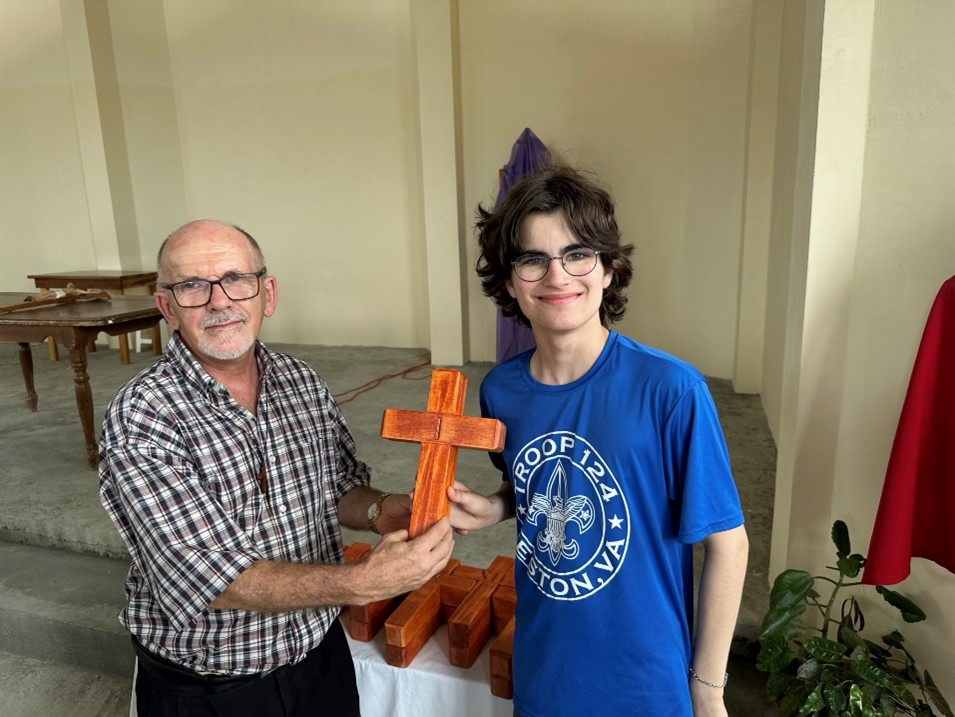
Kevin, a sophomore at South Lakes High School and a member of SJN's Boy Scout Troop 124, used his Eagle Scout service project and a pre-planned family trip to Manta to present the parish with a beautiful set of wooden crosses, each representing a Station on Christ's path to Calvary.
"I got the idea to create the stations from talking to Celia Sandoval," our SJN Hispanic Community coordinator and wife of Deacon Antanocio Sandoval, "we were discussing visiting Niño Jesús and what the people there needed to enhance the newly constructed Amor Divino chapel. Ms. Sandoval confirmed that the chapel lacked Stations of the Cross and would like to have them, and the project was born out of that conversation."
"The project was a lot more than the 14 wooden crosses. It also included prayer booklets for a Stations of the Cross service created for Niño Jesús. Each booklet included prayers and reflections created by 14 different ministries here at SJN, along with appropriate scriptural passages, which Fr. Don Heet, OSFS, selected." Deacon Sandoval and Celia Sandoval contributed the opening and closing prayers for the booklets. Kevin’s older sister Brigid formatted the booklets and his younger sister Mairead created original artwork for the booklets. Parishioner Jay Eidson, himself a former Boy Scout and current Charter Organization Representative for Troop 124, took all of the content and translated it into Spanish.
"We especially wanted to help with the Amor Divino chapel because it has a strong connection to Fr. Tom Murphy," SJN's former pastor, who passed away in October of 2019. "Fr. Tom wanted everyone to understand the love and joy of the people of Niño Jesús, and talked about the chapel often."
"One of the things I did in the project was leave one of the extra crosses I created here, along with bilingual versions of the prayer booklet. This will now make it possible for us at SJN to pray the same service that is being prayed at Niño Jesús and using the same wooden cross in future years, really cementing the connection between our two parishes. In fact, the wonderful thing about going to Niño Jesús, meeting the people, making new friends, and seeing the joy and energy there, was knowing that the entire Catholic world is connected. We all pray the same prayers, we all celebrate the same liturgy, we are all the same - no matter where we are on the planet, we are united in faith."
"I also found that kids are the same all over the world. I met Ecuadorian youth, some of whom were also scouts at the parish, and we compared stories of our Scouting experiences. Those same scouts showed up the next day eager to help hang the stations with us – two parish communities working alongside each other to install the crosses."
"If you have the opportunity to go to Niño Jesús, go!" There's really so much you will get out of the experience of visiting Niño Jesús and its wonderful parishioners, it is life altering."
Kevin was joined on his journey by his family (parents Mary Beth & Rick Morrow and siblings Brigid, Mairéad, and Brendan), fellow parishioners Flor Graves and Celia Sandoval, as well as former SJN Deacon Denny Holley and his wife, Patricia "Patty" Holley – all of whom were involved from the beginning with setting up the sister parish connection between Niño Jesús and SJN.
For years to come, the people in the Amor Divino community at Niño Jesús will be able to celebrate the Stations of the Cross with their beautiful, wooden crosses and prayer booklets, all because of a conversation and Kevin Morrow.
(Picture: Fr. Fr. Roque Bisognin, OSFS (Niño Jesús, pastor)(left) with Kevin (right) as they hold one of the Station Crosses).
| |
|
A Catholic First
The Knights of St. Peter Claver
| |
|
by Duane Hyland
We have all heard of the Knights of Columbus, but perhaps, not many know about the Knights of St. Peter Claver (KPC) - the world's largest fraternal organization for Black men.
In 1909, Black Catholic men did not have a lot of options if they wished to join fraternal organizations, especially in the South. While the Knights of Columbus did not have a national policy of discrimination based on race, far too many local councils had overt or covert policies of discrimination, effectively barring Black men from membership. These policies meant that if you were a Black male wanting to join a fraternal organization, your choices were the Masons or the Elks, neither of which adhered to the tenants of the Catholic faith.
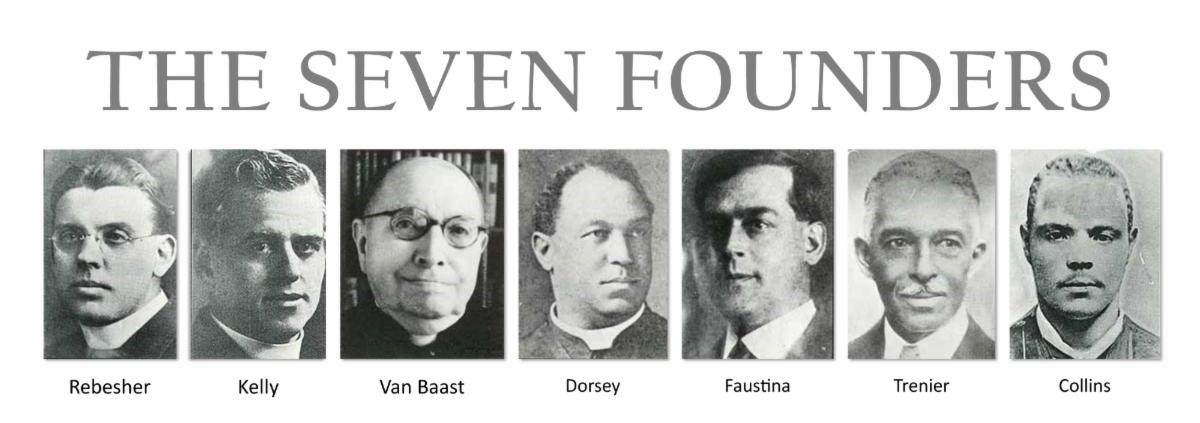
Seeing this unmet need, seven men in Mobile, Alabama, decided to do something about it. "Josephite father Conrad Friedrich Rebesher, a native of Kłodawa, Poland, and pastor of Most Pure Heart of Mary Parish, along with three other Josephite priests: Father Samuel Joseph Kelly, Father Joseph Peter Van Baast, and Father John Henry Dorsey; and three Black laymen: Gilbert Faustina, Francis Xavier "Frank" Collins, and Francis "Frank" Trenier, founded the Knights of St. Peter Claver. Right Rev. E. P. Allen, Bishop of Mobile, Alabama, attended the organization's first installation ceremony.
They named the organization after St. Peter Claver, a Spanish priest renowned for his work with the enslaved in Colombia and the Caribbean.
From their founding, the Knights of St. Peter Claver have devoted themselves to supporting charitable works, especially causes promoting civil and social justice, scholarships, and building community relations.
While early growth of the Knights of St. Peter Claver happened in the southern states of the U.S., by 1946, the organization had taken root in the north and became a truly national organization. Today, the KPC has a presence in 40 states.
Even though the Knights gave Black men their Catholic fraternal organization, fighting race-based discrimination was not something the Knights did in their early days, even when that discrimination was within the Catholic Church. As Nate Tinner-Williams pointed out in the American Black Catholic, the nation's leading Black Catholic newspaper, "Marcellus Dorsey (brother of founding member Fr. John Henry Dorsey) was expelled from the Knights of Peter Claver after criticizing various Josephites specifically—including founding member, Fr. Conrad Rebesher, a White priest who had helped found the KPC. At the time, neither the Josephites nor the KPC openly opposed segregation." By the end of the 1930s, this attitude had changed, and the KPC aligned itself with the NAACP and other organizations fighting for civil rights. They even went as far as to oppose Black priests being sent to Africa, as they realized that to grow and strengthen the Catholic faith among Blacks, Black priests would be critical to the mission. By 1942, the Knights prevailed upon the Josephite order to open the doors of their seminary to Black men wanting to be priests. The KPC has fought for racial equality and civil rights ever since.
In 1922, the KPC created its Women's Auxilary, giving Black women their fraternal organization to support the Knights and provide Black women barred from other white organizations - like the Legion of Mary - a space of their own. The KPC also has a junior division open to any practicing Catholic between the ages of seven and 17.
Today, the KPC continues the mission of its founders - supporting Black Catholics nationwide and supporting charitable causes. And, thanks to the bravery of Marcellus Dorsey and others - standing up for civil rights and against racial intolerance and discrimination.
The KPC shows us that the desire for fraternal solidarity is strong among all Catholics, and it reminds us that our Church wasn't always on the right side of the civil rights issue. Their patience and persistence in fighting racial discrimination and opening the seminaries to Black American Catholics demonstrate how we are to conduct ourselves - consistently fighting against the evil tide of racism in our nation. Most of all, they show us how committed Catholics can change the lives of our country and those in it for the better.
| |
“I am the true vine, and my Father is the vine grower. He takes away every branch in me that does not bear fruit, and every one that does he prunes so that it bears more fruit.”
John 15:1-2
| | | | |