|
St. John Neumann Catholic Church
Staffed by Oblates of St. Francis de Sales
| |
|
Current Mass Times
Saturday: 5 p.m.
Sunday: 7:30 a.m., 9:30 a.m., 11:30 a.m., 2 p.m. (español), 5 p.m.
Monday-Friday: 9 a.m.
Monday-Wednesday-Friday: 12:10 p.m.
Watch a livestreamed or recorded Mass
Confession
Saturday: 10 a.m.-10:30 a.m. (English)
Sunday: 3 p.m.- 4 p.m. (español)
Triduum Schedule
March 28, Holy Thursday Bilingual Mass: 6:30 p.m.
March 28, Altar of Repose: 8 p.m.-midnight
March 29, Good Friday, Morning Prayer: 9 a.m.
March 29, Good Friday Service (English): 3 p.m.
March 29, Stations of the Cross: 6 p.m.
March 29, Good Friday Service (Spanish): 7 p.m.
March 30, Holy Saturday, Morning Prayer: 9 a.m.
March 30, Easter Vigil: 8 p.m.
March 31, Easter Sunday Masses: 7:30 a.m., 9:30 a.m., 11:30 a.m., 2 p.m. (Spanish)
| |
|
Live Jesus Through Salesian Spirituality
by Carol Swiger
| |
|
"The soul cannot live without love. We can never love our neighbor too much."
– St. Francis de Sales
Salesian [suh-leez-juhn] Spirituality – often called the spirituality of the laity – is inspired by the life and writings of St. Francis de Sales (1567-1622) and St. Jane de Chantal (1572-1641). It emphasizes God’s love for each of us and encourages us to live with deep love and friendship with the Lord. St. Francis de Sales’ balanced approach to living a good and holy life is often described as “inspired commonsense.”
Many ideas and practices proposed by St. Francis appear to be reasonable and doable. That does not mean that Salesian Spirituality is not demanding. Rather to live in loving relationship with God and others demands doing little, ordinary and everyday things for God and others with great passion and great love. St. Francis developed a practical plan on how to journey through life with great hope and joy as we embrace the duties of day-to-day living. The plan begins with being authentic (Be Who You Are) and learning to focus on present moment living (Direction of Intention). In the 21st century, we liken present-moment living to mindfulness. Next, St. Francis recommends each person should develop an attitude of gratitude. Gratitude to God for our gifts and talents and gratitude for the gift of faith and friends to help us journey through life.
We are encouraged to maintain an optimistic, balanced life with an encouraging spirit – one that is intent in winning hearts and not in winning arguments. It is a down-to-earth spirituality for everyone. God gives us a set of tools that St. Francis calls the Little Virtues. By mastering the little virtues – Gratitude, Gentleness, Patience, Humility, Simplicity, Thoughtfulness, Kindness, Hope, Friendship, Joy, and Trust – we live in right relationship with our neighbor as we Live Jesus.
"We graciously help others in their needs both by prayer and actual service because in this way we truly show our good-will and love."
– St. Jane de Chantal
St. Francis de Sales encourages us to try to approach each person in a gentle and humble way while fostering peace and justice in our family, community, and world. Vive Jesu, or Live Jesus, is the Oblate motto. It was the guiding principle in the life of St. Francis de Sales and appeared on his own coat of arms. On the Oblate Shield, the motto is situated in the center of the Rising Sun, which symbolizes the Risen Christ. Living Jesus is what the Oblate way of life is all about. This way of life is expressed in the following hymn, entitled, "Live Jesus":
Be gentle, grateful and giving, be patient, kind and forgiving,
tell everyone of the boundless love of Christ.
Be loving, caring and humble, raise up God‘s children who stumble,
tell everyone of the healing grace of Christ.
Cry out to end all division, and sing of God‘s blessed vision
tell everyone of the holy peace of Christ.
Live, Jesus, live Jesus, come follow and abide in him.
Live Jesus, live Jesus, live Jesus for as long as you live.
To help the Oblates “tell everyone of the boundless love … healing grace … and holy peace of Christ,” St. John Neumann parishioners organized a morning of reflection titled Live Jesus! during Lent 2004. The purpose was to provide an opportunity to better understand Salesian Spirituality. To answer questions like…"How can we find the inner strength to remain upbeat, joy-filled, and optimistic in the trying, polarizing times in which we live?" From the pressures of work and family to the busyness and frantic pace of our rapidly changing world, there are plenty of challenges to go around for young people, older folks, and everyone in-between.
The spirituality developed by St. Francis de Sales and St. Jane de Chantal is nothing if not practical, crafted for every day, ordinary people with both feet planted firmly in the real world dealing with real problems. At a Live Jesus! morning of reflection, we explore the common sense and uncommon challenges that both St. Francis de Sales and St. Jane de Chantal experienced in living the life of Christian disciples. How can their wisdom ground us to live well in the places and spaces we find ourselves every day?
Each year, the annual program draws from the perspectives of both Oblate and family life, with opportunities for participants to reflect on ways one can bloom in God’s garden.
The 2004 morning was so successful it is now attended by hundreds of attendees from throughout the Diocese of Arlington and beyond. The 19th annual Live Jesus! is being held at Bishop Ireton High School in Alexandria on Saturday, March 9th. This year’s theme is Bloom Where You Are Planted. To learn more about Live Jesus! gatherings and to register to attend click here.
Our parish offers several other opportunities to learn more about Salesian Spirituality, including:
- Multi-week Classes
- Monthly Presentations
- Fall Salesian Retreat
- Monthly Youth Ministry Salesian Sunday (5 p.m. Mass & Youth Night)
- Salesian book section in the Parish Library
Watch the bulletin for announcements of new and recurring ways to learn more about Salesian Spirituality.
| |
Our Parish Lenten Mission Team: The Maryknolls
By Jean Lupinacci
| |
|
This weekend, please welcome our Parish Mission Team – Fr. Romane St. Vil and Br. John Brazo, Maryknoll priest and brother
Who are the Maryknolls?
Maryknoll is the official Catholic foreign mission society of the United States and is over 100 years old. The focus is on intercultural gospel sharing in order to assist people in understanding Jesus’ message and its implications. There are four organizations that comprise the Maryknoll:
-
Maryknoll Fathers and Brothers serve the poor and those in need in over 20 countries.
- Maryknoll Sisters are religious sisters who serve the poor and marginalized around the world.
- Maryknoll Missioners are lay people who commit to 2.5-3.5 years of overseas service to respond to basic human needs and to help create a more just and compassionate world.
- Maryknoll Affiliates are small groups in the context of Chapters that gather for prayer, reflection, and action committing to the mission goals of Maryknoll with the focus of peace and justice.
History and interesting facts
Established in 1911, their headquarters are in Ossining, New York, just North of New York City on over 100 acres. It is located near the Croton Dam, which was completed in 1906. In the early 1900s, there were many Italian immigrants, who were skilled in masonry work, located in this region to build the dam and available to then construct the Maryknoll headquarters. The first parcel of land they wanted to purchase was denied because of anti-Catholic sentiment, but they went to court and won the case granting them the ability to purchase the land. When adjacent property became available for purchase, they wanted to avoid the trouble of going to court again, so they created a different strategy to be approved. Mother Mary Joseph (founder of the Maryknoll Sisters and Smith College graduate) dressed up as a rich woman accompanied by their lawyer, who posed as her husband. Fr. Walsh (one of the founders) dressed as the family chauffeur. The ruse worked, and they were approved to purchase the additional property and expand.
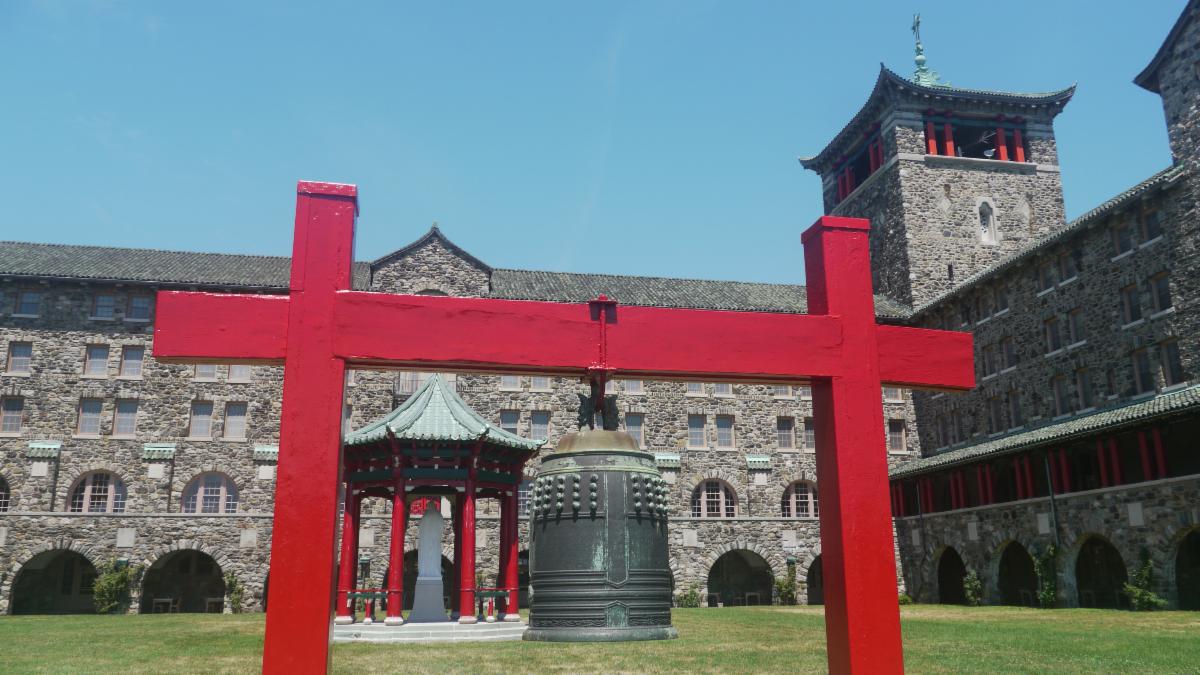
Maryknoll headquarters is located on a hill and was referred to as Mary’s Knoll, eventually became known as Maryknoll. The Maryknoll seminary in Ossining was built with a Chinese motif to encourage priests to go to China on mission trips. The central point of the campus is the Blessed Mother and Child statue in a Chinese kiosk. Next to that is a Japanese bell presented to the Maryknolls just before their first departure ceremony in 1918. It rang at the ceremony, and is rung at subsequent ceremonies as well as at 6 a.m., noon and 6 p.m. Maryknoll is located on the Hudson River and during World War II civilian spotters kept watch at Maryknoll for German planes and ships.
At the entrance to Maryknoll the message in Latin translates to “Peace be to those who enter.”
Schedule for our Parish Lenten Mission,
“Deepening our Faith as Missionary Disciples”
March 2 and 3: Fr. Romane and Br. John will preach at all Masses
Sunday, March 3 at 7 p.m.: Parish Mission kicks off in the Church with a bilingual opening and then the Spanish speaking participants will go to the Chapel to hear the talk in Spanish with English in the Church. We gather again at the end in the Church for a bi-lingual closing. A light dinner will be provided after the 5 p.m. Mass and before the Mission.
Monday, March 4 after the 9 a.m. Mass: A recap of the previous nights talk will be presented in the Chapel.
Monday, March 4 at 7p.m.: The second presentation of the Parish Mission in the same format as Sunday night.
Tuesday, March 5 after the 9 a.m. Mass: A recap of the previous nights talk will be presented in the Chapel.
Tuesday, March 5 at 7p.m.: The third presentation of the Parish Mission in the same format as the previous two nights. A dessert reception will follow to close the Parish Lenten Mission.
We encourage all SJN parishioners to join us for this event. All are welcome!
| |
With Us Not For Us:
World Down Syndrome Day
By Elizabeth Wright on behalf of the SJN Pro-Life Ministry
| |
|
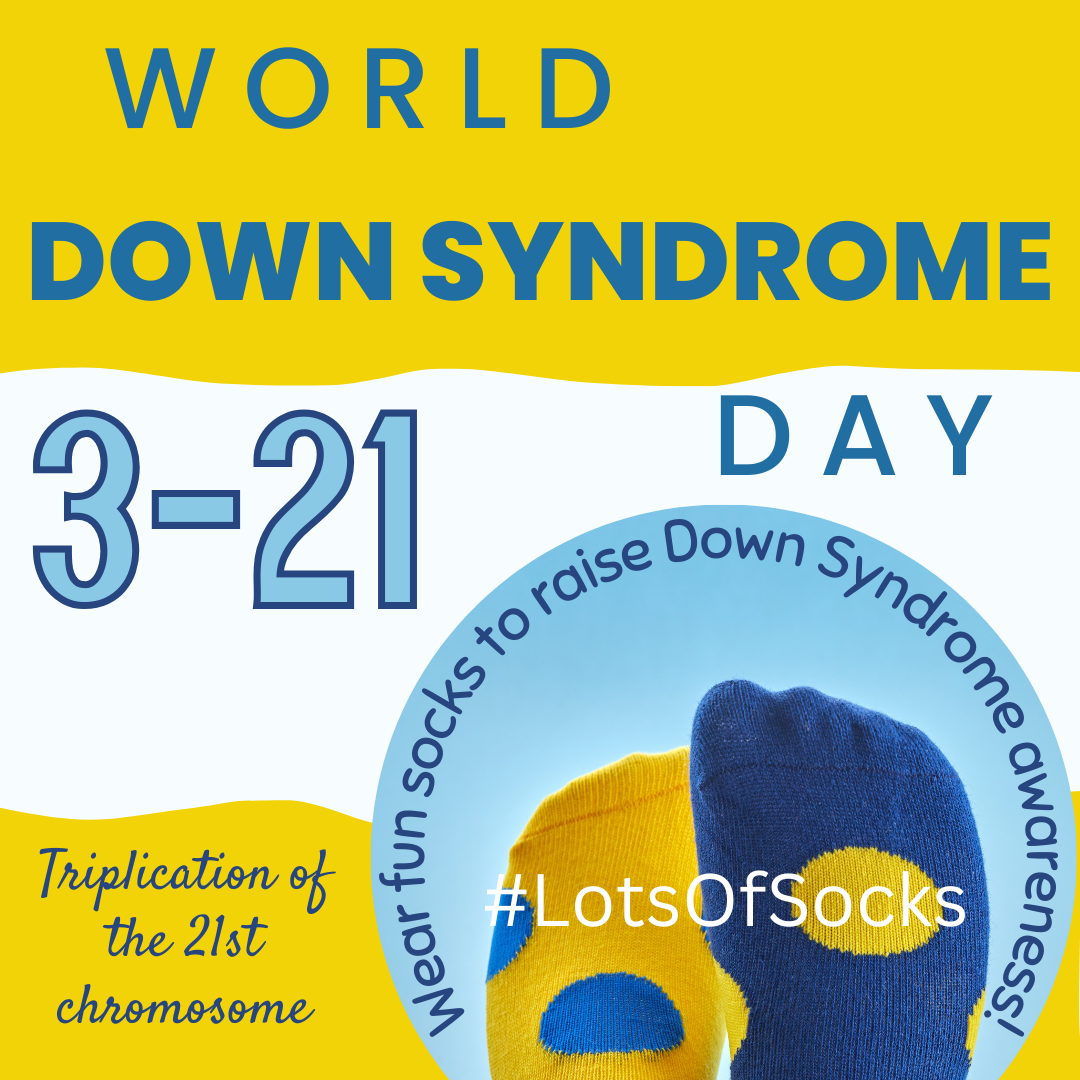
Each year, on March 21st, World Down Syndrome Day (WDSD) is celebrated around the world. On this day, people with Down syndrome and their community supporters organize and participate in events aimed at raising awareness to create a single global voice advocating for the rights, inclusion, and well-being of people with Down syndrome. The following depicts the dark history of the treatment of people with disabilities like Down Syndrome (using uncomfortable and demeaning terms that are not acceptable today), illustrating both the extraordinary progress in understanding and awareness, while also highlighting existing needed efforts as we continue to strive for the inherent dignity of life for people who have Down syndrome.
In 1858, a physician by the name of John Langdon Down began a position as medical superintendent at Earlswood Asylum for Idiots in England. He became fascinated with the classification of race and started studying the 400 residents of the Asylum. He measured their skulls, compared their anatomy, and took hundreds of photos of them. That same year, he published his findings in an article entitled, “Observations of an Ethnic Classification of Idiots.” In the classification findings, he noticed that an overwhelming number of people were classified as “Mongolian,” which was marked by flat, broad faces, round cheeks, small noses, and upturned eyes. Down stated that, “’Mongols’ are good at imitating those around them, and they are humorous and full of life.” He continued to observe that they do not speak well, have poor coordination, and a short life expectancy; however, they can improve their skills with applied techniques. Two years later, Down and his wife left to open their own center for the mentally disabled persons near London. He dedicated the rest of his life to providing specialized education to improve quality of life and proving that people with disabilities could learn and become valuable members of society, rather than destined to abandonment and institutionalization.
Into the 1900s, “idiot” and “imbecile” were commonly accepted medical terms for people with disabilities. It was not until 1965 that the racially biased term of “Mongolism” ceased usage, and the World Health Organization, along with the scientific community, recognized it as Down syndrome. In 1958, French physician Jerôme Lejeune discovered the cause of what Down had labelled “Mongolism.” In his research, Lejeune found that this condition resulted from an extra chromosome, which is called trisomy, specifically a complete or partial copy of the twenty-first chromosome, which then became known as Trisomy 21. In 2000, the collaborative research of international scientists led to the cataloguing of the estimated 329 genes on chromosome 21, opening the door to greater advancement and understanding in the field of Down syndrome research.
The coupled advancement of medical research and wider societal awareness has led to progress beyond ceasing to use inappropriate terms, but more importantly, a dramatically increased life span. As recently as 1983, the life expectancy of an individual with Down syndrome was 25 years. Today, largely due to the end of inhumane treatment for people with disabilities and significant quality of life improvements, the average life span of a person with Down syndrome is 60 years old. According to the Down Syndrome Association of Northern Virginia, there are an estimated 400,000 people in the U.S. with Down syndrome. The United Nations (UN) estimates that between 3,000-5,000 babies worldwide are born each year with Down syndrome. The worldwide population is not accurately known but thought to be around six million people with the condition.
While the understanding of the genetic condition is now advanced, there is still little known about the cause of Down syndrome, and research still needs increased attention and funding. The only known fact is that the incidence of the condition is higher with the mother’s age, but beyond that it occurs in every nation, race, and socioeconomic level. The good news is that medical understanding combined with societal education and awareness has provided people with Down syndrome greatly improved quality of life. Educational opportunities are leading to fulfilling places in the workforce, in family life, and in communities. Legislation in many countries both protect and provide opportunities for those with disabilities.
Currently, the birth rate for a baby with Down syndrome in the U.S. is approximately one in every 700 births, and the worldwide birth rate, according to the U.N. is about one in every 1,000 live births. While we have advanced to the point where most countries do not medically categorize people with disabilities as “idiots” or abandon them to cruel institutions where they linger for years without proper care or compassion, the latest trend is that medical advancements have resulted in a movement toward eradication of Down syndrome through abortion. Significant developments in the accuracy and availability of non-invasive prenatal genetic testing for disabilities have resulted in the increasing number of abortions of babies diagnosed with Down syndrome before birth. Most notorious is Iceland, where today almost 100 percent of pregnancies testing positive for Down syndrome are terminated. Nationally, only one or two babies are born with Down syndrome in Iceland each year.
“Iceland’s track record for abortions of babies with Down syndrome is appalling, but the UK and many other countries also have an extremely poor track record,” said Catherine Robinson, Right to Life UK spokesperson in 2022. “One would think that, in this world where equality in opportunity and rights are championed and fought for, this kind of discrimination would be outlawed. Unfortunately, the hypocrisy of many western nations leaves this practice unchallenged. This has got to change.”
The stark truth is that many developed countries are not faring much better. In Denmark, the rate of terminated pregnancies due to a Down syndrome diagnosis for the baby is 98 percent, the rate in France is 77 percent, while it is 67 percent here in the U.S. In 2022, the UK Parliament passed the Down Syndrome Act, which provides guidance on meeting the needs of persons with Down syndrome. Also in 2022, however, the section of the Abortion Act, which allows the abortion of a baby with Down syndrome up until birth, was upheld by the Court of Appeal in the UK. A contradiction of human rights seems to be the status quo in many countries—a person with Down syndrome is protected once born, but abortion is making it less likely that a baby with Down syndrome will even be born. The case in developing countries is also bleak, more closely mirroring the pre-1980s view of Down syndrome. Babies born with disabilities to include Down syndrome are often abandoned, rejected, or sent to institutions where they will linger without adequate care, to keep the families from being stigmatized by their child’s special need.
Ever-progressing awareness and understanding of people with Down syndrome has been essential since the days of John Langdon Down’s initial research. The General Assembly of the United Nations declared March 21 as World Down Syndrome Day in 2011. The chosen date reflects Trisomy 21—the third month for the third chromosome that is fully or partially replicated, and 21 for the specific chromosome that is affected. Down syndrome exists in all corners of the globe, and while we still do not know the cause, significant strides have been made in understanding the needs of individuals with Down syndrome. We no longer focus on the limitations of disabilities but have seen many capabilities blossom. Time and again, we have witnessed the reality that quality health care, therapies, education, and general love and inclusiveness result in persons with Down syndrome achieving much greater potential and quality of life. Many are graduating high school and even continuing to college, marrying, joining the workforce, and living independently engrained as members of society. One of the focuses of individuals with Down syndrome is to be seen as capable human beings, not objects of charity. The “With Us Not For Us” message embraced by the Down syndrome community is vital to the overarching human rights campaign for those with disabilities. Individuals with Down syndrome have the same wants and needs as any other person: to have opportunities for improvement and have other people work with them rather than doing for them.
On March 21, the SJN Pro-Life Ministry will host a celebration of World Down Syndrome Day. We will begin with prayer for the worldwide protection of pre-born babies diagnosed with disabilities, for an increase in research funding to improve the lives and health of those individuals with Down syndrome, for the end of discrimination against people with disabilities, and for continued improvements in quality of life for people with Down syndrome worldwide. We will hear from the Down Syndrome Association of Northern Virginia and families and their loved ones with Down syndrome, and we will celebrate Down syndrome awareness with Jake’s Ice Cream, a local employer of adults with special needs, and Big Kyle BBQ, and of course, a wonderful opportunity for fellowship at SJN. Also, be sure to wear colorful, fun socks on March 21; the #LotsOfSocks campaign helps bring awareness to Down syndrome. Please join us--all are welcome! Click here for more information and to join the celebration of World Down Syndrome Day on March 21st!
Footnote: Statistics on the number of people with Down Syndrome and babies born with Down Syndrome each year differ between sources, even between the U.N., the Center for Disease Control, and the Down Syndrome Association of Northern Virginia. The numbers here represent the best estimation from credible sources.
| |
|
A Beginner’s Guide to Taizé Prayer
by Dr. John J. Mitchell
| |
|
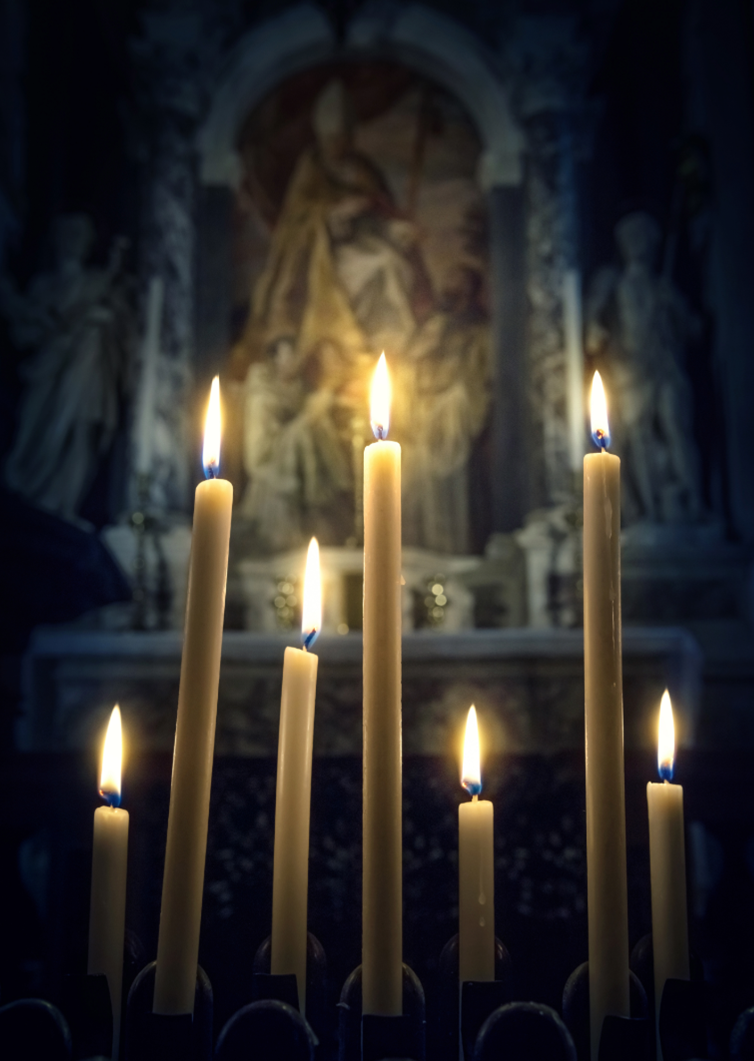
A quietly shadowed chapel is gently illuminated by hundreds of flickering candles. Their golden glow reveals icons with saintly eyes that seem to knowingly peer into the soul of the mystified viewer. A modest group of instrumentalists and an unassuming cantor guide the congregants in repeated tranquil choruses, while the orations echo at an adagio pace. The hopeful lyrics of these uncomplicated songs radiate peace, light, assurance, and other simple reflections of Christian worship. This briefly described experience of transformative musical meditation is merely a glimpse of the awakening and healing elements of Taizé Prayer.
The small village of Taizé is situated west of Geneva in eastern France, which was a significant location during World War II because of its proximity to the demarcation line. Roger Schütz, later known as Brother Roger, was 25 years old and had a strong conviction to offer assistance to victims of the war in Europe. He moved to Taizé from Switzerland in 1940, bought a small farm house, and offered a place of shelter and safety for refugees. Many refugees crossed out of the Zone Occupé (Occupied Zone) to escape the Nazis and found their way to the small, quiet community of Taizé. Eventually, the citizens of Lyon learned that Taizé was a safe haven and directed those fleeing persecution to the village. The people seeking refuge came to Taizé from various faith backgrounds, and communal ecumenical prayer became the norm there.
In his book "God is Love Alone," Brother Roger wrote, "Since my youth, I think that I have never lost the intuition that community life could be a sign that God is love, and love alone. Gradually, the conviction took shape in me that it was essential to create a community with men determined to give their whole life and who would always try to understand one another and be reconciled, a community where kindness of heart and simplicity would be at the centre of everything." Under Brother Roger’s leadership, an order of brothers formed in Taizé that was dedicated to living a simple, celibate Christian life. The brothers often sang in prayer together. Seeking ecumenical songs centered on themes such as light, forgiveness, and hospitality, the brothers commissioned French composer and organist Jacques Berthier to write music for the community. The collection of songs that would eventually become known as “Music From Taizé” lyrics written by Brother Roger and set to music by Berthier. The composer also translated several of the texts into twenty languages, and "Music From Taizé" is sung around the world today.
Even after Brother Roger's tragic death in 2005, Taizé continues to flourish and welcome thousands of pilgrims annually, especially young people. These visitors come to pray with the brothers in song and meet other like-spirited individuals from different corners of the earth. To learn more about the Taizé community in France and others around the world, click here.
If you would like to experience Taizé Prayer, however, you need not board a seven-hour flight across the Atlantic. Here at St. John Neumann, we recreate our own Taizé and pray in the tradition of this community, usually on the first Wednesday night of the month. The assembly reflects Brother Roger's vision of unity, including our own parishioners, other Catholics from around our diocese, and our neighbors from other Christian denominations. We invite professional musicians to accompany and have a fabulous team of volunteers that help to prepare the worship space and serve as cantors and lectors.
Our next Taizé Prayer, which has a Lenten theme, will be Wednesday, March 6 at 7:30 p.m. in the St. Francis de Sales Chapel. Bring your friends and join us for about 45 minutes of transformative song, reflection, and prayer.
| |
Applying Salesian Spirituality During Lent
by Mae O'Neill
| |
|
The following was written by Mae O'Neill, who is a senior at Chantilly High School, as part of our H.S. Youth Ministry's monthly Salesian Youth Night.
Interiority, being inward with your thoughts, feelings, and struggles, is something extremely relevant in my life, and something that I think everyone can relate to. It could be something as small as keeping a secret from a friend, but interiority is no stranger in our daily lives. For me, and for many my
age, I know this is most prevalent when it comes to college: choosing not only where to go to school, but also where to live for the next four years is daunting, and especially when an admissions decision doesn’t align with your goals, it is easy to shy away from sharing and opening up, keeping those feelings internal. In December, I was deferred from my number 1 school, and I remember hiding those emotions and feelings from others. Having hyped up my desire to go to this school, having to tell friends and family that I wasn’t “qualified or good enough” for was difficult. One Salesian quote, though I didn’t realize it at the time, helped me through the last 2 months: “The challenge of each moment is discerning God's will, that is, the particular, unique way that God may be calling you to love Him, yourself, and others.” Looking back, being deferred was the best decision for me at that time; it forced me to focus on my relationship with God, myself and those around me, and strengthened my faith more than I would have thought. It forced me to prioritize the people and things that I have now, rather than focusing on a potential or future possibility.
I look back on the last few months with gratitude for the personal growth and growth in my faith, stemming from me realizing that, had I kept those emotions and feelings inside, they only would have hurt me further and damaged my relationship with those around me. This was the first time that I saw the Lord working in my life in a way that stemmed from internal reflection, and is the biggest example of interiority that I have seen in my personal life.
With that being said, Lent itself is a time of reflection that can easily lead to positive benefits in our lives. As we reflect on Jesus’ choice to die for our sins, interiority can help us grow by pointing out aspects of our lives where we can move closer to the Lord. Lent, a time of preparation and an opportunity to go deeper in our faith, can only help our relationships with God, and interiority and reflecting within ourselves is the best way to do so during this Lenten
season.
| |
|
“Christ indeed from death has risen,
our new life obtaining."
Victimae paschali laudes
| | | | |