|
St. John Neumann Catholic Community
Staffed by Oblates of St. Francis de Sales
| |
|
Current Mass Times
Saturday: 5 p.m.
Sunday: 7:30 a.m., 9:30 a.m., 11:30 a.m., 2 p.m. (español), 5 p.m.
Monday-Friday: 9 a.m.
Monday-Wednesday-Friday: 12:10 p.m.
Watch a livestreamed or recorded Mass
Confession
Saturday: 10 a.m.-10:30 a.m. (English)
Sunday: 3 p.m.- 4 p.m. (español)
Ash Wednesday Schedule
6:30 a.m. (Mass); 9 a.m. (Mass); 12:10 p.m. (Service); 6 p.m. (Mass)
8 p.m. (Servicio en español)
Distribution of ashes will be at all Masses and Services.
The Liturgy of the Eucharist will not be at the Ash Wednesday service.
| |
|
Dear Friends,
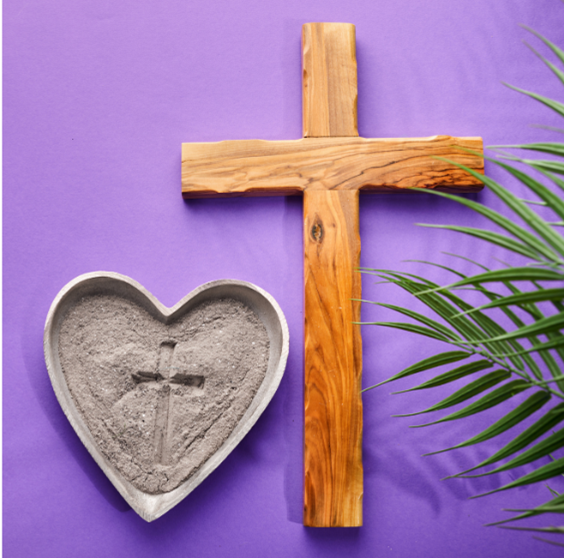
In a couple of weeks, we will celebrate Valentine’s Day on the same day as we begin the Lenten Season on Ash Wednesday. In many ways, I have always seen Valentine’s Day as a nice gesture but really one of those "Hallmark" kind of celebrations. Upon further reflection, Valentine’s Day is an opportunity to reflect on the heart and my relationships. One of the primary functions of the heart is to love. For any of my relationships to thrive in authentic love, they must somehow reflect my relationship with God and love for him.
This brings me to Lent, a time to reflect on both our personal and communal call in our journey, ultimately, to being one with God. I recently read a short article entitled, "Our Struggle in Faith – Between Knowing It is True and Believing It!" by Ron Rolheiser, OMI. He states that at the heart of our faith is a fundamental truth: we are unconditionally loved by God. “You are my beloved child; in you I take delight!” We hear this over and over in different contexts and environments and know its truth, yet we struggle to believe it or allow ourselves to fully live it. There may be a number of reasons why; I would like to suggest two reasons. The first is that, over time, I think we develop inner voices, perhaps demons within, that tell us we are not worthy. Perhaps it is because of past failures or mistakes, misunderstandings, or an addiction that enhances an internal low self-image or lack of confidence. Second, and I think related to the first, often in our lives we experience love with conditions, whether it is perceived by us or real, and we cannot fathom unconditional love.
Lent can be the opportunity to go deep within to recognize those inner voices that keep us from more fully experiencing God’s unconditional love and stifle our ability to experience and celebrate that love. This is often not an easy task, but if we are open to being honest with ourselves and realize it might mean some hard work ahead, perhaps even seeking counselling, it can also be a freeing experience. I believe it is when we are free that we are able to reap the grace of authentic relationships, especially with ourselves and with God.
May our Lenten journey be one that renews our baptismal identity where we have been welcomed into his holy people and anointed with the chrism of salvation. “As Christ was anointed Priest, Prophet, and King, so may you live always as members of his body, sharing everlasting life.”
May our Lenten journey be fruitful and may we encourage one another in the faith.
Live Jesus,
Fr. Joe
| |
February 2: The Presentation of the Lord
...and the Groundhog?
By Elizabeth Wright
| |
|
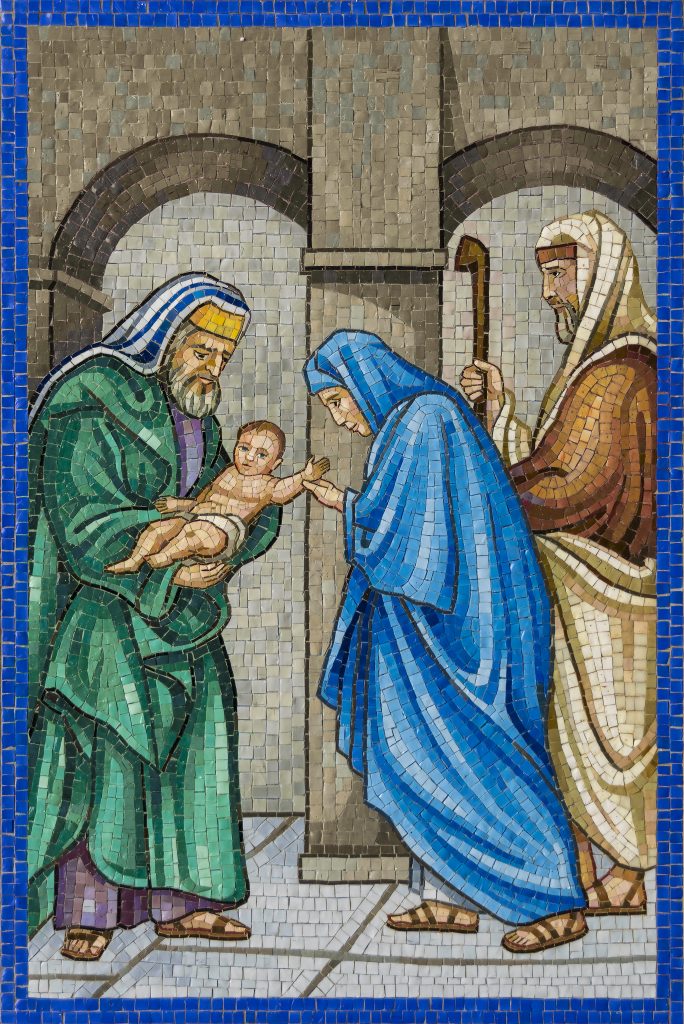
As we begin February, it is likely that your calendar says, “Groundhog Day” on February 2; if you have a Catholic calendar, it also will have, “The Presentation of the Lord.” February 2 is a date significant in many traditions, even pre-dating Christianity. (The Celtic feast of Imbolic/Impolg is a pagan festival of renewal also celebrated at this time.)
The Feast of the Presentation of the Lord, or Candlemas, has been celebrated since about 350. It started in Jerusalem and was accounted in the diary of a pilgrim from Spain who visited the city during the feast around 380. In that time, it was called Hypapante or “Meeting,” referring to the meeting of Simeon and Anna with the Infant Jesus in the Temple. It also is sometimes called the feast of the Encounter or the feast of the Presentation. Later, when the feast was adopted by the Western church, it became known as the “Purification of Mary” because according to Jewish law in Leviticus, forty days after giving birth, a woman was to visit the temple with a sin offering for purification. Although, this did not apply to Mary, she was obedient to the Mosaic law, and the name remained until 1974 when Pope Paul VI wrote in Marial Cultus that the feast of the Presentation of the Lord is to be given back its ancient name.
The name Candlemas came from England in the late seventh century, named for the tradition of blessing candles and carrying them in procession on the feast day. The candles signify the light of Christ and as the Infant Jesus is presented in the temple, we are reminded that he IS the temple. Candlemas is also a pivotal celebration in the Church year as we shift our thinking from the nativity of Christ to the passion of Christ. As Catholics, it is forty days after the birth of Jesus, which means the presentation of the Lord, but it coincides with this seasonal transformation which has organically been imprinted on all God’s creatures.
February 2 is celebrated by many cultures through history as the halfway point between winter solstice and the spring equinox. (Technically, depending upon the year, the halfway point can fall anywhere between February 2nd and 7th; the halfway point for 2024 is actually February 3rd.) For centuries there have been all sorts of traditions, feasts, and celebrations around this time. While the candles distributed at Candlemas are symbolic of the light of Christ, the origins also involve a practical nature derived from the need to use candles throughout the dark days of winter.
As Candlemas traditions were adopted throughout Europe, there was also a seasonal facet. These were times that people planned for winter—and not planning could very well mean not surviving winter. Spring was not just a revitalization and relief, but a milestone of having survived winter. People began to guess or forecast how much winter was left for practical reasons: to ration winter food supplies, schedule planting, etc. There were even several Candlemas songs, like this Old English lyric: “If Candlemas Day be fair and bright, winter will have another fight. If Candlemas Day brings cloud and rain, winter won’t come again.”
Sound like another holiday on February 2? Hibernating animals were another way to forecast the coming spring. When Germans immigrated to the United States, they brought with them their custom of observing the hedgehog emerge from his burrow on Candlemas. Settling in Pennsylvania, hedgehogs were no longer available as weather forecasters, but groundhogs were plentiful. On February 2, 1887, at Gobbler’s Knob in Punxsutawney, Pennsylvania, the first groundhog emerged and was celebrated. A newspaper editor, who was also part of the Punxsutawney Groundhog Club, named him Phil, and he has been celebrated ever since. Phil did not see his shadow this year, which indicates “winter won’t come again.” Happy Candlemas…and Groundhog Day!
| |
WorkCamp: One Family's Journey of Faith
By Claudine O'Byrne (and family)
| |
|
WorkCamp is a weeklong intentional Christian community, within the diocese of Arlington, where youth have an opportunity to serve and strengthen their relationship with Jesus Christ. Our family’s WorkCamp journey began six years ago. We had heard great things about WorkCamp from friends, and I was very eager for our oldest child, Conor, to attend. This would be his first time away from home for a week, and I was nervous, so I signed up to volunteer as an adult crew leader. As an adult leader I was assigned a parish “small group." Each group consists of an adult leader with 4-6 teens, who embark on a faith journey together, beginning in January through the week of WorkCamp and beyond. I have found it such a blessing to get to know these teens and accompany them on this fun and faith-filled experience.
Every year, I am amazed at what a well-oiled machine WorkCamp is. The diocese works year-round preparing for this week, so the only thing we need to focus on is helping our resident and growing closer to both the Lord and each other. Every morning, we start the day with Mass; this is truly a blessing. In addition to our parish group, each adult crew leader is matched with five or six teens from other parishes to lead on-site. Every teen is given a specific job on their crew, and all the “tools” necessary to help their crew through that job – they are empowered and inspired to lead. Some teens take to their roles naturally, but others, through the encouragement of their crewmates, grow into their roles. It is truly a joy to watch this all come together.
In the middle of WorkCamp week, Bishop Burbidge and 50 priests join us for an evening of adoration and reconciliation. I look forward to several aspects of WorkCamp, but this is the one I look forward to the most. Being in this community of over a thousand people together in eucharistic adoration is truly life changing. “Workcamp has made such a difference in my faith life,” said Conor. “I have learned that one of the best ways of growing my faith is just being in the presence of our Lord through adoration.”
I was excited to return to WorkCamp in 2022, when the diocese resumed the program after COVID. That year, I attended with two of my daughters, my son, and my niece—how joyful! My eldest daughter, Kyla, was apprehensive. This was way out of her comfort zone. She was worried about the long hot days in the heat, cold showers, no cell phones, and many people in close quarters. She now says about WorkCamp, “This is not the easiest experience, and there are times that I get upset or annoyed, but the large presence of faith surrounding WorkCamp reminds me that those are just times that God is challenging me to grow in virtue.” She will be going for the third time this coming summer.
On the last day of WorkCamp, we gather together and have a celebration of thanks. We invite the residents to share lunch with us to thank them for trusting us to come into their homes. It is a moving afternoon full of laughter and tears, with many of the residents’ giving testimonies of their experience. On this last day, I am always deeply impacted by the teens’ testimonials—it is so inspiring. Numerous teens go on stage—alone with a microphone in front of over a thousand people—and humbly, openly share their reflection of the week at WorkCamp—how courageous! The greatest thing is that on the stage, after this week of community and faithful growth, these kids do not feel “alone” up there. They are with their people. My daughter, Lorali, reflects, “A lot of Catholic teens nowadays aren’t exposed to good examples of how a Catholic teen should act in everyday life. We’re exposed to bad role models all the time on the internet and at school, and it can be easy for us to feel alone in our faith journey. This experience reminds us that we are not alone. There are thousands of teens in the area just like us who are fighting every day to make the right decisions, despite the influence of the secular world. WorkCamp gives us hope and it gives us a community to confide in.”
I recently was surprised to learn that Conor was not as eager as I thought that first WorkCamp: “The first time I went to WorkCamp was six years ago, and I only went because my mom wanted me to go. I kept going back because WorkCamp is a place where I made new friends and enhanced my relationship with God a little more every time I went.” It turns out, moms do know best!
This year, God-willing, our whole family will experience WorkCamp together. Our three girls, all in high school, will attend, and I will be joining as a crew leader again. We are also hopeful that my husband will be able to join us as a contractor. Both my husband and our youngest daughter, Samara, will finally get to have this amazing experience they have heard so much about over the years. Conor, now a sophomore in college, is hoping to work at “HomeBase” where he will get to see and participate in the magic that makes WorkCamp come together. As Conor so aptly put it, “WorkCamp is such a big deal because it brings over a thousand people together to improve hundreds of people's lives with our faith leading the way.”
There are so many ways for each of us to be a part of WorkCamp; whether it is your “time, treasure, or talent,” each is vital to the success of WorkCamp for our teens and community. Thank you to everyone who is part of this amazing effort! You have made such a difference in so many lives, and I feel truly blessed to play this small role.
| |
|
Lenten Prayer, Fasting, and Almsgiving
by Jean Lupinacci
| |
|
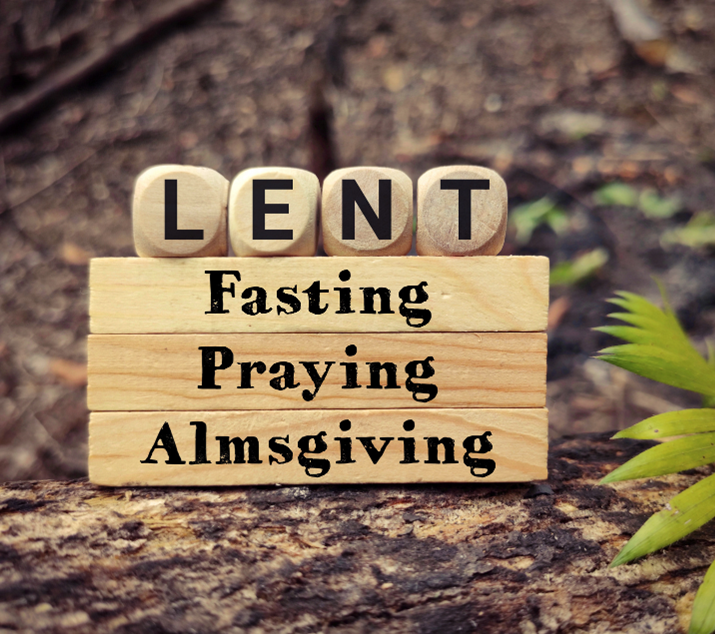
"Lent is a 40-day season of prayer, fasting, and almsgiving that begins on Ash Wednesday and ends at sundown on Holy Thursday. It is a period of preparation to celebrate the Lord's Resurrection at Easter. During Lent, we seek the Lord in prayer; we serve by giving alms, and we practice self-control through fasting. We are called not only to abstain from luxuries during Lent, but to a true inner conversion of heart as we seek to follow Christ's will more faithfully. We recall the waters of baptism, in which we were also baptized into Christ's death, died to sin and evil, and began new life in Christ." (USCCB website)
How can we practice prayer, fasting, and almsgiving (service) as a family or individual? Here are some ideas both from the USCCB website and "Corporal Works of Mercy On the Run" by Beth Belcher:
Prayer
- Go to Mass on Ash Wednesday and/or attend a daily Mass.
- Attend Soup and Stations of the Cross on Fridays. See bulletin for details.
- Say a prayer for those coming into the Catholic Church at our Easter Vigil Mass: Erik, Quenedi, Nicolle, Edwin, and Tatiana.
- Make a list of the good things that God has given you and say a prayer of thanksgiving for God’s loving care.
- After dinner, say a decade of the Rosary for those who feel unwelcomed, unheard, and unloved.
- Pray one of the Penitential Psalms (Ps 6, 32, 38, 51, 102, 130, 143), and give thanks for God’s mercy.
- Go to the Sacrament of Reconciliation on Saturday at 10-10:30 a.m. or Wednesdays 6:30-8 p.m. (The Light is On)
Almsgiving
- Make cards for homebound, wounded veterans, or sick family members.
- Share your lunch at school or work with someone who forgot theirs.
- Give gently used clothing to the poor.
- Send a Mass card to someone you know is sick or has recently lost a loved one.
- Visit a homebound friend or family member.
- Donate to the poor through our CRS Rice Bowl project. See the bulletin for details.
Fasting:
-
Click here to read the Lenten Fasting Regulations.
- Explore some new meatless recipes and commit to living more simply, accompanying our brothers and sisters who lack material resources.
- Fast from electronic devices and/or social media.
- Ideas from Pope Francis on fasting:
- Fast from hurting words and say kind words.
- Fast from sadness and be filled with gratitude.
- Fast from anger and be filled with patience.
- Fast from pessimism and be filled with hope.
- Fast from worries and have trust in God.
- Fast from complaints and contemplate simplicity.
- Fasts from pressures and be prayerful.
- Fast from grudges and be reconciled.
May you have a blessed Lent!
| |
Holy Twins!
by Elizabeth Wright
| |
|
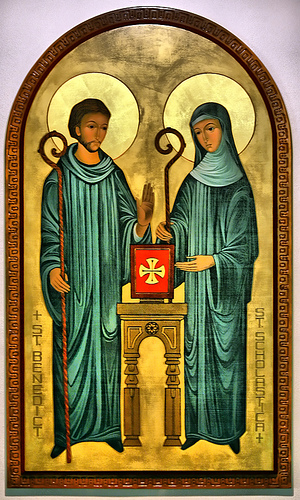
I have held a special devotion to St. Scholastica since I was confirmed with her as my saint at 12 years old. As someone with five siblings, how could you not adore a saint who called on God to invoke a thunderstorm to make her brother do what she wanted him to do? All sibling rivalry aside, the story of the holy twins is a beautiful one reflecting the siblings love and devotion to each other, and a perfect story for a month with Valentine’s Day and Ash Wednesday coinciding!
St. Scholastica and her twin brother, St. Benedict, were born around 480 in Nursia, a town in the same Italian region as Assisi. Like many early saints, they were born into a noble family; their mother, Claudia, died after giving birth to them. Benedict was sent to Rome for schooling at the age of 12, and Scholastica followed soon after. Both were radically Christ-centered and devoted to prayer from an early age. They abhorred the licentious lifestyle in the city, and Benedict was first to seek a life of solitude. He sequestered himself as a hermit devoting his life to prayer before realizing the need for community. He then established the first Benedictine monastery at Monte Cassino, south of Rome (St. Benedict is the father of Western monasticism and the patron saint of Europe). Following her brother, Scholastica sought to also join the religious life. She set up a convent for religious women five miles from her brother’s monastery and adopted her brother’s Rule of Benedict for leading as the first abbess of the Benedictine order for women. Both orders thrive all over the world yet today and continue to follow the Rule of Benedict, a book of instructions for monks living communally.
Though the twins led busy lives leading their religious brothers and sisters, Scholastica and Benedict met up once a year at a house between her abbey and outside the gates of the monastery. Benedictine rule allows for an occasional visit with family but never an overnight visit. In “Dialogues,” written by St. Gregory the Great in 593, he recounts a story of the twins from fifty years prior. In February 543, Benedict and Scholastica were enjoying their annual visit when Benedict prepared to depart. Scholastica, likely fearing this would be the last time she saw her brother, implored him to stay, wanting to continue the deep spiritual conversations they shared. Benedict, knowing he could not contravene his own rule, refused her. Scholastica quietly lay her head upon her clasped hands and prayed, and when she raised her head there were “brilliant flashes of lightning” and “great peals of thunder.” Benedict cried out to Scholastica, “May God forgive you, sister. What have you done?” Scholastica replied, “I asked you and you would not listen; so, I asked God, and he did listen.” Adding in true sibling-fashion, “So now go off, if you can, leave me and return to your monastery.” Well, he did not, as he could not. Benedict stayed with his sister that night, and when he departed the next day, it was never to see her again. Scholastica died just three days later. Benedict was praying in his cell at the monastery when he saw a dove circle the building before ascending into the heavens. He sent for her body and lay it in the tomb he had prepared for himself. Not long after, St. Benedict died—on the very day that God had told him he would. Today both St. Benedict and St. Scholastica lay in tomb together at the cathedral of Monte Cassino, though the building itself has been rebuilt since destruction during World War II, the altar, where the twin saints tomb lay, was never damaged.
Sts. Scholastica and Benedict are not the only holy twins—in fact, they weren’t even the first. Sts. Gervasius and Protasius are the patron saints of Milan, where they were martyred for their Christianity in 165. Their parents, St. Vitalis and St. Valeria, were also martyred. In 386, St, Ambrose, bishop of Milan, discovered their relics through a miraculous dream, which is accounted by St. Augustine in “Confessions.” Through examination of the relics, it was confirmed that they were brothers, in their 20s, and highly likely twins due to the same congenital vertebrae defect and identical features. St. Ambrose brought the relics to a newly built basilica and laid them in the place he had one day intended for himself. Sts. Gervasisu and Protasius are traditionally named in the Roman Litany of the Saints.
Sts. Crispin and Crispinian were born of a noble Roman family in the third century. They fled from persecution to Soissons, where they became shoemakers, using their artisan work to convert people to Christianity. Under the reign of Diocletian in 285, they were captured, tortured, and thrown into the river with millstones tied to their necks. They survived but were then beheaded. They are the patron saints of shoemakers.
Sts. Mark and Marcellian lived in Rome during the early Church. They both converted to Christianity and became deacons of the Church. Both were captured after refusing to worship Roman gods, however, they converted their guards and were allowed to escape. They were soon recaptured and martyred under the rule of Diocletian.
Sts. Cosmas and Damian were twins, both physicians, and were martyred together in the year 287 under Diocletian. These twins lived in present-day Turkey and were known for practicing medicine and surgery for the poor who could never repay them. They were renowned for their art of healing and converted many through their charitable treatment of the poor. When they are captured and tortured, they received no injury, even from water and on the cross. They were finally beheaded with the sword, along with their three brothers, Anthimus, Leontius, and Euprepius. These twin saints are the last two men mentioned in the canon of the Mass before the Pater Noster and are invoked in the Litany of the Saints. They are the patron saints of physicians and surgeons.
Sts. Medard and Gildard were born on the same day, consecrated as bishops on the same day at the age of 33, and died together in 545. The brothers lived in France—Medard was Bishop of Noyon and Gildard was Bishop of Rouen. They are beloved in northern France, especially St. Medard who start the annual custom of crowning the most virtuous girl in his diocese as Rose Queen. Their feast day is June 8, and in northern France, if it rains on the feast of St. Medard, the Catholic peasants believe it to be a sign of forty more days of rain.
Finally, we are most likely to think of the apostle Thomas, as “doubting Thomas,” but in three places in the Gospel of John, he is called Didymus, which is Greek for twin. Nothing in sacred Scripture names a twin to Thomas, but there are two theories. First, it is believed that possibly he was twins with Matthew because their names are listed together in Matthew, Mark, and Luke. The other theory is based upon the apocryphal book, the Acts of Thomas, which suggests this was a nickname because Thomas looked like Jesus.
There have not been any more twin saints since the early centuries of the Church, and certainly none as well-documented as Sts. Scholastica and Benedict. While I have long had a devotion to the twin sister, I later developed a devotion to her brother, St. Benedict, who is commonly invoked to ward off evil. (He had many “near misses” in his life to warrant this recognition.) In 1880, the Benedictine medal was made and is a popular sacramental to wear or have in your home for spiritual protection. It is clear the holy twins, as they are often known, are both examples of sibling love, as well as role models of virtue. On February 10, we will celebrate the feast of St. Scholastica, a saint who most with siblings can certainly relate to and maybe even adore, as I do. She is the patron saint of nuns and education and is invoked against, you guessed it, thunderstorms.
| |
|
“The Lord is my shepherd;
there is nothing I shall want."
Psalm 23:1
| | | | |