|
St. John Neumann Catholic Community
Staffed by Oblates of St. Francis de Sales
| |
|
Current Mass Times
Saturday: 5 p.m.
Sunday: 7:30 a.m., 9:30 a.m., 11:30 a.m., 2 p.m. (español), 5 p.m.
Monday-Friday: 9 a.m.
Monday-Wednesday-Friday: 12:10 p.m.
Watch a livestreamed or recorded Mass
Confession
Saturday: 10 a.m.-10:30 a.m. (English)
Sunday: 3 p.m.- 4 p.m. (español)
Holy Day of Obligation
December 8, Solemnity of the Immaculate Conception of the Blessed Virgin Mary
Mass Times: 9 a.m., 12:10 p.m. and 7 p.m. (Bilingual)
| |
|
Dear Friends,
As we begin the season of Advent, my focus has turned to thinking about how Christ is present to me and the world in my daily life. I am not always the most patient person, especially when I want something to happen now. Advent is a reminder of the importance of patiently waiting, anticipating, and seeing more clearly where God is directing me. These weeks of learning to wait patiently through prayer and listening to the world around me, enable my mind, body, and spirit to be awake and present to the Divine within and around me.
To become spiritually awake with hopeful anticipation, I find it helpful to choose one or two practices that clear my mind of the interruptions that easily occur this time of year and keep me focused on the waiting. One practice I have chosen in the past is to create my own Advent Calendar of people in my life, both living and deceased, who have influenced my faith life. This year I am going to create a different Advent Calendar, one that focuses on a line of scripture taken from the daily readings for this season. I will read the daily readings first thing in the morning and then select one line that stands out to me and write it down in my Advent Calendar. Throughout the day, I will focus on the Scripture and reflect on it. In addition throughout this season, I will focus on something from the life and ministry of Christ that will help me be a better Christian, for example, being forgiving or showing more mercy to people in need. Hopefully by doing this, Christ will become more present not only in my life but in the world around me.
Whether it is picking a proven Advent practice or creating a new one, I encourage you and your household to dedicate a part of each day, even a very small part, preparing for Christ to come into your lives and that of the world. Also, take time each day and be grateful how God has blessed us in the past with the coming of Christ into the world!
Advent blessings and Live Jesus,
Fr. Joe
| |
Ideas to Observe Advent
By Jean Lupinacci
| |
|
The liturgical season of Advent begins this year on Sunday, December 3. Advent is the four weeks before Christmas which recalls anticipating the coming of the Messiah as told in the Old Testament and anticipating the celebration of the birth of Jesus Christ—the Messiah. It gives us an opportunity to talk about the importance of the virtue of hope, something that is so desperately needed in our world that is experiencing so much despair. My family of six have wonderful memories of observing Advent in our home.
Here are some ideas for observing Advent:
1. Advent Calendar: Hope is at the core of Advent and is embodied in the very notion of an Advent calendar, as anticipation grows with each door of the calendar that is opened. My sister made us a large felt banner more than 30 years ago that has a Christmas tree and 25 pockets containing something to pin on the tree. Our four children looked forward to taking turns pinning something on the banner each day as we anticipated the coming of Jesus.
2. Advent Wreath: Traditionally a wreath of evergreen branches with four candles, one to be lit during each Sunday of Advent, is kept in Christian homes. The circular wreaths symbolize eternity. Each candle (three purple and one pink) represents an aspect of the spiritual preparation for the coming of Jesus: Hope, Peace, Joy, and Love. Several years ago my oldest daughter gave us a Celtic pottery wreath for our candles that we use each year and cherish.
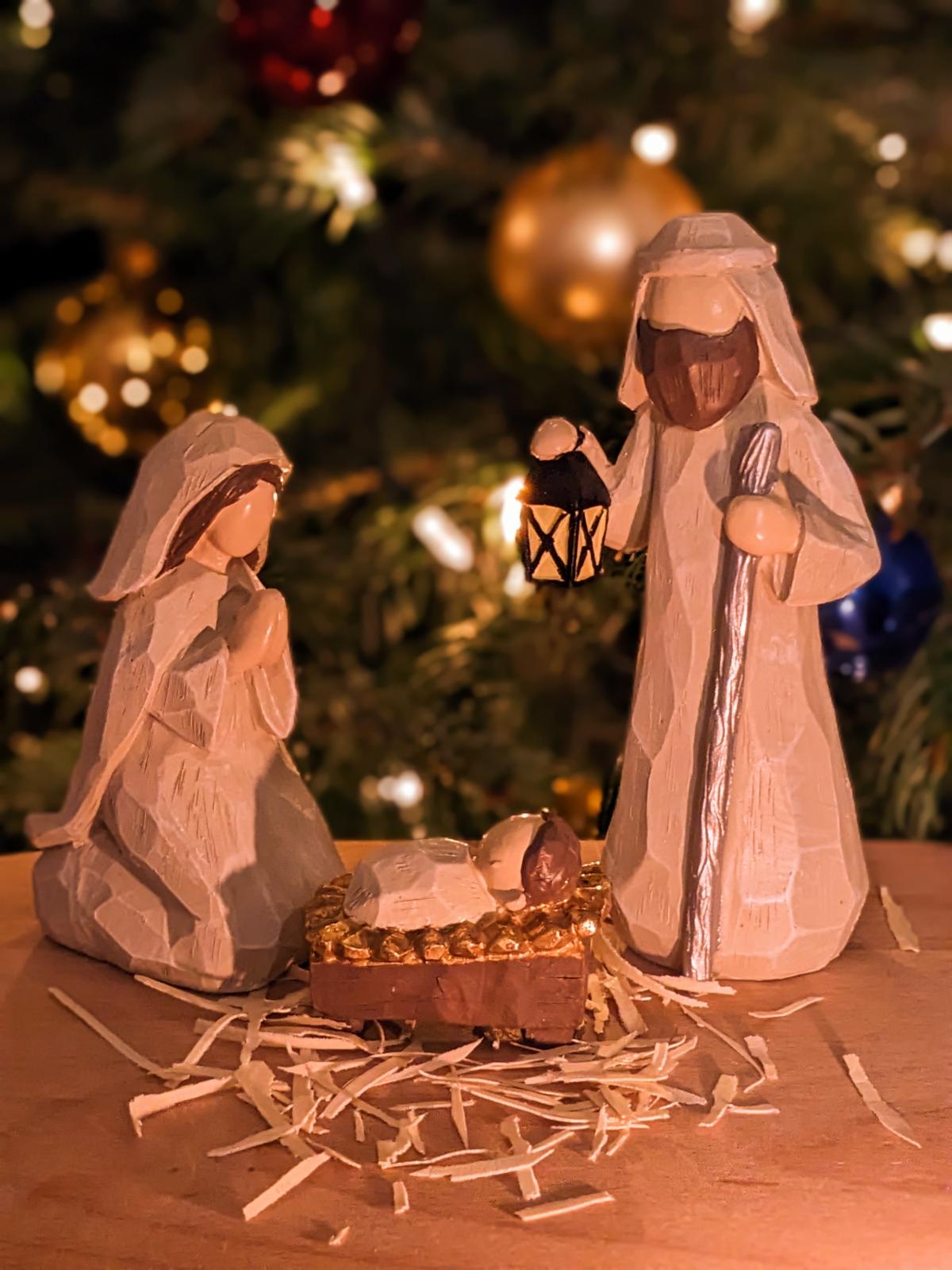
3. Nativity Scene (Creche): A three-dimensional display of the scene at the birth of Jesus is put up in the home as a reminder of Jesus’ birth. In our home we ended up with many creche sets that were given to us by faith formation students or friends including the pieces from my childhood set. We had a table where we set them up during Advent but left the crib empty. On Christmas Eve the youngest Lupinacci child would place Jesus in the crib. When we first set up the sets, the shepherds would be placed far away from the nativity scene, and we would move them closer every Sunday. A friend of ours used to keep theirs up year-round!
4. Christmas Tree: Many people put up their Christmas trees to enjoy through Advent. Evergreen trees symbolize survival when it is the only green during winter. We did something a little bit different and left our tree bare for most of Advent. Toward the end of Advent, we would add lights and then add the ornaments all together as a family-this was a much-loved Christmas tradition for us. Each week of Advent we would bring up a box of Christmas decorations to display in our home. One of the boxes contained soft ornaments that my mother had made in the 1980s that we would hang on all the doorknobs. Another tradition I have is to put a very small tree, which was a gift from my niece many years ago, up in my kitchen with mini ornaments during Advent.
5. Jesse Tree: This is a wonderful way for both children and adults to countdown and anticipate the coming of Christ. You can use anything as a Jesse Tree: a mini tree, a lighted branch, or even just taping each ornament to a door or window. Click here for printable ornaments that children can color as well as accompanying readings to describe each symbol. Each day, your family can read the short Advent reflection as you follow the thread of Salvation History to the birth of Jesus.
6. Christmas Lights: Lights are put up on trees and houses outside to dispel the dark of winter and to symbolize the light of Christ. Every Christmas eve after Mass our family would drive around the neighborhood and admire Christmas lights. Most years we would hang lights on the front of our house and on the large evergreen tree in the front yard.
7. Buying Christmas gifts: Advent is the time when most people purchase gifts for friends and family for opening at Christmas. Our family’s tradition was to open gifts on Christmas morning, but some families open gifts on Christmas eve. Now that our children are all young adults, they organize a gift exchange so that everyone (including my husband and I) purchases one gift for a family member. I am not sure what will happen this year because now there are foster grandchildren and I suspect there will be more presents than usual!
8. Feast/Saint days: There are days in December that can be celebrated in your home by reading about the saints and possibly preparing special foods or having a special activity on the day.
a. December 6: Memorial of St. Nicholas Since St. Nicholas is the patron saint of children, they put out their shoes the night before for small gifts (usually oranges or chocolate coins). Other traditions include telling the story of St. Nicholas and making cookies for neighbors.
b. December 8: Solemnity of the Immaculate Conception of the Blessed Virgin Mary Families can attend Mass together and then pray the rosary together at home.
c. December 12: Feast of Our Lady of Guadalupe. St. John Neumann will celebrate on December 9 with the Rosary at 6:30 p.m. followed by Mass at 7 p.m. and a reception to celebrate. There is a novena (nine-day prayer) to our Lady of Guadalupe that can be prayed together as a family.
These are just a few ideas on how to observe Advent in your home. If you want more ideas, a friend of mine (Colleen Rooney) wrote Celebrating Advent and Christmas with Children.
What are your Advent traditions? It is never too late to start new ones! Have a Blessed Advent!
| | | |
The Holidays? It's Complicated
By Susan Infeld, RN BSN FCN
| |
|
Each year, I am curiously puzzled by the constant barrage of “Hallmark” holiday messaging, which often does not reflect reality. Does it comfort and delight us to plan for and wander through the magical splendor of the perfect holiday experience or conversely, does it magnify underlying apprehension and disappointment?
The reality for many at “the most wonderful time of the year” is the surfacing of complicated or emotional issues, such as, personal loss, aging, or the empty nest. Some of these changes impact our family traditions; perhaps this is the year for adult children to spend Christmas with the in-laws or maybe there has been a divorce or separation and “it’s his/her year to have the kids.” The truth is holidays can highlight the brokenness in family relationships and draw issues to the surface. Often, this season is not like the Hallmark messaging; it can be much more complicated.
As Christians, how can we stay centered on the waiting for Christ’s birth, while emotionally navigating the past and present, joys and disappointments, connection and isolation? In a healthy way, how do we manage our lives and emotions amidst the irrational crazy expectations of a “Hallmark" holiday?
It is simple; we do not manage it--we let God do it, and to do this, we look to the manger. This is the season to truly rely on trust in God and lean into that silent night with absolute wonder. There we find strength to mindfully accept, not fight or bury, the turbulent emotional waters that may be swirling around us. With the humility and strength modeled by the Blessed Mother, we begin to soften, formulate reasonable expectations, acknowledge that sorrow is a part of life’s journey, and commit to non-judgmentally accepting our feelings: the good, the bad and the ugly. We exhale, knowing that God incarnate is constant and never changing, and our divine Father, faithfully walks with us as our hearts openly reflect upon Christmases past, present and future.
Secondly, make a plan for December. A Christmas season plan left up to chance is a prescription for disappointment. The Advent Season begins Sunday, December 3. Light the first candle—HOPE—and reserve time each day in front of the crèche. Reflect daily upon the Advent readings and the courage of that young woman who trusted in the words of the Angel Gabriel. Even if all you really want to do is crawl under the bed with kitty, step out of your comfort zone, using the inspiration of Mary’s courage and unwavering trust to develop an Advent plan that focuses on others. Schedule lunch with a friend, choose a tag from our Angel Gifts, sign up to help decorate the church, invite someone to help with your own tree decorating, bake cookies with the sole purpose of giving them away, visit and adorn the graves of loved ones, and attend the numerous Advent events at SJN where we mean it when we say, “All are welcome!” Perhaps you will even start a new tradition this year.
Bottom line: get out of the house, and though it might seem incredibly hard to do given your own personal circumstances, step back into life. To help temper losses, disappointment, and pain, allow yourself the possibility of experiencing connection and even some joy. Sadness and recrimination are exhausting weights that take a toll; give yourself permission to lay them at the foot of the cross, and as they would say in AA, show up and “fake it till you make it.”
The door of living with purpose is always open and welcomes us to the grace and blessing of sweetness that always lies beneath sorrow. In Psalm 30:12, David thanks God for turning his “mourning into dancing.” While Hallmark messaging abounds, as Christians we know that there will be mourning as well as dancing, with joy, there will be sorrow. This Christmas season we bless and offer deep gratitude to the triune God who encourages us, walks with us—even, or rather, especially, in the messes—and encourages us to keep living, keep loving, and to keep showing up as an example of His love.
| |
Our Lady of Guadalupe
by Elizabeth Wright
| |
|
If you do not already know Our Lady of Guadalupe, now is the time to discover the beauty of this Marian apparition. Her feast day is celebrated on December 12. SJN will have a Rosary, Mass, and reception for Our Lady of Guadalupe on Saturday, December 9 (which is the feast day of St. Juan Diego). While our celebration is in Spanish, it is important to realize the grace and humility she offers is not limited by language or culture; Our Lady of Guadalupe came for ALL people, and all are invited to have special devotion to her.
It is without doubt you are aware of the image of Our Lady of Guadalupe, and likely the story of St. Juan Diego, but in reality, the depth and detail of the story and the image itself is astounding—nothing short of a miracle that has withstood the test of nearly five centuries and countless scientific examinations.
To truly appreciate the details of Our Lady of Guadalupe’s story, it is imperative to understand the time and place. The year was 1531, and the place was Mexico City, specifically, Tépeyac Hill, which is believed to have been a sacred Aztec site associated with the worship of Tonantzίn, an indigenous goddess. Prior to the arrival of Cortés in 1519, the Aztecs ruled and part of their worship was the need to offer their gods life in the form of human sacrifices. A recent excavation in Mexico City found 80,400 skulls of men, women, and children from ritual sacrifices. In 1523, Franciscan missionaries also arrived from Spain and began the conversion of the indigenous people to Catholicism. In 1524, more Franciscan Apostles, the “Twelve Apostles,” arrived in Mexico City, now the seat of the new Spanish empire, and in 1528, His Excellency Don Juan de Zumárraga, OFM, was sent from Spain to become the first bishop of Mexico (New Spain) and “Protector of the Indians.”
According to the National Institute of Health, Mexico’s native population was experiencing epidemic disease in the 1500s. In the wake of the European conquest, the indigenous people were left susceptible to smallpox, which alone killed close to 8 million indigenous people in the first wave after the Spanish arrived. The colonization of Mexico had left the indigenous people devastated and vulnerable. Additionally, Mexico was experiencing a severe drought. Life in Mexico City was desperate for the indigenous people, and they needed a miracle.
In 1524, a man named Juan Diego Cuauhtlatoatzin (“he who talks like an eagle”) was baptized and converted to Christianity. By our standards, there was nothing spectacular about Juan Diego; he was not a priest or holy man, but an ordinary, indigenous man thought to be around 50 years of age. On December 9, 1531, Juan Diego was crossing Tépeyac Hill on his way to Mass when a young woman appeared to him. She claimed to be the Blessed Virgin Mother, but she did not appear like the European images of the Virgin Mary he had seen from the Franciscan missionaries. Her skin was brown, like his, her hair was dark, and she wore clothes in the style of of the indigenous people. She also spoke to him in Nahuatl--his language. She requested that Juan Diego go to bishop-elect Zumárraga and ask for a chapel to be built on that very hill. The reluctant messenger took the Virgin's request to the bishop and was turned away. Returning home, Juan Diego encountered Our Lady a second time, and she sent him back to see the bishop. An obedient servant, Juan Diego returned to the bishop, and he was again denied, but the bishop asked him to return with proof of this encounter with the Virgin. He returned to the Blessed Virgin and was told to come the next day.
On December 11, Juan Diego did not return. His beloved uncle was deathly ill, and Juan Diego had to care for him. On December 12, believing his uncle needed a priest, Juan Diego set out to the church. Though he sought to find another route, he again encountered Our Lady of Guadalupe. The Blessed Mother comforted Juan Diego and told him not to fear, his uncle had recovered. She then instructed Juan Diego to climb the hill and pick the flowers he would find blooming there. Though it was not the weather or conditions for blooms, he discovered many flowers thought to be Castilian roses, a flora not indigenous to Mexico, but one that would be familiar to the bishop-elect. Juan Diego collected the roses in his tilma or cloak and returned to the vision. She touched each flower and placed them back in his cloak.
Juan Diego proceeded to seek the bishop-elect to give him the flowers as “proof” of the Virgin. Standing before the man to be the first archbishop of Mexico, Juan Diego opened his tilma pouring out the flowers, but what is remarkable is what was revealed. On his tilma remained a brilliant image of the Blessed Virgin Mary as she appeared to Juan Diego.
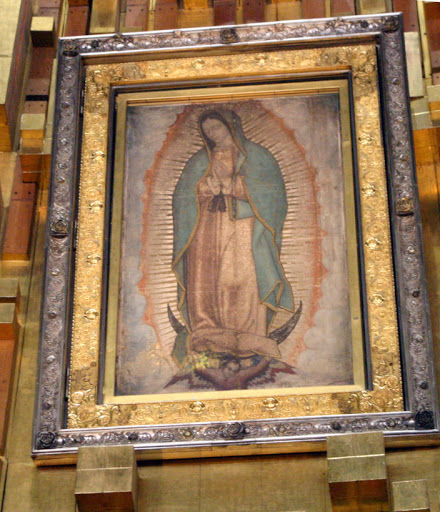
The image on the cloak is a woman with characteristics of both Aztec and Spanish ethnicities. Her dark hair is unbraided to indicate her as a virgin, and a black ribbon, the Aztec pregnancy belt, is tied around her waist, indicating that she is with child. The Aztecs understood the rich symbolism of this blessed image. Mary stands in front of the sun, indicating preeminence over the Aztec sun god, Huitzilopochtli. She stands on a dark crescent moon showing the Aztecs that she is over the god of the night, and Mary is being carried by a winged angel as she is delivered to the people. Her hands are postured in prayer as there is one greater than her, the one true God. Her mantle is the color of Aztec royalty, as she is Queen of Heaven. Around her neck is a brooch with a black cross; though she looks like the indigenous people, she wears the symbolism of the Spanish missionaries—the symbol of Jesus Christ; she comes in peace to unite the people. Her mantle is covered with 46 stars that reflect the exact pattern of the constellations that appeared in the night sky on December 12, 1531. Finally, on her dress across her womb is a four-petaled flower that represents a sacred symbol of life and the presence of God.
Unlike the gods of the Aztec people, she does not stare straight ahead. Her eyes are downcast in her humility and compassion—she is there in peace, and there is one God whom she professes. Mary’s eyes may be the most amazing aspect of the image. In her eyes, the images of 13 people are reflected with great detail. The same people are present in both eyes, but different ratios, just as human eyes transmit images. Though this has been studied by many over the centuries, no one can explain the enigma. Though many aspects of Our Lady of Guadalupe can differ and there certainly are false claims, such as the painting maintaining the exact temperature of a human body or the womb having a heartbeat, it is widely believed and accepted that Our Lady of Guadalupe’s image was not created by human hands.
In divine intervention, Our Lady appeared exactly when the people cried out in despair. Bishop Zumárraga did build the chapel on the hill as Our Lady requested. The three-day exchange between Our Lady and Juan Diego was a living gospel. Our Lady was a message of hope and compassion, a promise for protection of all mankind. Over the next ten years, ten million natives were baptized and converted to the one true faith. Her light and grace were exactly what the people needed in the desperation of their time.
In the nearly 500 years since Our Lady of Guadalupe appeared to Juan Diego, the devotion to her has only strengthened. The image, which measures 41 inches wide by 67 inches high, has stood the test of time. First of all, the cloak is made of maguey cactus fibers, a material that should have deteriorated due to time and environmental elements, particularly during the first 116 years when the tilma did not have any protection and was exposed to constant candlelight from pilgrims, as well as the salty, humid air. A replica of the image was attempted in 1789, painted on the same material, and immediately encased in glass; it was just eight years before the colors faded and the material deteriorated.
The fact is, there is no explanation for either the quality of this nearly 500-year-old image or the fact that despite numerous scientific examinations, brushstrokes indicating a painting are not present. Recently, a mathematician named Fernando Ojeda studied the arrangement of stars and flowers, and he claims that the arrangement is actually a musical arrangement. Ojeda used a computer program to transcribed them into musical notes, and in doing so, the image produced a harmony. He further analyzed comparable 16th and 17th century paintings depicting arrangements of stars and flowers and could not find any existing art that followed suit to create a musical arrangement. You can listen to the harmony here.
Our Lady has also withstood both an accident and an attack. In 1785, a worker cleaning the case accidentally spilled nitric acid solvent on the image. Legend says that the damage sustained miraculously vanished within 30 days. Truth is that there remains a subtle stain, but in reality, the acid should have been much more destructive to the fiber of the image. On the morning of November 14, 1921, an employee of the Private Secretariat of the Presidency, placed a bomb inside a floral arrangement at the altar of the Old Basilica. The image of Our Lady of Guadalupe hung on the wall just feet away. The blast damaged the marble altar steps, brass candlesticks, and brought a suspended crucifix crashing to the ground, but Our Lady was unscathed.
Today, Our Lady of Guadalupe hangs high above the altar at the Basilica of Guadalupe, built on the site where she appeared to Juan Diego. The Basilica is the second most visited church in the world (St. Peter’s Basilica in the Vatican is the first), welcoming an estimated 10 million visitors each year. An extensive list of miracles and interventions have been attributed to her. Recently, Father Eduardo Chávez, doctor in Church history and general director of the Institute of Guadalupan Studies, said, “Just as St. Mary of Guadalupe, in her marvelous image, is the work of God, so the Church is also the work of God. Christ is the head of this blessed church that proclaims truth, justice, love, forgiveness, mercy, what our people need so much today.” Our Lady of Guadalupe is indeed a messenger of the love, forgiveness, and mercy our world cries out for today. During this season of Advent, take time to reflect on the beauty and love the Mother of God offers you and the world.
| |
|
“My soul proclaims the greatness of the Lord; my spirit rejoices in God my savior.”
Luke 1:47
| | | | |