|
In December 2023, Vladimir Putin declared that the 2024 BRICS Summit, hosted by Russia, would be focused on establishing a “fair world order” based on shared principles. At the core of Putin’s goals for stronger BRICS economic integration is a longstanding and overriding objective to provide a viable alternative to the West’s global hegemony in nearly all facets of political, military, economic, financial, and security affairs.
Challenging Western Dominance
Creating a common currency designed to curtail — and displace – the dominance of the U.S. dollar as the world’s reserve currency has been a central theme when the BRICS Summit was formalized in 2009 with initial founding membership of Brazil, Russia, India, and China. Today, the dollar remains the commanding currency in global transactions, involved in an overwhelming number of exchanges, although a growing number of dealings involve the euro.
Putin has recently called for BRICS to establish a “safer and harmonious world” with a goal towards creating its own parliament.
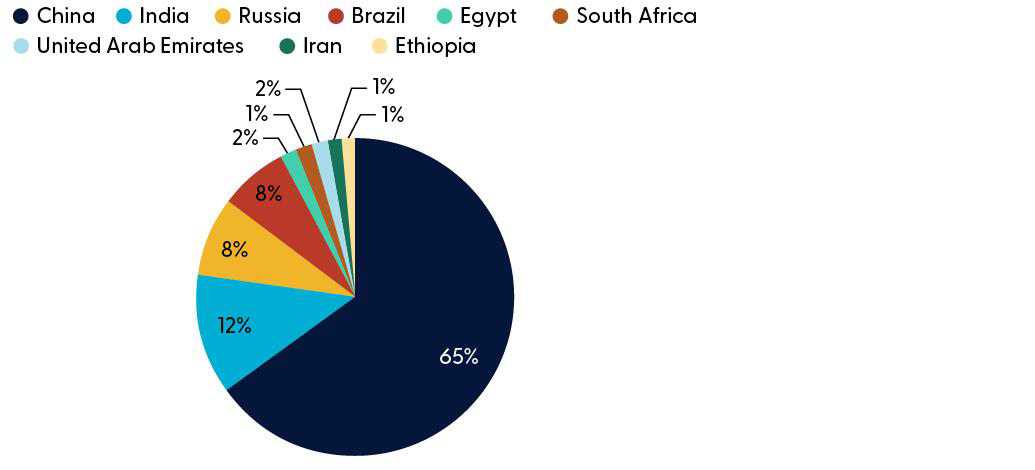
Today, BRICS as an intergovernmental organization is comprised of Russia, China, India, Brazil, South Africa, Egypt, Ethiopia, Iran and United Arab Emirates. Saudi Arabia, due to join formally in January 2024, has not yet declared its official membership, while rumors persist that North Korea is seeking affiliation. Argentina was also invited to join, although newly elected President Javier Milei has made it clear the nation will not be joining in the near-term.
Turkey, a NATO member, has requested BRICS membership as – according to reports – it pursues a path that includes its partnership with the West, but broadens its influence beyond the West.
BRICS Summit 2024 will be in Kazan (Russia) from October 22–24 amid a global backdrop of increased geopolitical conflict and tension.
Dislodging the Dollar From the Spotlight
With the dollar still considered the world’s reserve currency, it continues to reflect the broader hegemony BRICS fervently seeks to dismantle. The dollar’s primary rival is China’s yuan – or renminbi – as Beijing, despite making progress in having trading partners execute purchases in the yuan, is seemingly determined to overturn the dollar as the leading global reserve currency.
In 2016, giving sway to Beijing’s lobbying efforts at the International Monetary Fund (IMF), the renminbi was included in the IMF’s Special Drawing Rights (SDR) basket despite the fact that China was technically an emerging market. The basket included the dollar, the euro, the yen and the British pound. For Beijing, this was deemed a major step towards recognizing its growing economic prominence and offered confirmation and legitimacy to the global importance of its currency.
Beijing continues to transition away from the dollar as Russia and China claim Washington has weaponized the dollar by seizing dollar-denominated assets.
Moreover, as the dollar represents U.S. strength, transparency, and deep liquidity globally, reducing its influence is a primary objective for many in the BRICS community, although it still hasn’t dented the underlying strength of the greenback. Recently, the dollar has eased against a basket of its trading peers as the Federal Reserve has made it clear it will initiate a rate easing cycle at its September 18 meeting as inflation edges lower.
This is a function of the so-called “interest rate differential,” a financial/currency term that serves to soften a currency against other currencies when its central bank moves from higher to lower interest rates, as it similarly strengthens a currency when the respective central bank keeps rates higher.
The push against the dollar is expected to be, again, a major and popular theme at the upcoming BRICS Summit.
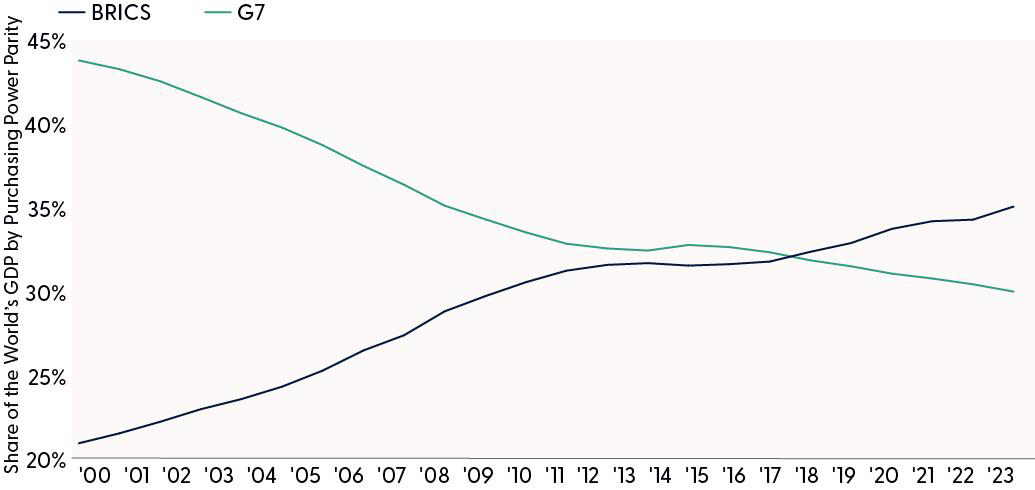
The Economic Importance of BRICS Continues To Grow
|