Robotics is cool! But it won't
always improve production speed and economy. Compare conventional and robotic bag palletizers to determine which best suits your packaging operation, budget and production rate.
Conventional and robotic bag palletizers have many similarities:
Both accept filled bags from bagging equipment, arrange the bags into layers and load the layers onto pallets.
Both are programmable from a touchscreen operator interface.
The capital investment is comparable.
The differences lie in the mechanisms for arranging the filled bags in layers and on pallets.
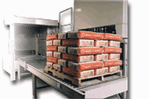
Conventional palletizers use a belt conveyor or live rolle
r bed to move filled bags into layers, then stack the layers to form a pallet load. High-speed models have packaging rates from 25 to 40 bags per minute.
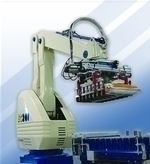
Robotic palletizers use arms to lift bags and place them on a pallet to form and stack layers. The robotic arm can swivel between two or more adjacent stations to load bags on another pallet while the completed pallet load is removed. Robotic palletizers safely handle up to 20 bags per minute - more could produce unstable pallet loads.
Before selecting a palletizer, consider your production rate and layout options. Look objectively at the characteristics of each.
Conventional Palletizer
Pros
Easier to troubleshoot, support and operate without special training.
Higher production rates.
More stable pallet loads (may be stacked up to four high).
Compresses and flattens so your pallets remain stable even with products that settle.
Cons
More moving parts require more routine maintenance.
May require mechanical adjustments for variations in bag sizes and stacking patterns.
Higher operating costs.
Robotic Palletizer
Pros
More easily accomodates different pallet patterns and product types.
Handles filled bags from multiple lower-speed packaging lines.
Requires less energy to operate.
Typically requires less space.
Cons
Higher repair costs
Less stable pallet loads (may be stacked only two high)
Slower palletizing rates
Your production rate and layout options will determine which palletizer is right for your application. A conventional palletizer is more economical for high-speed packaging lines or if your completed pallet loads are stacked more than two high. If you have 2 or 3 low-speed packaging lines, a robotic palletizer is likely the best choice.
A TEC engineer can explain how both types work and help evaluate your application and budget requirements.
The following two videos showcase a conventional and a robotic palletizer in action. Both are from
Chantland.
Chantland MHS 2400A Conventional Bag Palletizer 35 BPM with Tags Out Orientation
Chantland MHS EC201 Fuji Robotic Bag Palletizer
NEWS Centrifugal Impact Pin Mill
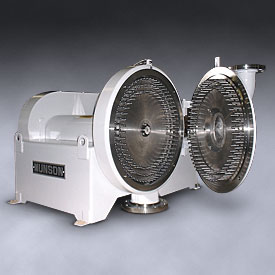
Munson's
Centrifugal Impact Mill is an economical and compact solution for reducing bulk materials into narrow particle size ranges,
from coarse to 400 mesh. The impact mill eliminates the need for screens, hammers, knives or rolls.
Available in carbon steel and stainless steel, as well as industrial and sanitary/pharmaceutical standards, it is ideal for a broad
range of food, chemical, pharmaceutical, nutraceutical, mineral and agricultural products.

 Conventional palletizers use a belt conveyor or live rolle
 from coarse to 400 mesh. The impact mill eliminates the need for screens, hammers, knives or rolls.