 |
In his effort to find his way out of the world of violence, Francis went beyond voluntary poverty to solidarity with the excluded ones of his society.
|
Having trouble viewing this email? Click here.
|
|
|
Richard Rohr's Daily Meditation
|
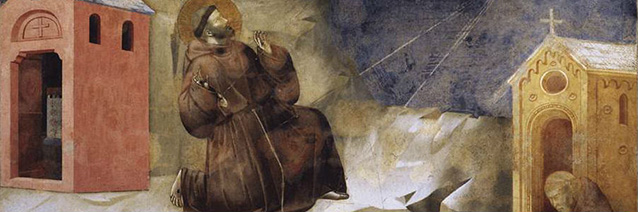
Stigmatization of St. Francis
(detail), 1297-1300, Giotto do Bondone, fresco,
Upper Basilica of St. Francis, Assisi, Italy.
|
|
The Franciscan Path of Descent
|
Solidarity
Tuesday, June 9, 2015
|
| Francis went beyond voluntary poverty in his effort to find the way out of the world of comparison, competition, greed, and the violence that comes with it. He also felt that he had to live in close proximity and even solidarity with the excluded ones in his society. If we are not marginalized ourselves in some way, we normally need to associate with some marginalized group to have an enlightened Gospel perspective and to be converted to compassion. We call this "the preferential option for the poor." Francis was one of the first to make this practice clear, and this very phrase is now included in the official documents of over 80% of the religious communities of the world. We cannot deny that Jesus both lived and taught this quite explicitly. Francis literally changed sides, changed teams. He was raised in upper Assisi, as one of those who considered themselves the majores or upper class. In the lower part of town lived the minores or the lower class. Francis actually moved even further down, into the plain below Assisi where there was a leper colony. (The word "leper," even in the Bible, is a term referring generally to the excluded ones. They did not always have the contagious disease of leprosy, but they were the people society had deemed unacceptable, unworthy, or shameful for any number of reasons.) On that plain was an abandoned, ruined church, which Francis physically rebuilt. The "Portiuncula," or "little portion" of the large Benedictine holdings, is the birthplace and home of the Franciscan Order. Although Franciscans do not legally own the church, each year, on August 2, we piously pay the good Benedictines with a basket of fish to be allowed to "use" it for another year. Members of religious communities usually place initials after their names to indicate their particular Order. We Franciscans use O.F.M., Ordo Fratum Minorum--Latin for the little brothers, or the "Order of the Minor Brothers." Francis told us to move down the social class ladder. We were not to identify with the upper class, nor with the climb toward success, power, and money. Rather, we were to go where Jesus went, which was wherever the pain was. We were to find our place not in climbing but in descending. This Franciscan vision is utterly countercultural to the worldview of Western society. We were to be mendicants, or beggars, which would help keep us as humble receivers rather than ecclesiastical consumers and producers. Francis resisted priesthood because, I believe, he was deeply aware of all that invariably comes with priestly ordination (education, titles, privilege, human respect, income, special clothing). He wanted his followers to be "blue collar" ministers who lived close to the people in every way, and not "white collar" superiors. However, poor Francis was not long in his grave before the Church started ordaining as many Franciscan men as possible--who soon wore stiff white Roman collars. It gave us access, credibility, status, and stipends in academia, church, and society. I know that it was probably inevitable, and not all bad, but it is indeed dangerous for the soul.
|
|
|
|
Gateway to Silence
Make me a channel of your peace.
|
| Discover a vision of your True Self through reading,
reflection, and engagement with Richard Rohr's book,
Immortal Diamond, in this self-paced, online course. Immortal Diamond:
A Study in Search of the True Self
September 9-November 18, 2015 Learn more and register at cac.org |
|
2015 Daily Meditation Theme
Richard Rohr's meditations this year explore his "Wisdom Lineage," the teachers, texts, and traditions that have most influenced his spirituality. Read an introduction to the year's theme and view a list of the elements of Fr. Richard's lineage in CAC's January newsletter, the Mendicant. |
|
Did someone forward this message to you?
Please do not reply to this email. For more info about:
* Technical Help with Daily Meditations, email techassist@cac.org.
Copyright ? 2015 Center for Action and Contemplation
cac.org |
|
|
|
|
|

