 |
|
Richard Rohr's Daily Meditation
|
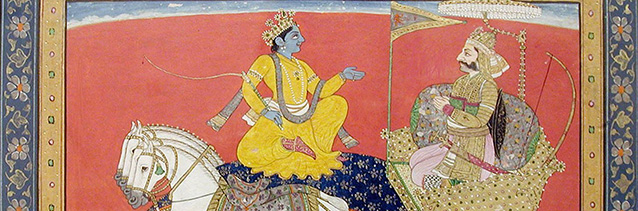
Dialogue between Krishna and Arjuna on the battlefield of Kurukshetra, Bhagavad Gita
The San Diego Museum of Art Collection
|
Wednesday, September 23, 2015
|
|
To begin to understand the ancient and many sources of Indian philosophy and Hinduism (which are often synonymous), and surely at the risk of immense oversimplification, I will briefly introduce their primary sacred texts.
In the next few days, I will elaborate with several key ideas that emerge from centuries of spiritual experience and reflection upon that experience. These ideas amount to the essential differences between Eastern and Western philosophies and show why some ideas of Eastern religions seem new or foreign to Western believers.
The Hindu sources clearly say contradictory things, with what are surely conflicting ideas, but there is no need to perfectly harmonize them in the Eastern mind. They are each contributing their waters to a pool of wisdom that we can swim inside of and thus learn to honestly struggle with the conflict itself--which can be quite broadening, deepening, and enlightening. This is similar to the Jewish idea of midrash and the Christian idea of lectio divina. If only we all could have approached the Bible and the Koran in the very same way, how different history would have been.
Westerners lived in blissful ignorance that holy people and saints were already coming to our own later conclusions centuries before Christ Jesus. One would think that Christians would know that this does not in the least diminish Jesus but in fact supports and affirms him.
The three major texts in Hinduism and Indian philosophy:
- The Vedas are the most ancient Sanskrit writings (as much as three to four thousand years old) containing hymns, philosophy, guidance, and rituals.
- The Upanishads--which means "what is learned sitting at the feet of"--are later (800-400 BC), even more mystical texts which elaborate on many of the ancient themes. There are probably 13 major and many minor Upanishads.
- The Bhagavad Gita emerged in various translations from four centuries before Christ to four centuries afterward. It is an extended dialogue between Prince Arjuna, who is a passenger in a chariot, and Lord Krishna, who is teaching him how to drive the chariot. The 700 classic verses amount to an extended commentary on "action and contemplation."
Hinduism was not even named when these texts were first written. And almost all of the Indian Scriptures were not translated into English or modern languages until the 19th century. Don't dismiss any of these until you have at least tried to read them.
|
|
|
|
Gateway to Silence
The Christ in me sees the Christ in you. Namaste.
|
|
On behalf of Illuman, the CAC invites all men to join
Soularize 2015
Seasons of Our Lives: How Do We Cultivate Wholeness?
November 6-8, 2015
Hyatt Regency Tamaya, Santa Ana Pueblo, New Mexico
Listen to Richard Rohr, Belden Lane, Jim Taylor, Jim Clarke, and Joel Blunk.
Participate in prayer, ritual, community, and council with other men.
Experience the beautiful high desert and cottonwood bosque along the Rio Grande.
|
|
2015 Daily Meditation Theme
Richard Rohr's meditations this year explore his "Wisdom Lineage," the teachers, texts, and traditions that have most influenced his spirituality. Read an introduction to the year's theme and view a list of the elements of Fr. Richard's lineage in CAC's January newsletter, the Mendicant. |
|
Did someone forward this message to you?
Please do not reply to this email. For more info about:
* Technical Help with Daily Meditations, email techassist@cac.org.
Copyright © 2015 Center for Action and Contemplation
cac.org |
|
|
|
|
|


