 |
|
Richard Rohr's Daily Meditation
|
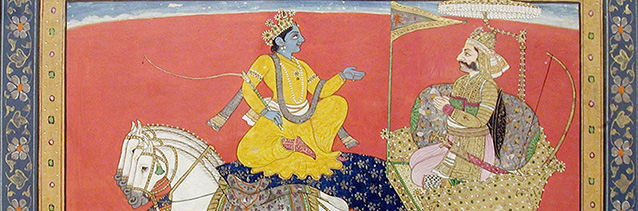
Dialogue between Krishna and Arjuna on the battlefield of Kurukshetra, Bhagavad Gita
The San Diego Museum of Art Collection
|
Tuesday, September 22, 2015
|
|
The Hindu word maya is often translated as "illusion." But that does not get to the root of the insight and is too easily dismissed by the Western person who prefers to take things for what they are at face value. We might understand deceit, but we do not understand illusion very well. A better translation of maya might be "tricky." This understanding can have a truly transformative effect on how you live and die. When Hinduism (or Buddhism which is a child of Hinduism) says all the world of forms is maya (or emptiness), they are trying to help you look deeper, broader, and in the long term.
If you recognize that what you first see is "tricky," you might be more open to this better seeing. If it walks like a duck and talks like a duck, it actually might not be a duck--it might be a goose, a swan, or a cartoon. The Upanishads illustrate maya using the familiar experience of finding a rope on a path. You jump back, thinking it's a snake, but it isn't. Mirabai Starr says, "Wisdom comes with being able to engage in inquiry with curiosity (with childlike wonderment as Jesus calls it) [in order] to see what really is, and to discover it's not something we have to defend ourselves against." [1] Reality is hard but also benevolent.
Hinduism is saying that all phenomena pass themselves off as total and final in their independent and free existence. But just wait a while, or look deeper, and you will see that all things are parts of much larger ecosystems of connection and life. In their separateness they will pass. Everything is qualified and provisional and contingent on something else. Anything that asserts its completely free and self-formed existence is lying to you. Everything from the "self-made man," to the myth of private property, to "my rights over my body," to the pollution of the earth--these all proceed from a Western hubris which is not willing to admit and face its self-serving illusions. Morally speaking, the illusion of our separateness makes it hard for us to seek the common good.
It is no surprise that the tragedy became the supreme form of both Greek and Shakespearean drama, which always ends in the sad results of human hubris. Yet of the many arts in India, the tragedy is the only form India failed to produce! If you face illusions early, lasting and destructive tragedies are rare. Hubris is undercut at the very start. Jesus, of course, taught the same when he told us to "take up the cross" of this passing world and our own fragile lives. |
|
|
|
Gateway to Silence
The Christ in me sees the Christ in you. Namaste.
|
|
Reference:
[1] Mirabai Starr, "Unitive Consciousness: An Eastern Perspective" (an unpublished webcast from the Center for Action and Contemplation: 2015).
|
|
Dear reader,
Your feedback is valuable to us! Please take a few minutes to tell us about your experience receiving Richard Rohr's Daily Meditations. We also invite your feedback regarding CAC's other programs (optional). Click here to begin the survey.
Thank you for sharing your thoughts and time with us!
Peace and Every Good,
Center for Action and Contemplation
|
|
On behalf of Illuman, the CAC invites all men to join
Soularize 2015
Seasons of Our Lives: How Do We Cultivate Wholeness?
November 6-8, 2015
Hyatt Regency Tamaya, Santa Ana Pueblo, New Mexico
Listen to Richard Rohr, Belden Lane, Jim Taylor, Jim Clarke, and Joel Blunk.
Participate in prayer, ritual, community, and council with other men.
Experience the beautiful high desert and cottonwood bosque along the Rio Grande.
|
|
2015 Daily Meditation Theme
Richard Rohr's meditations this year explore his "Wisdom Lineage," the teachers, texts, and traditions that have most influenced his spirituality. Read an introduction to the year's theme and view a list of the elements of Fr. Richard's lineage in CAC's January newsletter, the Mendicant. |
|
Did someone forward this message to you?
Please do not reply to this email. For more info about:
* Technical Help with Daily Meditations, email techassist@cac.org.
Copyright © 2015 Center for Action and Contemplation
cac.org |
|
|
|
|
|

