 |
|
Richard Rohr's Daily Meditation
|
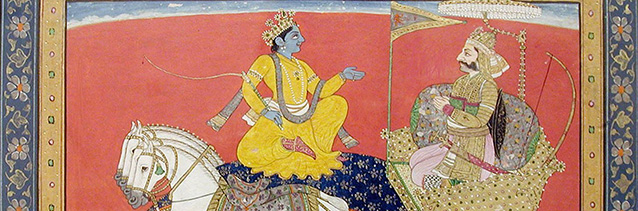
Dialogue between Krishna and Arjuna on the battlefield of Kurukshetra, Bhagavad Gita
The San Diego Museum of Art Collection
|
Monday, September 21, 2015
|
|
We have moved closer to the Eastern understanding in our more recent use of the term karma, but it is still said like a joke. "Bad karma!" or "Good luck!" or "What goes around comes around" we might say in half jest. For the Hindu, karma is an inviolate law and not just a clever aphorism. It is the nature of the universe and moves people toward purification of motive and honesty about why they are doing what they are doing. Karma is an absolute law of cause and effect. Even thoughts and desires have a predictable karma. You are responsible for your own thoughts and motives, and you cannot avoid the consequences. Thoughts and motives are real and create the Real. You cannot walk around thinking negative thoughts, or they will destroy you.
Conversely, no love is lost in the universe. I believe you are actually punished by your sins; whereas Western religions tend to teach that you are punished for your sins. Goodness is its own reward and evil is its own punishment, karmic law would say. These are two very different world views, and frankly, I am convinced that Jesus taught the karmic one. "You cannot pick grapes from thorns or figs from thistles. A good tree will bear good fruit," he said, "and a bad tree will bear bad fruit" (Matthew 7:17-18). Jesus also said, "If you show mercy, mercy will be shown to you." (Matthew 5:7, Luke 6:37) and "The standard you use will be used for you" (Mark 4:24).
Jesus sought to create a deep sense of personal choice, responsibility, and freedom right now, and not just disconnected payoffs in the afterlife. But we have understood much of the Gospel in terms of divine threats and artificial rewards--a delayed schedule of merits and demerits. This deeply distorted the transformative message of the Gospel and appealed to our self-interest instead of love. In other words, it fed us at the ego level instead of the soul level.
I believe Jesus teaches that rewards and punishments for behavior are inherent and now, and only by karmic implication are they external and later. Karma, rightly understood, creates responsible and self-actualized people instead of fear-based people. Your choices matter now! Threats of punishment or promises of candy later create perpetual adolescents and very well-disguised narcissism at every level of Christianity. |
|
|
|
Gateway to Silence
The Christ in me sees the Christ in you. Namaste.
|
|
Dear reader,
Your feedback is valuable to us! Please take a few minutes to tell us about your experience receiving Richard Rohr's Daily Meditations. We also invite your feedback regarding CAC's other programs (optional). Click here to begin the survey.
Thank you for sharing your thoughts and time with us!
Peace and Every Good,
Center for Action and Contemplation
|
|
On behalf of Illuman, the CAC invites all men to join
Soularize 2015
Seasons of Our Lives: How Do We Cultivate Wholeness?
November 6-8, 2015
Hyatt Regency Tamaya, Santa Ana Pueblo, New Mexico
Listen to Richard Rohr, Belden Lane, Jim Taylor, Jim Clarke, and Joel Blunk.
Participate in prayer, ritual, community, and council with other men.
Experience the beautiful high desert and cottonwood bosque along the Rio Grande.
|
|
2015 Daily Meditation Theme
Richard Rohr's meditations this year explore his "Wisdom Lineage," the teachers, texts, and traditions that have most influenced his spirituality. Read an introduction to the year's theme and view a list of the elements of Fr. Richard's lineage in CAC's January newsletter, the Mendicant. |
|
Did someone forward this message to you?
Please do not reply to this email. For more info about:
* Technical Help with Daily Meditations, email techassist@cac.org.
Copyright © 2015 Center for Action and Contemplation
cac.org |
|
|
|
|
|

