 |
In Franciscan theology, the best criticism of the bad is the practice of the better. Just go ahead and do it better. If you really believe in the values you say you believe in, then put them into practice.
|
Having trouble viewing this email? Click here.
|
|
|
Richard Rohr's Daily Meditation
|
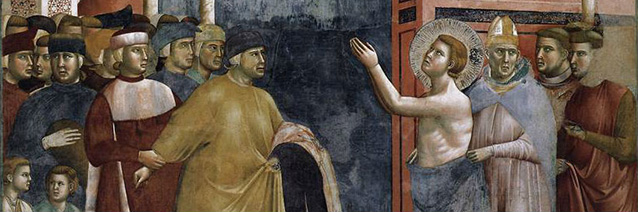
Legend of St Francis: 5. Renunciation of Worldly Goods
(detail fresco), 1297-99, Giotto di Bondone, Upper Church, San Francesco, Assisi
|
Just Do It
Thursday, June 25, 2015
|
One of the earliest accounts of Francis, the "Legend of Perugia," quotes Francis as telling the first friars, "You only know as much as you do." His emphasis on action, practice, and lifestyle was foundational and revolutionary for its time and at the root of Franciscan alternative orthodoxy ("heterodoxy"). You may be wondering, "How can Franciscanism be an alternative and still be called orthodox (right and true)?" Heterodoxy is precisely a third something in between orthodoxy and heresy! I sincerely think Francis found a Third Way, which is the creative and courageous role of a prophet and a mystic. He repeated the foundational message of all prophets: the message and the medium for the message have to be the same thing. Francis emphasized the medium itself, instead of continuing to clarify the mere verbal message (which tends to be the "priestly" job). The early Franciscan friars and "Poor Clares" wanted to be Gospel practitioners instead of merely "word police," "inspectors," or "museum curators" as Pope Francis calls some clergy. Both Francis and Clare offered their rules as a forma vitae, or form of life. They saw orthopraxy (correct practice) as a necessary parallel, and maybe even precedent, to mere verbal orthodoxy (correct teaching). History has shown that many Christians never get to the practical implications of their beliefs! "Why aren't you doing what you say you believe?" the prophet invariably asks. The Franciscan School found a way to be both very traditional and very revolutionary at the same time by emphasizing practice over theory. At the heart of their orthopraxy was the practice of paying attention to different things (nature, the poor, humility, itinerancy, the outsider, mendicancy, and mission instead of shoring up home base and "churchiness"). Franciscans at their best attempted to live inside the universal mystery of "church" and from there we went out to serve the world. Most Christians got it backward by living in the so-called secular world and occasionally "going to church." Franciscan spirituality is "a sidewalk spirituality" for the streets of the world and the paths of the forest. It is not primarily based in the monastery, in church buildings, or in any asceticism or celibacy. Francis himself spent most of his time on the road and in the woods, traveling between scores of towns. He also traveled with a couple of his followers to Syria, Egypt, and Spain. It does not seem he had much time for "community" as we now think of it. His life illustrated Jesus' first and foundational definition of church: where "two or three gather in my name" (Matthew 18:20). Truthful encounter is always and already the mystery of "church."
Francis emphasized immediate experience and lifestyle: living in a different way. We were to live on the edge of the church in a very different lifestyle than simply running the church institution. In Franciscan theology, the best criticism of the bad is the practice of the better. Just go ahead and do it better. If you really believe in the values you say you believe in, then put them into practice. Don't waste any time trying to prove someone else is wrong or evil. As it states in the popular paraphrase of Francis' Rule, "Preach the Gospel at all times, and when absolutely necessary, use words."
Franciscan Mysticism: I Am That Which I Am Seeking,
|
|
|
|
Gateway to Silence
"I am who I am in the eyes of God, nothing more and nothing less." --Francis of Assisi
|
"Franciscan prayer is not an escape from the world
but an entrance into it. We become conscious in prayer
of how much the world is with us and we are in the world."
--Ilia Delio, Franciscan Prayer
Join Ilia Delio, Richard Rohr, and Shane Claiborne at
The Francis Factor:
How Saint Francis and Pope Francis are changing the world
Sunday, August 30-Tuesday, September 1, 2015
Hyatt Regency Tamaya, Santa Ana Pueblo, New Mexico
Learn more and register at cac.org/events/the-francis-factor
|
|
2015 Daily Meditation Theme
Richard Rohr's meditations this year explore his "Wisdom Lineage," the teachers, texts, and traditions that have most influenced his spirituality. Read an introduction to the year's theme and view a list of the elements of Fr. Richard's lineage in CAC's January newsletter, the Mendicant. |
|
Did someone forward this message to you?
Please do not reply to this email. For more info about:
* Technical Help with Daily Meditations, email techassist@cac.org.
Copyright ? 2015 Center for Action and Contemplation
cac.org |
|
|
|
|
|

