 |
|
Richard Rohr's Daily Meditation
|
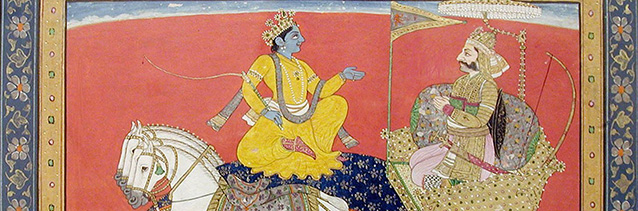
Dialogue between Krishna and Arjuna on the battlefield of Kurukshetra, Bhagavad Gita
The San Diego Museum of Art Collection
|
Sunday, September 20, 2015
|
|
As I mentioned before, Eastern and Western philosophies come from different starting points. With such dissimilar foundations, at core they have very different worldviews. Our Christian problem has been that we assumed Jesus was a Westerner, when his Aramaic language and thought forms would have been much more similar to the East. It is no accident that Jesus lived in what we call "The Middle East," on the cusp and under the control of Greek and Roman cultures, but surely not inside of them. Nonetheless, Western Christianity has understood and even pictured Jesus as if he were a European.
Several central ideas, affirmed by Jesus, were already formed in the ancient Hindu Vedas, then unfolded by the Upanishads and the Bhagavad Gita. In each case, notice that the mind revealed in these scriptures first sees things in their wholeness; whereas Westerners tend to first see things in their diversity. Today I'll briefly introduce advaita, then we'll explore the Hindu themes of karma and maya on Monday and Tuesday.
The word advaita is loosely translated as "having no duality," implying that the proper or spiritual way of understanding things is outside the realm of comparison or judgment. Advaita describes the non-dual or contemplative mind that understands things in their unity and connection before it separates them: not completely one, but not two either. Mirabai Starr says advaita "is not about everything being one big mushy, homogeneous, tasteless thing." [1] Rather, it's the subtle distinction that all things share the same ground of being, the same supreme reality that encompasses great diversity. At root, nothing is separate.
Can you "imagine" that way? Westerners have a very hard time doing this until they are trained: first one, then two; first similarity, then dissimilarity. If you start with two (dissimilarity and distinction) it is almost impossible to ever get back to unitive consciousness or similarity, from which most compassion, or at least tolerance, proceeds. If you start with advaita, you can still go back to making needed and helpful distinctions, but now love and union is prior to knowledge and information. That is the unique starting place of so many Eastern religions! |
|
|
|
Gateway to Silence
The Christ in me sees the Christ in you. Namaste.
|
|
Reference:
[1] Mirabai Starr, "Unitive Consciousness: An Eastern Perspective" (an unpublished webcast from the Center for Action and Contemplation: 2015).
|
|
Dear reader,
Your feedback is valuable to us! Please take a few minutes to tell us about your experience receiving Richard Rohr's Daily Meditations. We also invite your feedback regarding CAC's other programs (optional). Click here to begin the survey.
Thank you for sharing your thoughts and time with us!
Peace and Every Good,
Center for Action and Contemplation
|
|
On behalf of Illuman, the CAC invites all men to join
Soularize 2015
Seasons of Our Lives: How Do We Cultivate Wholeness?
November 6-8, 2015
Hyatt Regency Tamaya, Santa Ana Pueblo, New Mexico
Listen to Richard Rohr, Belden Lane, Jim Taylor, Jim Clarke, and Joel Blunk.
Participate in prayer, ritual, community, and council with other men.
Experience the beautiful high desert and cottonwood bosque along the Rio Grande.
|
|
2015 Daily Meditation Theme
Richard Rohr's meditations this year explore his "Wisdom Lineage," the teachers, texts, and traditions that have most influenced his spirituality. Read an introduction to the year's theme and view a list of the elements of Fr. Richard's lineage in CAC's January newsletter, the Mendicant. |
|
Did someone forward this message to you?
Please do not reply to this email. For more info about:
* Technical Help with Daily Meditations, email techassist@cac.org.
Copyright © 2015 Center for Action and Contemplation
cac.org |
|
|
|
|
|

