|
Richard Rohr's Daily Meditation
|
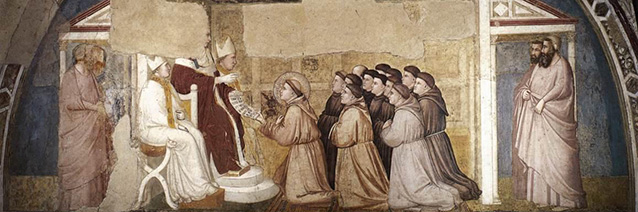
Scenes from the Life of Francis of Assisi: 5. Confirmation of the Rule (fresco detail), 1325,
Giotto di Bondone, Santa Croce, Florence, Italy.
|
|
An Introduction to Francis of Assisi
|
A Spirituality of Subtraction
Monday, May 18, 2015
|
| Meister Eckhart rightly pointed out that spirituality has much more to do with subtraction than it does with addition. I am sad to say that most spirituality in the West has largely become a matter of addition. This "spiritual consumerism" focuses on learning more spiritual ideas, earning merit badges from God, trying to attain enlightenment, and the will power of heroic moral behavior. Yet the counter-intuitive nature of the Jesus-journey shows it is not at all about getting, attaining, achieving, performing, or succeeding (all of which tend to pander to the ego). Jesus' spirituality is much more about letting go of what we do not need anyway. It more often involves unlearning than learning. Jesus taught us the way of descent, which we later called "the way of the cross." Like few other Christians, Francis profoundly understood such a major turn-around. He wanted God, not his ego, to steer his life; so he practiced letting go of his own will, his own needs, and his own preferences until he was free of their domination and able to find happiness at a much deeper and more truthful level. Much of Francis' universal appeal is that he took a joyful approach to inner and outer liberation. His entire lifestyle was a wholesale critique of the way most people live, yet he did not do this in a negative or moralistic way. After spending time as a prisoner of war when he was very young, Francis seemed to realize the intrinsic connection between violence and our preoccupation with money, possessions, and empty status symbols. He felt the only way to get out of the world of violence, competition, and hatred was to live a simple life--a life that did not appropriate anything to itself, sine proprio as he put it, but a life lived in constant presence to what was right in front of him, which was nature itself, an always present doorway to the divine. Seeing what was right in front of him also awakened Francis to the immense amount of suffering in the world. Francis did not shield himself from that suffering or deny the dark, negative side of himself and the world. Instead he did a pre-emptive dive right into "the tears of things," without judgment, rancor, or cynicism. For Francis, death belonged to life; death did not threaten life. And so he freely chose what most of us run from: poverty, failure, humiliation, and the search for human respect. He first worked with the lepers on the plain below Assisi, and there he "found what was once hateful to me became sweetness and life." We all learn the mystery of ourselves at the price of our own innocence. Francis did not try to remain "innocent" (the word means "unwounded"). He did not run from life's wounding, because he saw that in Jesus it became the way to resurrection and universal life. There are two major approaches to spirituality and to conversion. We can try to exclude and triumph over the negative parts, the shadow parts, the "inferior parts" (1 Corinthians 12:22), as Paul calls them. This leads us to a kind of heroic spirituality based on willpower and the achievement of some sort of supposed perfection. But if you are honest, what you are really doing is pretending--and excluding the dark side that you do not want to look at, or the people you do not want to deal with. The way of Francis included and integrated the negative--forgiving and accepting the imperfection and woundedness of life. He agreed with Paul that the supposed inferior or weakest are, in fact, "the most indispensable."
Adapted from The Art of Letting Go: Living the Wisdom of St. Francis,
discs 1 and 5 (CD)
|
 |
|
|
Gateway to Silence
I must do what is mine to do.
|
|
Now back in stock!
What the Mystics Know: Seven Pathways to Your Deeper Self
Drawing from the best and most poetic of Richard Rohr's writings, each chapter in this new collection examines core mystical truths from the Christian and Perennial traditions. This hardcover volume, with photographs to complement the text, is an excellent gift for all--those new to, as well as those already familiar with, Fr. Richard's teachings.
|
|
Job Opening
The Center for Action and Contemplation is seeking an experienced accountant to join our team in Albuquerque, New Mexico. If you're interested in helping us carry forward our nearly 30-year history of bringing transformative teaching to the world, and you have 4-6 years of experience in accounting, visit
cac.org/job-senior-accountant to learn more.
Please feel free to share this job opportunity with anyone you know who might be a good fit for the skills needed and CAC's mission.
|
|
2015 Daily Meditation Theme
Richard Rohr's meditations this year explore his "Wisdom Lineage," the teachers, texts, and traditions that have most influenced his spirituality. Read an introduction to the year's theme and view a list of the elements of Fr. Richard's lineage in CAC's January newsletter, the Mendicant. |
|
Did someone forward this message to you?
Please do not reply to this email. For more info about:
* Technical Help with Daily Meditations, email techassist@cac.org.
Copyright ? 2015 Center for Action and Contemplation
cac.org |
|
|

