|
RETIREMENT SECURITY MATTERS
A forum for retirement innovation information sharing
focused on states, supporters, and service providers.
Vol 80 🎉 | June 15, 2023
| | |
Greetings! Lisa, welcome to Retirement Security Matters – where we talk about retirement readiness innovation by states, supporters, and service providers. | |
Diving deep into June, we have some exciting updates, important news, and a touch of futuristic flair to share. Buckle up and get ready for a cool journey through the latest in retirement security and what it means to be innovative. You’re going to want an iced coffee for this one. Just sayin’.
-
The future of retirement savings, blockchain, and tokenization with CeFiWire Founding Editor, Sean Hanna - you read it here first, folks - unless you read it with Sean first
-
May data on state metrics, now including Maryland$aves
-
Updates from Massachusetts, New York, Minnesota, Missouri, and Nevada
-
Best Practices - Highlights from NAST TMTS Day 1 - June 13 - boy is this fresh
-
Hot Sauce! Five cool things you won’t want to miss and three other ones
-
PIX of the Week! We’re taking you to Dutch Bros, the Golden Gate, and an unnamed hotel room - what?
| Comments or content suggestions? We welcome both. Have something about your program you’d like to share? We are all ears. | |
|
RSM wants your support! Be seen.
Click to grab this space for your brand.
| |
What will Blockchain and Decentralization do to the Future of Retirement Savings: We Go Exploring with Sean Hanna | |
|
Sean Hanna
Founding Editor, InvestmentWires
| |
|
We met Sean Hanna in a friend’s living room ahead of a wedding early in this millennium. Sean is the founding publisher of InvestmentWires – including 401kwire.com, mutualfundwire.com, and a new publication – CeFiWire.com – focused on institutional investors and Web3 tech. Does this matter to you? We think it does. Sean has been a steady observer of and reporter on the financial services industry for more than 30 years. To say that he’s seen a lot is an understatement. We recently cornered Sean to grill him on what might be coming for the retirement savings and inclusion space. This is a bit long form but we think it’s worth it. And the best stuff is at the end. #ofcourse
We’re going with interview form this week. This is an excerpt. The full piece can be found here.
| |
|
Okay, we're ready. Let's go. What’s at the heart of your publishing?
401kWire is aimed at the decision makers in the industry -- the people running the providers, asset managers, what we call KPIs, the 401(k) focused advisors. Our bread and butter is that we break news. Our goal is that you're going to learn things from us that you're not going to learn somewhere else, and you're going learn a little bit faster.
NEW AND IMPACTFUL: ONE NEWSMAN’S VIEW
What are some of the newest and most interesting changes that you are seeing crop up in the retirement savings industry? Feel free to mention Auto IRAs! (shameless plug).
(Laughing) Actually, the state Auto IRA programs have had a big effect. What we're seeing from the state programs is they're driving retirement account adoption in the small employer market in a way that hasn't happened in the past. And the interesting side is they're driving adoption of 401(k)’s.
GOING GEORGE JETSON
Let's talk about the future. You started a new newsletter - CeFiWire. What does that stand for, and why should folks in the retirement community care about digital assets, new platforms and blockchain?
Here are three highlights from our conversation, but honestly, you’re going to want to read the long form of this one, to the end:
-
CeFi and DeFi: CeFiWire focuses on centralized finance (CeFi) and decentralized finance (DeFi). DeFi allows peer-to-peer trading without intermediaries, while CeFi caters to those who prefer financial services firms to manage their assets due to concerns about losing access to their digital keys.
-
Identity and Privacy: Identity is a crucial aspect of the digital asset space. Financial service firms need to know their customers and prevent fraudulent activities. However, privacy concerns have led to the development of technologies like zero-knowledge proofs, which allow individuals to prove their identity without revealing unnecessary personal information.
-
Regulatory Challenges and Technological Advancements: The adoption of blockchain technology and digital assets presents regulatory challenges, particularly in the US. The fear of losing control over monetary policy and banking security has caused hesitation among regulators. However, technological advancements, such as atomic transactions and blockchain-based recordkeeping, offer benefits like faster conversions and the potential for seamless platform-to-platform movement in the future.
There's a lot coming. What haven't we talked about yet today?
So one of the things that's coming is the ability, with tokenized assets, to build rules around them using a thing called smart contracts. more here.
We hope you enjoyed our far-ranging conversation about the future of retirement savings, blockchain, and tokenization.
Sean Hanna has spent more than two decades covering the asset management industry as a reporter and publisher. 401kWire is the most-read news service for executives in the defined contribution industry, including leaders at the major recordkeeping, TPA, RIA and consulting firms. MFWire is read by top executives each day at more than 400 mutual fund sponsors. He has also created the "Influencers" series of thought leadership conferences that have been attended by the who's who of the mutual fund and retirement industry. If you’d like to talk further with Sean Hanna or connect with him about one of the InvestmentWires publications (CeFiWire, anyone?), you can reach Sean here.
| |
*Fresh!* State Auto IRA Program Metrics | |
|
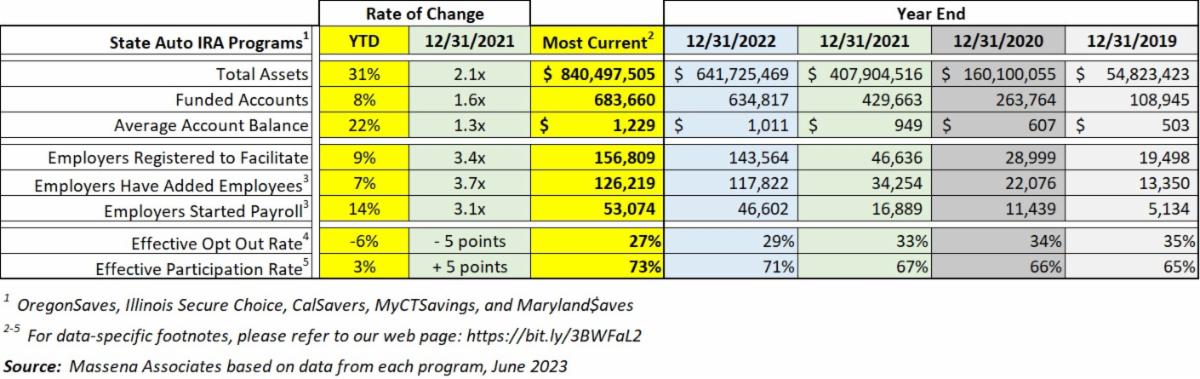
What’s up! We now have a full set of data for May across five programs (Maryland$aves - welcome to the fold, and thank you for sharing your progress).
Assets. Saver assets are up 31% year-to-date and 2.1x since December 2021 to $840 million. Average account balances across the programs are over $1,200. Longer term balances are higher.
Funded accounts. The five programs shown here now aggregate to over 683,000 funded accounts. For comparison, funded accounts are up 1.6x since December 2021, up about 2.6x since December 2020 and up about 6.3x since December 2019 – and up in 2023.
Facilitating employers. Over 156,000 employers are now registered to facilitate a state Auto IRA. Of that number, more than 53,500 have begun forwarding payroll contributions for savers.
| |
State Facilitated Retirement Programs - Fresh Highlights | |
|
Massachusetts (workforce 3.6 million) – The Massachusetts CORE Plan Statutory Committee met on June 8, 2023. The agenda included a Q1 2023 CORE investment review from Aon Investments, and a broader program update from Empower Retirement that included social media marketing and outreach strategy development.
| |
|
Minnesota (workforce 3.1 million) It’s official! Minnesota became the latest state to officially approve a state-sponsored retirement plan for private-sector employees lacking coverage. Governor Tim Walz (D) signed HF782, the measure that creates the Minnesota Secure Choice retirement program, into law on May 19, 2023. The law also establishes a Board of Directors which must begin operation of the secure choice retirement program no earlier than January 1, 2025. The program must open in phases, and the last phase must be opened no later than two years after the opening of the first phase.
| |
|
Nevada (workforce 1.5 million) is the latest state legislature to pass a state-run retirement savings program (SB305). The measure would establish the Nevada Employee Savings Trust and the program is targeted to go live July 1, 2025. It now awaits Gov. Joe Lombardo’s signature.
| |
|
C O M I N G U P
-
Oregon (workforce 2.2 million) – The next meeting of the OregonSaves Board is tentatively scheduled for August 15, 2023.
-
Virginia (workforce 4.3 million) – The next meeting is tentatively scheduled for August 23, 2023.
-
Massachusetts (workforce 3.6 million) - The next meeting is tentatively scheduled for August 28, 2023.
-
Maryland (workforce 3.2 million) – The next meeting of the Maryland$aves Board is scheduled for September 11, 2023.
| |
Highlights from NAST TMTS* - Retirement Security Track | |
If you missed us in Portland or had to step out to take a call, we’ve got you covered with highlights from this year’s Retirement Security Track conversations. As you would expect at a NAST event and with these innovators in the room, the Symposium was brimming with expert discussions and key insights on State Auto IRA programs. Summary here**: | |
|
1. Cost of Doing Nothing: In a thought-provoking discussion, Ethan Conner-Ross, Kim Olson, Mary Morris, and Treasurer Stacy Garrity stressed the high cost of inaction when it comes to retirement savings. The panel pointed out the increasing pressure on social safety nets and the risk of a lower standard of living for retirees without adequate savings. Bottom line: there’s a $1.3 trillion price tag for undersaving, and we can and are beginning to do something about it.
2. Feasibility & Sustainability: Angela Antonelli, Courtney Eccles, Hunter Railey, Jordan Seemans, and Troy Montigney discussed the feasibility and sustainability of state Auto IRA programs. Topics included potential administrative costs, the need for public-private partnerships, and the role of state treasurers in safeguarding the sustainability of these programs.
3. Legislative Relationships: It’s important to understand and cultivate relationships with state legislators. The role of Senator Bill Roth in Delaware was highlighted as an example.
4. Red State Motivations: What are the distinctive concerns and motivations of "red state" legislators and constituents? This conversation emphasized the importance of bipartisan support and understanding varying fiscal philosophies.
5. Rollout Timelines: The discussion turned to rollout timelines, with Colorado's three deadlines spread over two months presented as a case study. This contrasted with a 9-12 month one-wave rollout, without a pilot phase, potential approach. Bottom line: OregonSaves, CalSavers used conservative three year phased rollout approaches. States today can space their waves closer together and may get more consistent engagement if waves are spaced about two months apart.
6. Regulatory Pitfalls to Avoid: The team shared key lessons on avoiding "fee caps" and hard deadlines in statute while also ensuring appropriate enforcement mechanisms are in place. Not discussed: hard coding a 5% savings level with escalation may be a good statutory element. Otherwise, giving a lot of latitude to the implementing body is a best practice.
7. Small State & Partnerships: There was a deep dive into the unique challenges faced by smaller states and the importance of partnerships in addressing these. The Request for Proposal (RFP) process and best practices were also discussed. Bottom line: partnerships are forming. Maine and Colorado are working to formalize an agreement together, and other smaller states, like Delaware, are evaluating their options.
8. Navigating Legislation: Treasurer Dave Young offered guidance on navigating the legislative process after a bill is introduced, illuminating the steps needed to transform policy proposals into law.
9. Stakeholder Perspectives: Awesta Arkash, non profit representative Belinda Russell, small business owner Luke Huffstutter, Jonathan Herrera, and Anna Stevens shared their perspectives as stakeholders and as service providers to stakeholders. They emphasized the importance of stakeholder engagement and shared their experiences from Colorado. Luke Huffstutter particularly praised the OregonSaves program for its user-friendly design, stating it "has done such a great job of making this easy on me."
Andrea Feirstein facilitated a round-table ideas wrap up at the end of the day. The Symposium has been a rich tapestry of ideas, experiences, and suggestions, aimed at driving forward the mission of sustainable, feasible, and user-friendly Auto IRA programs at the state level. In our next edition, we’ll highlight Day Two and a session on retirement savings and data. Stay tuned.
Lisa
*That’s the National Association of State Treasurers - Treasury Management Training Symposium, if you are wondering. **For more context on these folks, including organizations and titles, see the NAST agenda.
| |
|
We. Are. Curating! Here are a few things you don’t want to miss.
One. Coming up on July 6! The NEST (UK) Insight Conference 2023 will bring together academics, policy-makers and senior industry figures to discuss themes related to the future of the UK’s auto enrolment policy. Focusing on some of the broader themes around financial behavior and financial wellbeing. Interested? Complete the registration form to sign up for the live steam. More information about the event can be found on NEST Insight website.
Two. Interesting takeaways from Taha Choukhmane’s paper on the “Default Options and Retirement Saving Dynamics”. According to Taha’s finding, auto-enrollment in retirement plans initially boosts savings, but employees may compensate by saving less in the future, resulting in a negligible long-term effect on wealth except for lower-income individuals. “Could auto-enrollment be giving a false sense of security? Does this suggest that auto-enrollment / behavioral tools are limited .... and that we should lean harder on Australian-style mandation or near-mandation?” our friend John Mitchem asks. Our take: we still think auto enroll plays a critical, useful role. And, more evaluation needed to understand impact over time.
Three. Check out this great piece from Planadviser featuring Prudential research findings that members of Generation X currently face financial obstacles that are reshaping their retirement plans as they approach their final working years. A survey from Unbiased shows similar findings, with only 30% of U.S. adults reporting high levels of confidence about their retirement.
Four. Don’t miss great insights from The Impact and Learnings Report (2019-2022) by BlackRock's Emergency Savings Initiative. The report includes successful program design tactics resulting in over $2 billion in new savings and reaching 10 million people, case studies with major employers like Best Buy and UPS, research on the connection between short-term and long-term savings, and insights into accessible and cost-effective solutions from ADP and Voya for employers to offer emergency savings to their employees. Get your copy here.
Five. Although we sadly missed the Longevity Book Club recent discussion, check out Hal Hershfield's book, "Your Future Self: How to Make Tomorrow Better Today,". Hal explores why people prioritize short-term decisions over long-term interests, attributing it to the perception of our future selves as strangers. By emphasizing the importance of connecting with our future selves, Hal suggests strategies such as writing letters to the future self to promote better decision-making, as seen in a successful collaboration with a Mexican bank where customers who wrote letters were more likely to sign up for automatic savings accounts. We had a chance to meet Prof. Hershfield at UCLA this spring and he is *ah-mazing*. Get it.
In Our Ears. Are we obsessed with longevity? Maybe. Maybe we are. We’re listening to and loving this podcast by David Sinclair - Lifespan. Current focus: brain health.
Before Our Eyes. Of course, it’s your TikTok moment! Also focused on health and natural living (theme here?) the silly but serious Orim - is it Anna Orim? – shares her love of beans, and what it’s like to take a beat on shampoo.
And, we’re still reading about FDR. The next president is Truman. There’s been a lot to admire so far in our journey through the first 32 presidents. We wish some of them had been women, though. #imagine
| |
OK That’s Enough – give us the Pix of the Week! | |
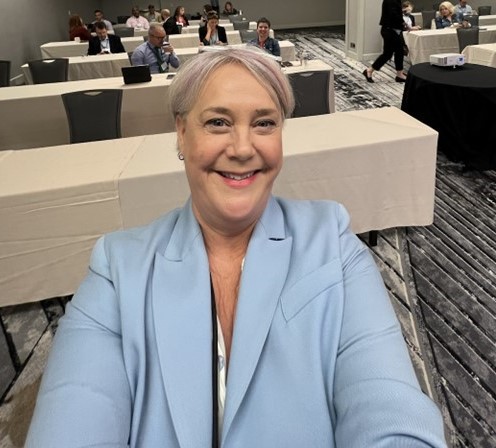
What it looks like when you are trying to do “all the things” and there’s a conference on. #idontrecommend. Fortunately the hotel staff never spotted us. | |
Before that we had the honor of laying our brother to rest just outside the Golden Gate Bridge ♥️. Come with us and share a family moment. ♥️ There were smiles. There were tears. There were a few words and some roses strewn into the Bay. And there was a great lunch at Scoma’s which my brother would have loved. We are a close family. #hugyourpeople | |
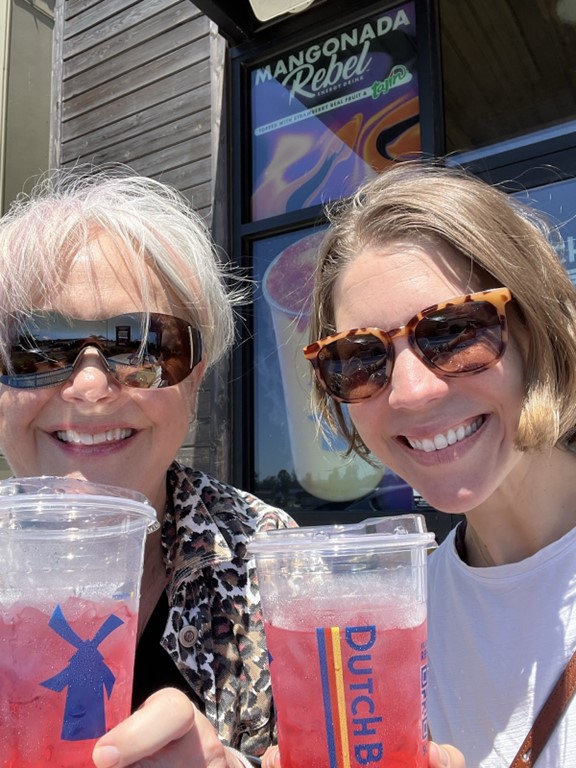
And y’all know it’s not like we don’t have any fun around here. Cuz it’s pretty much all about the coffee. Right, Court? And Gina Maria, where’s our Twofer? | |
|
That’s it for this edition. ❤️ Hug your people and change the world.
If you like this piece, please stick with us. We’ll be back in about two weeks. If you don’t like it, please unsubscribe below. Comments for us? Please let us know. Want your own subscription? Request one here. All information shared is from public sources or used with express permission.
| |
Massena Associates provides process, policy, and implementation consulting on retirement savings programs and products.
Our clientele includes public entities, policy organizations, and private sector providers. Our specialty – efficient, targeted results. We are an active speaker on retirement security topics, including state-facilitated programs, MEPs and more.
If you’d like to explore working together, we welcome the conversation. Connect with us here, and at 339-236-0684.
| |
|
Looking for a great retirement savings innovation resource? Led by Dr. Alicia Munnell, the Center for Retirement Research at Boston College develops and hosts terrific content and proprietary research related to states, financial security, social security, and more.
The Defined Contribution Institutional Investment Association (DCIIA) is dedicated to enhancing the retirement security of America’s workers. To do this, DCIIA fosters a dialogue among the leaders of the defined contribution community who are passionate about improving defined contribution outcomes. DCIIA's site provides a range of public and member-specific resources.
The Georgetown Center for Retirement Initiatives, Exec Angela Antonelli, provides excellent information on state-based and other retirement security innovation and policy.
Pew’s Retirement Savings Project studies the challenges and opportunities for increasing retirement savings and is another great resource - check out the work of John Scott and his terrific team.
If you want a great source of broad-based, consumer-focused retirement news, Jeffrey H. Snyder’s The Morning Pulse is your ticket. You can subscribe here.
| | | | |