|
|  |
|
Retail Beat
updates for retailers + key business partners
August 26, 2024
| |
|
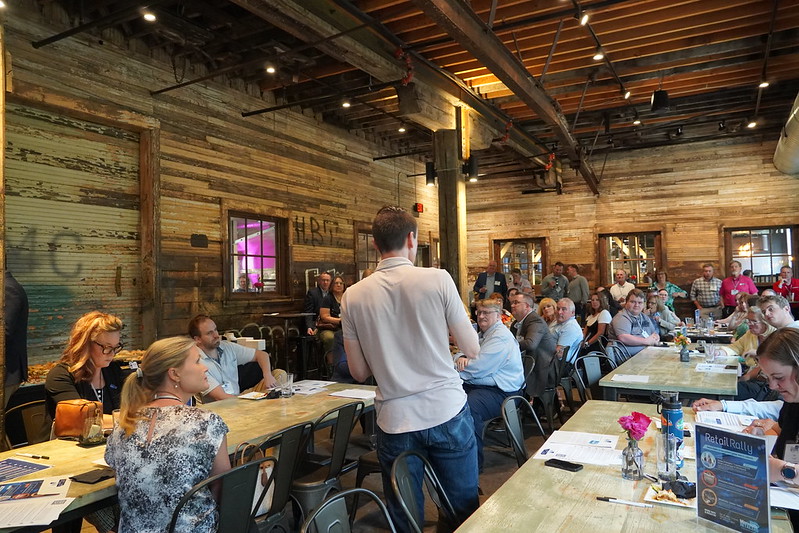
Rep. Matt Norris takes a moment to address attendees at last Wednesday's Retail+Policy Reception at The Market at Malcolm Yards. Rep. Norris--the author of Minnesota Retailers priority bill establishing a vendor collection allowance-- reaffirmed his commitment to helping retailers grow.
| |
|
Retail+Policy Event Wrap-Up: A Productive Conversation at the Intersection of Policy and Retail Growth | |
Last Wednesday, Minnesota Retailers hosted our annual Retail+Policy event at The Market at Malcolm Yards in Minneapolis, bringing together industry leaders and legislators to discuss key issues shaping the future of retail in our state. The event served as a vital platform for exchanging ideas, addressing challenges, and exploring opportunities to ensure that Minnesota’s retail sector continues to thrive in an ever-evolving landscape.
The event featured a dive into several critical topics, including our six proposed legislative priorities for the upcoming session. These priorities aim to bolster Minnesota’s retail landscape by focusing on:
- Cultivating a Competitive Retail Landscape for Minnesotans: Ensuring a balanced approach to taxes, regulations, and stewardship to maintain the state’s competitive edge.
- Supporting Retailers & Communities with a Vendor Collection Allowance: Advocating for a policy that provides relief to retailers through a vendor collection allowance, helping them manage the costs of collecting and remitting sales taxes.
- Modernizing Alcohol Regulations to Reflect Consumer Preferences: Updating outdated alcohol laws to align with current consumer demand and support retail growth.
- Combating Organized Retail Crime with Dedicated Resources & Coordination: Enhancing efforts to tackle organized retail crime by advocating for dedicated resources and better coordination between law enforcement and retailers.
- Enhancing Healthcare Accessibility at Retail Pharmacies: Expanding the role of retail pharmacies in providing accessible healthcare services to communities across Minnesota.
- Promoting Workforce Participation & Development with Affordable Childcare: Addressing workforce challenges by supporting initiatives that make childcare more affordable and accessible, thereby promoting greater workforce participation.
We extend our sincere thanks to Marisa Kinney of Red Wing Shoes, Logan McKee of Games by James, and Dan Wolter of Hy-Vee for sharing these proposed priorities from their unique perspectives. Their insights were invaluable in shaping the discussions and highlighting the practical implications of these legislative initiatives for retailers across the state.
We are also grateful to the legislators who took the time to join us and contribute their insights. Their participation was essential in fostering a rich and meaningful dialogue. A special thank you to:
-
Rep. Patti Anderson
- Rep. Steve Elkins
-
Rep. Mary Franson
-
Rep. Jim Joy
-
Sen. Mark Koran
- Rep. Erin Koegel
- Rep. Matt Norris
- Rep. Danny Nadeau
- Rep. Bernie Perryman
- Rep. Duane Quam
- Rep. Peggy Scott
- Rep. Nolan West
- Rep. Jeff Witte
- Rep. Mike Wiener
Their commitment to engaging with the retail community is truly appreciated, and we look forward to continuing these important conversations. Together, we can navigate the challenges ahead and seize opportunities to strengthen Minnesota’s retail industry for the benefit of all.
Stay tuned for more insights and updates from Minnesota Retailers as we continue to advocate for the policies that matter most to our members and the communities we serve.
| |
|
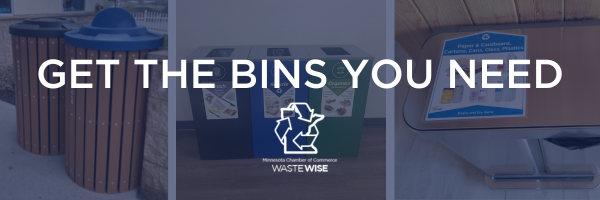
Boosting your recycling rate can be as simple as adding bins where they're needed most. In Anoka, Hennepin, Ramsey, Scott, and Washington counties, grant funding is available to help businesses improve their recycling efforts by providing necessary bins. Contact Waste Wise at mnwastewise.com to discover grant options to make recycling easier and more effective.
LEARN MORE
| | |
Consumer confidence sees small dip in July | |
From Chain Store Age, Zachary Russell, August 20, 2024
Consumer confidence dropped slightly from June to July, despite increased retail sales in the month. The July Consumer Confidence Score according to Numerator’s Consumer Sentiment Tracker was 56.4, a decrease of 0.6 from June. The figure is an average of how consumers feel about the job market, their household finances, and their spending comfort levels.
In July, more than two-thirds (39%) of consumers said it’s very or somewhat easy to find employment in the current job market. Meanwhile, 28% think it’s somewhat or very difficult. Almost half (48%) of consumers say their household’s financial situation is currently good or very good (-1 point vs. June), and 40% of consumers say they are very or somewhat comfortable spending money on discretionary purchases right now.
Numerator says the July Financial Outlook Score was 50.7 (-0.5 from June), indicating that consumers feel neutral about their household finances. Thinking about one year from now, 25% think their finances will be better than they are now, while 52% think they’ll be the same, and 23% think they’ll be worse. Black consumers and Gen Z consumers are the most optimistic about their financial situations, while White consumers and baby boomers are the least optimistic.
Additional findings from the Consumer Sentiment Tracker include the following.
- Consumers with spare cash say they’re putting it in savings (37%) and paying down debts (35%), while 12% of consumers say they do not have any spare cash (-1.1 points vs. June).
- With the warmer weather, consumers are looking to get out of the house or fix up the house. Thirty-percent plan to use spare cash to travel or go on vacation, and 22% plan to make home repairs / improvements.
- To save money, consumers are shopping for items on sale (43%), using coupons/discount codes (42%) and cooking at home (42%).
READ MORE
| |
Consumer pursuit of well-being intensifies | |
From Drug Store News, Sandra Levy, August 20, 2024
Consumers are turning to physical activity, social media, pet ownership and other elements to harmonize their physical, mental and social well-being. Circana, an advisor on the complexity of consumer behavior, has released a new report highlighting opportunities emerging from the growing global interest in well-being.
The report, “Tapping Into the Global Consumer Well-Being Opportunity,” reveals the complexity of personal well-being, with consumers turning to solutions as varied as physical activity, social media, food, pet ownership, beauty and books, among many other products and services, to harmonize their physical, mental and social well-being. Circana’s global research identified more than 55 ways consumers pursue their well-being across various sectors.
“The definition of health and wellness is continuously evolving, with a growing emphasis on mental health,” said Sally Lyons Wyatt, global executive vice president and chief advisor at Circana. “Beyond working to make sure wellness-focused products and services are accessible and affordable, successful businesses and services will identify their audience and connect with consumers in meaningful ways. Helping consumers become the best, healthiest versions of themselves is good for business.”
The report highlights several key findings:
- Embracing one’s body for optimal physical health: Consumers prioritize physical health through food choices, exercise and quality sleep, focusing on multifunctional products and clean ingredients. Digestive and oral health are important to consumers who have increased spending on vitamins, supplements and oral care devices. The demand for increased energy is driving growth in energy-related products. Similarly, from sipping to skincare, hydration is a primary, global wellness goal. But the pursuit of optimal health comes at a cost, with consumers reporting that high prices for healthy food and beverages are a significant challenge.
- Pursuing positive mental health for emotional well-being: The pandemic increased consumers’ awareness of mental health. Book sales on mental health and self-help have surged, and popular self-care activities focus on reducing stress and anxiety, improving sleep and boosting mood and motivation. Sleep aids, cleaning supplies and mood-enhancing items are increasingly popular among consumers looking to reduce stress and anxiety. Younger generations, in particular, are driving trends in stress-relief products and home scents.
- Seeking community and social engagement to make a difference: Social and community engagement is crucial for well-being, and in-person events, social media, co-exploration and participation in organized sports are on the rise. The arts, entertainment and recreation industries saw significant growth, with trends including increased participation in volunteer activities, social media-driven self-care practices, group activities like travel and dining and the rise of sports like pickleball.
READ MORE
| |
Employment inequality has declined since the mid-2010s | |
From the Federal Reserve Bank of Minneapolis, July 24, 2024
The labor market has strengthened significantly in recent years. More workers ages 25 to 54 are participating in the labor market, with that increase driven disproportionately by women. However, these trends can conceal how people with differing demographic characteristics experience the labor market and how employment inequality has evolved over time for men and women.
In an analysis based on a new methodology that more fully uses available demographic information, we find that for both men and women, the likelihoods of being employed have recently converged. That is, men and women with the lowest likelihoods of employment—who are disproportionately from low-income families—have gained ground on their counterparts with higher likelihoods of employment.
Large employment gaps are gradually diminishing
Employment inequality—that is, differences in employment rates between those most likely and least likely to have a job—speaks to the availability of jobs and inclusiveness of economic growth. The typical approach to assessing these differences is to separate people into groups by a single variable—for example, education—and estimate each group’s employment rate. While straightforward, this approach is imprecise if the goal is to fully understand employment disparities, including those within each education group.
For our analysis, rather than look at one variable at a time, we simultaneously considered a rich set of individual-level characteristics like age, race/ethnicity, presence of children, and foreign-born status. Starting in a base period, we used machine learning to predict employment on the basis of all of those characteristics. We then divided individuals into five groups, or quintiles, ordered from lowest predicted employment rate to highest. We conducted these analyses entirely separately for men and women, such that roughly one-fifth of men are in each of their quintiles and one-fifth of women are in each of their quintiles. The method we use is described in more detail in our earlier paper, The Evolution of Employment Dispersion.
READ MORE
| |
Connect with Minnesota Retailers! | | | | |