| School Social Work NOW! Supporting Innovative Practice, Effective Leadership, and Applied Research VOL 8 - NO 6 |
|
|
Mark Your Calendar!
ACSSW
is hosting its 5th National
Advancing School Social Work Practice Institute. . .
January 17-19, 2018
in beautiful New Orleans
Why should you go? Click here to find out. Registration is open now, and team discounts are available.
Register today!
~~~
Here are 8 powerful tips to help parents protect their children with disabilities. Share them widely!
8 Tips
REMINDER: To those whose membership deadline has expired, this will be your last newsletter unless we receive your renewal in the next 7 days. Please check your inbox for previous email reminders. Thanks!
President
|
On August 4, 2017, the Delegate Assembly of the National Association of Social Workers approved a number of significant amendments to the NASW Code of Ethics. These changes to the Code, the first since 2008, will go into effect January 1, 2018. It is expected that the new Code will be online (
www.socialworkers.org) by late October, and print copies can be pre-ordered from NASW Press, to be available November 1.
The changes to the Code include some of the most significant changes since the 1996 version of the Code was approved. Professional social workers need to keep up to date on the changes to the Code, not only to avoid malpractice, but also to promote the highest standards of ethics in their everyday practice.
Get summary of changes.
Sesame Workshop, the non-profit educational organization behind Sesame Street, announced today its first-ever comprehensive initiative designed to help children cope with traumatic experiences. The initiative is a major new addition to
Sesame Street in Communities, a program to help community service providers, parents, and caregivers give children, especially the most vulnerable, a strong and healthy start...T
he new traumatic experiences initiative is focused on mitigating the harmful effects of Adverse Childhood Experiences (ACEs) and unexpected stressful occurrences, like natural disasters or witnessing violent acts, so they don't define a child's life trajectory. Learn more.
from CASEL:
This practical toolkit describes how restorative practices can help create safe, supportive learning environments in schools. It defines restorative practices, explains why they are a transformational tool for fostering healthy relationships in schools, and shows how they can be useful processes for students, educators, and learning communities. The toolkit is intended for all educators who support the growth and health of students in schools. It includes models, frameworks, and action steps for schoolwide implementation, accompanied by guiding questions to support reflection for practitioners looking to make restorative methods part of the fabric of daily life in schools. It also recognizes the significant role all education professionals play in maintaining a school community that models respectful, trusting, and caring relationships. Download PDF.
|
|
|
 |
|
Mastering 4 key management skills would go a long way in helping middle and senior-level managers around the world face the challenges of working in today's frenetic economy...
It's interesting to note that managerial effectiveness has been a top challenge of managers for decades. Despite all the technology available to modern managers, they still struggle to manage competing priorities with limited resources while keeping up with organizational changes and dynamic competitive environments.
As much as managers might wish, during those busy weeks, that their workload was lower or the pace of change slower, they simply must adapt. Effective managers develop a systematic, thoughtful approach to their work.
Learn more.
|
Children who are suspended from school are more likely to develop a range of mental disorders, such as depression and anxiety as well as behavioral disturbances, according to a new study published in the journal Psychological Medicine.
Researchers at the University of Exeter in England investigated the impact of exclusion from school among the general population and found that suspension may lead to a new onset mental disorder, and that, separately, poor mental health can lead to suspension from school.
The findings show that consistently poor behavior in the classroom is the primary reason for school exclusion, with many students, particularly those in middle and high school, facing repeated dismissal from school. Relatively few pupils are completely expelled from school, but the researchers warn that even temporary exclusions can exacerbate psychological distress.
The researchers assert that identifying and supporting children who struggle in class could prevent suspension and improve their success at school.
Continue.
|
Time to register!!!
ACSSW's 6th National
Advancing School Social Work Practice Institute
January 17-19, 2018 --
New
Orle
ans
|
|
School Social Work Survey Request!
|
Survey Request
from Dr. Susan Elswick
You are invited to complete a 10 minute survey on school safety and school social work practice in the United States. This survey will help us develop a better understanding of schools in which today's school social workers practice. Please note that your involvement in this study is completely voluntary and all information you provide will remain strictly anonymous. For your participation in this study, we invite you to provide your email address at the end of the survey to be entered into a drawing to win one of five $50 Amazon gift cards. Please
click the link to complete
the survey.
|
|
Recommended Read for October
|
Hot off the presses!!
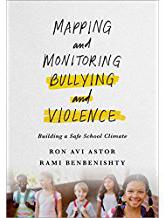
Mapping and Monitoring Bullying and Violence
by Ron Avi Astor and Rami Benbenishty
Mapping and Monitoring Bullying and Violence
is a guidebook for district and school education leaders and professionals to reduce incidents of violence and bullying and enhance students' well-being. Written in a step-by-step format, the text is designed to assist in collecting and making better use of data on non-academic issues in schools, such as reports of victimization, weapon and drug possession, theft of personal property, suicide ideation, and other areas. The authors advocate an ongoing monitoring approach that involves collecting information from multiple audiences about what is taking place in and around schools. One part of this process is mapping, which gives school leaders, students, and staff members a visual record of areas of the campus considered safe, alongside those that students view to be places where they might encounter bullying, harm, or trouble. Other common parts of such systems are surveys among students, educators, and parents. The authors include practical examples of how to design such a system, gather current information, analyze and display the data, share it with different audiences, and use it to find solutions. Ultimately, this timely guidebook is a must-have for social workers, educators, psychologists, counselors, nurses, and others working to improve safety in schools.
ACSSW readers receive a 30% discount with code: ASPROMP8
now only $24.50 with discount
or
|
In traditional school discipline programs, students face an escalating scale of punishments for infractions that can ultimately lead to expulsion. But there is now
strong research that shows pulling students out of class as punishment can hurt their long-term academic prospects. What's more, data show that punishments are often unequal. Nationally,
more black students are suspended than white students, for example.
As a result, alternative programs like restorative justice are gaining popularity in public schools from Maine to Oregon. Early adopters of the practice report dramatic declines in school discipline problems, as well as improved climates on campuses and even gains in student achievement.
Access article.
More and more, people in education agree on the importance of schools' paying attention to stuff other than academics.
But still, no one agrees on what to call that "stuff."
I originally published a story on this topic
two years ago.
As I reported back then, there were a bunch of overlapping terms in play, from "character" to "grit" to "noncognitive skills."
This bagginess bugged me, as a member of the education media. It bugged researchers and policymakers too. It still does.
If anything, the case for nonacademics has gotten even stronger since then. In fact, it has been enshrined in federal law. The Every Student Succeeds Act mandates that states measure at least one nonacademic indicator of school success.
Full article.
|
| Professional Development Opportunities |
|
School Social Work Positions
|
Mix It Up At Lunch Day Is October 31st
Are you ready to Mix It Up?! the next Mix It Up at Lunch Day is October 31, 2017. Register now, and get a jump on your planning by viewing this short, fun
webinar.
More info and a video (on demand).
This video focuses on using motivational interviewing techniques to identify and address depression. In one scenario, a 15-year-old boy presents for a yearly physical. During the visit, he mentions feeling tired and having trouble getting up in the morning. When he is not in school, he stays alone in his room and no longer spends time with his friends.
Access video.
|
|
4th Quarter Deadline: December 31, 2017
Grants of up to $500 are available for "innovative programs, events, or projects" from the
Meemic Foundation for Michigan, Wisconsin or Illinois. Apply online using their easy application that takes less than 30 minutes to complete. These grants are open to any employee of a K-12 public or private school. Universities and colleges may also apply.
Grants are accepted year round, but the fourth quarter cycle ends December 31st. Grants are up to $500. Recipients will be notified by February 23, 2018..
The foundation says it supports "basically anything that supports teachers and enhances the student's educational experience" - from field trips to books to behavior modification programs; science, music, or art equipment to professional development.
More info.
|
|
|
|