Robert Hiett
Executive Director
| |
Creating Regional Solutions Since 1971 | |
Partnerships Promote Local Government Success
NC League of Municipalities, NCACC, and Councils of Government help towns make the most of their American Rescue Plan funds
Author: Jessie Holmes
COVID-19 presented towns, cities, and counties with a historic challenge: continue to deliver vital government services while responding to an evolving public health crisis. Costs rose as local governments took measures to protect their employees and their communities, while tax revenue fell for some.
Congress provided a lifeline in March 2021 with the passage of the American Rescue Plan Act (ARPA). It included $350 billion in State and Local Fiscal Recovery Funds to help governments address the economic effects of COVID-19 and build more resilient, equitable communities.
But this opportunity also came with a complex landscape of U.S. Treasury rules and time-consuming reporting requirements – often with fewer employees to handle them due to a public-sector labor shortage. To support local governments, North Carolina legislators provided a total of $30 million in grants from the State’s ARPA funds to the North Carolina League of Municipalities, the North Carolina Association of County Commissioners, and the North Carolina Association of Regional Councils of Government, which represents sixteen individual Councils of Government (COGs).
These long-time organizations had the experience and relationships needed to partner with local governments to strategically plan for and spend COVID-19 relief funds, leading to better outcomes for communities and the people who live there.
|  | |
Regional Councils of Government Provide Technical Support
Similar experiences are playing out across North Carolina, saving communities time and money. For example, while some local governments such as Biscoe already had a vision for spending ARPA funds, others turned to their local COG for the best strategy.
“We have created over 200 spending plans for local governments to roadmap how they want to spend those funds,” says Robert Hiett, who serves as both Chairman of the North Carolina Association of Regional Councils of Government, and Executive Director of the Upper Coastal Plain COG based in Wilson.
Hiett says they’ve also helped local governments to secure an additional $83.5 million in grants from other sources to maximize the number and scope of projects communities can tackle, and COGs promote information sharing through meetings, newsletters, and resource databases.
While COGs have served local governments for decades, the ARPA funds they received from the State have allowed them to expand that assistance at a time of historically heightened demand, and tailor it to each region.
“We’d like to thank our state and federal elected officials for allowing us to be an assisting organization with our state’s pandemic response, and to be part of the statewide solution,” says Hiett.
| |
Funding Opportunites and Resources | |
|
DOT Opens Thriving Communities Technical Assistance Program
The U.S. Department of Transportation (DOT) announced the second round of its Thriving Communities Program (TCP) (FY 2023) to support low-resourced communities in advancing transformative transportation projects. Communities in need of free technical assistance can submit a Letter of Interest by November 15. To learn more, visit the Information for Communities webpage.
New for 2023: Technical Assistance Providers can apply for funding to offer assistance to communities within their own regions or at the national scale. Regional technical assistance funding could provide an opportunity for coalitions of RDOs, state RDO associations, or other providers to help their communities conduct planning, pre-development, grant application activities, or other assistance. Read about both the National-level and Regional-level capacity building opportunity on the Information for Capacity Builders webpage. Capacity builder applications are due November 28.
|  |
Application | CDBG Neighborhood Revitalization Grant Program Guidance and Application
Applicants can apply for Community Development Block Grant Neighborhood Revitalization (CDBG-NR) funds for 2023 by using this application and guidance document.
The 2023 key points are:
- Deadline is 4:00 pm on Wednesday, November 15, 2023.
- All applications must be sent by way of United States Postal Service or an overnight delivery service.
- The available amount is approximately$12.48 million. Of this amount, $4.8 million is set aside for the Rural Community Development funds to assist Tier 1 counties with stand-alone, non-housing-focused projects.
-
Contacts are Angela Williams, Grants Management Representative, at awilliams@commerce.nc.gov or the new CDBG Section Chief, John F. Brooks at john.brooks@commerce.nc.gov.
Documents
If you need local UCPCOG assistance, please contact Tirence Horne at THorne@ucpcog.org.
| |
NC Homeowner Assistance Fund Still Accepting Applications
Do you know someone who is past due on a mortgage and housing-related payments? The North Carolina Homeowner Assistance Fund may be able to help. The Fund, which was established through the American Rescue Plan of 2021, is designed to help prevent mortgage delinquencies, defaults, displacements, and foreclosures due to COVID-19. The program is still accepting applications and providing financial assistance.
For qualified homeowners who are past due on mortgage and housing-related payments by at least 30 days, the fund offers:
- Housing payment assistance for primary residence in North Carolina
- Assistance for mortgage reinstatement to catch up on late payments (first and second mortgages) or other housing-related costs due to a period of forbearance, delinquency, or default
- Assistance covering other housing-related costs such as homeowner’s insurance, flood insurance, mortgage insurance, homeowner’s association dues/fees or delinquent property taxes to prevent foreclosure.
Visit the program website for more information, to determine eligibility, and to apply for assistance: www.nchaf.gov.
| |
|
Upcoming Environmental Justice Funding Opportunities
Environmental Justice Funding Opportunities
The Environmental Protection Agency (EPA) plans to invest 40 million dollars into Environmental Justice (EJ) grants across the country. The EPA’s funding opportunities are expected to award non-profits with grants ranging from $100,000-$500,000 and US Territories, local governments, and federally recognized tribal government with access to $20 million in funding through the State Environmental Justice Cooperative Agreement (SEJCA) Program. $50 million is dedicated to the creation of Environmental Justice Thriving Communities Technical Assistance Centers (EJ TCTAC), one-stop-shops dedicated to supporting environmental justice initiatives in under-served communities.
A 14 minute presentation from the North Carolina Department of Environmental Quality covering these funding opportunities can be found here.
Other Resources
· EPA’s Office of Environmental Justice
Environmental Justice Thriving Communities Technical Assistance Center
· EPA Grants
| |
|
SITE PROGRAM
Golden LEAF recognizes that rural and economically distressed communities must have sites available for development to attract new businesses and create opportunities for existing businesses to expand. To address this need, Golden LEAF created the SITE Program. Through this program, Golden LEAF will provide support to communities to identify potential sites for economic development, enable completion of due diligence on sites already identified, or extend public utilities to or conduct grading and clearing of sites for which due diligence has been completed. Golden LEAF will accept applications from organizations in all counties, but will prioritize awards within counties that have been persistently economically distressed (as demonstrated by County Tier status determined by the N.C. Department of Commerce) and in economically distressed, rural, and tobacco-dependent communities.
The SITE Program consists of the three phases described below. Communities will be able to participate in the program in any of the three phases, and a site may progress from Identification through to Development over time.
-
SITE Program – Identification provides support to identify potential industrial sites in communities that do not currently have quality industrial sites to market.
-
SITE Program – Due Diligence provides funding to complete eligible due diligence activities such as environmental assessments, archaeological analyses, and mapping.
-
SITE Program – Development provides funding for public infrastructure and, for publicly owned sites, clearing and grading, to benefit sites that have completed the due diligence necessary to demonstrate that the site is suitable for development.
If you’re not sure which phase is right for your project, we have a few questions to help guide you.
| |
|
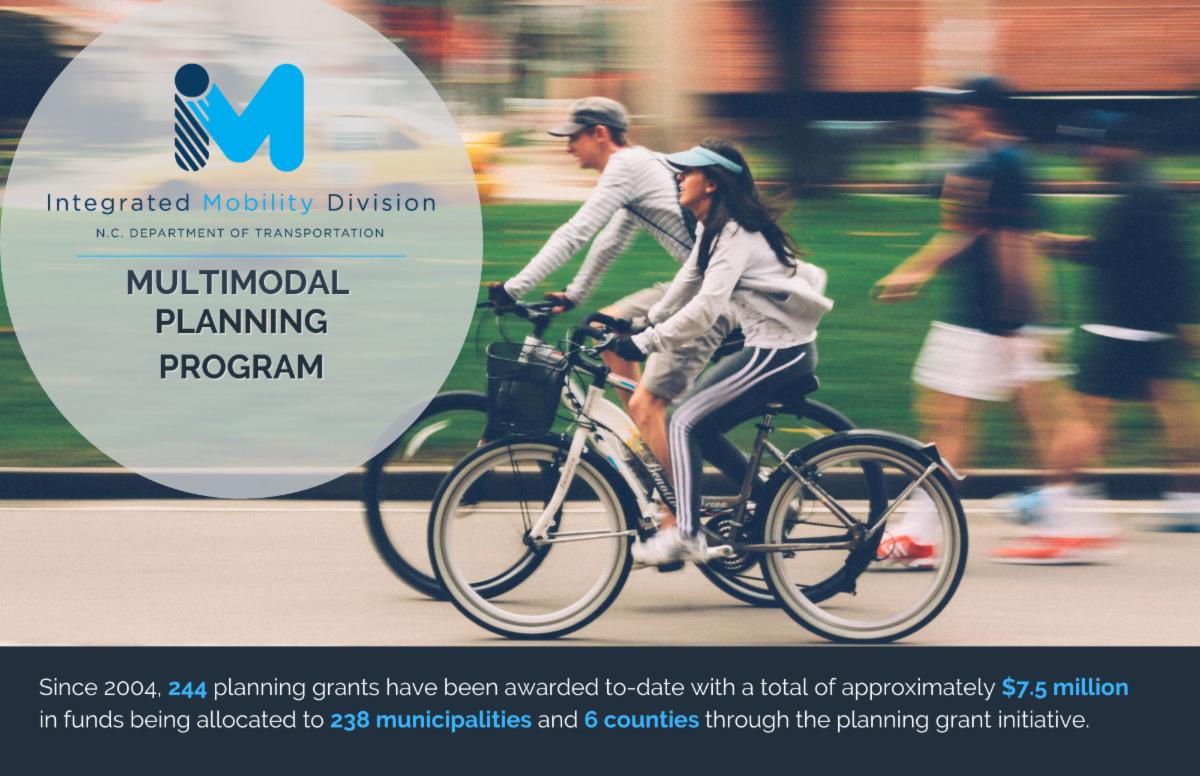
The NCDOT Integrated Mobility Division (IMD) and the Transportation Planning Division created an annual matching grant program – the Multimodal Planning Grant Program (MMPG) – to encourage municipalities to develop comprehensive bicycle plans and pedestrian plans. This program was initiated in January 2004 and is currently administered through NCDOT-IMD.
The Multimodal Planning Program has been successful in its 20 grant cycles - since 2004, 254 planning grants have been awarded. To date, a total of approximately $8 million has been allocated to 248 municipalities and 6 counties through this grant program.
| |
|
EDA accepting applications to support public planning and construction/renovation projects that advance job creation and economic development
The Economic Development Administration is a federal agency that provides grant funds to support a range of construction and non-construction activities which will advance economic development and enhance the competitive environment in which jobs can be created and private investment leveraged. Public entities, or nonprofit entities working in collaboration with local governments, looking for support to construct or renovate public assets, or to conduct analysis or regional technical assistance programs with clear economic development outcomes should consider EDA’s grant programs. EDA currently has a range of programs available. For further information, please go to https://eda.gov/funding-opportunities/.
North Carolina applicants are also encouraged to reach out to the NC EDA representative, Hillary Sherman at hsherman@eda.gov to discuss program requirements and processes and alignment with potential projects.
| |
PROTECT
Promoting Resilient Operations for Transformative, Efficient, and Cost-Saving Transportation (PROTECT) Discretionary Grant Program Notice of Funding Opportunity
Summary
The vision of the PROTECT Discretionary Grant Program is to fund projects that address the climate crisis by improving the resilience of the surface transportation system, including highways, public transportation, ports, and intercity passenger rail. Projects selected under this program should be grounded in the best available scientific understanding of climate change risks, impacts, and vulnerabilities. They should support the continued operation or rapid recovery of crucial local, regional, or national surface transportation facilities. Furthermore, selected projects should utilize innovative and collaborative approaches to risk reduction, including the use of natural infrastructure, which is explicitly eligible under the program.
The NOFO can be found on grants.gov at: https://www.grants.gov/web/grants/view-opportunity.html?oppId=347585.
More information on this NOFO and the PROTECT Program can be found at: https://www.fhwa.dot.gov/environment/protect/discretionary.
Applicant questions should be directed to: PROTECTdiscretionary@dot.gov
| |
|
Need technical assistance? UNC Environmental Finance Center is here to help!
The UNC Environmental Finance Center offers free one-on-one technical assistance for small water systems. If you have an interest in our support, fill out our interest form here.
| |
ARP OFFICE HOURS
The School of Government just released new dates:
- Thursday, October 12 – 12:00-1:00 p.m. (Focus on Subawards)
- Thursday, October 19 – 8:30-10:30 a.m. (Focus on ARPA Basics)
- Tuesday, October 24 – 12:00-1:00 p.m.
- Tuesday, October 31 – 8:30-9:30 a.m.
ZOOM LOG IN
Here is the new Zoom Log in for all Office Hour Sessions:
https://zoom.us/j/95481909044?pwd=UlE2VHNhN2luS0JEYTJqeTZTMFRWdz09
Meeting ID: 954 8190 9044
Passcode: 779726
One tap mobile
+16469313860,,95481909044# US
| |
|
Have you reviewed guidance and other resources and still have questions about getting started and administering your local ARPA funds? For technical assistance, please contact your Upper Coastal Plain Council Of Governments. We are here to help!
Betsy Kane, Senior Regional Planner, phone 252-234-5902
email: bkane@ucpcog.org
| |
|
STATE AGING PLAN
The Division of Aging and Adult Services of the North Carolina Department of Health and Human Services is required by federal and state laws to submit a State Aging Plan every four years as a guide for the aging and adult services population in North Carolina.
What is a State Aging Plan?
- Highlights goals, objectives, and strategies aimed at assisting older adults, their families and caregivers, and persons with disabilities.
- Serves as a valuable tool for planning/tracking all efforts on behalf of older adults, particularly in optimizing the state's home and community-based service system.
- Reflects extensive input from the community, actively considering the needs of populations facing racial and ethnic disparities.
-
Click here to access the 2023-2027 State Aging Plan.
-
Click here to read more about the vision and priorities of the 2023-2027 plan and here for a overview of the plan process and goals.
| |
Input Needed: Proposed Regulations for Adult Protective Services Programs
ACL is seeking input on a proposed rule to establish the first-ever federal regulations for adult protective services (APS) programs. Instructions for submitting comments and registering for an informational webinar can be found on ACL.gov and at the bottom of this announcement.
APS programs across the country support older adults and adults with disabilities who experience, or who are at risk of, abuse, neglect, self-neglect, or financial exploitation. APS programs investigate reports of maltreatment; conduct case planning, monitoring, and evaluation; and provide, or connect people who have experienced maltreatment to, a variety of medical, social service, economic, legal, housing, law enforcement, and other protective, emergency, or support services to help them recover. Over the past decade, ACL has led federal efforts to support the critical work of APS programs through a variety of initiatives.
First-Ever Federal Regulations for APS
The proposed rule aims to improve consistency and quality of APS services across states and support the national network that delivers APS services, with the ultimate goal of better meeting the needs of adults who experience, or are at risk of, maltreatment. To those ends, the proposed rule:
-
Establishes a set of national standards for the operation of APS programs that all state APS systems must meet. These standards formalize — and build upon — the existing National Voluntary Consensus Guidelines for State APS Systems.
- Establishes common definitions for the national APS system to improve information sharing, data collection, and standardization between and within states.
- Requires state APS systems to develop policies and procedures, consistent with state law, for coordination and sharing of information to facilitate investigations with other entities, such as state law enforcement agencies and state Medicaid agencies.
- Requires state policies and procedures to be person-directed and based on concepts of least restrictive alternatives.
- Establishes requirements for data collection, retention, and reporting.
- Establishes requirements for mandatory staff training and ongoing education on core competencies for APS staff and supervisors.
We have created a fact sheet with highlights of key provisions of the rule, and the full text of the proposed rule can be found on the Federal Register website.
Input Needed
The proposed rule is the culmination of many years of engagement with stakeholders from APS and long-term care ombudsman programs, as well as disability advocates, from across the country. It also reflects input received through several listening sessions, extensive research, and analysis of data from a 2021 survey of 51 APS systems, ACL’s National Adult Maltreatment Reporting System, and policy profiles from APS programs in all states and territories.
ACL now seeks feedback on the proposed rule from all who are interested in improving implementation of APS programs and services. Input from the aging and disability networks and the people served by APS programs is particularly crucial.
Comments will be accepted for 60 days, beginning when the proposed rule is officially published in the Federal Register (which currently is scheduled for Tuesday, September 12). Instructions for commenting, along with the comment deadline, can be found in the Federal Register notice and on ACL’s website.
| |
CMS Finalizes Rule To Streamline Medicare Savings Program Enrollment
On September 18, CMS issued a final rule to simplify enrollment in Medicare Savings Programs (MSPs), which cover Medicare premiums for eligible older adults and people with disabilities. CMS estimates the changes will make coverage more affordable for approximately 860,000 people.
According to MACPAC, only around half of people currently eligible for MSPs are enrolled due to the unwieldy and difficult application process. To make it easier for eligible people to receive MSP benefits, MSPs will now automatically enroll many eligible SSI recipients into MSP coverage that covers cost sharing and Medicare premiums. Furthermore, states will now be required to use data from the Medicare Part D Low Income Subsidy to encourage eligible people to also enroll in MSPs. The rule is set to go into effect on November 17, 2023.
| |
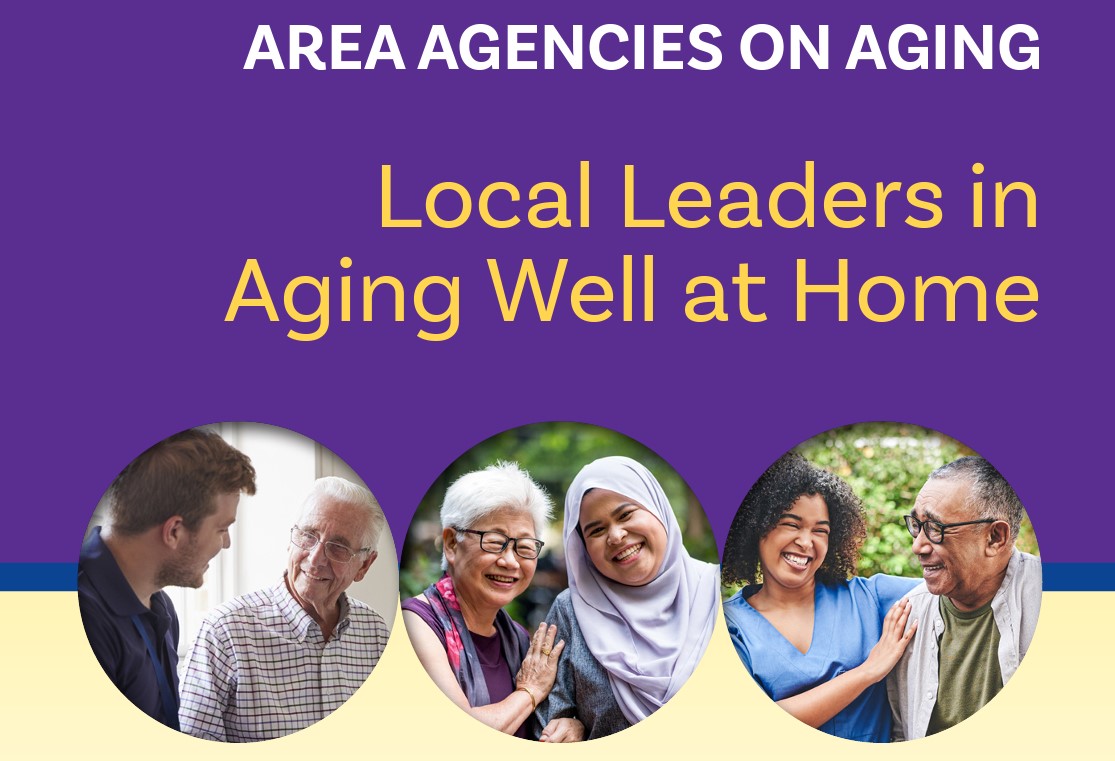
2023 Publication by USAging on the Role of AAA’s Nationwide
This brochure features an overview of the latest data gathered from AAAs nationwide to provide a snapshot of the evolving role these vital agencies play in the planning, development, coordination and delivery of a broad range of aging and other home and community-based services in every community in the United States.
https://www.usaging.org/Files/USAging_Local%20Leaders%2023_508.pdf
| |
Project HOPEFUL: Increasing Connection, Reducing Suicide Risk
A Guest Post for Suicide Prevention Month
By Laura Shannonhouse, Erika LeBlanc, Matthew Fullen
Even though older adults are the most at-risk age group for suicide, they’re the least likely to get the services to prevent suicide. Home and community-based service providers, like the nutrition programs funded by the Older Americans Act (OAA), are uniquely positioned to offer supports and connections that can reduce this community’s risk of suicide.
“More than 25% of Americans 60+ live alone, those 85+ have the highest suicide rate of any age group, and up to 90% of older adults have been exposed to a traumatic event in their lifetime,” says Edwin Walker, Deputy Assistant Secretary for Aging at ACL. “We know meaningful social connections can help prevent suicide — and fostering those connections is a core element of our nutrition and health promotion programs.”
The OAA nutrition programs have a three-pronged purpose: reduce food insecurity, hunger, and malnutrition; enhance socialization; and promote the health and well-being of older adults. They pay particular attention to reaching older adults with low income, people from underserved communities and rural areas, people with limited English proficiency, and people at risk of institutional care — all of whom may be at risk of isolation and mental health issues.
Since 2017, ACL has funded “Innovations in Nutrition Programs and Services” grants to test and document innovative and promising practices to enhance the quality and effectiveness of OAA nutrition programs. With an Innovations grant in 2020, Dr. Laura Shannonhouse and her team created and tested a training program called BE WITH (Belonging and Empathy With Intentional Targeted Helping). Through the program, nutrition service volunteers who had received suicide intervention training conducted weekly supportive phone calls with at-risk older adults who receive home-delivered meals. Preliminary results showed that BE WITH reduced social isolation, loneliness, depression, and suicidal desire.
This year, ACL awarded a five-year grant to fund project HOPEFUL (Helping Older Persons Find Useful Links), which will work with the Georgia Division of Aging Services and the North Carolina Division of Aging and Adult Services to adapt, expand, and evaluate this promising program.
Through Project HOPEFUL, volunteers who provide home-delivered meals in Georgia and North Carolina will be trained in how to listen well, form meaningful connections with older adults, and respond to crises when needed. Implementation of the training program will shift from being university-run to being run by the aging services network. The aging services network also will learn how to adapt BE WITH for congregate meal programs, with the goal of improving the mental health and well-being of participants in group settings.
Project HOPEFUL expects to reach at least 1,000 older adults over the five-year grant project. The project also will involve research to inform future replication and expansion.
As we look to the future, there are other reasons to be hopeful about mental health supports for older adults. Setting its sights on the next innovation, Project HOPEFUL aims to pilot a mental health coordination role that will serve as a bridge between the aging services network and local mental health providers. The outcomes of the pilot will lead to building a roadmap for how counseling professionals and aging services professionals can work together to improve the mental health of older adults.
| |
‘Resilience factors’ can help mitigate negative effects of loneliness in older adults
(Credit: SolStock / Getty Images)
Engaging in more activities, expanding social networks and increasing the use of technology are examples of “resilience factors” that can lower the risk of loneliness among older adults, according to a new study from Hebrew SeniorLife.
In the midst of the COVID-19 pandemic, researchers from Hebrew SeniorLife, along with Brown University, the Connell School of Nursing at Boston College, Harvard Medical School, Brigham and Women’s Hospital and Beth Israel Deaconess Medical Center, set out to determine whether social isolation during the pandemic had adverse effects on health outcomes for older adults, and if so, whether resiliency factors could help mitigate those effects.
Their findings were published this month in the American Journal of Geriatric Psychiatry.
The researchers said that their study confirmed that even in a highly educated, high-functioning cohort of older adults, loneliness during the COVID-19 pandemic was significantly associated with poorer self-rated health and declines in mental health scores compared with pre-pandemic levels.
Using the COvid Related Isolation AND Elders with Resilience (CORIANDER) study — designed to investigate loneliness through the Successful Aging after Elective Surgery, or SAGES, cohort — they found that 16.4% of participants reported loneliness. The SAGES study is a National Institutes of Health-supported ongoing cohort study of older adults who underwent elective surgery at Harvard-affiliated academic medical centers.
| |
 | |
Two Upcoming Disaster Recovery Workshops
We invite local governments to bring 2-4 representatives, including (but not limited to) an elected official, a town or county manager/lead administrator, a planner, public works director, and/or an emergency management professional.
To register: a single representative from the local government can follow the link for their preferred workshop below, and register their fellow representatives by adding guests to their registration order. Individuals can also register separately, and note the others from their municipality or county that will be joining them in the “Name of Other Attendees” box on the registration form.
For more information on the workshops, including questions about how to register, please contact Jenni Rogan, jenni@workinglandscapesnc.org. More information is available at the registration links below:
Wednesday, October 18th from 1:30-4 pm at the Halifax Community College, Building 400, Room 401 (Weldon)
Thursday, October 19th from 9-11:30 am at the Gateway Technology Center, NC Wesleyan University (Rocky Mount)
*NOTE: These two workshops are identical. Please determine with your local government participants which time and location works best and register by Wednesday, October 11.
Refreshments and door prizes will be provided.
|  |
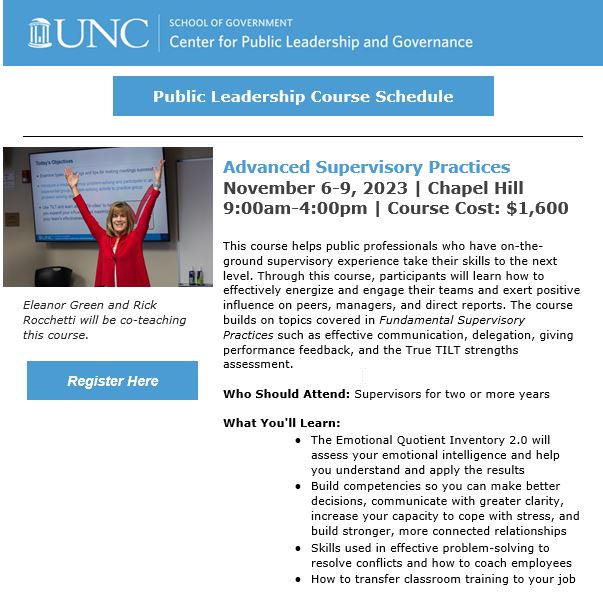
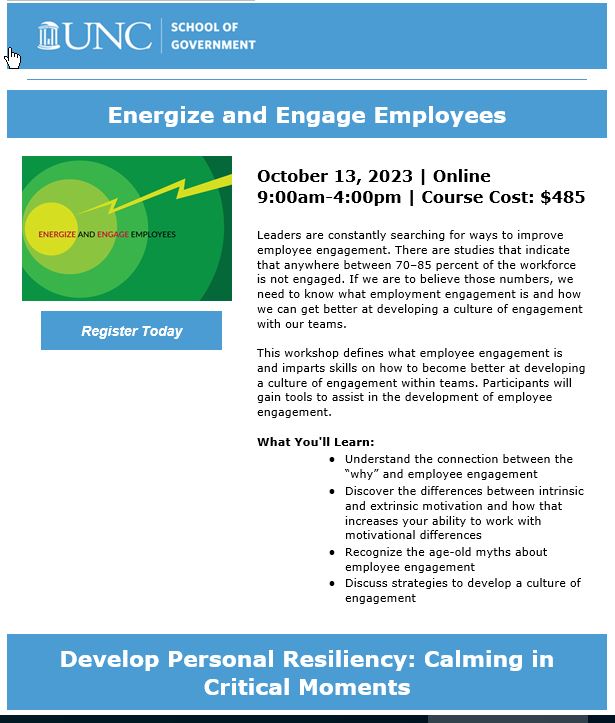
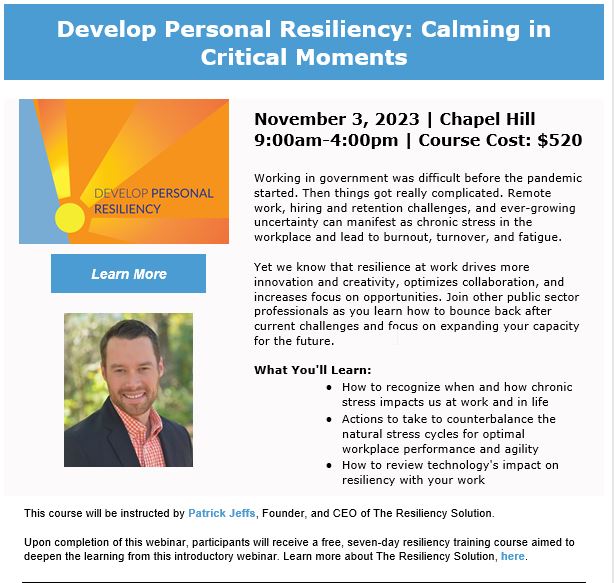
School of Government FY 23-24 Course Catalog
As the School of Government looks ahead to 2023-2024, we are pleased to release our updated course catalog.
The courses in this catalog focus on topics related to local government law, finance, management, administration, and leadership.
This catalog lists all scheduled courses at the time of its printing. Additional courses may be added throughout the year.
For up-to-date-information, view upcoming course opportunities online.
|  |  |  |  | |
This is an application-based course. Applications for the 2024 offering are now open and are due on November 10, 2023.
Beginning on Sunday afternoon, February 4, and ending after lunch on Friday, February 9, the residential component of the Advanced Leadership Corps is held at the Rizzo Center on the campus of UNC-Chapel Hill.
ALC is an immersive personal development program comprised of three parts:
Part 1: The coach comes to you! In advance of the course, you will complete an assessment designed to give you insights into your leadership style. You will receive a preliminary one-on-one session with a coach that is scheduled at a time and place you select. The focus of this coaching is to work on your oral presentation skills. You will learn how to hold an audience’s attention and begin to craft your personal leadership vision.
Part 2: Residential leadership program In this week-long intensive course, you will create strong and lasting relationships with your fellow participants as you learn together in a series of activities that will strengthen your ability to effectively lead and govern. Sessions are held each day, and you will work together all day and most evenings.
Part 3: Follow-up leadership coaching Every participant receives two additional sessions with a professional executive coach. An experienced coach will help you interpret the feedback you received from your multi-rater leadership assessments. This personal leadership coaching will help you delve further into your own behaviors and practices in a way that strengthens your capacity to lead others.
Added Benefit: Upon completion, you become part of an extensive alumni network called ambassadors and attend future ambassadors’ events tuition free.
Who Should Attend:
This unique three-part course is open to local elected officials, including county commissioners, municipal elected officials, school board members and members of American Indian tribal councils.
The program is limited to 24 participants. Any experienced local elected leader is encouraged to apply, with preference being given to those who have served more than one term of office.
What You Will Learn:
• Improve your ability to inspire others to work toward a shared vision
• Develop deeper insights into what it means to lead and govern in the public sector
• Reflect on leadership as a skill to be learned and a relationship to be nurtured
• Learn to observe and adapt to others’ communication styles to form more effective relationships
Our Goal and Vision:
By offering this immersive course it is our goal to enable you to become an extraordinary and inspiring leader in your community, region, and state.
Our Vision is to form a dynamic and sustainable local elected leadership network across the state.
We Expect from You:
In exchange for this opportunity, we expect from you:
• Complete all advance assignments
• Commit to spending a week in Chapel Hill February 5th-10th
• Attend and participate in all events
• Share with others and respect differences
• Be fully present
Course Cost:
Thanks to generous support from our sponsors, The North Carolina Association of County Commissioners (NCACC) and Empower (formerly Prudential), the fee to attend is only $875. Included in the fee are registration, material, meals, and accommodations.
| |
Top 10 Primer: Gifts, Favors, and Conflicts of Interest
November 17, 2023 online via Zoom from 10:00 to 11:15am.
Elected officials are often bombarded with good will! Sometimes, that good will takes the form of gifts, most unsolicited but no less problematic. What’s an elected official to do?
In this interactive on-line workshop, faculty member Crista Cuccaro offers important points for elected officials to know about the legal and ethical boundaries of conflicts of interest, and accepting gifts and favors. Workshop participants will learn the answers to the following questions:
- What is a confliict of interest?
- How does North Carolina law define gifts and favors?
- When can you accept gifts and favors, and when should you politely decline?
- Does it make a difference if your unit is entering into a contract?
- What is the difference between a financial interest and a direct benefit?
- What does it mean to have a Duty to Vote? When can you be excused from voting?
- What do federal rules restrict regarding gifts, favors and financial intrests?
This is a LELA 101 level course. Elected officials participating in the Local Elected Leaders Academy earn 2 recognition credits for attending the live version of this program.
| |
On-Demand Courses Available Now | Ethics and Newly Elected Leaders Bundle
Ethics for Elected Municipal Officials
The League's General Counsel Office has developed an online Ethics training for members that meets the state statutory requirements. This engaging, on-demand course offers insights into the laws and principles that govern conflicts of interest, ethical standards of conduct at the local government level, and provides enhanced issue-spotting analysis and reasoning skills.
Register Here
Want To Take Ethics As A Group?
The League is now offering the ability for members to take their Ethics training as a group. For example, if your full council would like to take the Ethics course together during a meeting, you can view it under one person's account, but each registered attendee present will receive credit. If you are interested, please email Grace Findley to make sure each participant receives full credit.
| |
121 W. Nash St. Wilson, NC 27893
252-234-5952
| | | | | |