Robert Hiett
Executive Director
| |
Creating Regional Solutions Since 1971 | |
|
Greater Rocky Mount, Greenville, & Wilson Area Regional Transit Plan
North Carolina has experienced significant population growth in the last decade and this growth is impacting where, how, and why people travel around the state. The goal of the Greater Rocky Mount, Greenville, & Wilson Area Regional Transit Plan (RTP) is to plan for public transportation needs in a consistent and coordinated manner for the diverse population included in the ten counties of the Greater Rocky Mount, Greenville, & Wilson Area Coordinated Region.
Link to survey:
Regional Transit Plan | Greater Rocky Mount, Greenville, & Wilson AreaOnline Survey (surveymonkey.com)
The Greater Rocky Mount, Greenville, & Wilson Area Coordinated Region covers ten counties:
- Beaufort
- Bertie
- Edgecombe
- Halifax
- Herford
- Martin
- Nash
- Northampton
- Pitt
- Wilson
The Regional Transit Plan will analyze population and demographic data, travel trends, current transit services, as well as prior policies and plans to complete a regional assessment.
To augment the data analysis, public and stakeholder engagement activities will include stakeholder interviews, discussion groups, public meetings, and a virtual room housing various project details. A Coordinating Committee, with representatives from each county, will oversee the project’s engagement process.
Once the needs of the community are understood, a set of potential transportation solutions will be developed. The prospective solutions will be evaluated and prioritized into a five-year plan. A financial plan will also be developed.
| |
|
Respond to Regional Food System
Survey for Local Governments
As one of North Carolina’s top industries that brought in $93 billion dollars to the state’s economy in 2020 and was responsible for 17.5 percent of the state’s total jobs, agriculture and associated industries are essential in our economic plans. The Upper Coastal Plain, Kerr-Tar, and Triangle J Councils of Governments have identified regional food system development as a key strategy in our regions to help drive economic development. This three COG partnership promotes rural-urban connectivity, explores strategies to circulate more money in the local economy and build on farm and food business retention and expansion efforts to increase the economic vitality, equity and resilience of our region. As partners in this work, it is integral to hear from you and your colleagues about your experience and interest in food system development in your community by answering this short ten question survey.
| |
 | |
Rural Center planning 12-stop summer tour of rural communities
RALEIGH, N.C. — The North Carolina Rural Center will travel the state during its 2023 Summer Road Trip, visiting 12 rural counties from May to August to listen and learn more about the forces shaping communities and regions.
“Engagement in rural communities is the heart of our work at the NC Rural Center,” said Rural Center President and CEO Patrick Woodie. “This opportunity to spend time with the people we represent in their hometowns will allow us to strengthen our programs and deepen our relationships.”
The Center recently released the publication “Forces Driving Change in Rural North Carolina,” an examination of eight major forces driving change in modern rural communities. At each stop on the road trip, Rural Center staff will present the region-specific findings of this data-driven report to elected officials, community leaders, business owners and others interested in rural development. The visits will also help Center staff learn what obstacles communities may be facing and where and how they’re having the most success.
Data and stories from the tour will be featured at the Center’s 2024 Rural Summit in Raleigh. The information will also be used to refine and deepen publications and research.
The first six stops of the tour have been scheduled in the southern and eastern parts of state. Residents of the host counties as well as people in surrounding counties are invited to join, and they can register at https://cvent.me/x39g0R. Details about the July and August stops on tour will be released closer to those dates.
Southern Leg
May 15 – Montgomery Community College, Troy, 2-4 p.m.
May 16 – UNC-Pembroke, Thomas Entrepreneurship Center, 1-3 p.m.
May 18 – Lois G. Britt Agricultural Center, Kenansville, 10 a.m. - noon
Eastern Leg
June 6 – Albemarle Commission, Hertford, 10 a.m. - noon
June 7 – Halifax County Cooperative Extension, Halifax, 10 a.m. - noon
June 8 – Beaufort County Community College, Washington, 10 a.m. - noon
###
| |
|
DOT Opens $700M Grant Program for EV Chargers, Alternative Fuels
The Transportation Department opened a $700 million funding opportunity for states and local governments to install EV chargers and other alternative fuel infrastructure, part of its initiative to build a national charging network of 500,00 public chargers by 2030.
Funds from the Charging and Fueling Infrastructure (CFI) program - which will total $2.5 billion over 5 years - will flow directly to state and local agencies to build infrastructure for electric, hydrogen, propane and natural gas vehicles. The money will be split equally between projects in two categories: those along state-designated alternative fuel corridors, and those at community gathering points like stores and apartment complexes, the latter of which will be prioritized for rural areas and disadvantaged communities.
Background: The CFI program is designed to work in conjunction with the other major EV charging program funded by the Bipartisan Infrastructure Law, the $5 billion National Electric Vehicle Infrastructure Formula Program.
While the NEVI program is focused on helping states build fast chargers along interstate highway corridors, primarily for long-distance trips, CFI grants will mostly fund slower, "Level 2" chargers at common stopping points near residences.
Gabe Klein, who heads the Joint Office of Energy and Transportation, said in a statement that the CFI program will complement NEVI by providing the "right type of charging in the right location - whether that's high-powered charging on highway corridors and in urban hubs or Level 2 charging where EV drivers or riders live, work, and play."
Where the NEVI funds are relatively restricted - they are distributed by formula to states and their use is restricted to major highways - CFI grans are much more flexible. Awards can go to a range of state, local, and tribal agencies and the grants are discretionary, with applications weighted according to guidance in the Notice of Funding Opportunity released by DOT on Tuesday.
That means equity will be a major focus of the CFI grants, with the administration aiming to ensure lower-income and rural areas aren't left behind in the rapid push to electrify.
What's next: Applications for CFI grants are due May 30.
| |
|
Upcoming Environmental Justice Funding Opportunities
Environmental Justice Funding Opportunities
The Environmental Protection Agency (EPA) plans to invest 40 million dollars into Environmental Justice (EJ) grants across the country. The EPA’s funding opportunities are expected to award non-profits with grants ranging from $100,000-$500,000 and US Territories, local governments, and federally recognized tribal government with access to $20 million in funding through the State Environmental Justice Cooperative Agreement (SEJCA) Program. $50 million is dedicated to the creation of Environmental Justice Thriving Communities Technical Assistance Centers (EJ TCTAC), one-stop-shops dedicated to supporting environmental justice initiatives in under-served communities.
A 14 minute presentation from the North Carolina Department of Environmental Quality covering these funding opportunities can be found here.
Other Resources
· EPA’s Office of Environmental Justice
Environmental Justice Thriving Communities Technical Assistance Center
· EPA Grants
| |
Golden LEAF Flood Mitigation Program -- Accepting Applications
Eligible Entities
Funds may only be awarded to units of local government. Local governments from all 100 counties are eligible.
Eligible Projects
Up to $250,000 may be awarded per project.
- Construction of new or improvement of existing publicly owned stormwater infrastructure, including natural drainage infrastructure and flood control equipment.
- Repair of existing stormwater infrastructure damaged or destroyed by flooding, which must include improvements to mitigate against future flooding.
- Engineering expenses related to planning and development of flood mitigation solutions.
Process
Applications will be accepted until all available funds are awarded. Applications are accepted on a rolling basis.
Information about the program is available here.
Questions from potential applicants can be directed to submit the form here.
| |
|
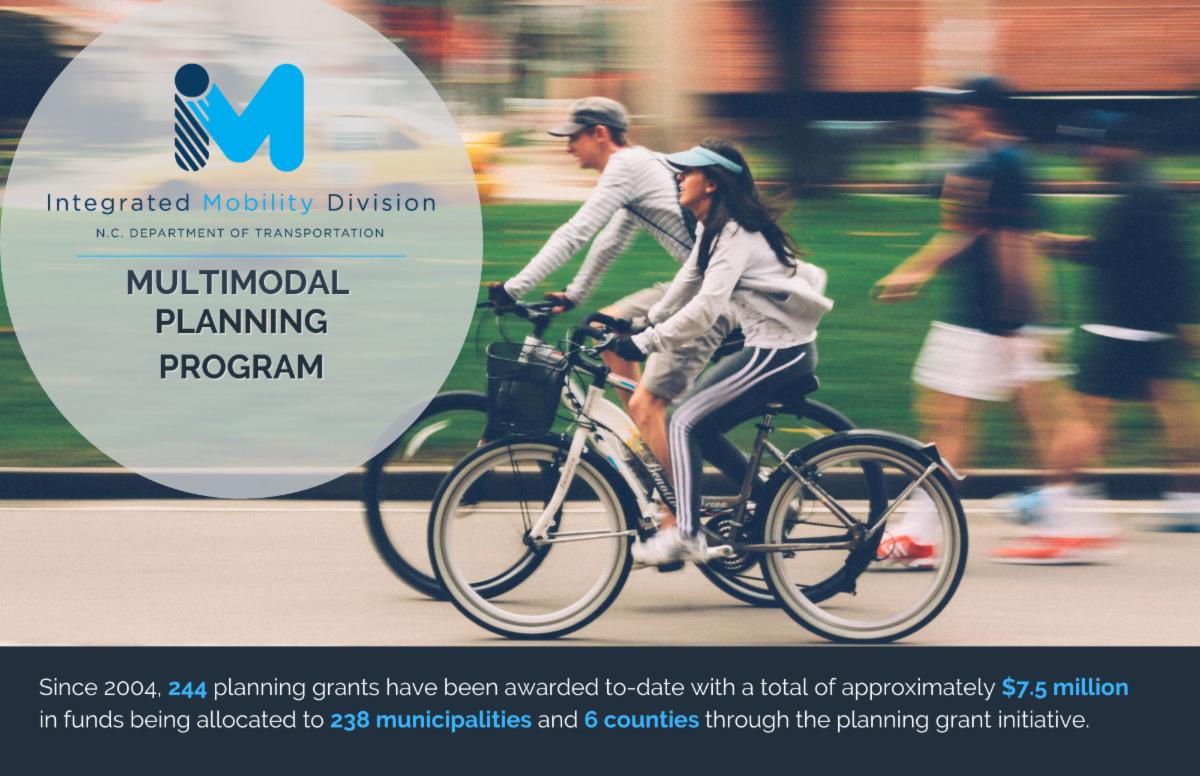
The NCDOT Integrated Mobility Division (IMD) and the Transportation Planning Division created an annual matching grant program – the Multimodal Planning Grant Program (MMPG) – to encourage municipalities to develop comprehensive bicycle plans and pedestrian plans. This program was initiated in January 2004 and is currently administered through NCDOT-IMD.
The Multimodal Planning Program has been successful in its 20 grant cycles - since 2004, 254 planning grants have been awarded. To date, a total of approximately $8 million has been allocated to 248 municipalities and 6 counties through this grant program.
| |
|
EDA accepting applications to support public planning and construction/renovation projects that advance job creation and economic development
The Economic Development Administration is a federal agency that provides grant funds to support a range of construction and non-construction activities which will advance economic development and enhance the competitive environment in which jobs can be created and private investment leveraged. Public entities, or nonprofit entities working in collaboration with local governments, looking for support to construct or renovate public assets, or to conduct analysis or regional technical assistance programs with clear economic development outcomes should consider EDA’s grant programs. EDA currently has a range of programs available. For further information, please go to https://eda.gov/funding-opportunities/.
North Carolina applicants are also encouraged to reach out to the NC EDA representative, Hillary Sherman at hsherman@eda.gov to discuss program requirements and processes and alignment with potential projects.
| |
$4.5 Million STEM Talent Challenge Funding Opportunity
Launched to Build a Robust STEM Talent Workforce for Emerging and Transformative Innovation Sectors
EDA is now accepting applications for its STEM Talent Challenge to support programs to train science, technology, engineering, and math (STEM) talent and fuel regional innovation economies across the nation.
The $4.5 million competition will provide funding for programs that help build a robust STEM workforce in emerging and transformative sectors such as aerospace, aeronautics, biotechnology, advanced manufacturing, cybersecurity, among others.
Read more in today’s blog post.
Competitive applications will demonstrate how the program will develop or expand regional STEM workforce capacity to support entrepreneurial ventures, industries of the future, and other innovation-driven businesses.
Eligible applicants include cities, counties, states, other political subdivisions of states, and Tribal Nations; as well as non-profit organizations, public-private partnerships, federal laboratories or science/research parks, institutions of higher education, Economic Development Organizations, and consortia of the aforementioned with government support.
| |
|
Contact: press@oc.usda.gov
NEWS RELEASE
USDA Offers New Funding to Promote the Expansion of High-Speed Internet in Rural Areas
$20 million in Technical Assistance Funding is Available to Plan High-Speed Internet Projects in Rural Communities
WASHINGTON, April 17, 2023 – U.S. Department of Agriculture (USDA) today announced the availability of $20 million to deliver broadband technical assistance resources for rural communities, and to support the development and expansion of broadband cooperatives.
USDA is offering the funding under the new Broadband Technical Assistance Program. The program supports technical assistance projects such as conducting feasibility studies, completing network designs and developing broadband financial assistance applications. Funding is also available to help organizations access federal resources, and to conduct data collection and reporting.
“USDA is committed to making sure that people, no matter where they live, have access to high-speed internet. That’s how you grow the economy – not just in rural communities, but across the nation,” said USDA Under Secretary for Rural Development Xochitl Torres Small. “USDA is partnering with small towns, local utilities and cooperatives, and private companies to increase access to this critical service which in turn boosts opportunity and helps build bright futures.”
To learn more, read the full news release.
| |
|
Need technical assistance? UNC Environmental Finance Center is here to help!
The UNC Environmental Finance Center offers free one-on-one technical assistance for small water systems. If you have an interest in our support, fill out our interest form here.
| |
|
Have you reviewed guidance and other resources and still have questions about getting started and administering your local ARPA funds? For technical assistance, please contact your Upper Coastal Plain Council Of Governments. We are here to help!
Betsy Kane, Senior Regional Planner, phone 252-234-5902
email: bkane@ucpcog.org
| |
|
April 2023 Annual Career Fair
Nash Community College
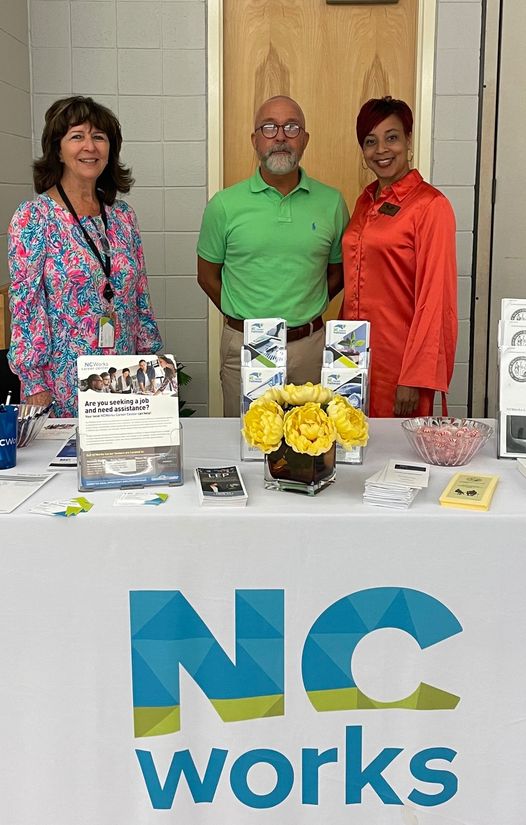
Turning Point Workforce Board, Business Services Manager, Carisa Rudd visited with NC Works Career Center Managers, Taylor Hawkins and Diane Thomas at the Nash CC career fair event, April 18, 2023. This event is in collaboration with Nash CC, numerous employers, Skills USA, NC Works and Turning Point WDB. Held annually, the Turning Point Local Area is proud to continue to be a partner to Nash CC and all its efforts to provide training and educational programs to employers and students of all ages in our Region.
| |
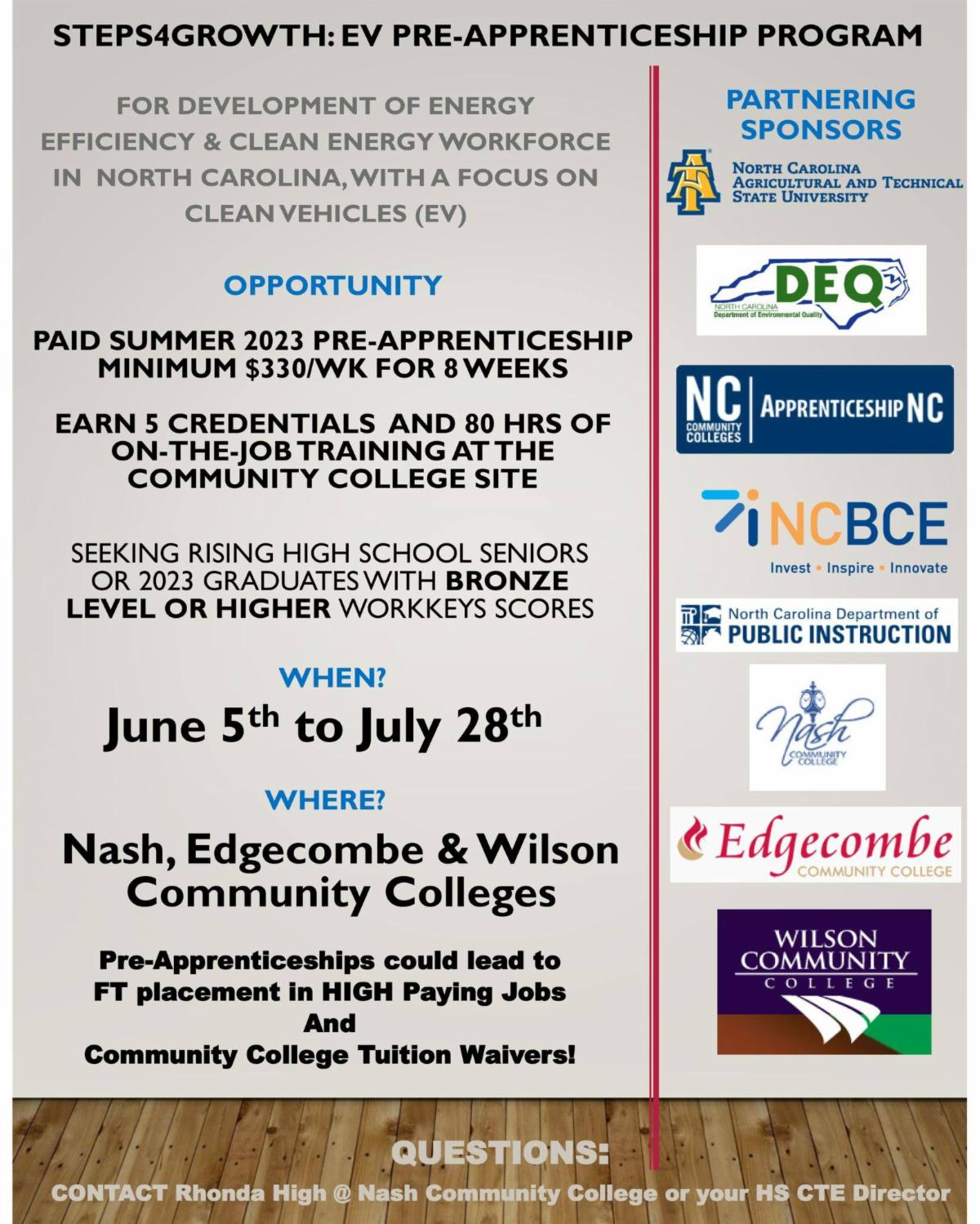
Our partners at these Community Colleges of our Region are offering opportunities! We are happy to be part of this STEPS4Growth work group as Clean Energy was a focus. Now they are ready for you! Contact them today! | |
|
Governor Cooper Signs Executive Order to Highlight North Carolina’s Commitment to Building an Age-Friendly State
Order directs the state to develop a comprehensive plan for aging, strengthen the caregiving workforce and enhance transportation options
RALEIGH: Governor Roy Cooper issued Executive Order No. 280 directing action to continue the state’s commitment to building an age-friendly state. The Executive Order brings a whole-of-government approach to support North Carolina’s aging population.
“Our rapidly growing and diverse older adult population strengthens our state and communities,” Governor Cooper said. “We’re going to continue our work to make North Carolina the best place in the country to grow older.”
Executive Order No. 280 directs the North Carolina Department of Health and Human Services (NCDHHS) along with expert working groups to develop a Multisector Plan for Aging. The Order also directs NCDHHS and the North Carolina Department of Commerce to convene a Caregiving Workforce Strategic Leadership group to develop and implement recommendations to bolster the caregiving workforce. It also directs NCDHHS to develop recommendations to improve adult protective services.
The Order also directs the North Carolina Department of Natural and Cultural Resources to improve access to outdoor spaces, the North Carolina Department of Transportation to improve transportation options and the North Carolina Department of Information Technology to improve access to broadband and digital literacy.
“I am so grateful for Governor Cooper's leadership in signing this executive order to make North Carolina a place where all people can thrive throughout life's seasons,” said Mary Penny Kelley, Executive Director of Hometown Strong. “By joining the Livable Communities network, North Carolina joins a consortium of other states working to advance policies to help a growing demographic. It's an honor to be a part of the incredible dedicated team that worked to make this possible.”
“In just a few short years, there will be more people living in North Carolina over age 65 than under 17,” said Joyce Massey Smith, Director of the Division on Aging and Adult Services for NCDHHS. “To address this unprecedented shift in the age of our population we are committed to capitalizing on the benefits of an older population as we provide them with the services and support they need in order to thrive.”
“Nearly 3.7 million North Carolinians live in communities that have joined the AARP Network of Age-Friendly States and Communities and are working on age-friendly improvements” said Mike Olender, Director of AARP North Carolina. “The state’s enrollment into the Network coupled with the executive order will be the glue that holds us all together to collaborate, will accelerate progress and will inspire even more improvements to our cities, towns, and rural areas that benefit North Carolinians of all ages.”
Approximately 1.7 million North Carolinians are aged 65 or older. By 2030, one in five North Carolinians will be older than 65. The Executive Order builds on the Governor’s previous actions supporting older adults. In 2022, Hometown Strong in the Governor’s Office and the North Carolina Department of Health and Human Services partnered with AARP to conduct the Age My Way NC survey which assessed North Carolinians’ needs and preferences with regards to aging.
Read the Executive Order.
###
| |
|
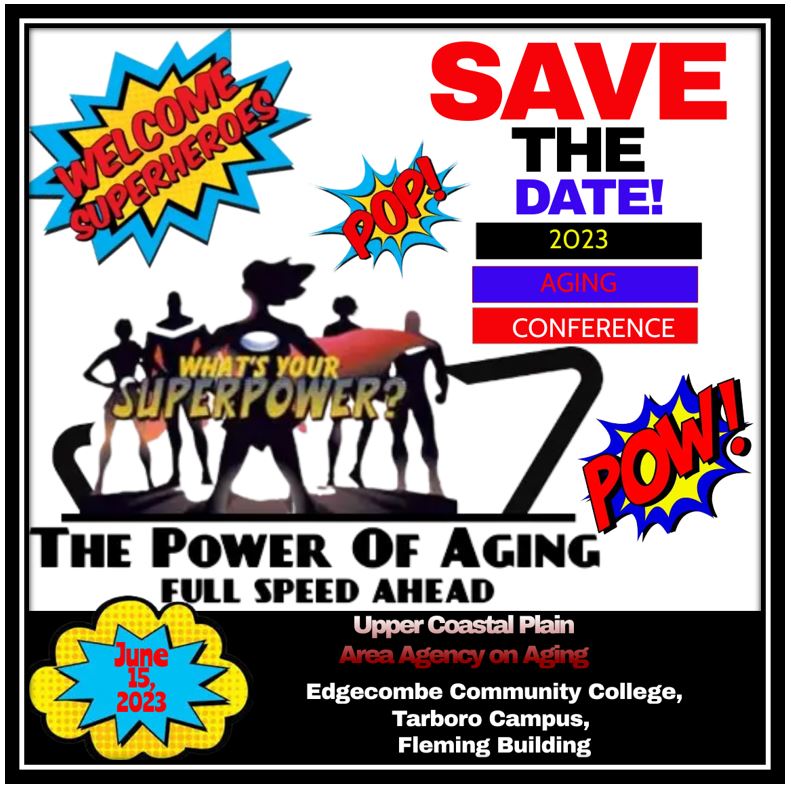
Our Superpowers have been activated and we’re excited to join forces with other Superheroes across the Aging Network.
Save the Date for our annual Aging Conference
Event: The Power of Aging: Full Speed Ahead Aging Conference
Date: Thursday, June 15, 2023
Venue: Edgecombe Community College—Tarboro Campus
Stay tuned for more information!
| |
How Exercise Leads to Sharper Thinking and a Healthier Brain
New findings from 350,000 people make the strongest case yet that exercise improves cognition.
To build a better brain, just exercise.
That’s the message of two important new studies of how physical activity changes our minds. In one, scientists delved into the lives, DNA and cognition of thousands of people to show that regular exercise leads to much sharper thinking.
Another study helps explain why exercise is good for the brain. Researchers found that just six minutes of strenuous exertion quintupled production of a neurochemical known to be essential for lifelong brain health.
The studies arrive at a moment when some recent, widely discussed research has been raising doubts about the extent to which exercise bolsters thinking and memory. But the new findings, which analyzed data for almost 350,000 people, make the strongest case yet that regular exercise can improve cognition.
These studies reinforce the idea that “absolutely, exercise is one of the best things you can do” for your brain, said Matthieu Boisgontier, an associate professor at the University of Ottawa, who oversaw one of the studies.
The first inklings that exercise remodels brains and minds came decades ago in mouse studies. Active, running animals in these experiments scored much higher on rodent intelligence tests than sedentary mice, and their brain tissues teemed with elevated levels of a substance known as brain-derived neurotrophic factor or BDNF, often referred to as “Miracle-Gro” for the brain.
| |
On-Demand Courses Available Now | Ethics and Newly Elected Leaders Bundle
Ethics for Elected Municipal Officials
The League's General Counsel Office has developed an online Ethics training for members that meets the state statutory requirements. This engaging, on-demand course offers insights into the laws and principles that govern conflicts of interest, ethical standards of conduct at the local government level, and provides enhanced issue-spotting analysis and reasoning skills.
Register Here
Want To Take Ethics As A Group?
The League is now offering the ability for members to take their Ethics training as a group. For example, if your full council would like to take the Ethics course together during a meeting, you can view it under one person's account, but each registered attendee present will receive credit. If you are interested, please email Grace Findley to make sure each participant receives full credit.
| |
|
May 17-19, 2023 | Chapel Hill
9:00am-12:15pm | Course Cost: $450
This course will review several topics to broaden participants' scope and understanding of public contracting issues. It will equip public managers to appreciate various make-or-buy decision techniques, learn about management and legal challenges in contracting and how to mitigate them, identify various ways to design context-driven contracts, and learn how to select, administer, and manage contracts. This course is best suited for mid-career and supervisory purchasing officials, finance officers, and line managers that oversee and administer contracts.
What You'll Learn:
- Identify issues in the contracting decision-making process
- Identify various options for contract design
- Better understanding of contractor and vendor relationship management
- Better understanding of how to contract with nonprofit organizations
- Better administer, monitor, and assess contract efficacy
- Appreciate challenges and find solutions in public contracting
- Appreciate legal limitations in the contracting process
Click here to view the course page and register.
| |
|
Top 10 Primer: Use of Social Media for Local Elected Officials
May 12, 2023 | Online
10:00am-11:15am
Course Cost: Free
Do Facebook, Twitter, TikTok, and other social media platforms have appropriate places in communications for local elected officials? What are the upsides? What are the downsides? What is public? What is private? How does your use of social media change once the campaign is over and you start governing? The answer to all these questions can be complicated when the people you communicate with live next door, see you in the grocery store or know where you have lunch every day.
What You'll Learn:
- Managing good and bad social media practices
- Improve your awareness of some of the murky areas around free speech and consequences
Register Now
| |
|
May 25, 2023 | Online
10:00am-12:00pm | Course Cost: $75*
Under North Carolina law, members of governing boards of cities, counties, local boards of education, unified governments, sanitary districts, and consolidated city-counties are required to receive at least two (2) clock hours of ethics training within twelve months after each election or appointment to office. The ethics training requirement is an ongoing obligation, triggered by each subsequent re-election or reappointment to office.
*Pricing Details:
Single Participant- $75
2-4 Participants from the same jurisdiction* - $150
5+ Participants from the same jurisdiction* - $225
*You must register each individual in the same transaction.
| |
Quasi-Judicial Board Workshop
1:00pm-4:30pm | Course Cost: $95
Participants can choose one of the following dates:
May 3, 2023: Asheville
May 10, 2023: Wilmington
May 17, 2023: Greenville
May 24, 2023: Kernersville
June 8, 2023: Online
Register Now
Join us in your region or online for a board workshop on quasi-judicial development decisions. This spring the School of Government is collaborating with partners across the state to host regional workshops in-person and one workshop online on procedures and considerations of land use decisions. AICP credit available.
Who Should Attend:
- Whether you are new to the board of adjustment or other quasi-judicial board, or you’ve been around for a while and need a refresher, this workshop is for you
What You'll Learn:
- Do you have to hold an evidentiary hearing for a variance?
- What is ex parte communication?
- What evidence should be considered when we are making the decision?
| |
121 W. Nash St. Wilson, NC 27893
252-234-5952
| | | | | |