Rail & Labor News from RWU
| |
Weekly Digest Number 28 - July 9th, 2024 | |
Welcome to the RWU Rail & Labor News! This news bulletin is produced and emailed out each Tuesday morning. We hope you find each week's news and information useful. If so, please share with co-workers, friends, and colleagues. If you like, you can sign them up to get all the news from RWU HERE. Or forward them the link. Got a hot tip? Please forward the article and a link to raillabornews@gmail.com. Note: If you read over this news bulletin each week, you will be sure to never miss the important news of what is going on in the railroad world from a worker's perspective! | |
Editor's Note: The long-awaited "White Paper" commissioned by RWU and our allies in support of public ownership and control of the nation's railroad makes a compelling case to do away with the Wall Street hedge fund controlled railroad sytem after nearly two centuries, to be replaced by a modern, efficient, robust, expanding, worker and passenger friendly publicly run railroad system. Check it out! | |
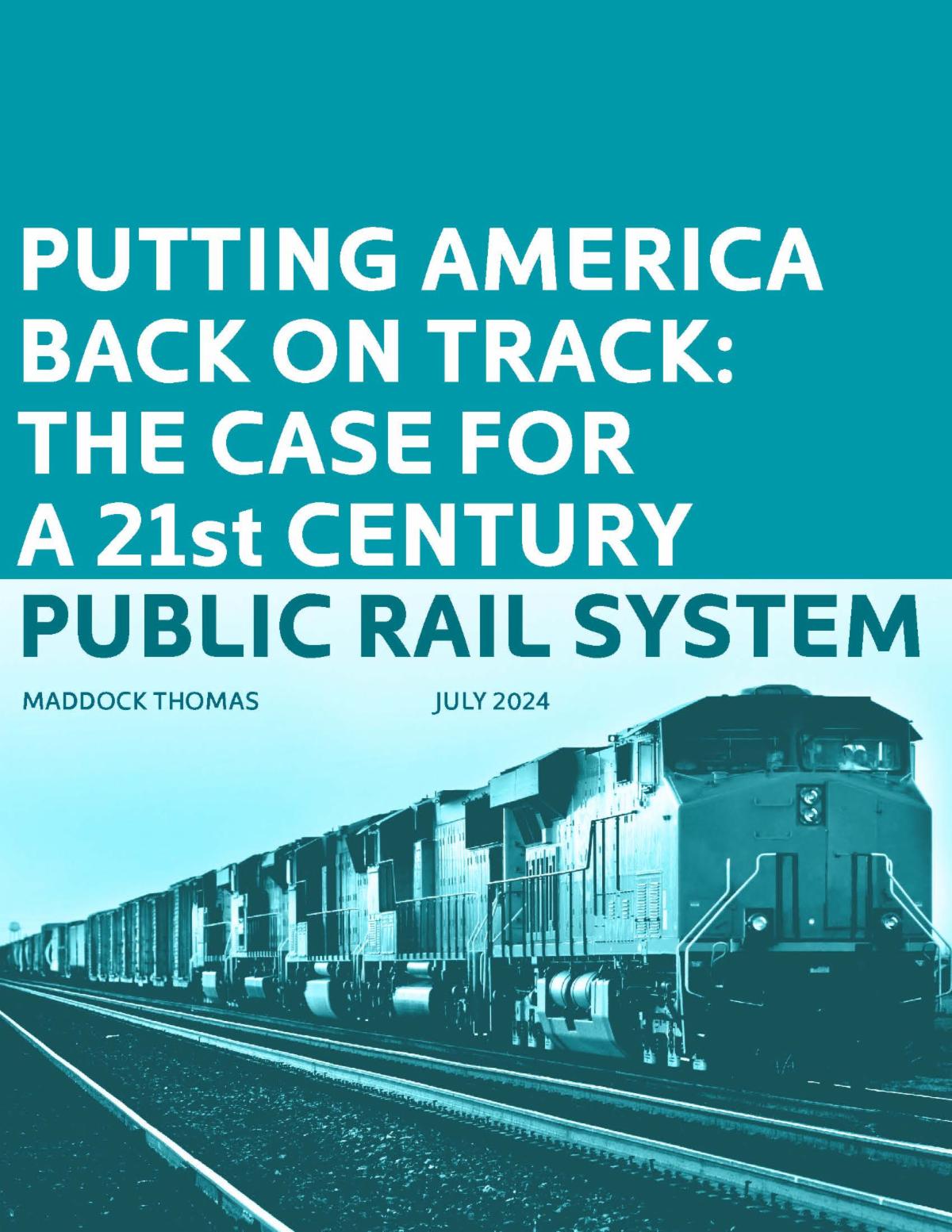 |  | Railroad Workers United and a Brown University fellow on Monday published a white paper calling for the institution of a public rail system to replace America's corporate railroad giants. The 110-page white paper, written by Brown University undergraduate Maddock Thomas and published as part of RWU's Public Rail Now campaign, argues that U.S. railroad corporations such as BNSF, Union Pacific, Norfolk Southern, and CSX have failed on safety, workers' rights, service, electrification, and expanding capacity to meet rising freight demand. Instead of using profits to invest in critical infrastructure, the railroads have lined shareholder pockets with dividends and buybacks, Thomas wrote, advocating for a public system where that money could be spent to improve safety and decarbonize freight transport, among other goals. Thomas M. Hanna, research director at the Democracy Collaborative, called for democratic, public ownership of railroads in a Public Rail Now statement. "At a time when we need it most, our nation's rail system is in disarray," Hanna said. "Dominated by a small group of giant for-profit companies, it is imperiling the health and safety of workers and communities, providing poor service for customers, abandoning growth and development, and stalling the expansion of passenger rail services."
| |
Editor's Note: The two brothers who jointly authored the piece below have served as state legislative board chairs for their respective unions in the state of Nevada, one at SMART-TD, the other at BLET, and have cooperated for years on promoting safety issues for trainmen and engineers, making for a shining example of how the unions of the operating crafts can cooperate and work together. (See article below on the sordid history of BLET (BLE) and SMART-TD (UTU) relations). | |
In an era when technological advancements promise enhanced efficiency and safety, Union Pacific Railroad’s shift toward remote control locomotives (RCLs) in Las Vegas represents a dangerous leap backward. The Brotherhood of Locomotive Engineers and Trainmen, Division 766, stands at the forefront of this issue, not as resistant to change but as guardians of safety in the face of profit-driven recklessness. Las Vegas is a hub of rail transportation that navigates a complex network of steep grades and bustling crossings — a task that demands the irreplaceable human judgment and situational awareness of certified locomotive engineers. Replacing these skilled professionals with remote operators strips away a critical layer of safety, introducing a high risk of miscommunication and delayed emergency responses. This is not speculative; it is a conclusion drawn from a disturbing record of accidents involving RCLs that speak to the inherent dangers of diluting human oversight in rail operations. | |
Editor's Note: In recent years, a series of young and inexperienced railroad workers have been killed on the job in switching moves. Whether the rail industry likes it or not, switching cars in a rail yard is a highly skilled job that requires lots of training and mentoring which the industry is not providing. At best, the work gets done inefficiently with poorly trained workers. At worst, someone gets killed. | |
|
MELROSE PARK, Ill. — The National Transportation Safety Board is investigating the death of a Union Pacific railroader who was fatally injured in Proviso Yard over the weekend.
“Preliminary information indicates on July 6, at approximately 1:59 a.m. CDT, a Union Pacific employee was fatally injured during shoving operations in Proviso Yard in Melrose Park, Ill.,” the NTSB said in a statement today. NTSB Chair Jennifer Homendy, in a post on X, said railroads must do more to prevent yard worker fatalities.
|
|
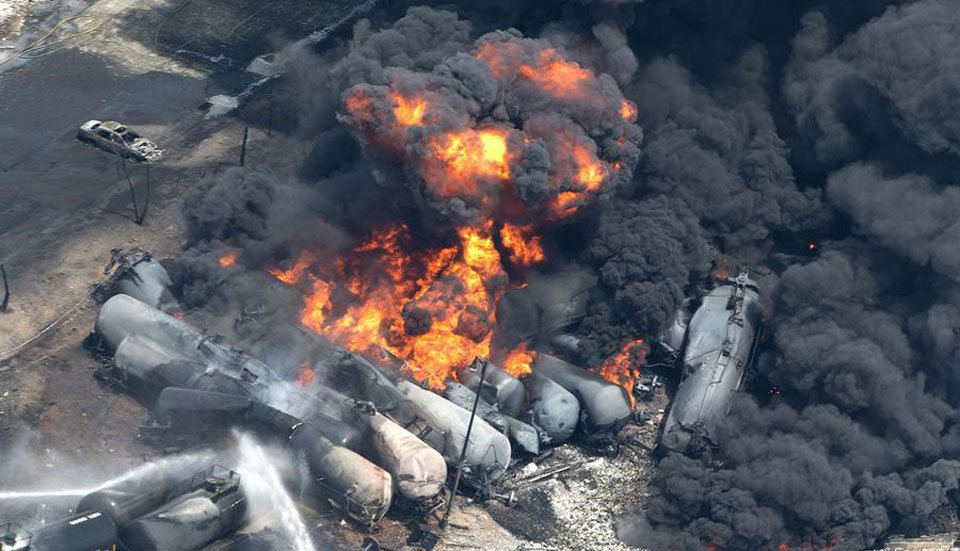
Editor's Note: Thankfully - unlike East Palestine, Ohio in 2023, this derailment and resultant fire were in a remote location away from structures and people. It sounds like compared to that wreck, perhaps twice as many derailed cars involved caught fire. Imagine had this been in downtown Fargo rather than out in the hinterlands? | |
|
Rail cars carrying hazardous material that derailed early Friday were still burning more than 12 hours later in a remote area of North Dakota, but officials said no one was hurt and the threat to those living nearby appeared to be minimal. Twenty-nine cars of a CPKC train derailed around 3:45 a.m. in a marshy area surrounded by farmland that's about 140 miles (225 kilometers) northwest of Fargo, said Andrew Kirking, emergency management director for Foster County. By late afternoon Friday, responders were able to “go on the offensive” in fighting the flames and have had “some success knocking the fire down,” Kirking said. With water on both sides of the tracks, officials were still working to get equipment close enough.
| |
Editor's Note: As rail's intrinsic efficiencies become known and understood by more and more people, the industry stands to experience a renaissance world-wide. Rail's limited carbon footprint, ability to be electrified, safety, and environmental sensitivity all combine to make it the preferred means of transportation in the era of climate change, crowded and crumbling highways. But it is going to take the political will to move the whole thing forward. And ironically the biggest stumbling block to progress is the rail industry itself. | |
|
Rail is currently the most carbon efficient means of transport and one of the most likely means for governments to hit their net-zero and emissions targets across the world. But there is still space for advancing the technology behind decarbonisation in rail. Will rail ever completely eliminate carbon emissions? Global Railway Review spoke to industry experts from around the world about decarbonisation in the rail industry and how it might be achieved.
| |
Editor's Note: This article from BMWED (railroad track workers) points out the hypocrisy of those in Congress who pose as "fiscally responsible" budget cutters when in fact they are thieves and liars. | |
|
Before we get into the proposed 21 percent cuts to the Railroad Retirement Board’s administrative budget and the devastating effect those would incur, it is important to note this simple fact right at the top: The RRB’s administrative budget is financed by payroll taxes paid by RAIL EMPLOYEES and rail employers. Funding is appropriated from the RRB Trust Funds and NOT FROM the U.S. Treasury’s general fund. In other words, the proposed cuts to the RRB released last week by the U.S. House Appropriations Subcommittee on Labor, Health and Human Services, Education and Related Agencies for Fiscal Year 2025 steals from railroaders. These reductions do not save “John Q. Taxpayer” any money. This is RRB Trust Fund money tethered to the federal government’s oversight.
| |
Editor's Note: Sooner or later, sometime this summer, it appears there will be a strike in Canada in logistics. How successful rail/longshore workers will be is dependent upon how much the government stays out of the fight and grants the workers their right to take strike action; and should the state intervene, just how willing the workers are to defy its authority and take action regardless. | |
|
Strike action has threatened to erupt at both Canada’s ports and rail networks, leaving the Canadian Industrial Relations Board (CIRB) with its hands full. In its ongoing dispute against the British Columbia Maritime Employers Association (BCMEA), the International Longshore and Warehouse Union (ILWU) issued a formal 72-hour notice of intended strike action against DP World Canada, set to commence today at 4.30pm. Yesterday, however, the CIRB instructed the union to rescind the notice, ruling a strike would be unlawful ... Meanwhile, the CIRB announced it had denied the Maritime Employers Association’s (MEA) request to be granted intervenor status in the dispute between the Teamsters Canada Rail Conference union (TCRC) and rail operators Canadian National (CN) and Canadian Pacific Kansas City (CPKC).
| |
Editor's Note: Pro-corporate, pro PSR, and a harsh critic of rail workers, the author of this piece nevertheless is worth re-printing on occasion and this is one of them. Frank Wilner documents to destructive infighting that has plagued the operating craft unions for decades. Every trainman and engineer needs to take a long hard look at this list of sins committed by your unions, and ask yourselves, what has this gained us? The time to stop this fratricide and to come together in unity and solidarity is NOW! | |
|
Alleged are dishonorable recruitment, selling out the other union’s jobs, being weaker on safety, and misfeasance in member representation. Precipitating the current rumble is strenuous competition to hold and attract members and an April 2024 BLET attempt at a sweetheart deal with private equity fund Ancora that SMART-TD alleges would have harmed its members’ job security on Norfolk Southern had Ancora succeeded in a proxy battle.
Troublingly, this is more than a cacophonous parade of publicly traded insults as the infighting menaces good faith bargaining in an approaching new round of contract negotiations amending wage rates, benefits and work rules. The fault lines run deep—the two having six times rejected marriage and serially initiated hostilities against the other.
The underlying cause for each to leap at the other’s jugulars are declining numbers of dues-paying conductors and engineers as new technology has allowed Class I railroads to improve productivity and efficiency while slashing total employment from 458,000 in 1980 to under 116,000 today.
| |
| |  | Since the 2023 East Palestine derailment disaster, the railroad industry has continued to lobby against federal safety regulations, even as new data suggests that recent increases in train length have made derailments more likely. Months after railroad lobbyists pressured the Biden administration to brush off railworkers’ demand for safety limits on train length, new data show longer freight trains are significantly increasing the risk of derailments across the country. According to a new academic study evaluating a decade’s worth of federal data, one-hundred-car trains are 11 percent more likely to derail than two fifty-car trains, and two-hundred-car trains are 24 percent more likely than four fifty-car trains. The study follows other data showing that train derailments have risen since the 2023 disaster in East Palestine, Ohio.“Even when accounting for the reduction in the number of freight trains operated when the average train is longer, longer freight trains are associated with an increase in the aggregate odds of freight train derailment,” wrote researchers at Georgetown University, Virginia Tech, and Brigham Young University. “As the Railway Safety Act of 2023 is debated including the pros and cons of longer trains, an important consideration in these debates is the additional risk of derailment in the system that comes with longer trains.”
| |
Editor's Note: Hopefully all of these disparate these unions will now be able to bargain together in the next round and do better. | |
|
BOSTON — The Massachusetts Bay Transportation Authority has completed agreements with all 28 of its labor unions, an accomplishment covering 16 collective bargaining agreements, the agency announced today (Wednesday, July 3). The agency says this is the first time in 15 years it has had agreements in place with all its unions, and — with all the contracts for four-year periods — ensures the longest period of labor stability since the 1980s. The final agreement, ratified by MBTA Plumbers in June, completes a series of contract that built on an agreement reached with the Carmen’s Union, Amalgamated Transit Union Local 589, in August 2023 That agreement included an 18% raise over the life of the contract, as well as bonuses focused on employee retention and hard-to-fill positions.
| |
Editor's Note: If it is not one thing it is another. Amtrak's woes at the hands of the freight carrier "hosts" is endless. Proper track circuit shunting is crucial for the safe operation of trains, and operating and MOW workers simply must be involved in the process and at the table on these vital safety issues. | |
|
Unions say they have been shut out of Canadian National-led process; final report remains under wraps
| |
|
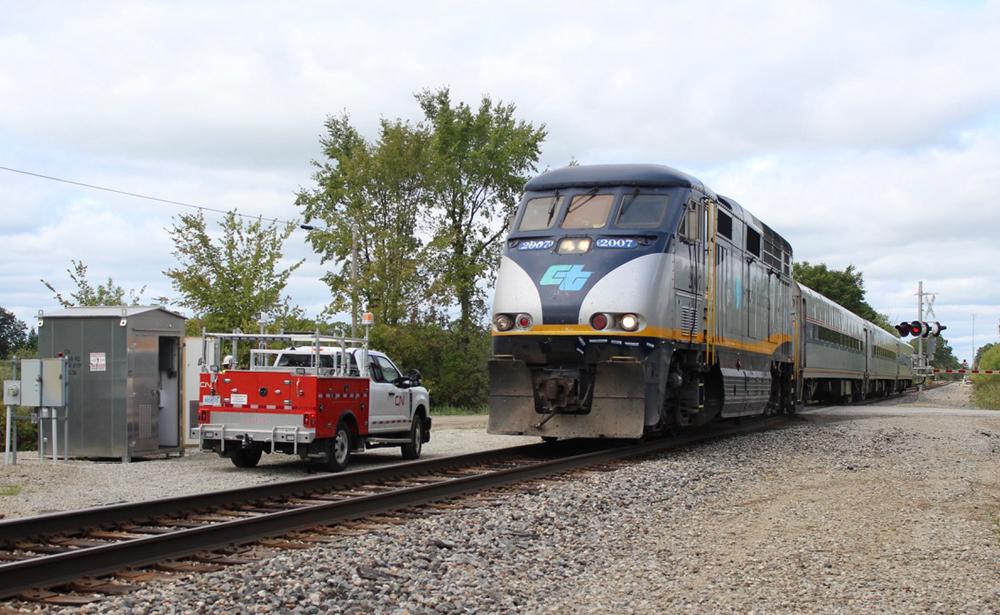
WASHINGTON — Three labor organizations have opposed Amtrak’s request for a waiver allowing installation of a device the company claims will prevent incidents where trains fail to trigger track circuits. As a result, a decades-old issue that recently has forced Amtrak to assign at least seven Superliners to trains operated over Canadian National’s Chicago-Carbondale, Ill., route is no closer to being resolved. Amtrak filed a petition with the Federal Railroad Administration to allow “shunt-enhancer antenna” installations on Charger locomotives, the power normally assigned to state-supported Illini and Saluki round trips. If the locomotive can provide a reliable electrical path between the rails from these antenna, which would be installed less than 2.5 inches from the top of the rail, the weight and type of passenger cars assigned won’t matter.
| |
Editor's Note: Curiously, on the 11th anniversary of this tragic wreck, a CP train derailed numerous cars and burst into flames that raged for two days in North Dakota (see artcile this issue). Thankfully the wreck was away from a population center. The citizens of Lac-Megantic were not do lucky 11 years ago. | |
|
LAC-MÉGANTIC, Quebec — Canada’s Transport Minister, Pablo Rodriguez, today released a statement as part of events marking the 11 years that have passed since Canada’s worst rail disaster, the derailment and fire in Lac-Megantic that killed 47 people and destroyed most of the community’s downtown. “Since the tragedy on July 6, 2013, 11 years ago today, our hearts and thoughts have been with the victims and residents of Lac-Mégantic, and all others who have been affected by this tragedy in one way or another. … “It’s been 11 years now that Lac-Mégantic has been living with the memory of this tragedy, and throughout this time, the people of Lac-Mégantic have shown strength, resilience and determination to overcome this ordeal and rebuild their lives. Their courage is an inspiration to all Canadians
| |
NEWS FROM AROUND THE LABOR MOVEMENT | |
Editor's Note: The creative actions of Truckers Movement for Justice are bringing truckers and logistics workers along the supply chain together. | |
|
MONAHANS — Low wages and working conditions that truck drivers describe as degrading have sparked an organized labor movement in the Permian Basin, a historic first for the nation’s busiest oil field.
About a dozen truckers and local environmental activists descended Monday on three West Texas cities — Kermit, Mohanans and Odessa — and blocked entrances to sand mines with a row of cars to hand out fliers listing their demands to other truckers.
Workers said the one-day demonstration, which slowed production in the nation’s largest oil supplier, was a sequel to a similar protest last year that was largely ignored and a warning of the steps they’ll take to be heard. The truckers are demanding to be paid for the long hours they spend waiting to load and unload frac sand — or sand used during fracking to separate the rock, prop it open and prevent it from closing — more restroom facilities near loading areas and the ability to negotiate pay rates based on driving times and cargo weight, said Billy Randel, a lifelong trucker and organizer with the Truckers Movement for Justice.
| |
Editor's Note: Finally, a step in the right direction for working people who are regularly exposed to high temperatures to keep them safe. | |
|
OSHA announced today the issuance of a draft Heat Protection standard that will protect 36 million workers from the deadly effects of extreme heat in indoor and outdoor work settings. The draft comes 52 years after the National Institute for Occupational Safety and Health first issued a “Criteria Document” calling for “employee exposure to heat in the workplace be controlled by requiring compliance with the work practice standard,” and one day after Florida’s “Don’t Speak Heat” law came into effect which prohibits Florida localities from issuing ordinances that protect workers from heat. The proposal is part of a White House climate change day where President Biden is announcing numerous actions to protect Americans against heat and other impacts of climate change.
| |
Editor's Note: RWU is on record as supporting a "just transition", but railroad workers and other workers must insist any such transition has teeth, and that miners, refinery workers, railroad workers, and others do not suffer while white collar workers skate, | |
|
This June, government, worker, and employer delegates from around the world will meet at the International Labour Conference in Geneva to discuss how to achieve “a just transition towards environmentally sustainable economies and societies for all”. This discussion must look at the distinct role of the ILO in developing and implementing mitigation and adaptation measures within a rights-based context, and in particular the right to work.
| |
WEEKLY DERAILMENT DEPARTMENT | | | | |