A BEHIND-THE-SCENES LOOK AT THE SERI R2 ASSURANCE PROGRAM | |
We often say “R2 is how you know,” meaning that every vendor will say they process electronics sustainably and responsibly, but how do you know who actually does? The high bar set by R2 Certification is what gives customers confidence that their electronics partners really will protect the environment, the health and safety of workers and communities, data, and their brands.
One of the key strengths of R2 is in the structural design of the Certification process. To maintain integrity, there is a very intentional separation of roles for SERI and the independent Certification Bodies (CBs) who audit and evaluate facilities.
SERI facilitates the continued development of the R2 Standard, educates organizations on its implementation, and advocates for the global adoption of R2 Certification to build capacity for electronics sustainability around the world. And as the single scheme owner for R2 Certification, SERI also builds the rules for the R2 Certification program and monitors performance of the system.
To prevent any conflicts of interest, SERI has deliberately removed itself from certification decisions. It is the sole discretion of the CB to determine which facilities have earned R2 Certification, and which have not. Since CBs are the ones issuing the certifications, it is also their responsibility to suspend or even revoke the certification of any facility who doesn’t uphold the requirements of R2 in their day-to-day operations.
| |
The goal of the assurance program is to work toward consistency and accountability across all CBs and auditors. Where CBs make determinations about individual facilities, SERI’s work is at the program level. | |
SERI does quite a bit behind the scenes, supporting the CBs to safeguard the quality and integrity of the R2 Certification program. In fact, there is a SERI team dedicated to assurance of the R2 Certification program. The SERI Assurance team reviews recent audits conducted by the various CBs, proactively conducts unannounced spot inspections, and performs witness inspections of R2 audits. This globally dispersed team works to improve the R2 Certification program by using lessons learned from assurance activities to revise audit protocols, coach auditors, make formal complaints to CBs, build content for ongoing training and education, and in the most egregious cases, work with CBs to remove bad actors from the R2 Certification program.
The goal of the assurance program is to work toward consistency and accountability across all CBs and auditors. Where CBs make determinations about individual facilities, SERI’s work is at the program level.
Sharing Lessons From Investigations
Through the assurance activities conducted in the first half of 2024, SERI has learned that the definition of “campus” is being appropriately applied within Certifications.
On the other hand, package reviews showed that the auditing of Brokers needs some attention. In response, SERI initiated a continuing education course to train auditors on evaluating brokering transactions and has developed a new Broker Transaction Sheet and guidance. This new method is currently being piloted and will evolve based on field experience to improve the auditing of brokers. Though intended for auditors, these resources are publicly available in the Knowledge Base.
| |
|
Another lesson learned from the package reviews was that auditors had difficulty assessing the legitimacy of quality management system certifications such as ISO 9001 in various regions around the world. To address this, SERI created a guidance document to assist auditors with resources in checking the validity of the management system certificates to ensure they meet the specific R2 requirements and are not just “pay to play” certificates.
Ultimately, the value of any certification lies in its credibility. While most R2 Certified facilities are responsible refurbishers and recyclers that are meeting the requirements of the R2 Standard, there are sometimes those who cut corners to gain competitive advantages. This creates an unfair market for the industry, and is why we all have a vested interest in rooting out the bad actors.
We all hear the rumors, and SERI’s Assurance team is regularly performing oversight and is working to investigate reports of impropriety. It isn’t SERI’s style to publicly call out those organizations, but rest assured we are diligently working behind-the-scenes with the CBs to identify, correct, or get rid of bad actors. And at the same time, we celebrate all the R2 Certified facilities who are committed to contributing to a more circular and sustainable future.
| |
THE CODE OF PRACTICES HAS BEEN UPDATED | |
|
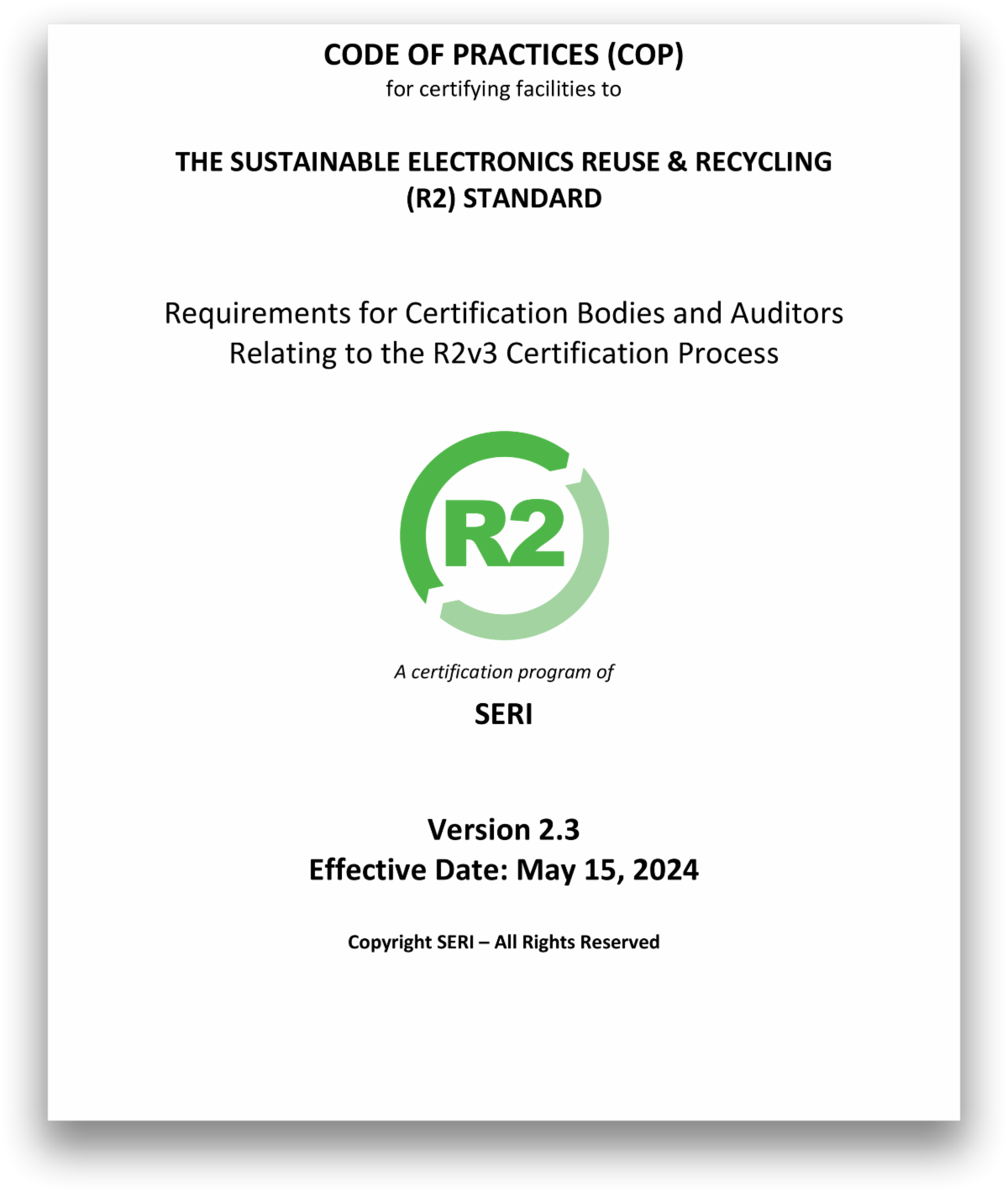
The Code of Practices (COP) is the document that Certification Bodies who are accredited to offer R2 Certification are held accountable to by their Accreditation Bodies. It provides detailed requirements for the R2 certification process, including audit durations, steps to handle nonconformity, and procedures for managing complaints.
Who Is the COP For?
While the COP is for Certification Bodies and their auditors, it also indirectly affects all certified facilities in the rules to certify to the R2 Standard.
What Are COP Updates?
Just as R2 is built for continual improvement, SERI approaches maintaining the R2 Certification program in a similar fashion. That is why it is important to apply learnings to the COP each year to continue to strengthen the overall program. The first version of the COP was introduced in 2013. The current version, 2.3, marks the fifth revision of this important document.
Some Key Updates in Version 2.3
-
Added Certification protocols for Appendix G: PV Modules to enable the auditing and certification of solar panel reuse and/or recycling.
-
Added a Code of Ethics for CBs and auditors that strengthens the commitments of all certification personnel to the highest professional behavior.
-
Updated Conflict of Interest Language to eliminate paid or reciprocal relationships between CBs and consultants, family members, and others.
-
Added New Major Nonconformities including the failure of an R2 Facility to audit legal compliance, as well as the failure to maintain the required management system certifications.
-
New Probationary License: SERI created a new process that will allow for the issuance of a probationary license for R2 Certification, thereby invoking additional assurance measures from the CB and SERI where past performance or questionable activities are known.
-
Audit Time Calculations: increased minimum audit time for Appendix A to provide more CB auditor time for auditing downstream vendor qualifications.
-
Added a 20% discount in the Core certification time to those facilities already certified to AS/NZS 5377 (Australia/New Zealand) or EN 50625 (Europe).
For a detailed list of changes and to download the complete document, visit the SERI document library. The full list of revisions can be found at the end of the COP.
| |
R2 TAC REQUESTS FEEDBACK ON PLASTICS | |
On Jan. 1, 2021, the Basel Convention Plastic Waste Amendments went into effect by subjecting certain plastic waste to controls, such as mixed plastics often found in electronics. Basel’s Amendments have significant ramifications for the recycling chain worldwide, including facilities that export plastics to recycling facilities in other countries. For U.S. exporters, the Amendments have a specific effect because the U.S. is not a party to the Basel Convention, which limits legal options for international trade in compliance with the Amendments. Due to a lack of domestic plastics recycling capacity in the U.S., the Amendments might drive companies to landfill or incinerate plastics as a solution to compliance. Beyond the negative environmental impacts, landfilling and incineration may also create difficulty for producers to meet extended producer responsibility (EPR) program goals.
A common baseline in every standard is to be compliant with the law and the R2 Standard requires R2 Certified Facilities to specifically implement the legal requirements related to the export, transit, and import of electronic equipment, components, and materials. To improve the implementation of the Basel Amendments in R2’s legal requirements, the R2 TAC is considering adding Basel-controlled plastics to the R2 Equipment Categorization (REC) as an R2 Controlled Stream. Before taking action, the R2 TAC wants to ensure that industry stakeholders such as R2 Facilities, OEMs, and others have a chance to understand how the potential additions would affect them and provide feedback for the TAC to consider.
SERI has assembled Q&As to delve deeper into the topic. To learn more about the proposed additions and share your feedback regarding including these controlled plastics in the REC, please visit our Basel Plastics Page. Feedback submissions will be open until August 15th, 2024
| |
R2v3 STANDARD NOW AVAILABLE IN SEVEN LANGUAGES | |
|
As a global standard now in 42 countries, SERI remains committed to R2 being a way for customers to have confidence in their electronics reuse and recycling partners, wherever they may be in the world. To support the adoption of R2 globally, SERI continues to add translations of the R2 Standard so customers and facilities have access to the documents in their native language.
We are pleased to announce that in addition to English, SERI now offers translations of the R2v3 Standard in six additional languages: Chinese, Portuguese, French, Spanish, Japanese, and Hindi. Additionally, the R2 REC is available in English, Portuguese, French, Spanish, and Japanese, with more translations coming soon.
While the translations were produced by professional translation companies, technical documents pose unique challenges in terms of specific terminology and industry related concepts. SERI would like to thank the following volunteers for their help reviewing the translations as an additional level of quality control: Jane Zhou, Dalis Garzon, Louis Reny, Michel Raby, and Arun Sinha. Your contributions are essential in helping us move the world toward a more sustainable future!
All translated documents are available for download free of charge in our document library.
| | |
|
R2 TIP: WHY THE DESCRIPTION ON YOUR SHIPPING DOCUMENTS MATTERS
Mislabeling of shipments is a non-conformity under R2. Core Requirement 10(c) states that all shipping documentation, labeling, and import/export declarations need to use accurate codes, descriptions, and required declarations consistent with regulatory requirements for the equipment, components, and materials being transported.
For instance, if the packing list says power supplies or scrap servers, but the ocean freight documentation for that same load uses codes for “copper flakes” or “aluminum flakes,” then that would not be an accurate code and would most likely be a nonconformity against the requirements of Core 10.
| | |
|  |
THE POWER OF THE R2 KNOWLEDGE BASE | The R2 Knowledge Base is filled with videos, implementation articles, podcasts, and more helpful resources, all built to support the R2 community through the R2 certification process. | | |
RECENTLY ADDED TO THE KNOWLEDGE BASE | |
CTIA GRADING Q&A – Now that CTIA, the wireless industry association, announced that it has aligned its wireless industry device grading standard to reflect the requirements of SERI’s R2 Equipment Categorization (REC), we dive into what this might mean for an R2-certified facility.
DOWNSTREAM VENDOR QUALIFICATIONS FOR PERFORMING DATA SANITIZATION - If an R2 Facility sends unsanitized equipment or components to an R2 downstream vendor for testing, repair, and logical sanitization, does the R2 downstream vendor also need to be certified to Appendix B for physical sanitization just in case some of the devices fail logical sanitization?
E-PLASTICS MARKET RESEARCH – STAKEHOLDER ENGAGEMENT REPORT - With the feedback period for the e-Plastics Market Research Stakeholder Engagement Report now closed, SERI has released a final version of the report, which is now available for download.
| | |
|
AVAILABLE R2v3 TRAINING CLASSES | |
|
NEW TO R2: INTRO TO R2 WEBINAR
If you want to learn more about R2, join us on our Intro to R2 Webinars. They are held 3-4 times per month and are offered to accommodate time zones on all continents.
| | |
|
R2 AUDITOR TRAINING CLASSES
Looking for in-depth, online, and interactive training on R2v3? These classes are open to auditors, consultants, and facilities. We have a range of class schedules to accommodate different time zones, including London in June and Mumbai in July. Space is limited, so sign up for the class today!
| |
EVENTS:
CHAMPIONING ELECTRONICS SUSTAINABILITY AROUND THE WORLD
| |
|
|
Each month, we let you know where we’re going and what conversations we’re having for two reasons. First, we hope you’ll catch up with us if you plan to be in the same places. But even more importantly, we want everyone to know how and where we are sharing our message, talking about electronics sustainability for a global circular economy and, in many cases, how R2 fits as a part of the puzzle. We see educating all the decision-makers to make better choices as a big part of the journey to electronics sustainability.
In May, Chief Provocateur Jeff Seibert led a panel discussion helping corporate sustainability teams understand how they can make a positive impact with electronics in their organizations at Circularity24.
Where we're headed next:
| |
-
E-WASTE WORLD CONFERENCE & EXPO, Frankfurt, Germany, June 26-27 – SERI is pleased to lead the Circular Electronics program for a second year and promote a whole-lifecycle approach. The SERI team, including Corey Dehmey, Jeff Seibert, Sarah Kim, Macy Toal, and Isabel Benitez will be part of the Circular Electronics programming and in the exhibit hall promoting R2 Certification.
| | |
|
HOW CAN WE HELP YOU?
Let us know what questions you have or what resources you would find valuable. The SERI Team is here to help!
| |
The R2 Update newsletter is a publication of SERI, a 501(c)3 non-profit organization that works to create a world where electronic products are reused and recycled in a way that promotes resource preservation, the well-being of the natural environment, and the health and safety of workers and communities. | Got the R2 Newsletter as a forward? Sign up to start receiving your own copy. | | | | |