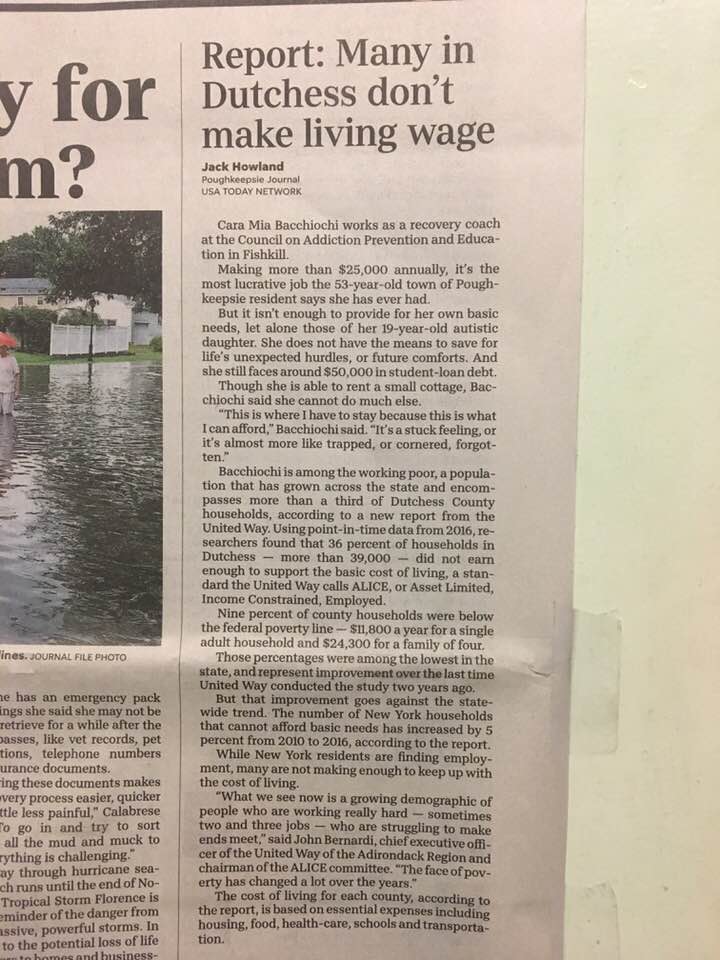
[yep that article just above (re-typed by hand just below by yours truly lol because it didn't make it to PoJo website) actually made it to top of front page of today's paper-- informing us that 27% of Dutchess households are with jobs yet in poverty-- and another 9 percent of county households poor as well (we need living wage NOW)...pls seize on this opportunity-- to email countylegislators@dutchessny.gov-- to help support my new resolution calling for creation of a Working Class Dutchess Task Force!...recall how on Aug. 20th Co. Leg.'s Giancarlo Llaverias, Kris Munn, Randy Johnson, and Nick Page actually signed my letter on this issue
https://conta.cc/2ORZXEn
-- tomorrow (Mon.) 4:30 pm is deadline for me to get enough co-sponsors; make sure my new resolution get on to Oct. Co. Leg. agenda!]
[recall as well how PoJo reported this Mar. 22nd: "The cost of living in the Poughkeepsie metro area is fourth-most expensive in the state, and Dutchess is the 19th-most expensive county in which to live, according to a report released this month. For a family of two adults and two children to live in the metro area, which includes Poughkeepsie, Newburgh and Middletown, the average annual cost is $117,826, according to a report from the
Economic Policy Institute
. The cost for a family of four to live in Dutchess County on average is $117,856 per year, which is sixth-highest in New York. However, the median household income in the Poughkeepsie metro area is $90,600, and $92,789 in Dutchess, according to the study. The review from the think tank included all 3,142 counties and 611 metro areas across the country. Of the costs that were factored into the average, including housing, food, transportation, health care and taxes, child care was the biggest projected expense locally, with a Dutchess family of four paying more than $2,400 per month."
Labor Day Rally: Advocates Call for Higher Wages, Benefits for Dutchess Workers
Dutchess County Needs To Ensure a Living Wage
= = = = = = = = = = = = = = = = = = = = = = = = = = = = = = = = = = = = = = = = = = = = = =
[note: below is excerpt of article from front page of today's paper-- update to this:
Report: Many in Dutchess Don't Make Living Wage
by Jack Howland Poughkeepsie Journal Sept. 16, 2018
Cara Mia Bacchiochi works as a recovery coach at the Council on Addiction Prevention and Education in Fishkill.
Making more than $25,000 annually, it's the most lucrative job the town of Poughkeepsie resident has ever had.
But it isn't enough to provide for her own basic needs, let alone those of her 19-year-old autistic daughter. She does not have the means to save for life's unexpected hurdles, or future comforts. And she still faces around $50,000 in student loan debt.
Though she is able to rent a small cottage, Bacchiochi says she cannot do much else.
"This is where I have to stay because this is what I can afford," Bacchiochi said. "It's a stuck feeling, or it's almost more like trapped, or cornered, forgotten."
Bacchiochi is among the working poor, a population that has grown across the state and encompasses more than a third of Dutchess County households, according to a new report from the United Way. Using point-in-time date from 2016, researchers found that 36 percent of households in Dutchess-- more than 39,000-- did not earn enough to support the basic cost of living, a standard the United Way calls ALICE, or Asset Limited, Income Constrained, Employed.
Nine percent of county households were below the federal poverty line-- $11,800 a year for a single adult household and $24,300 for a family of four...The number of New York households that cannot afford basic needs has increased by 5 percent from 2010 to 2016, according to the report.
While New York residents are finding employment, many are not making enough to keep up with the cost of living.
"What we see now is a growing demographic of people who are working really hard-- sometimes two or three jobs-- who are struggling to make ends meet," said John Bernardi, chief executive officer of the United Way of the Adirondack Region and chairman of the ALICE committee. "The face of poverty has changed a lot over the years."
The cost of living for each county, according to the report, is based on essential expenses including housing, food, health-care, schools and transportation.
It doesn't include unforeseen circumstances that could set a person back, like a medical situation not covered by insurance. It doesn't take into account saving for the future.
In 2014, 39 percent of Dutchess households were below the ALICE threshold, including 10 percent that were below the poverty line, according to the 2016 report...
The percentages vary by geographic area within counties. In Dutchess, the city of Poughkeepsie and towns in the east are among the areas with the fewest households with an income level the United Way characterizes as stable. However, families below the ALICE standard live in all areas, from urban to suburban to rural, and have backgrounds of all ethnicities and ages.
What It Costs To Get By
In Dutchess, a single adult needs to make at least $25,764 annually to meet the cost of living, according to the report, while a family of two adults, one infant, and one preschooler has to make at least $80,016 a year.
Those costs increased between 2014 and 2018. In the previous study, the cost of living in Dutchess for two adults, one infant and one preschooler was $73,212.
Of Dutchess' 108,200 households in 2016, 39,401 failed to make a living wage, according to the report, including 9,699 below the poverty line.
Nearly half the county's households (51,134) were single people under the age of 65 living alone or co-habitating. But the percentage of those households below the ALICE household (37 percent) was equal to households led by someone 65 or older, and comparable to households with families (34 percent)...
According to the study, 51 percent of all jobs across the state in 2016 paid less than $20 per hour. In Dutchess County, a wage of at least $24.67 per hour is needed to survive in a single-parent, single-child. household.
Patrick DeLeon, a town of Poughkeepsie resident living below the federal poverty line, said thinking about finances is a constant while living paycheck to paycheck.
He works as a financial empowerment employee with the United Way, and puts on financial literacy workshops in struggling communities. DeLeon said he is paid a small salary "to teach us how it is for those at the poverty level."
He's signed up for Medicaid, lives with his girlfriend and her parents to save on rent and avoids buying clothes and shopping anywhere but at a dollar store.
"I'd say the number one challenge is managing stress," he said. "It's a grind to worry about your bills a lot."
Geographic Divide
While Dutchess residents living below the poverty line can be found in every area of the county, some cities and towns experience more economic hardship than others, the report said.
The city of Poughkeepsie has the highest number of households below the ALICE threshold of any size in the county. Of 12,563 households, 62 percent are below that mark, and 21 percent are below the poverty line. Nearby Arlington also has 59 percent of its 1,263 households below the ALICE level.
But more rural areas also struggle. In eastern Dutchess, Dover Plains (61 percent), Dover (46), Amenia (46), Pine Plains (45), Pawling (46), and Millerton (56) all have a high number of households with income that makes it difficult to make ends meet.
Conversely, much of central and southern Dutchess, including Spackenkill, Beekman, Union Vale, Stanford, and Clinton, has at least 70 percent of households who surpass the ALICE mark. Of the 5,222 households in LaGrange, 80 percent are above the ALICE threshold and just 3 percent are impoverished.
The numbers can also vary sharply between neighboring areas. While 67 percent of households in the town of Wappinger can make ends meet comfortably, 54 percent in Wappingers Falls struggle.
Bacchiochi said the battle to survive is delicate, and slight changes in wages or the cost of living in an area can make a big difference for someone fighting to get above the poverty line or get by comfortably...
= = = = = = = = = = = = = = = = = = = = = = = = = = = = = = = = = = = = = = = = = = = = = =
https://www.poughkeepsiejournal.com/story/opinion/valley-views/2018/08/28/dutchess-county-needs-ensure-living-wage-column/1113023002/
Dutchess County needs to ensure a living wage: Column
by Joel Tyner, Valley Views.
Published 1:00 p.m. ET Aug. 28, 2018
Join us for our 24th annual Dutchess County Labor Day Rally at noon Monday Sept. 3 on the steps of Poughkeepsie Post Office.
Among those attending will be Hudson Valley Area Labor Federation Executive Director Beth Soto, Dutchess County Central Labor Council President Rob Pinto of the Communications Workers of America 1120, 1199S EIU Organizer Joseph Stratford, Webutuck Teachers Association President Rebecca Garrard, UWUA Business Agent Craig Dickson, United Service Workers No. 355 Shop Steward Tom McLain, Dutchess County Legislature Minority Leader Hannah Black, former Poughkeepsie Council member Ann Perry, activist Mae Parker-Harris, Beekman Democratic County Legislator candidate Tara Langworthy, folksinger Pat Lamanna and me.
We'll be carrying forward the letter to Dutchess County Executive Marcus Molinaro signed by County Legislators Giancarlo Llaverias, Kris Munn, Randy Johnson, and Nick Page that I circulated at the Aug. 20 full board meeting: "It is a moral imperative for our county government here in Dutchess to launch a new Working Class Dutchess Task Force to address the crisis facing working-class Dutchess County residents. We ask you to work with us and the Dutchess County Central Labor Council to launch such a task force, to consider local possibilities/initiatives like making sure the minimum wage is just as high here in Dutchess County as in Westchester County and Long Island (including wage justice for waiters/waitresses and Uber/Lyft drivers as in New York City), banning salary history questions as Westchester County has done, follow New York City's lead in banning job discrimination re: credit history, passing legislation to ensure fair workweeks and paid sick leave (New York City did both), enforcing a ban on wage theft the way San Francisco has done, protecting freelance workers in this new on-demand/gig economy, and ramping up creation of green-energy/infrastructure jobs through a new BlueGreen Alliance."
Workers here in Dutchess need a living wage — $15 an hour by 2022 (just as in Westchester County, Long Island, and New York City) — and at least $20 an hour by 2027-- recall this newspaper's front-page headline Nov. 27, 2016 — "40 percent of Dutchess Households Struggle Financially. In Dutchess, 30,215 of 104,190 households did not make a living wage. The living wage for the average family size was $60,000 for a household under 65 years old, The household survival budget in Dutchess was $73,212 for a family of four. 46 percent of senior households struggle financially."
Seattle's unemployment rate (3.4 percent) continues (as it has been for several years now) to be much lower than ours here in Dutchess County (3.8 percent) — in spite of the fact that a $15/hour minimum wage has already been implemented for companies with 500 or more employees (being phased in by 2021 for large and small firms); as it is now small businesses there who don't contribute to their workers' health insurance have to pay a $14/hour minimum wage (those who do pay $11.50/hour minimum wage).
As economist Robert Reich has pointed out, the Institute for Research on Labor and Employment looked at "employment in several hundred pairs of adjacent counties lying on opposite sides of state borders, each with different minimum wages, and found no statistically significant increase in unemployment in the higher-minimum counties, even after four years; they also found that employee turnover was lower where the minimum was higher."
A 2015 University of Connecticut/Jobs with Justice study found that taxpayers there subsidize government benefits for employees of large profitable corporations to the tune of $486 million a year — in a state 11 times the population of Dutchess; indubitably taxpayers here in our county shell out tens of millions for Medicaid, food stamps, healthcare, and other benefits for workers at such large firms — companies who should be paying a living wage. Can you say "corporate welfare"? I knew you could.
Joel Tyner is a Dutchess County Legislator representing Clinton and Rhinebeck.
= = = = = = = = = = = = = = = = = = = = = = = = = = = = = = = = = = = = = = = = = = = = =
[excerpt here below of article]
A Dutchess life: Surviving on only a few hundred bucks a week
by Nina Schutzman Poughkeepsie Journal
Published 3:05 p.m. ET Oct. 17, 2015 | Updated 11:33 a.m. ET Feb. 16, 2016
She's a single mom working to buy diapers, clothes and food for her growing daughter.
Nineteen-year-old Trista Moseley is no stranger to struggle.
Until recently, the City of Poughkeepsie resident held down two part-time jobs to try to make ends meet — one at Against All Odds, a clothing store in the Poughkeepsie Galleria, and the other at Stewart's Shops.
About three months ago, Moseley started working at Dutchess ARC, a nonprofit agency that serves local children and adults with developmental disabilities. Her former Poughkeepsie High School guidance counselor helped her land the job, she said.
The new job pays $12 an hour and she typically works about 30 hours a week, Moseley said. And while she could make more money by working more hours at the two part-time jobs, she now has more time to spend with her daughter, Saraii Dancy, who turns 2 in November.
But Moseley worries about the future.
"Kids are expensive...she (Saraii) grows so fast," Moseley said. "I pick up as many days as I can at work."
...many local people struggle daily with finances and the county has a "considerable economic divide... when it comes to making ends meet, particularly for the working poor and young adults," according to a Dutchess County/City of Poughkeepsie 2013-17 plan.
For a single parent with one child, that difference is more than $38,000 a year.
The federal poverty level is $15,930 this year for two-person household. If Moseley works a regular 30-hour work week every week, her annual gross salary — $18,720 — would be above the poverty level. But the living wage for a Dutchess household with one parent and one child is nearly $55,000 a year, when factoring in expenses such as housing, child care, medical costs and transportation.
And the living wage for a two-adult household with no children — the most common household type in Dutchess, according to Community Profiles — is more than $39,000.
Moseley makes ends meet by relying on family. She and her daughter live with Moseley's grandmother; Moseley's sister watches Saraii while she works.
After caring for her daughter, Moseley's income lets her pay her cell phone bill and help out her grandmother with rent.
"I give her like $200 a month for rent and food," Moseley said. "She doesn't really ask me for anything. She knows how hard it is."
Families eligible for most local assistance programs have incomes of less than 200 percent of the poverty level, said Sabrina Marzouka, commissioner of the Dutchess County Department of Community and Family Services.
"The programs are designed to help people at different needs," Marzouka added. The number of people who need some level of help fluctuates, but "on average...we have about 2,171 individuals" per month participating in some sort of financial assistance program.
The people who seek help from the department "want to be independent," Marzouka said. "They just need a little help to get out there and claim that independence"...
Moseley hopes to get a job at a Carmel-based rehabilitation center, which offers a higher hourly wage.
And one day, she wants to go back to school — she dropped out of Poughkeepsie High School when she got pregnant — and become a registered nurse.
"I could get my own place...not have to worry about struggling," Moseley said.
Nina Schutzman: nschutzman@poughkeepsiejournal.com, 845-451-4518,
= = = = = = = = = = = = = = = = = = = = = = = = = = = = = = = = = = = = = = = = = = = = = =
[recall below sent out by yours truly to this list Aug. 21st]
Giancarlo, Kris, Randy, Nick agree-- time for new Working Class Dutchess Task Force
Update-- thx tons to Co. Leg.'s Giancarlo Llaverias, Kris Munn, Randy Johnson, and Nick Page-- for agreeing at last night's full board mtg. to sign on to my new Working Class Dutchess Task Force here below-- email countylegislators@dutchessny.gov to help build support for actual resolution based on this to be passed this year!...
= = = = = = = = = = = = = = = = = = = = = = = = = = = = = = = = = = = = = = = = = = = = = =
To: countylegislators@dutchessny.gov
Subject: Colleagues-- 40 percent of Dutchess County households are the working poor-- it's time for us to ramp up efforts to seriously address this crisis in our midst...
Date: Aug 19, 2018 7:35 AM
Hi all...
Do you remember the article on the front page of the Poughkeepsie Journal November 27, 2016? I do.
"40 Percent of Dutchess Households Struggle Financially" [re: United Way ALICE report]
Pls check out at least some of these links here and read the letter just below them-- I'll be circulating that letter at our meeting tomorrow night.
Joel
- - - - - - - - - - - - - - - - - - - - - - - - - - - - - - - - - - - - - - - - - - - - - - - - - - - - - - - - -
The Honorable Marcus Molinaro
Dutchess County Executive
22 Market Street
Poughkeepsie, NY 12601
Dear County Executive Molinaro:
The Poughkeepsie Journal front-page headline November 27, 2016 was this-- "40 percent of Dutchess Households Struggle Financially." The article reported that, "In Dutchess, 30,215 of 104,190 households did not make a living wage in 2014 according to United Way. An additional 10,419 households lived in poverty...the income for April Messina's family of four is too high to qualify for food stamps but too low to live comfortably; Messina, 33, and her husband struggle to pay rent and bills and buy food with their. income-- he makes around $30,000 working full time at a commercial glass and glazing company, and she just started a new job at Walmart. 'There are so many people like me, said Messina, who just moved from Poughkeepsie to central Ulster County with her husband and two children. 'When I see the (poverty) statistics, I don't really believe it. I feel like I struggle more" than people who make less money but qualify for more public assistance. In Messina's household, it's important to scrutinize every expense. Each week, 'we make sure to put away what we need for rent,' which is $1400 a month, Messina said. 'I go to Aldi (a discount grocery store chain) for all my food shopping. I always make dinner at home because it's so much cheaper-- it's a lot of chicken and pasta but it's cheap. I see people debating a $15-an-hour minimum wage,' Messina added. 'And that's not even enough to survive."
It is therefore a moral imperative for our county government here in Dutchess to launch a new Working Class Dutchess Task Force to address the crisis facing working-class Dutchess County residents laid out in this letter head on. We, the various undersigned members of the Dutchess County Legislature ask you to work with us and the Dutchess County Central Labor Council to launch such a Task Force, to consider local possibilities/initiatives like making sure the minimum wage is just as high here in Dutchess County as in Westchester County and Long Island (including wage justice for waiters/waitresses and Uber/Lyft drivers as in NYC), banning salary history questions as Westchester County has done, follow NYC's lead in banning job discrimination re: credit history, passing legislation to ensure fair workweeks and paid sick leave (NYC did both), enforcing a ban on wage theft the way San Francisco has done, protecting freelance workers in this new on-demand/gig economy, and ramping up creation of green-energy/infrastructure jobs through a new BlueGreen Alliance.
The Poughkeepsie Journal article continued-- "A new report from United Way of New York shows that Messina is hardly alone-- nearly 40 percent of Dutchess County families struggle to make ends meet, according to United Way's report. That includes 10 percent of households at or below the federal poverty level and 29 percent of households that United Way refers to as ALICE, an acronym for asset limited, income constrained, employed. ALICE households have incomes above the federal poverty level but below the basic cost of living, which includes housing, child care, food, transportation, and health care premiums...The United Way rated Dutchess County as "poor" for housing affordability. Covering basic needs means simply surviving. It doesn't include saving for the future or other modern essentials, like a cell phone. And just surviving means that any unexpected expenses-- medical bills beyond insurance, accidents, etc.-- can sink a family barely staying afloat...ALICE people are just one paycheck away from disaster. There's a big difference between the federal poverty level-- which was #23,850 for a family of four in 2014-- and a living wage. "We see it (the federal poverty level) as a really outdated measure in terms of understanding the hardships that people are facing," said Stephanie Hoopes, lead researcher and director of the United Way ALICE Project."
The Poughkeepsie Journal article continued-- "In Dutchess, the living wage for the average family size (which is 2.61 people according to county officials) was $60,000 for a household under 65 years old, United Way reported. The household survival budget in Dutchess was $73,212 for a family of four-- two adults, an infant and a pre-achooler. The household stability budget for a family of four-- which unlike the survival budget, includes savings and a cell phone bill-- is nearly double that of a survival budget, United Way reported. Prospects for public assistance for ALICE families are moderate, United Way reported. With many government benefits now linked to work and many jobs increasingly subject to changes in hours due to seasonal or economic activity, ALICE workers are often in a recarious position. The median household income in Dutchess was $71,165 in 2014, higher than surrounding counties, the state and the nation, according to Mid-Hudson Valley Community Profiles. Dutchess County has a 'considerable economic divide ... when it comes to making ends meet, particularly for the working poor and young adults,' according to a Dutchess County/City of Poughkeepsie 2013-17 plan. City of Poughkeepsie residents are not the only ones struggling. All eight of the county's villages — Fishkill, Millbrook, Millerton, Pawling, Red Hook, Rhinebeck, Tivoli and Wappingers Falls — had a higher than average percentage of ALICE households for Dutchess. In Dutchess, 57 percent of black households and 53 percent of Hispanic households don't make enough money to get by, versus 36 percent of white households and 25 percent of Asian households, according to United Way. Meanwhile, 46 percent of senior households struggle financially."
The Poughkeepsie Journal article went on-- "Nearly six in 10 Dutchess residents surveyed thought the Mid-Hudson Valley region was unaffordable in 2012, a study by the Dyson Foundation and the Marist Institute for Public Opinion showed. A quarter of the county residents polled said they made just enough money to cover their basic expenses. Kayla McDonald, 27, lives with her husband and three children in the Village of Wappingers Falls. She works in medical records and her husband is a chemical compounder. Combined, the family's annual income is about $70,000 a year, McDonald said. But between bills, health insurance, monthly student loan and credit card payments, 'we live paycheck to paycheck right now.'"
Moreover, as former Secretary of Labor Robert Reich wrote for The Guardian July 29th and quite pertinent to us here in Dutchess County, "the official unemployment rate hides more troubling realities: legions of college grads overqualified for their jobs, a growing number of contract workers with no job security, and an army of part-time workers desperate for full-time jobs. Almost 80% of Americans say they live from paycheck to paycheck, many not knowing how big their next one will be. Blanketing all of this are stagnant wages and vanishing job benefits. The typical American worker now earns around $44,500 a year, not much more than what the typical worker earned in 40 years ago, adjusted for inflation. Although the US economy continues to grow, most of the gains have been going to a relatively few top executives of large companies, financiers, and inventors and owners of digital devices. When a $1.5 trillion tax cut was passed last December a big wage boost for American workers was predicted. Forget it. Wages actually dropped in the second quarter of this year. Not even the current low rate of unemployment is forcing employers to raise wages. Contrast this with the late 1990s, the last time unemployment dipped close to where it is today, when the portion of national income going into wages was 3% points higher than it is today. What’s going on? Simply put, the vast majority of American workers have lost just about all their bargaining power. The erosion of that bargaining power is one of the biggest economic stories of the past four decades, yet it’s less about supply and demand than about institutions and politics. Today, fewer than 7% of private-sector workers are unionized, and public-employee unions are in grave jeopardy, not least because of the supreme court ruling. The declining share of total US income going to the middle since the late 1960s – defined as 50% above and 50% below the median – correlates directly with that decline in unionization. Perhaps even more significantly, the share of total income going to the richest 10 percent of Americans over the last century is almost exactly inversely related to the share of the nation’s workers who are unionized. the richest 10% of Americans own about 80% of all shares of stock (the top 1% owns about 40%), and you get a broader picture of how and why inequality has widened so dramatically."
Additionally, MarketWatch reported August 5th this-- "America’s 1% hasn’t controlled this much wealth since before the Great Depression; the top 1% took home 22% of all income in 2015. The gap between the rich and the poor in America has ballooned over the last several decades. In 2015, the top 1% of Americans made 26.3 times as much income as the bottom 99 percent — an increase from 2013, when they earned 25.3 times as much, according to a recent study released by the Economic Policy Institute, a left-leaning Washington, D.C. think tank. A family needed an annual income of $421,926 to be part of the 1% nationally, the study said, but in some states the threshold was higher. The top 1% of Americans took home more than 22% of all income in 2015, the study found. That’s the highest share since a peak of 23.9% just before the Great Depression in 1928. One in five Americans say they have more credit-card debt than they do in emergency savings and less than 40% of Americans say they have enough savings to cover a $1,000 emergency room visit or car repair."
Bloomberg News reported this as well August 10th-- "Highest Core Inflation in Decade Flattens Real U.S. Wage Growth: a gauge of U.S. consumer prices jumped by the most in a decade in July, eating into wage gains that have barely budged in the past four months. The core measure of the Consumer Price Index, which excludes food and fuel, rose 2.4 percent from a year earlier, the biggest advance since September 2008, a Labor Department report showed Friday. A separate Labor Department report on Friday showed inflation-adjusted wages were unchanged in July from the previous month and dropped 0.2 percent from a year earlier. The lack of much real wage growth has become a contentious issue..."
We need you to work with us to create a new Working Class Dutchess Task Force for our county on these issues-- let's do this now in 2018-- together.