How the Delta Conveyance Project Would Make California's Water Supply More Resilient Against Earthquakes | |
|
The Sacramento-San Joaquin Delta is an essential part of California’s water supply system and the State Water Project (SWP), relied on by 27 million Californians and 750,000 acres of farmland. The District is one of 29 State Water Contractors that utilize the SWP to convey water from northern California, in our case, to replenish groundwater in the Main San Gabriel Basin.
One of the most serious threats to the Delta and our water supply is the risk of earthquake in and around the Delta and Bay Area (according to the U.S. Geological Survey, there is a 72% chance of a 6.7 or greater magnitude quake in the Bay Area by 2043). An earthquake could cause fragile, earthen levees in the Delta to fail (there are 1,100 miles of levees in the Delta) and result in significant amounts of saltwater being drawn into the Delta region, raising salinity levels, and crippling the State Water Project’s ability to deliver fresh water.
Since 2020, the District provided $2.68 million to help fund environmental planning for the Delta Conveyance Project which is designed to increase the long-term integrity and stability of the Delta’s water supply and assist the Delta’s delicate ecosystem. Key features of the Project include new intakes in the northern Delta and an earthquake resilient tunnel. The California Department of Water Resources has already invested millions of dollars to reinforce many Delta levees and has developed a range of strategies to address the earthquake risk. In addition to protecting against water supply disruption caused by an earthquake-induced levee failure, a tunnel at the depth proposed in the Delta Conveyance Project is at less risk of earthquake damage than a canal or pipeline.
Note: The above article is a shortened version of an article released by the California Department of Water Resources.
| |
|
OPERATIONS &
INFRASTRUCTURE
| |
|
|
Operations Update
Following the April 20, 2023, announcement that State Water Project (SWP) allocations to state water contractors, such as SGVMWD, were being increased to 100% of plan for the first time since 2006, the benefits have continued to flow to the Main San Gabriel Basin and our member cities. The increase means the District will be allocated 28,800 acre-feet of imported water in 2023 to deliver and use for replenishment of groundwater in the Main San Gabriel Basin.
| |
|
We are working closely with state and county water agencies to utilize available capacity in reservoirs, pipelines and spreading grounds to deliver the imported water. With water delivery capacity “overflowing” due to the abundance of stormwater runoff and snow melt throughout the state, scheduling deliveries is complicated and requires smart water management. Some of the 2023 water deliveries will likely need to carry over into the next calendar year.
In August, the District delivered 2,113 acre-feet (AF) of water to cyclic storage and 860 AF to CIC on behalf of Three Valleys Municipal Water District. Three important facility maintenance projects are underway: the Hydro 24-inch Butterfly Valve Replacement Project is nearly completed, and contract documents have been submitted to the contractors for both the San Gabriel Flow Control Structure 30-inch Ball Valve Replacement Project and Schedule I Pipeline Continuity Bonding and Corrosion Assessment Validation Project. On May 15th, the District began generating power at its San Dimas Hydroelectric Facility for the City of Azusa. Power generation in August was 182.4 MWh.
Imported water supplements local groundwater supplies in the Main San Gabriel Basin, the primary sources of water for the District’s member cities of Alhambra, Azusa, Monterey Park, and Sierra Madre. The planned allocation may be adjusted in the future based on hydrological conditions.
| |
|
Water Supplies Remain Improved as We Experience Hot and Dry Summer and Fall Months
| |
|
The continuation of the snowmelt and ensuing water runoff in August, coupled with increased flow of imported water into the San Gabriel Valley, precipitation created by Tropical Storm Hilary, and aggressive stormwater capture infrastructure and programs, further improved drought and water supply conditions statewide and the Valley. Smart water management and collaboration between water agencies is needed to strategically time releases of water in reservoirs into nearby streams and spreading grounds.
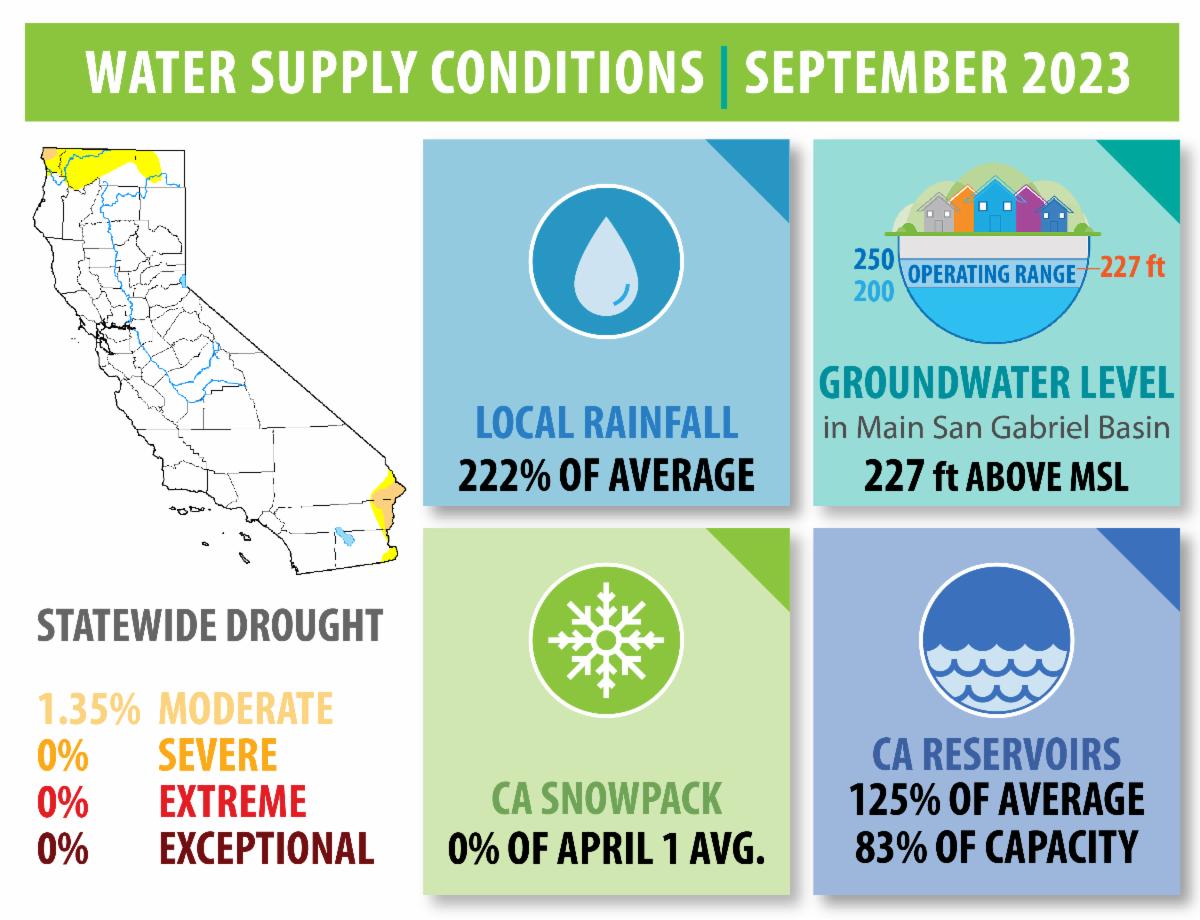
The graphics above show the marked improvement from January through September 2023 in state and local reservoir, snowpack and groundwater conditions, including significant lessening of drought conditions statewide. Local groundwater, which improves more slowly due to the time it takes stormwater runoff to percolate down to groundwater levels, has risen more than 50 feet year-to-date!
The Main San Gabriel Basin captured more than 95% of stormwater to supplement local groundwater supplies in the storm surge earlier this year, which is much different than other watersheds that convey the majority of their stormwater to the Pacific Ocean as a flood control measure. Data from Watermaster reveal that of the more than 500,000 acre-feet of stormwater captured this year, about 300,000 AF came from the San Gabriel River watershed.
While Mother Nature has granted us a reprieve from the most recent drought, we must remember we live in a region where most years are dry, infrastructure is aging, drought will return, and climate change makes the work of water planning and delivery challenging. The reality remains that we use more water than Mother Nature provides and if we’re not in a drought, we are probably either getting into one or recovering from one.
We need to sustain our focus on investments in long-term water infrastructure and developing a long-term water conservation ethic that enables us to save water now, when it’s wet, for when it’s dry. While the State and some municipalities have lifted certain water use restrictions, it’s important to note that in the past 1-2 years Californians fell short of meeting the voluntary 15% conservation goal and also fell short of the 25% conservation level achieved in the next most recent drought period.
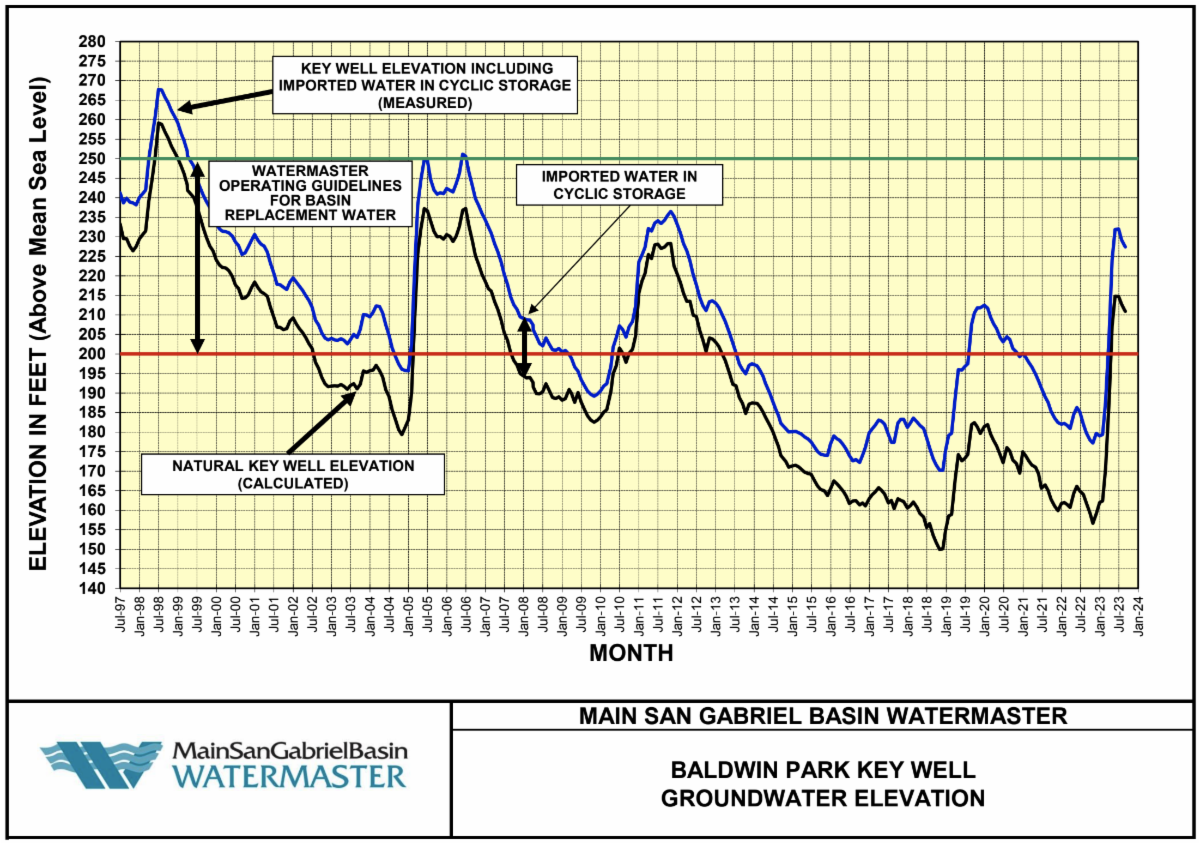
Groundwater – in the Main San Gabriel Basin, the “Baldwin Park Key Well” is the indicator of local groundwater levels (see graph – blue line includes cyclic storage; black line does not). As of September 1, 2023, the level decreased slightly to 227.4 feet above mean sea level (see most recent Baldwin Park Key Well below).
Prior to the storms earlier this year, the Basin had experienced a steady decline in groundwater levels from a high of 212.5 feet above mean sea level in December 2019 and was trending downward toward the historic low of 169.4 recorded on November 21, 2018. One vertical foot is equivalent to about 8,000 acre-feet of groundwater in the Main Basin. Watermaster’s operating guidelines for replacement water or “safe yield” is between 200 and 250 feet above mean sea level.
About 80 percent of the Valley’s water supply is furnished by local groundwater, and the Valley imports about 20 percent of the water we use from northern California and the Colorado River. A 60 percent allocation is needed to meet the demand of our member cities for replacement water. Thus, in years where the allocation dips below that amount, we see the important role that water storage and water conservation play.
Note: Groundwater use accounts for 41% of California’s total water supply (80% in the San Gabriel Valley) on an average, annual basis, and as much as 58% in a critically dry year. About 85% of public water systems rely on groundwater as their primary supply. Of water diverted and pumped in California, about 80% is used by agriculture and 20% is used by cities and towns.
| |
|
Imported Water – In April, the California Department of Water Resources increased State Water Project allocations to State Water Contractors such as SGVMWD for 2023 to 100% for the first time since 2006. Imported water is used to supplement local groundwater supplies in the Main San Gabriel Basin.
Note: Two-thirds of California’s water originates in the Sierra Nevada Mountains and flows through the Delta, a large inland river delta and estuary in northern California.
| |
Local Rainfall – the LA County Department of Public Works (DPW) reports annual rainfall levels from October 1 to September 30 of each year. As of September 1, 2023, the DPW headquarters location in Alhambra had recorded 39.64 inches of rain, about 222% of average (average annual rainfall at this location is 17.83 inches). The graph below shows both annual rainfall totals dating back to 1960, as well as the major drought cycles since then. | |
|
Statewide Snow Pack – as of September 1, the State is reporting 0% for its snow data, effectively starting its recordings anew as we head into the fall and winter months. Snowpack is measured from April 1 to March 31, a 12-month period). April 1 is usually the “high point” for snow accumulation each year. What remains of the recent winter’s snowpack is one of the biggest the state has experienced since the 1950s.
Note: On average, the Sierra Nevada Mountains snowpack, which is a key source of water banked in reservoirs, supplies about 30% of California’s water needs as it melts in the spring and early summer, feeding reservoirs and the water table, resulting in groundwater. The snowpack is often referred to as California’s “frozen reservoir.”
Statewide Reservoir Levels – statewide, as of July 30, 2023, (the latest statewide data available to us), reservoir levels had risen to 125% of average and 83% of capacity. As of September 1, storage levels at Shasta Lake, the state’s largest reservoir, were 77% of capacity and 129% of the historical average for this date, and storage levels at Lake Oroville, the state’s second largest reservoir, were 80% of capacity and 138% of the historical average.
Locally, both San Gabriel Reservoir and Cogswell Reservoir are conducting sediment removal, and Lake Silverwood, which rests above San Bernardino and is adjacent to the start of the District’s Devil Canyon-Azusa Pipeline, is filled to 87% of capacity and 98% of average. During the recent drought, low precipitation levels, high temperatures, hot and dry soil, and high levels of evaporation decreased stormwater runoff from surface levels to replenish both reservoirs and local groundwater supplies.
Note: Every winter, most areas need about 12 inches of rainfall before the ground is saturated enough to get large amounts of runoff into streams and reservoirs. California’s reservoirs generally hold enough water to go one dry year without impacts but begin to empty if a wet year does not follow.
| |
|
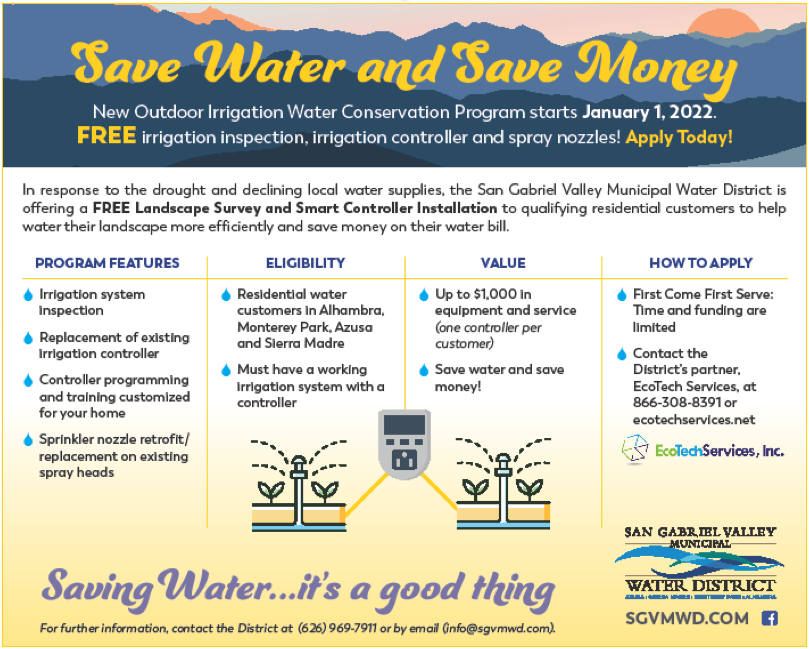
Our popular irrigation system retrofit program continues to feature 1) a FREE irrigation system inspection; 2) replacement of an existing irrigation controller with a FREE, new programmed unit; and 3) FREE installation of new sprinkler nozzles on existing pop-up spray heads. In fiscal year 2022-2023, EcoTech performed 278 site assessments and 235 properties qualified. 261 weather-based “smart” controllers were installed, and 6,517 sprinkler nozzles were upgraded to water-efficient rotating nozzles. The approximate cost/value per landscape is $1,169. According to the EPA, replacing a clock-based controller to a WaterSense labeled weather-based controller can save an average property 7,600 gallons/year. Our projected water savings were 1,983,600 gallons of water for FY 22-23!
Funding is limited, so please review the informational flyer below and on our website and act as soon as possible. Residents in all our member cities may apply for the irrigation retrofit program by contacting our partner, EcoTech Services (866-308-8391 or ecotechservices.net).
|  |  | |
|
Water Saving Tips For Our Hot, Early Fall Months
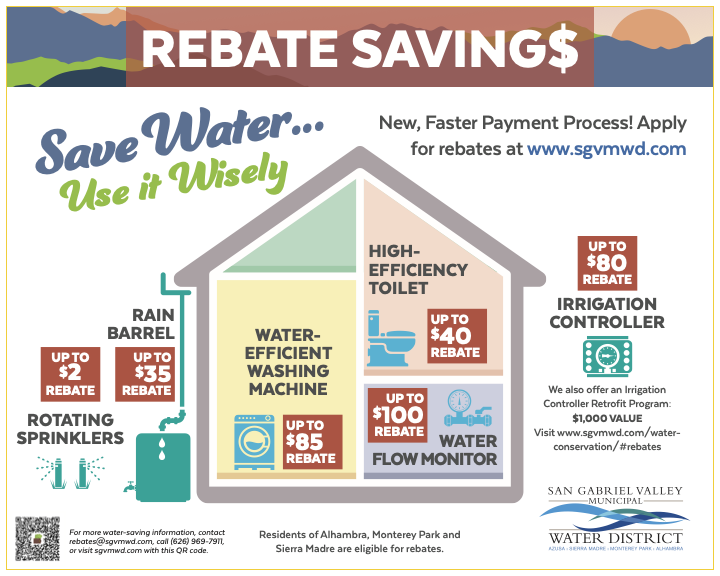
The most important thing residents can do during our hot and dry summer and fall months is save water…and use it wisely. Here are some water saving tips for you to use around your home (indoors and outdoors). Now is also the time to start planning to plant California Native and drought-tolerant plants in the upcoming, cooler fall and winter months.
| |
Hispanic Heritage Month in Monterey Park
For the upcoming Hispanic Heritage Month, The City of Monterey Park will be celebrating with various events and activities which include a Movies in the Park cosponsored by the District. Join us with the City of Monterey Park on Thursday, September 21, 2023 at 6:30pm for the showing of Selena at Barnes Park. Check the City of Monterey Park's website for more details.
| |
|
2023 Speakers' Bureau and H2Owl Appearances
With summer weather upon us, the District will continue to support, sponsor and attend a variety of in-person community events. District representatives are available to make informational and educational presentations (in-person and virtually) at community and business meetings, city council and school board meetings and business/chamber meetings.
Our presentations cover topics such as the role of the San Gabriel Valley Municipal Water District; explaining drought; the importance of local groundwater; local and state water supply conditions; the State Water Project and imported water; water conservation and future water supply solutions.
To request an in-person or virtual meeting or presentation with your group, please contact Evelyn Reyes, External Affairs Manager (626-969-7911 or ereyes@sgvmwd.com).
| | | | |