|
Fontana della Tartarughe--the Fountain of the Turtles |
|
Rione XI--Sant'Angelo--the Jewish Ghetto | |
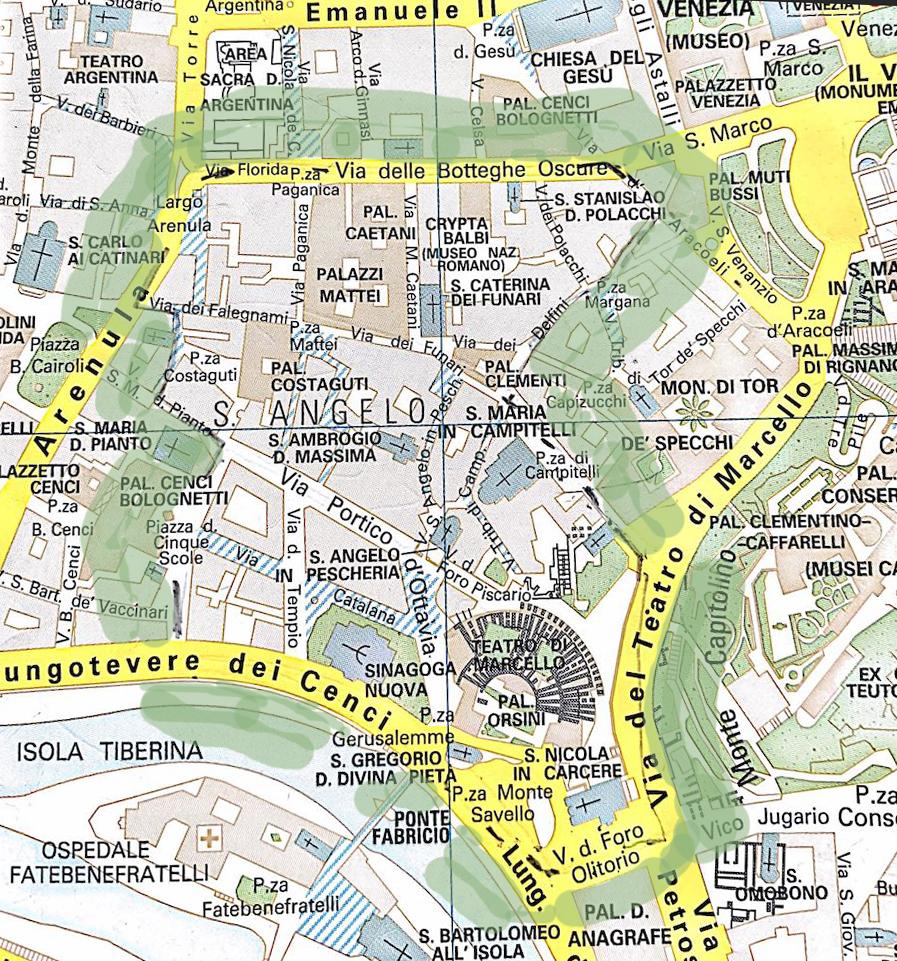
The Rione Sant’Angelo is one of my favorite neighborhoods in Rome, probably because it has the Fountain of the Turtles! But there is so much more here. Rione XI is home to the Jewish quarter with the best artichokes in the world. It gets its name from the church of Sant’Angelo in Pescheria, which is built into the space of the ancient Porticus of Octavia here. It was originally called Sant’Angelo Pescivendolo, or Saint Angels of the Fishmonger, for the Roman fishmarket here. The symbol for the Rione, which you will find if you scour the walls of the streets, is an angel holding the palm. Some versions have the angel standing on a human figure, perhaps an allusion to the Final Judgment day. And a final version you may encounter has simply a fish! | |
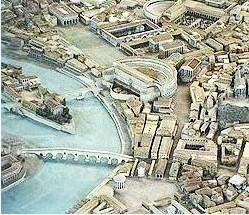
Above you see a photo from the Model of Ancient Rome with the segment showing what is now the Sant’Angelo neighborhood. The centerpiece is the Circus Flaminius, which was not really a circus at all, because it didn’t accommodate chariot-racing, had no seating, and wasn’t even in the proper form of a circus. It was built by C. Flaminus Nepos in 220BC. It was just a large general purpose open space, suitable for public meetings, funerals, markets, and on special occasions, horse races. It was on the southern extreme of the Campus Martius and was the point of assembly for military expeditions and the point of departure for parades celebrating triumphs. Over time eleven Victory temples were put up around the perimeter. Only one of these has visible remains today, that of Juno Regina, whose podium and two columns we can see on the block between Via S. Angelo in Pescheria and Via Tribuna di Campitelli. | Having covered the now vanished ancient anchor of the Sant’Angelo, we begin our walk in the Angelo with the Piazza d’Ara Coeli and the delightful Fountain there. At the Piazza d'Ara Coeli we are actually outside the Rione Sant’Angelo in a corner of Rione Campitelli, but we are only over by a titch and we want to begin in the Northeast corner of the Rione, and so we begin here. | |
When Sixtus V Peretti (1585-1590) brought his new aqueduct the Felice to the Capitol in 1589, a fountain was eagerly set up in the Piazza d'Ara Coeli at the foot of the Ara Coeli steps and Michelangelo’s la Cordonata. This was before Mussolini ruined the Piazza by setting up his monstrous speedway the Via del Teatro di Marcello which he intended to run all the way to the sea. The fountain was designed by the most prolific fountain-maker of Rome, Giacomo della Porta (1532-1602). Today moss has completely obscured its most special feature, the four small children on the top, who each bear under their heavy moss cover a water spouting vase and who encircle the hills/mounds of the Peretti shield, which are still visible. Della Porta copied these children from the fountain that had been in front of Old St. Peter’s, put up during the reign of the Cibo Pope Innocent VIII (1484-1492), destroyed when Bernini put up the new square. | 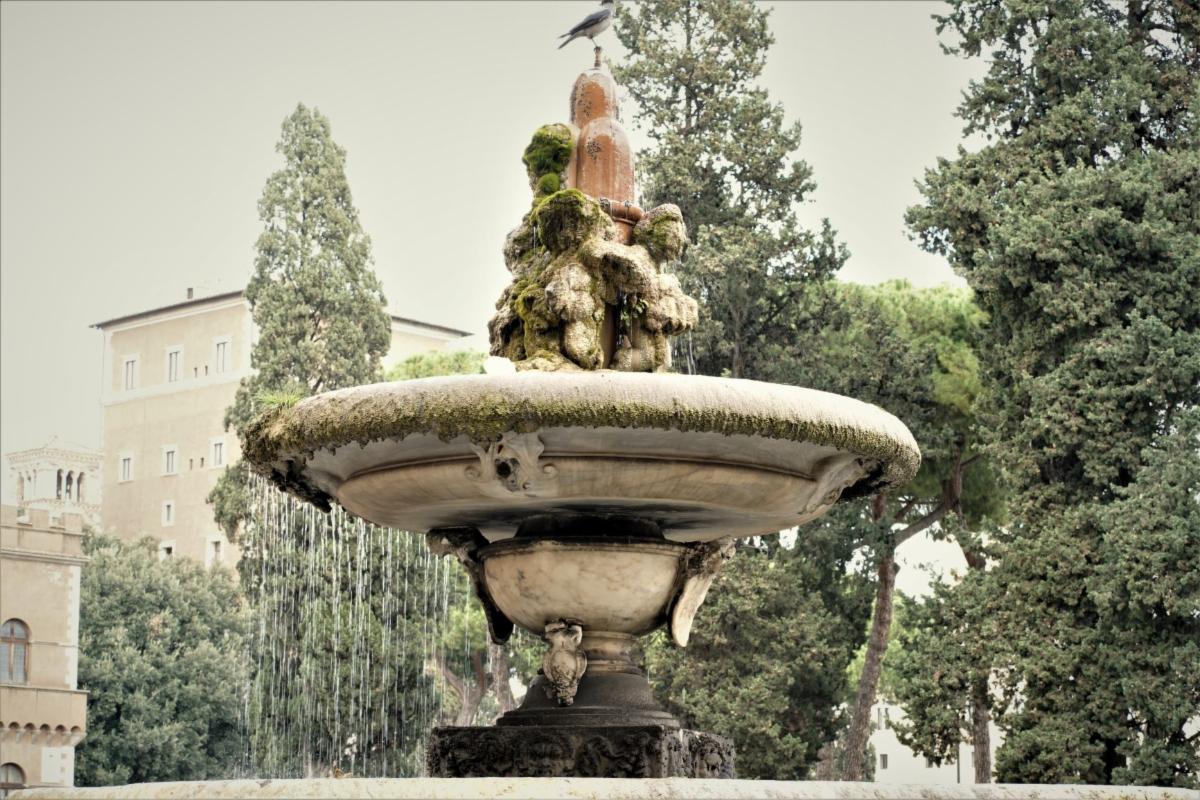 | |
We go down the Via d'Ara Coeli a bit to Via di Tor de’Specchi, whose name commemorates the legend of Virgil as a necromancer (wizard), who had his magic tower lined with mirrors here, which reflected and brought to light all of Rome’s secrets. Saint Francesca Romana (1384-1440) established her exquisite Oblate convent here, which we are able to see if we come on her feast day March 9 (now entered off the Marcello). If we are so lucky as to gain admittance we will see cloisters full of flowers and orange trees, and the fresco series (25 paintings!) of the life of the saint by Antoniazzo Romano (1430-1510).
We now go down the Via Marcello to the Via Montanara, take a right and a little ways down we find the Piazza Campitelli and on the left the church of Santa Maria in Campitelli. The name Campitelli comes from the Columna Bellica, which in ancient times was the column from which the Romans declared war by casting a dart onto the plot of ground adjacent, which represented the hostile territory. This was near here!
| 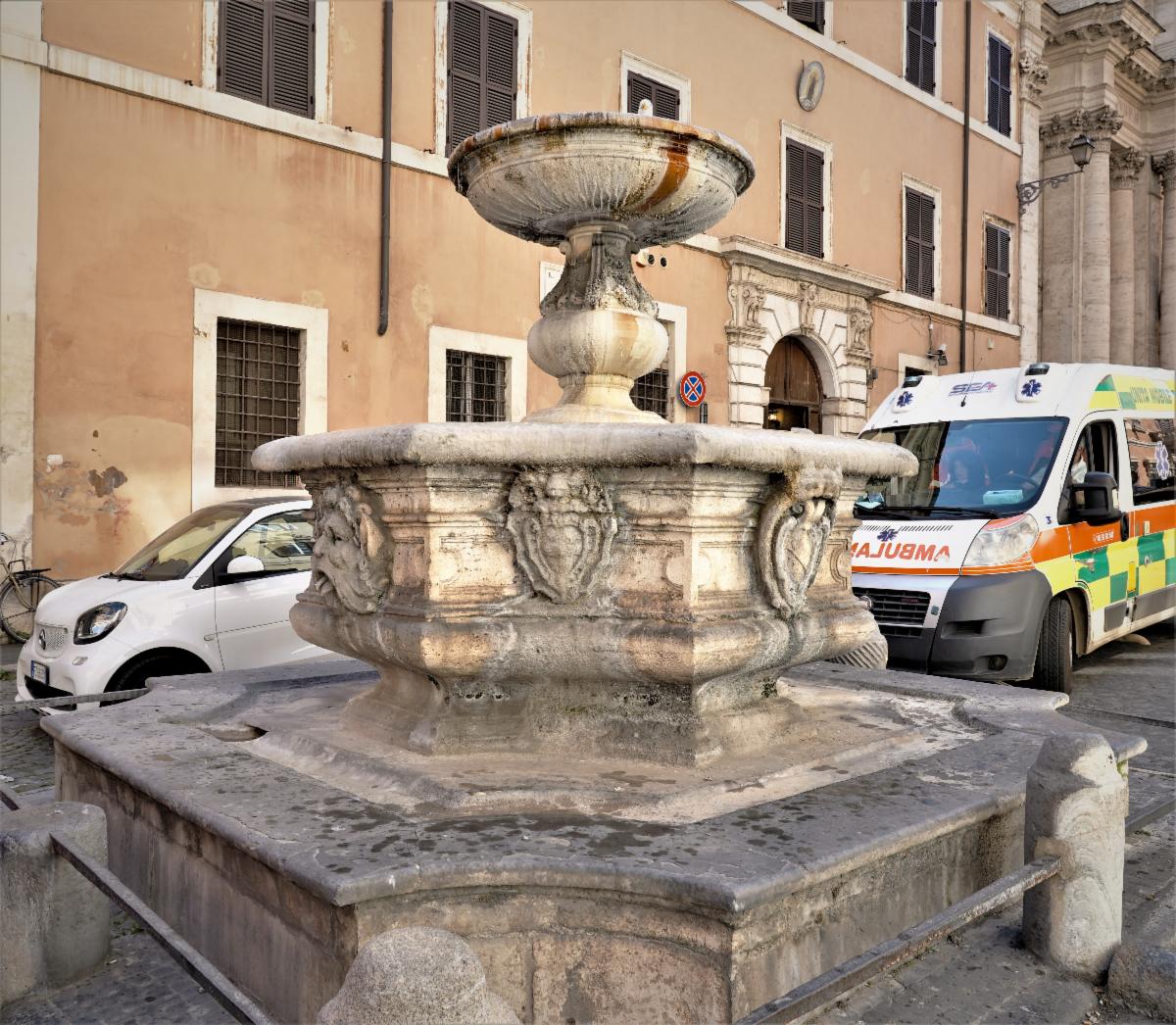 | We encounter in this piazza another splendid fountain by Giacomo della Porta, also made 1589 at the request of the influential neighbors who begged the pope’s aqueduct commissioners to run the waters of the Felice here. The main basin has another of della Porta’s original geometric designs. We see here the shields and coronets of the families who paid for the fountain, though weather has almost obliterated them. Pay special attention to the two grotesques who spout the water (when it runs!), one with donkey ears. | Santa Maria in Campitelli was rebuilt in 1657 under the great city beautifier Chigi Alexander VII (1655-1667) who approved the transfer of the Holy Image of the Mendicant Virgin to this church. This image had been in the now destroyed church of Santa Maria in Portico, which was the parish of Santa Galla (d550). The “Miraculous Image” appeared to Santa Galla in her pantry where she kept the food for her daily distribution of alms to the poor women of Rome. The Image was paraded throughout the city whenever plague struck the city, and after a successful procession in 1656 the pope decided to transfer the image to his newly planned Santa Maria in Campitelli. | 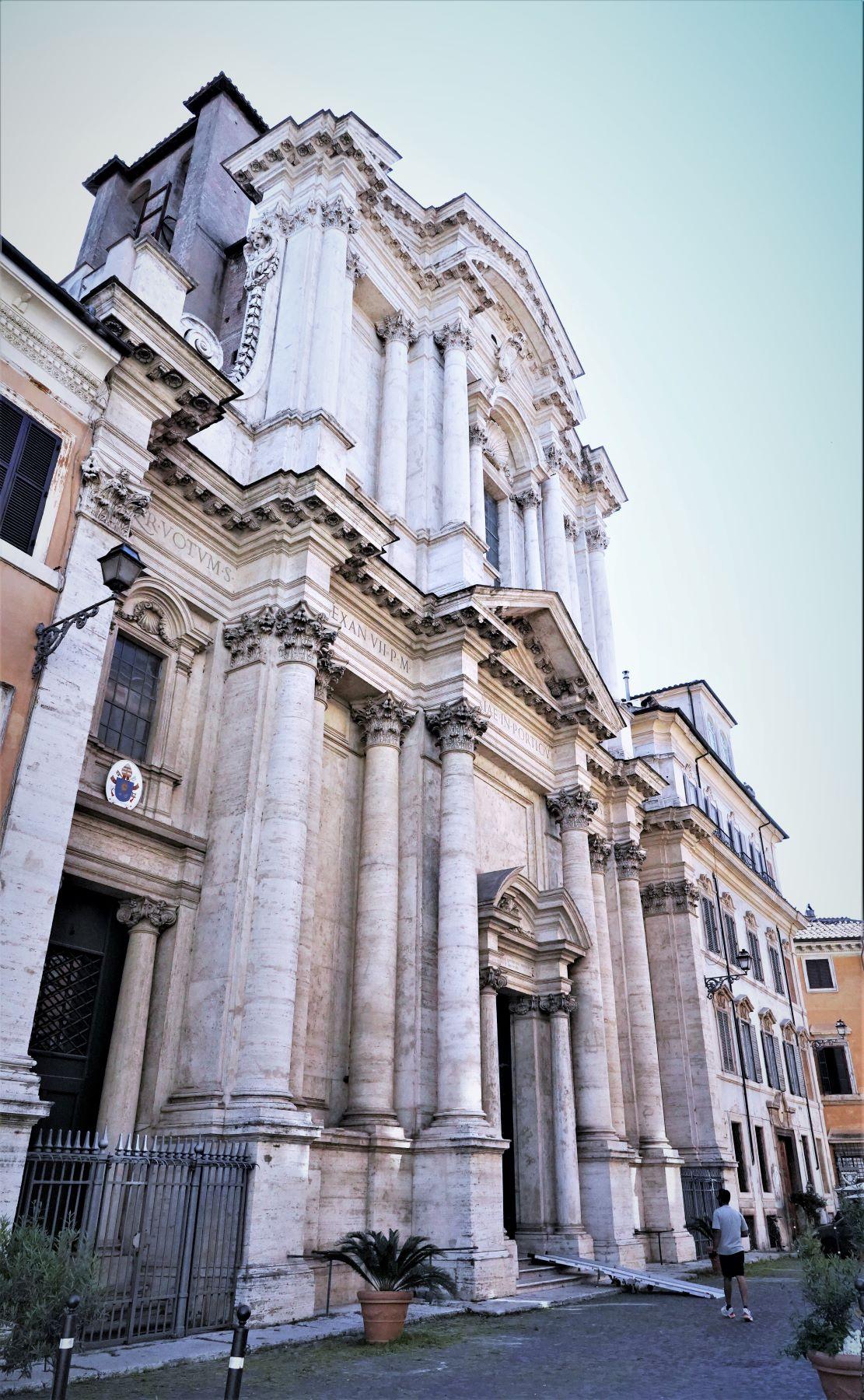 | 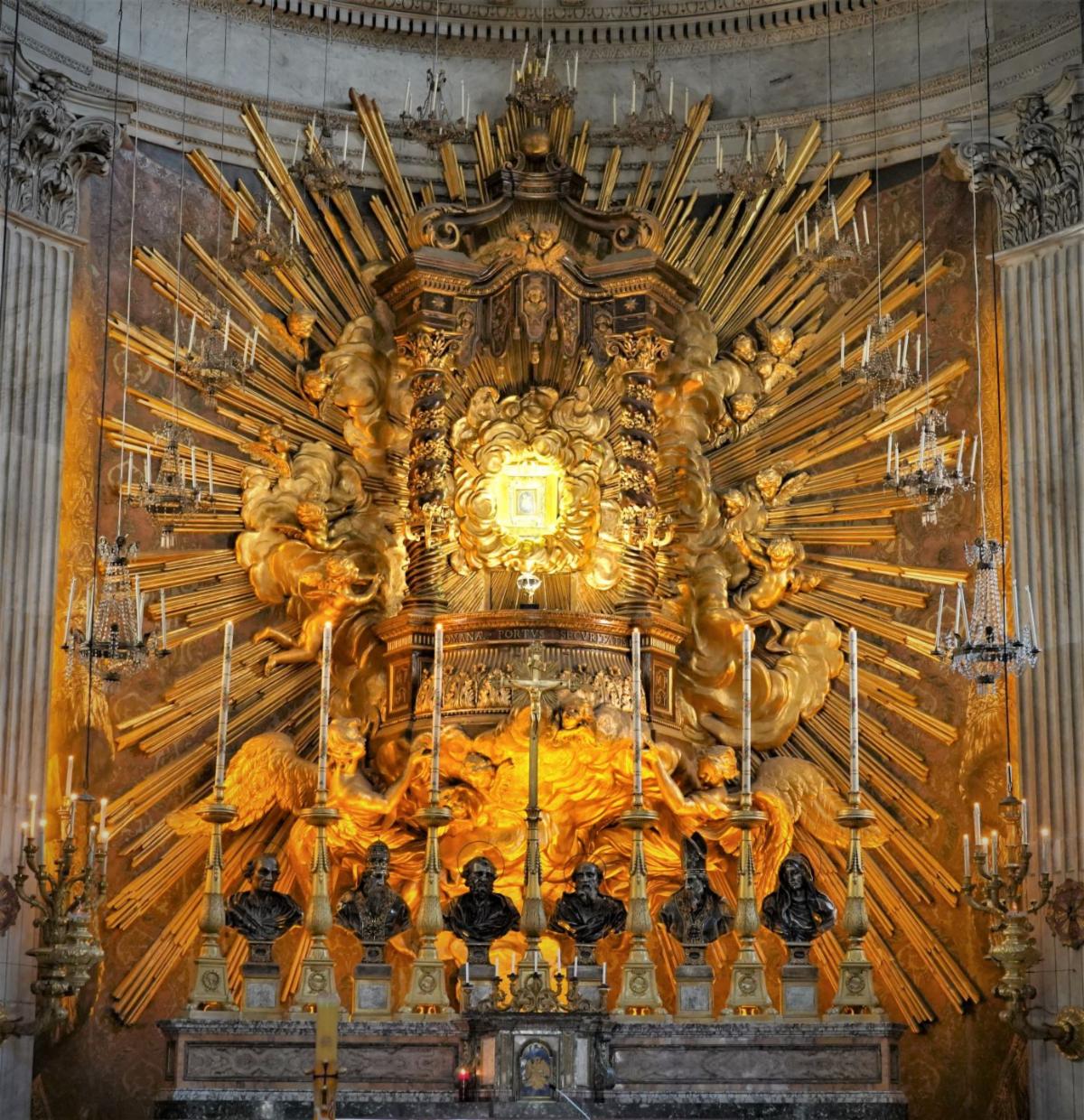 | Carlo Rainaldi (1611-1691) was the architect of the church. The façade has the usual Baroque festivity and movement, with a wall with inset columns and broken pediments. Rainaldi was baroque but conservative and we can see here the difference between his work and that of his great contemporary, the inventive Francesco Borromini (1599-1667). The inside is full baroque, and the Virgin is buried within a barrage of golden rays and angels in the Glory. It is almost like an explosion. The altar is home to the bodies of Saints Cyrica, Victoria, and Vincenza, and half of the body of Saint Barbara! Bernini’s assistant Ercole Ferrata (1610-1686) designed the angels in the Glory. The most special part here is Rainaldi’s coffered dome-- very beautiful indeed if not the equal of those of Borromini and the other great baroque architect Pietro da Cortona(1596-1669). | 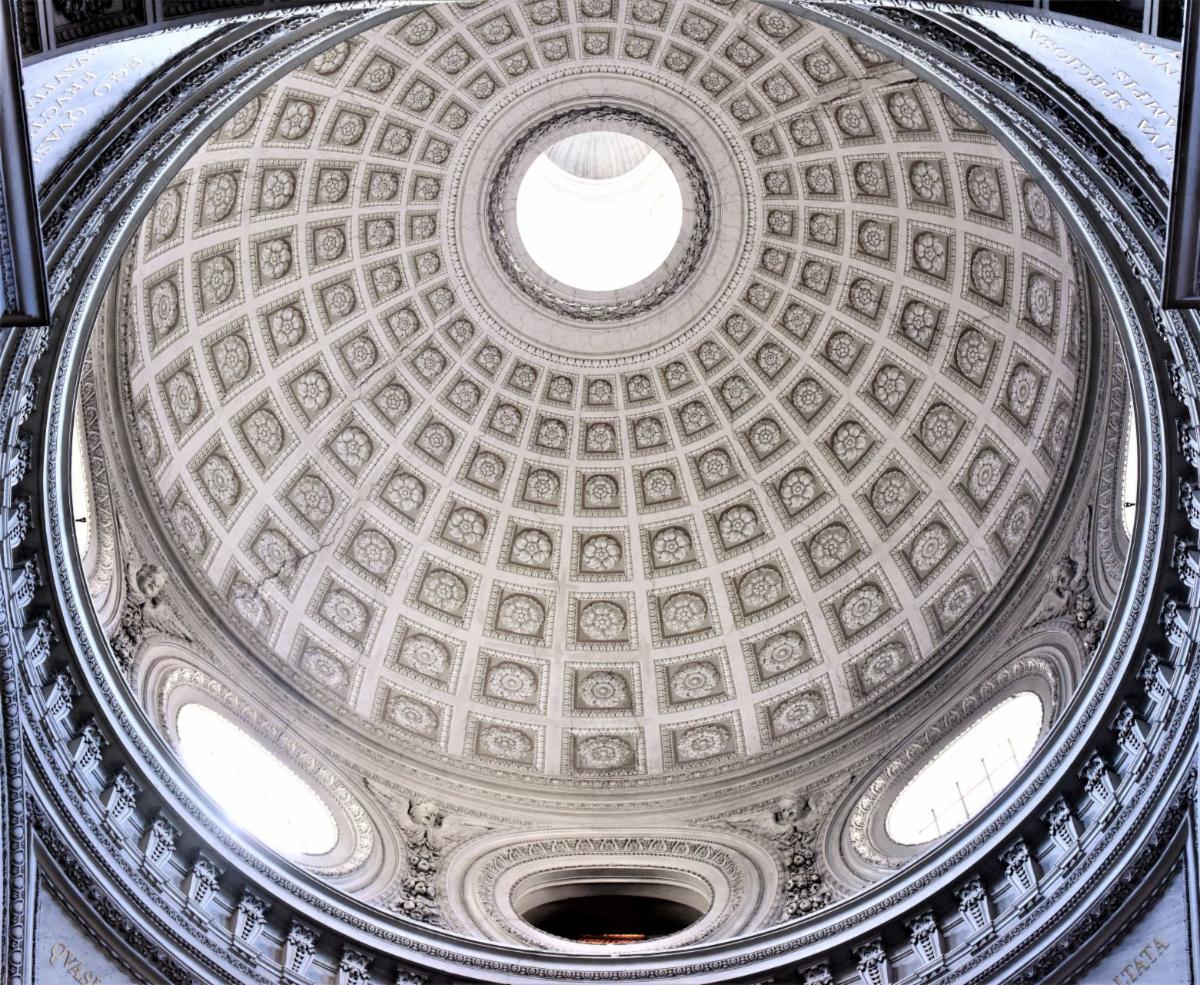 | |
We continue up the street, now the Via dei Funari, named for the string and rope makers who set up shop here after the abandonment of the Circus Flaminius in the sixteenth century, taking advantage of the vacant seats and the ample light of the open space. Here we come upon the church of Santa Caterina de’Funari, named for Catherine of Alexandria (287-305), built on the Castro Aureo of the Circus. Pope Paul III (1534-1549 ) gave the church to Ignatius of Loyola (1491-1556) in 1534, and Ignatius and Filippo Neri (1515-1595) and Gaetano di Thiene (1480-1547)(Cajetan) established what was to become a Confraternity for the schooling of poor girls. The beautiful façade with the Renaissance geometric shapes of circle, rectangle, triangle, all so perfectly proportioned, was made 1563 by Guidetto Guidetti (c1500-1564), student of Antonio da Sangallo the Younger (1484-1546) and influenced by Sangallo’s Santo Spirito in Sassia. Find in the festoons the palm of martyrdom, and the instrument of Catherine’s passion--the sword --and the intended instrument of her passion—the spiked wheel! I have not been able to gain admittance, but you should try as there are in the nave special frescoes by Annibale Caracci (1560-1609).
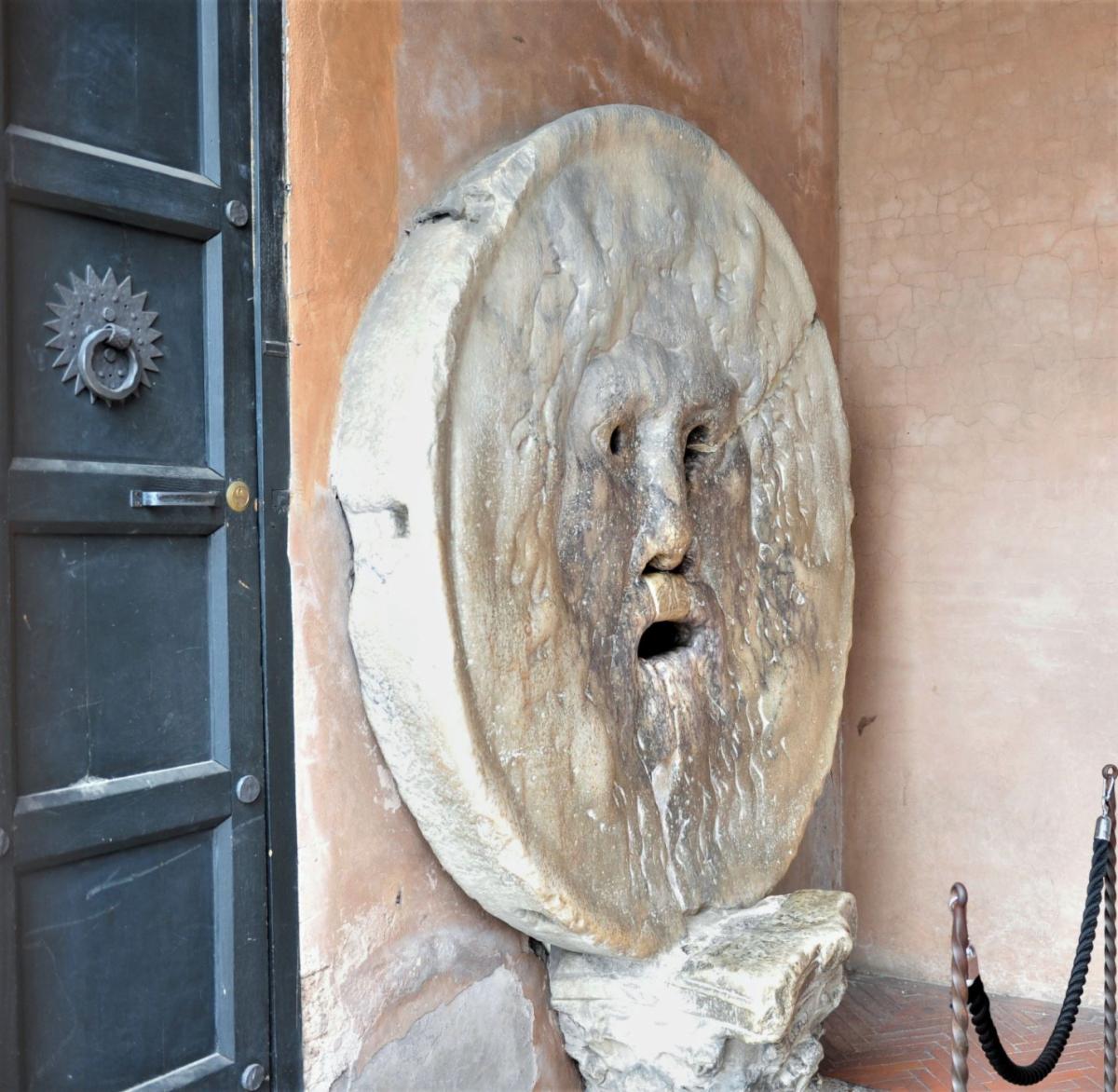
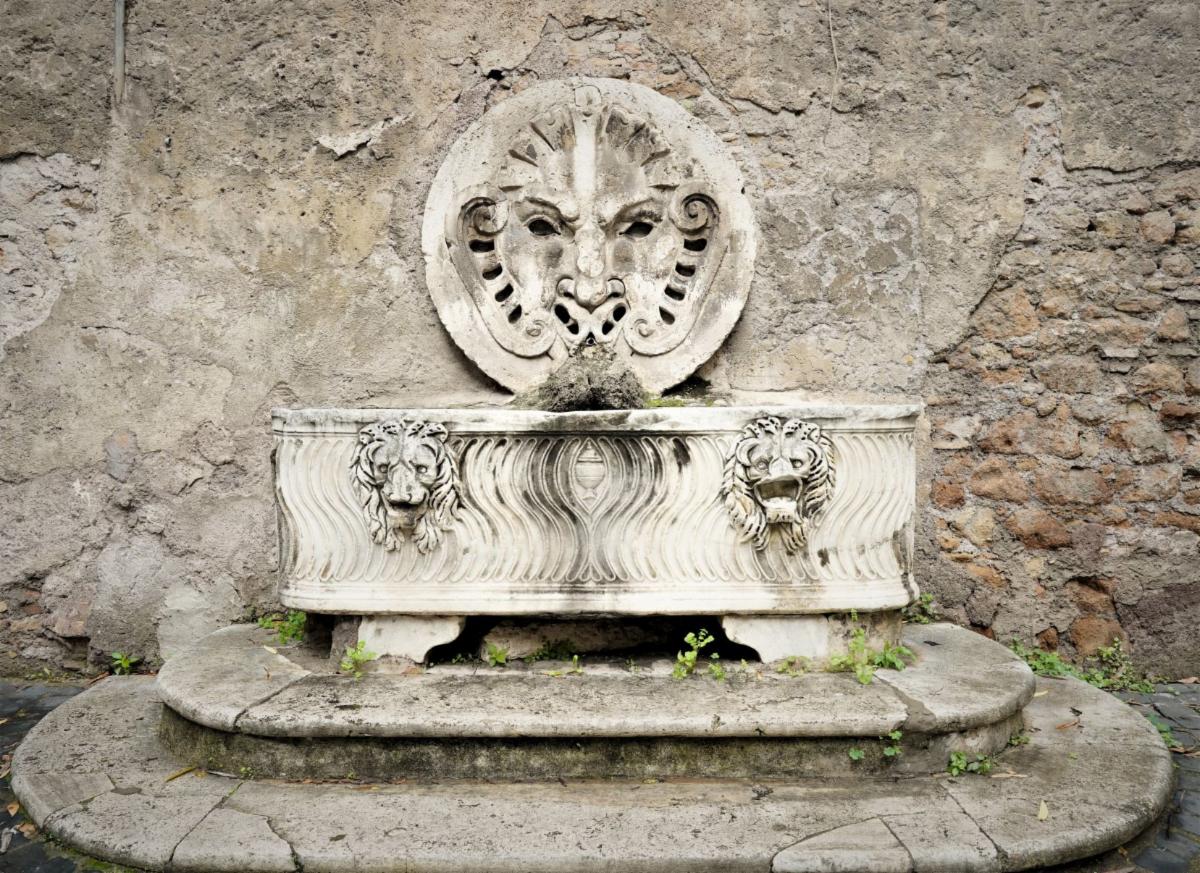
We can now divert a bit to the north and take a walk down the adjacent street, the Via Michelangelo Caetani, and on our right we will come to a memorial for Aldo Moro, the Italian Prime Minister assassinated by the Communist Red Brigades in 1978, his body left in the trunk of a car parked here. If we continued on we would come to the Via delle Botteghe Oscure and the Crypta Balbi, which we have visited on a prior walk. The street gets its name for the former narrowness of the street, which blocked the light of the sun from the shops. The Palazzo Caetani is now on our right as we go back down the Michelangelo Caetani. The Palace was purchased in the eighteenth century by the powerful Caetani family of Boniface VIII (1294-1303). In the courtyard is a scary Bocca.
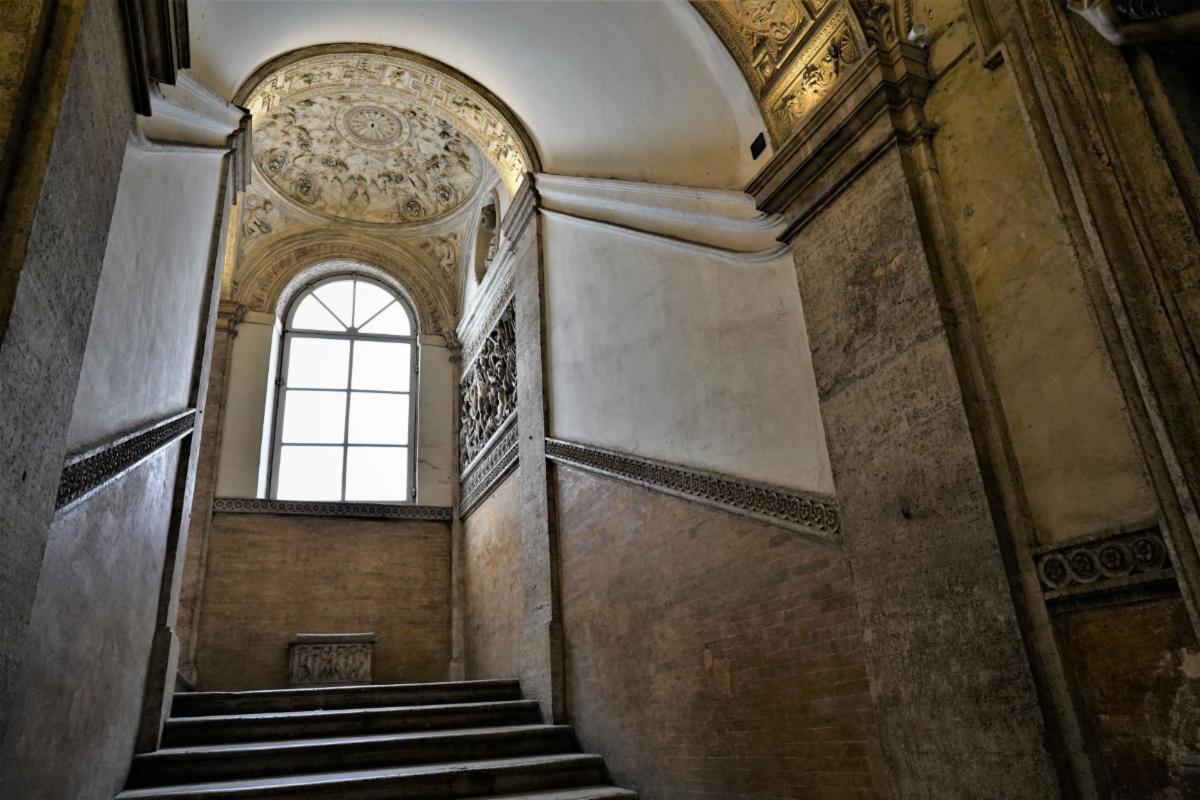
|  | Further down the street on the right we have the eastern Portal to the Palazzao Mattei di Giove, the main entrance off the Via dei Funari and across from the Piazza Mattei. Carlo Maderno (1556-1629) was engaged 1598-1618 in a palazzo for Duke Asdrubal Mattei, on the site of the Circus Flaminius. His distant nephew Francesco Borromini assisted him. The Duke had collected quite a few ancient bas-reliefs, sculptures and busts, and with these Maderno created a very lively courtyard. The building is now a cultural center, and home to the Center for American Studies. I was able to visit in 2019 and see the ceiling frescoes by Pietro da Cortona (1596-1669)(from the Life of Solomon). There are more here by Lanfranco, Domenichino and Albani, although the descendants of the Caetani sold a chunk off in the nineteenth century. But good luck getting any one here to allow you access! Borromini is responsible for some of the flourishes of the state staircase, and these you can see if you just go up the staircases. | 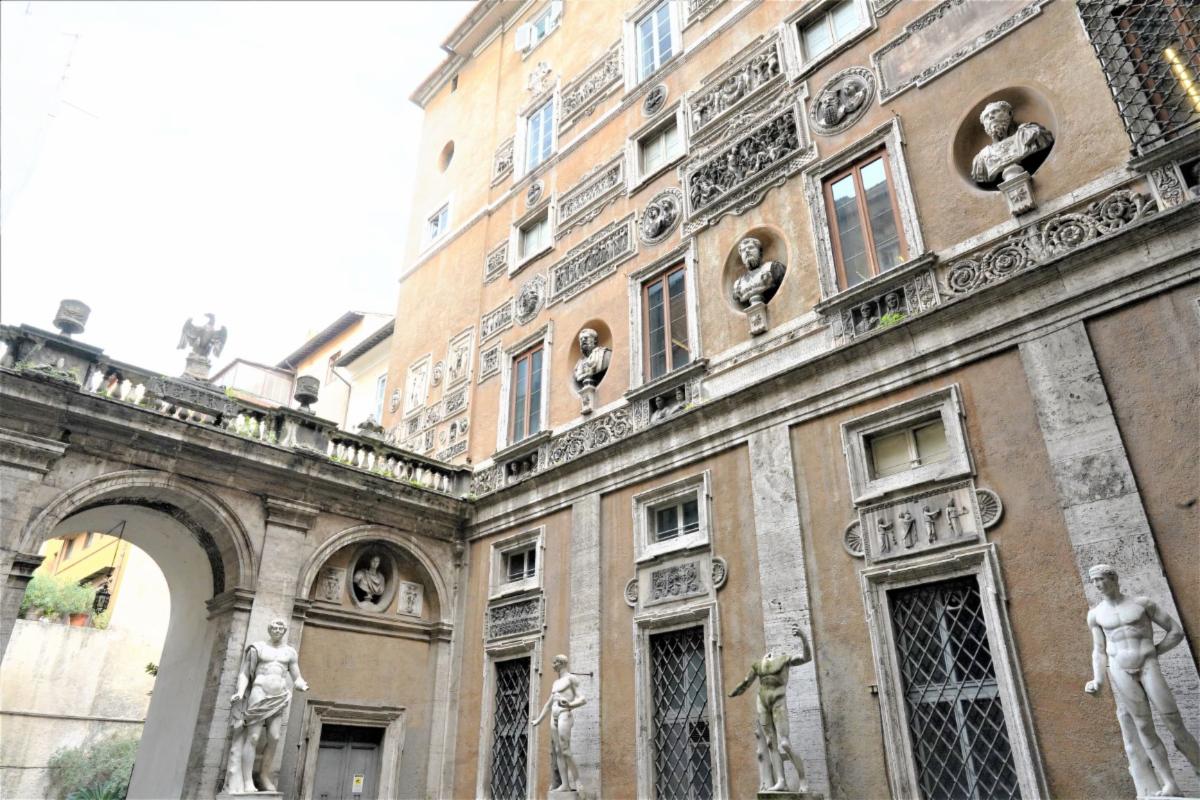 | Borromini assisted in the hallways | 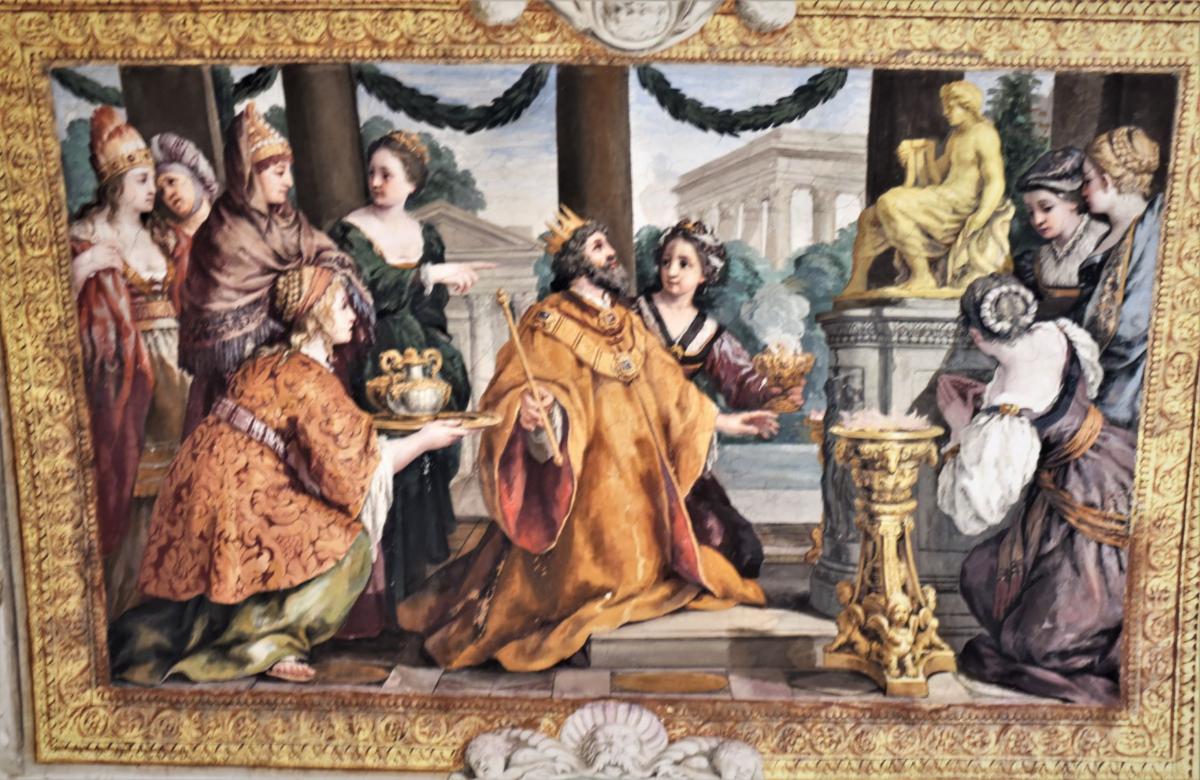 | 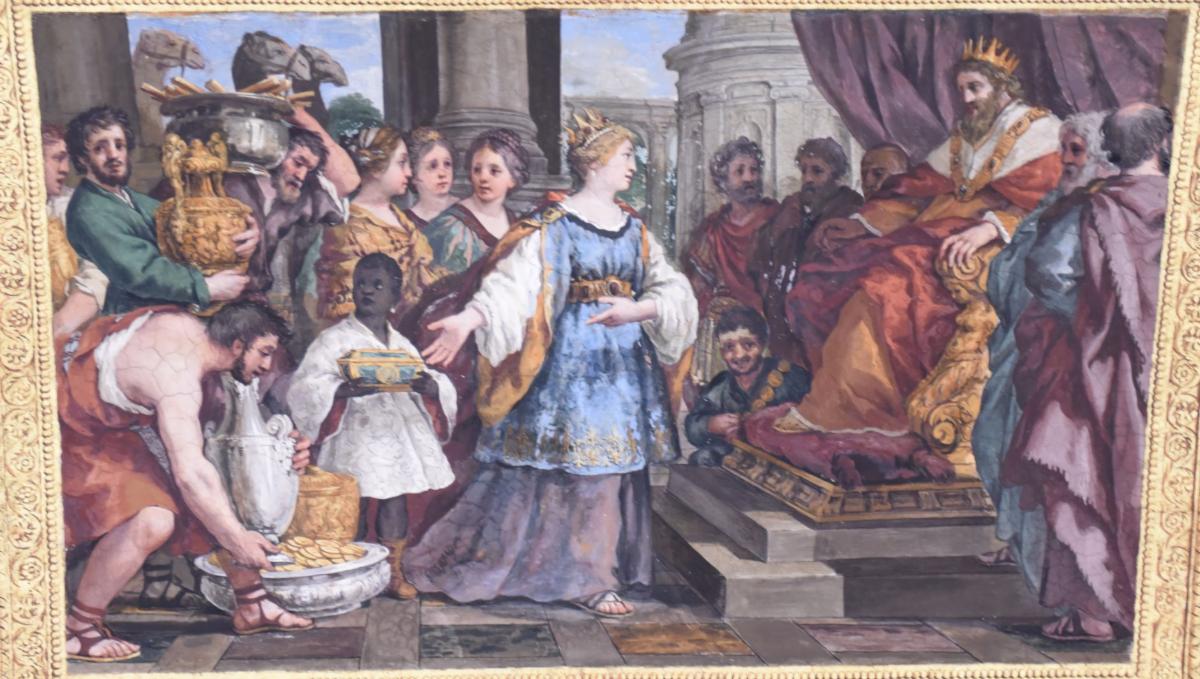 | |
We exit to see the other buildings of the Mattei family at numbers 17 and 19, which together with the Palazzo are known as the Isola Mattei or the Mattei Block. The oldest one of these is at 19, which has a well done double loggia and staircase from the fifteenth century.
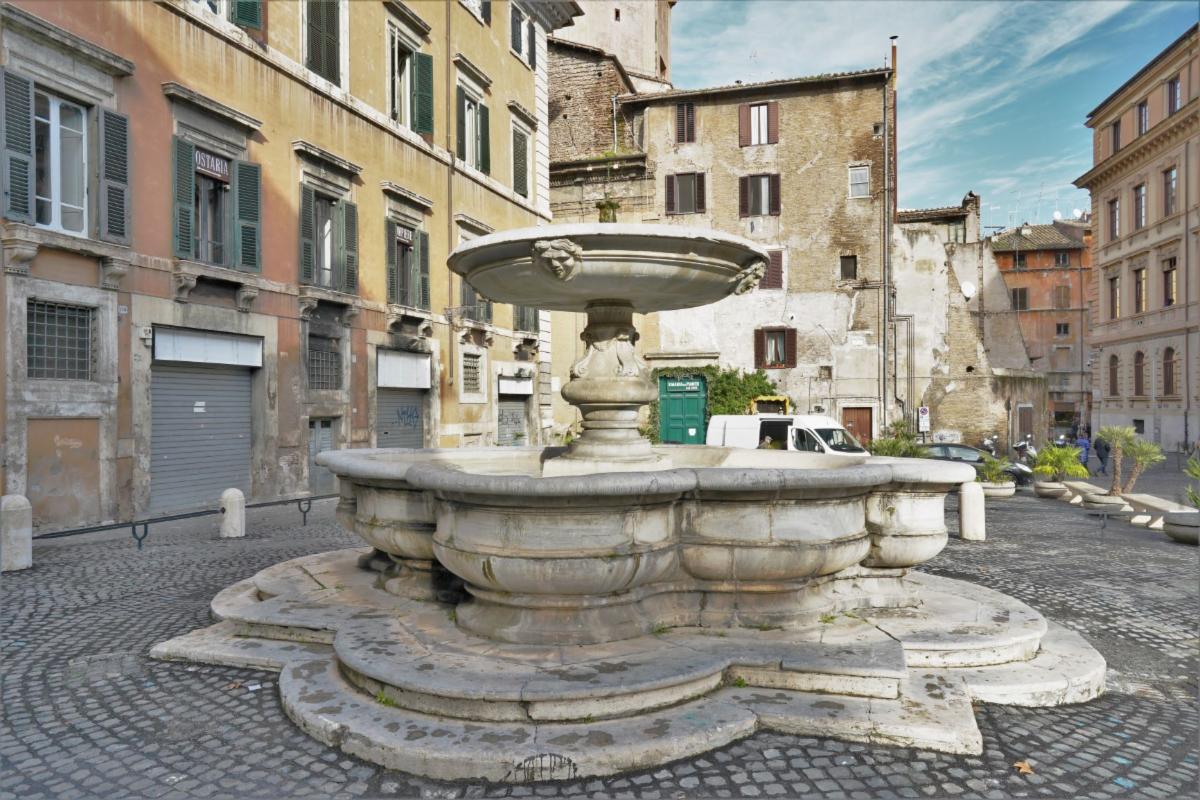
And in the middle of the Piazza Mattei (some call it the Piazza delle Tartarughe) is the jewel—the Fountain of the Turtles, the Fontana Tartarughe, perhaps the favorite of every visitor to Rome. In 1570 the waters of the restored Acqua Vergine were planned for the Jewish Quarter. The powerful Mattei family however intervened and convinced the Cardinalate “Water Spring Congregation” that the water should come to the Mattei instead. In 1582 Giacomo della Porta was engaged and he planned the fountain we see today, with the four young men sitting on dolphins, the work in bronze by the Florentine Taddeo di Leonardo Landini(1591-1596). The boys are like fauns, except they have no hooves or tails. Originally the boys were supposed to hoist dolphins into the upper basin, but these were taken by della Porta to the fountain in the Campo dei Fiori (from whence they promptly disappeared). This left the boys with their hands suspended in mid-air for some eighty years!
| 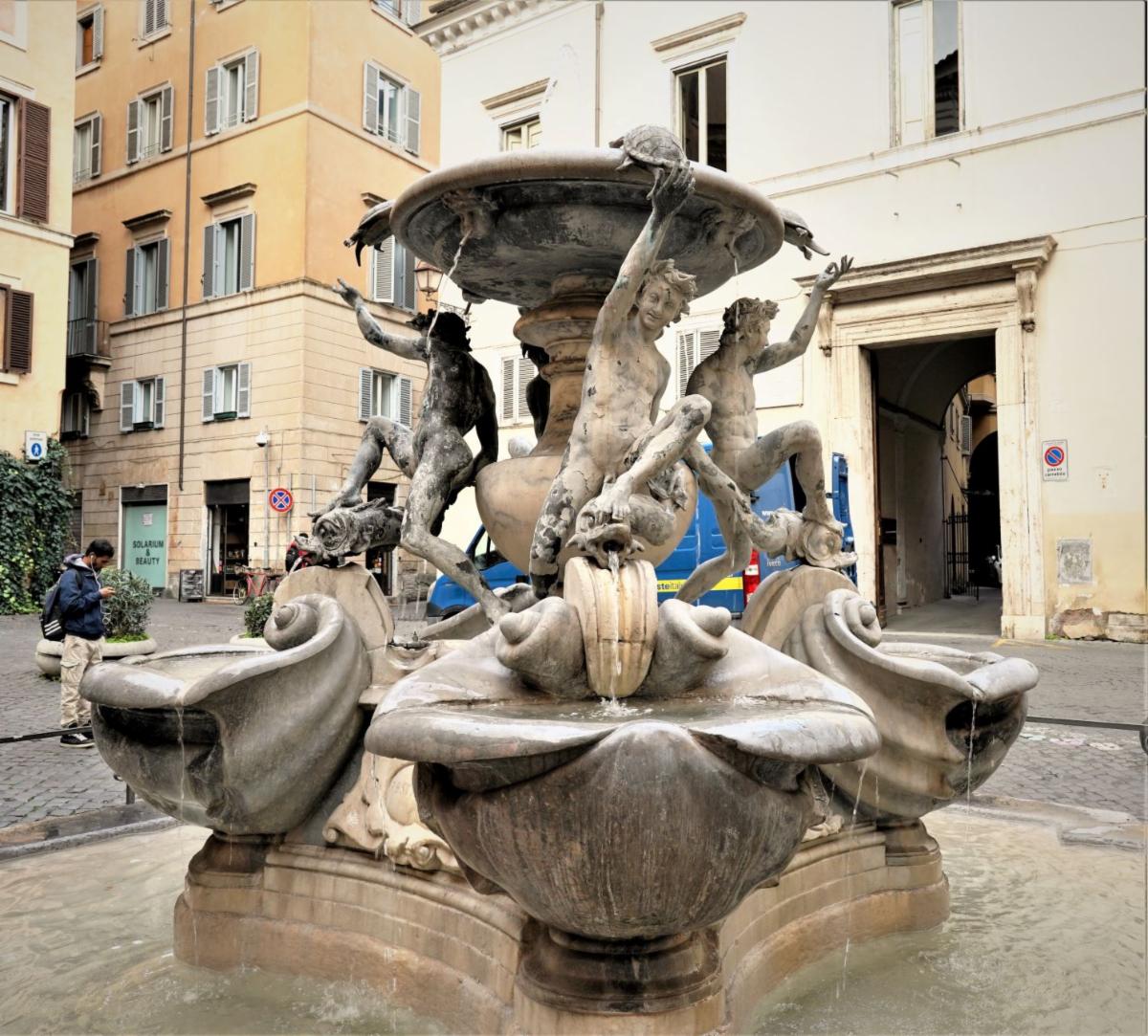 | 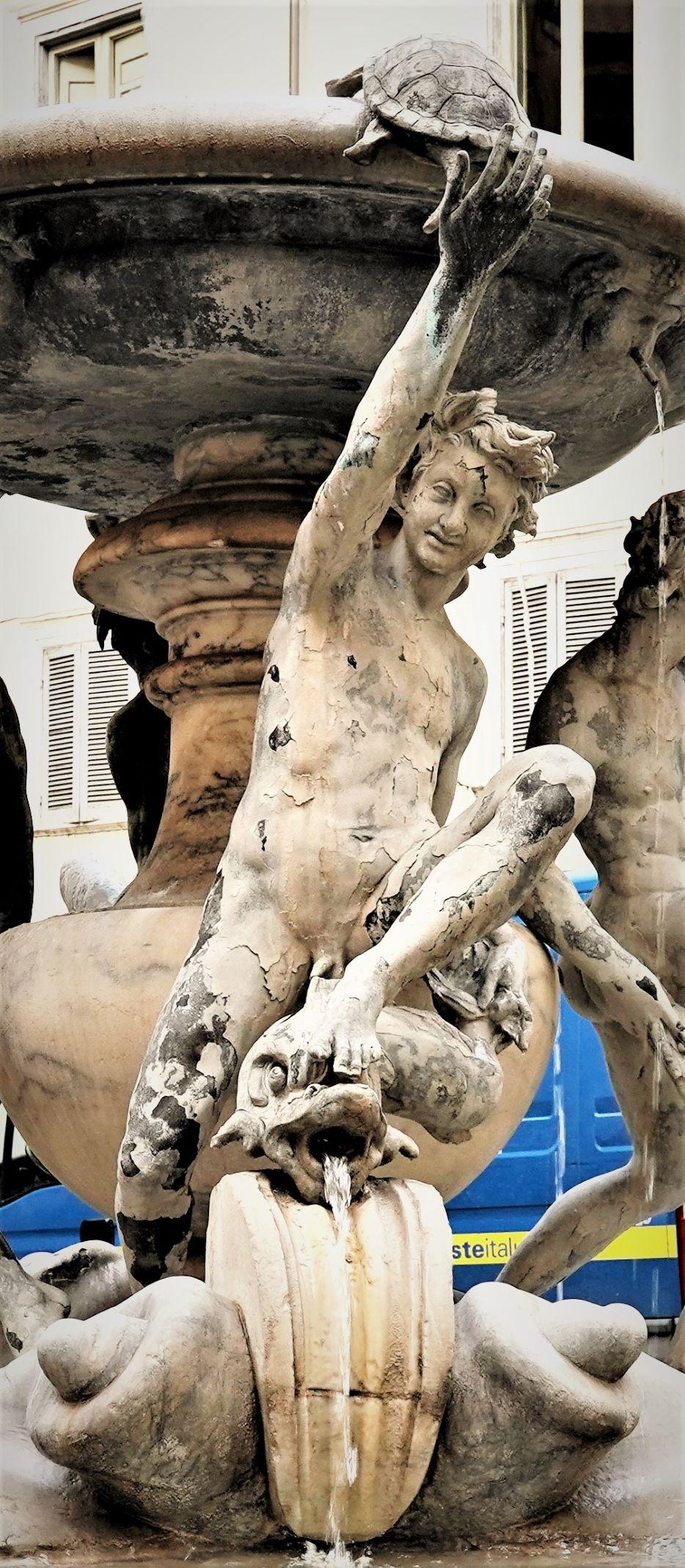 | |
Now enter the Chigi pope Alexander VII, who in 1568 restored the fountain and brought in the turtles we see today. Some say these are by Bernini, but most likely not (the ones we see are copies of the originals, which I have not been able to trace—see if you can!). They are sculpted to convey their anxious escape into the water above. The detail in their scales is impressive.
I think the best part of this fountain lies in the marbles. Just look at the grey African, the white with grey veins, and the smaller lower basins speckled in grey, red, and white portasanta marble, which contrast with the blotches of the wearing bronze of the young men.
From the Fountain of the Turtles we try to get into the Palazzo Costaguti (number 10) which has an entrance kiddy-corner from the turtles. See the large inscription of the family name over the portal. Here are or were ceilings by Albani (Hercules wounding the Centaur Nessus), Domenichino (Apollo), Guercino (Rinaldo and Armida in a dragon drawn chariot), Cavalier d’Arpino (Juno nursing Hercules, Venus and Cupids), and Lanfranco (Justice and Peace). The palace is closed to the public but perhaps you have an important friend!
We now enter the Jewish Ghetto of Rome.
Pompey the Great brought the first significant number of Jews to Rome after his conquest of Jerusalem in 63BC, and then under Caesar and Augustus who were kindly to the Jews more came. After Vespasian and Titus reduced Jerusalem and the Temple in 70 AD, yet more came, most as slaves (some say to build the Colosseo), and after Hadrian destroyed Jerusalem yet again, the Jewish Diaspora that followed brought more.
The Jews settled in this neighborhood hard by the fish market which was in and next to the Porticus of Octavia, but also in a quarter set aside for them in Trastevere. The Pons Sublicius came to be known as the Pons Judeaorum or the Bridge of the Jews for the traffic between Trastevere and what came to be called the Jewish Quarter on the left bank, which is an area of just seven acres. Some Emperors were kind to the Jews, some were not. But the Jewish community survived and even grew.
Under the popes it was much the same story. Some popes were kind (Gregory the Great for one), some were not. Under Paul IV Caraffa(1555-1559) gates were thrown up in 1555 to enclose the wall already up that separated the Quarter from the rest of the city (called the “seraglio”), and a curfew was imposed. Sixtus V (1585-1590) rescinded the curfew, but Clement VIII (1592-1605) reinstated it. And so back and forth the treatment went, until Pius IX (1846-1878) ended almost all the restrictions. The walls came down for good in 1888.
Then of course came Hitler. After Italy surrendered to the allies in 1943, Hitler’s troops invaded. On October 16, 1943 the 2091 Jews who had not previously fled the Ghetto were rounded up and by October 22 they were in Auschwitz and Birkenau. Only 101 survived. A plaque on the wall of one of the buildings on the Via Portico di Ottavia commemorates the massacre, and now the piazza in front of the Porticus of Octavia is named for the victims.
We head down the Via della Reginella then a right on the Via Portico d'Ottavia then left after the Piazza Costaguti to the Piazza Cinque Scole and the Piazza Giudea (fortunately this is now all pedestrian only), which to the visitor seem but one piazza. There were five separate Jewish schools around the Piazza: the Tempio, Sicilian, Castilian, Catalan, and Scola Nuova, reflecting the diverse groups within the Jewish community.
Off the Scole is the little church of Santa Maria della Pianta, on the street of the same name. This is technically in the Regola Rione, but so close we cover it here.
| 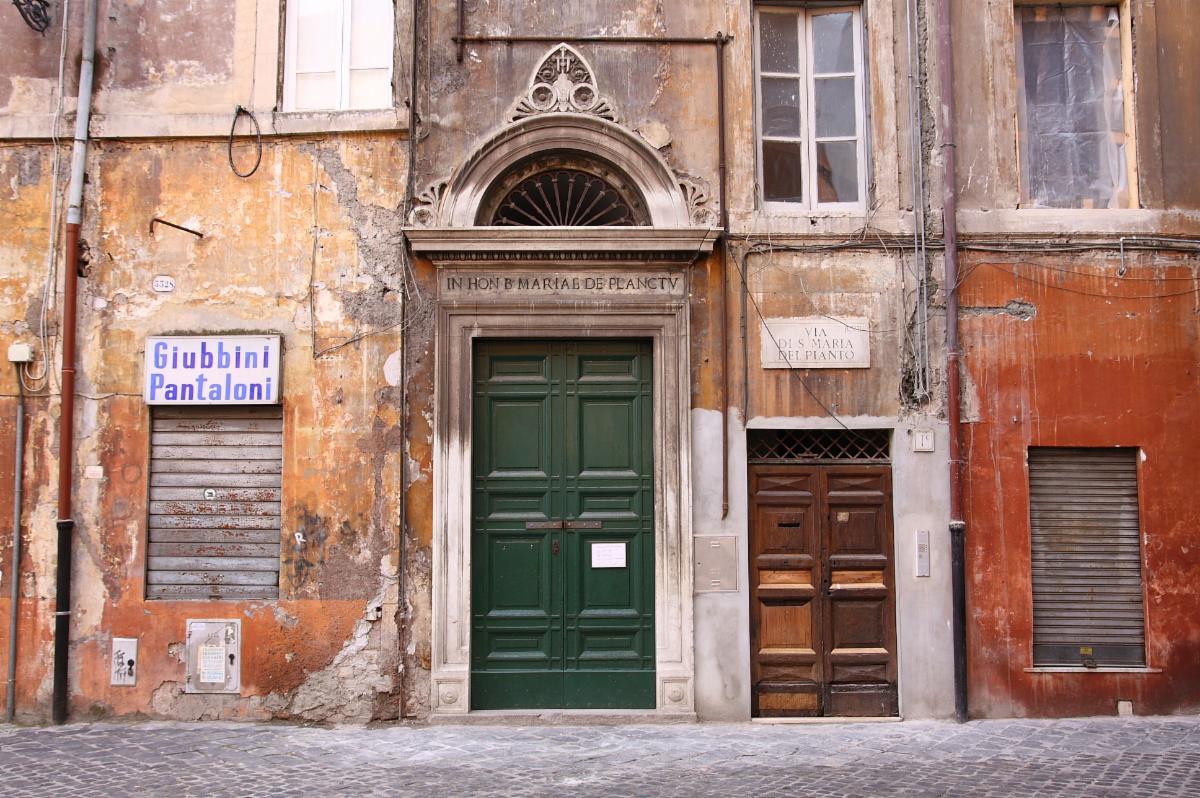 | This photograph is by Emanuele from Roma, titled S.M.del Pianti | |
As you can see all the Church has for a façade is a door and a small pediment. The Church owns the miraculous fresco of the Madonna which was located in an aedicula in the wall
of a close by building, which shed tears for the victim of a murder that occurred at her feet. It has never been open on my visits but has a certain spell upon me because of its humble entry. Be sure to try the door. There was once a Piazza della Pianta somewhere here, and it was here that Borgia Alexander VI’s son the Duke of Gandia was kidnapped and murdered, then thrown into the close by Tiber.
| |
In the Square of the Giudea/Scole we find yet another fountain made by Giacomo della Porta. We remember that the Jews were denied the fountain that graces the Piazza Mattei. They had to wait until 1585, when the waters from the rejuvenated Vergine were brought to this square. The Ghetto had never had running water and the Jews had always been forced to traverse across the Tiber to get their water from the well at Santa Maria in Trastevere. The water from the fountain was a welcome and deserved relief. The piazza here was remade in 1924, and the fountain was moved further to the south in 1930, with a restored upper basin (the original made its way to the Janiculum Hill). The lower basin consists of two semicircles of unequal sides, connected with short convex sides. The steps below have four corners which generally follow the slope of the lower basin. The upper basin has four Gorgons. From this spot gaze around what was the center of the Ghetto and imagine the several thousand people teeming from their cramped quarters here, with houses stacked up on top of each other. | |
We move along to the beautiful street of Via Portico d’Ottavia, around which we find at least five Jewish restaurants, which all have one thing in common—the world’s best artichokes. The Jewish cooks in Rome pride themselves in “la cucina ebraica-romana”—a combination of Jewish and Middle Eastern flavors and the Italian passion for fresh produce and simple fare. At number 51 we have Bellacarne (“beautiful meat’), home-cured and spit-roasted cuts their specialty, and Kosher carbonara. At Number 7 we find the best kosher pizza in Rome, at Bona Pizza Romana in teglie. It’s offered al taglio, or by the slice. At number 5 we have Renato al Ghetto, which has the famous pappardelle al sugo di stracotto (thick egg pasta with stewed beef), and also tonnarelli with honey mushrooms, truffles and dried meats. And at 57 we find the flagship of the Baghetto chain, with al fresco seating in the summer, right next to the Porticus of Octavia. Here they have Jewish-style Graffi (lamb cheeks) and grilled cuts, all paired with fine wines from across the world. | 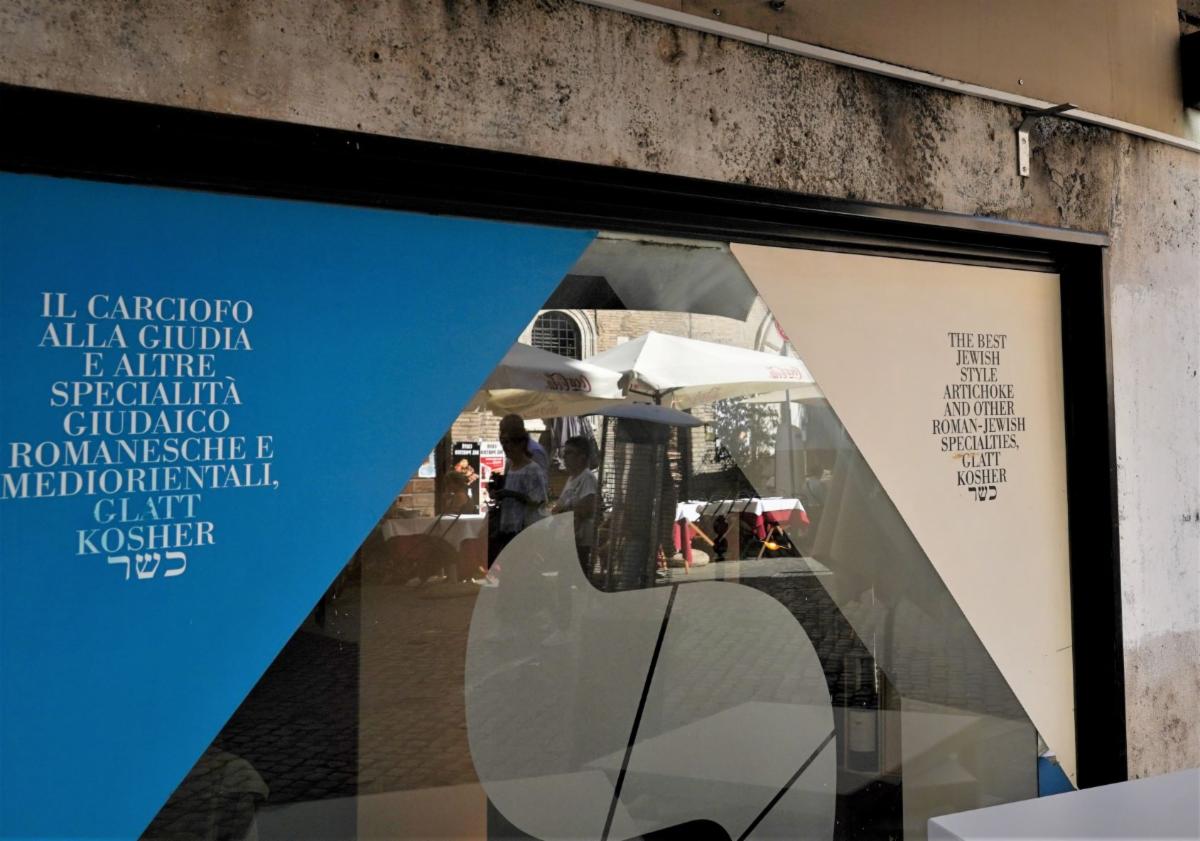 | |
We now make our way down the Via Portico d’Ottavia, and on our left we come to what is left of the Porticus of Octavia. The fishmongers of the medieval fish market set up their stands and chopping stations right smack dab within the Porticus. The small avenue that runs east from the Porticus and on the north side of the Theater of Marcellus is called the Via di Foro Piscario.
Before we enter the area of the Porticus, we pass through a piazza renamed Largo 16 Ottobre 1943 for the Nazi roundup of the Jews left in the Ghetto, and then on the Via Catalana we admire on our left the Synagogue, always ominous for the guards and thorough fencing. In 1982 on Shemini Atzeret a Muslim threw a hand grenade at the Jews leaving the synagogue, and then a dozen of the man’s accomplices opened machine gun fire. Fortunately only one Jew died, but thirty five were wounded. Only one of the attackers was caught, and he escaped when the Greeks refused his extradition. The synagogue is beautiful but I do have to say cold. There are tours, check them out!
| 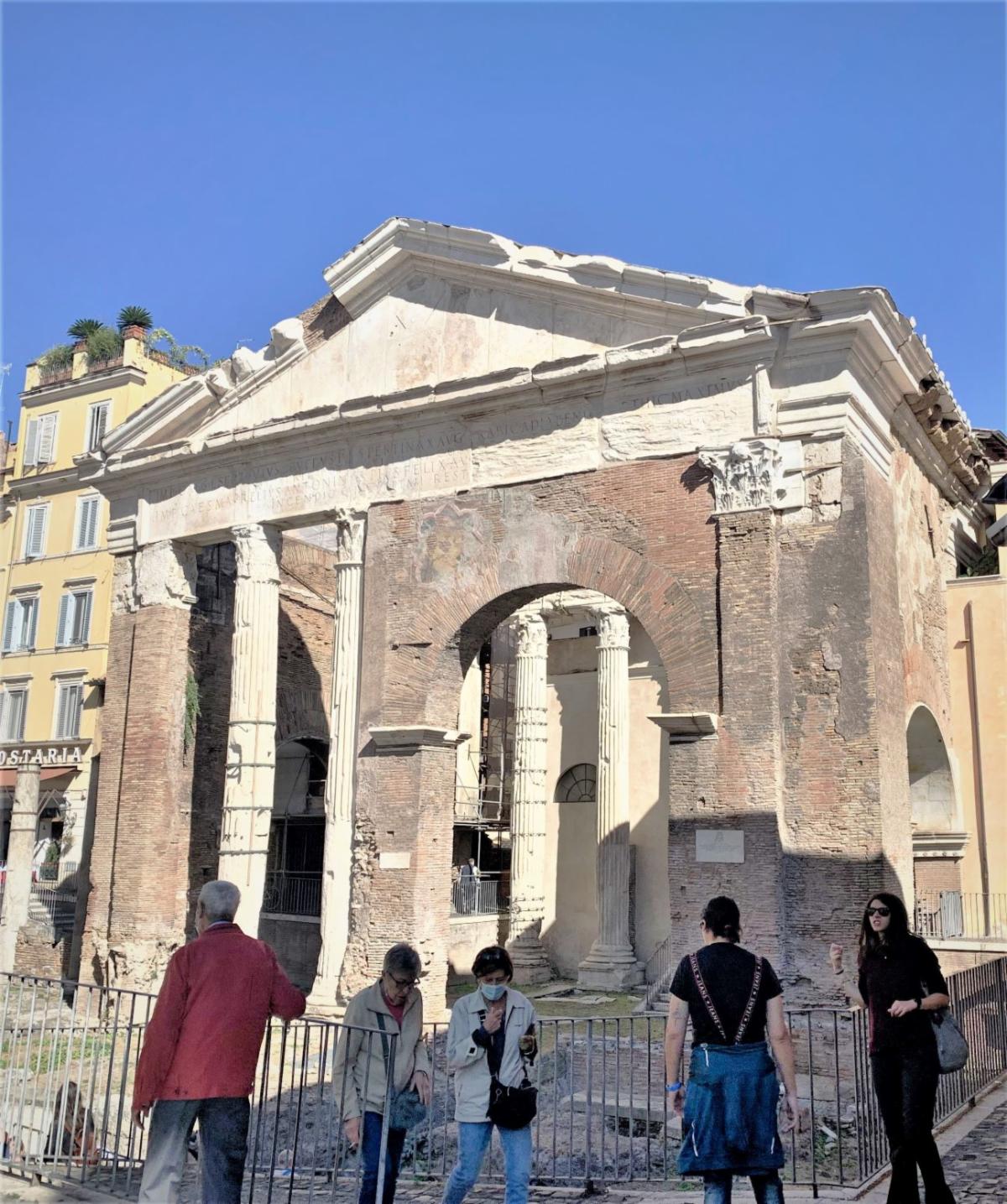 | |
Next we walk amidst the Porticus. Quintus Metellus made the portico in 149 BC. Then Augustus rebuilt it 23 BC and renamed it for his sister Octavia (unlucky wife of Marcus Antony, mother of Marcellus and grandmother of Claudius). Septimius Severus and his son Caracalla rebuilt the porticus yet again in 203 after a fire. In medieval times the porticus was known as the Severus Temple.
The rectangular porticus was home to temples for Jupiter and Juno, and served as a meeting place for the Theatre of Marcello which was adjacent. The columnar porch was double-sided, the porticus itself measured 50 m by 140m, had some 300 columns, and was home to an incredible collection of Greek masterpieces, including Lysippus’ bronze statues of Alexander on horseback with the twenty-five cavalry companions who had died in the battle of the Granicus in 334 BC. Metellus had taken these as spoils from the sanctuary of Dion in Greece. These disappeared at some point after the Gothic sack of 410.
| |
Pay special attention to the marbles of the architrave (Greek pentelic) and the Corinthian columns (Italian luna). Also very interesting here is the inscription “Tribute of Fishheads” inserted into the right pillar which you can make out with the beginning “CAPITA PISCIVM” and which commands that every fish greater in length than this marble figure must be handed over to the Conservators!
The church of Sant’Angelo in Pescheria is built right into the porticus, made before the time of Pope Stephen II (714-757). Stephen translated the remains of the Roman martyr Saint Symphorosa and her seven martyr sons in 752. In 1610 a sarcophagus was found with an inscription describing Stephen’s translation of the martyrs. The church is still open, but I have not been able to get in. There is also a small Oratory of the Fishmongers here which has a small relief of Andrew and his cross and below a latin inscription reading “Place of Prayer among the Fishmongers.”
Cola di Rienzo (1313-1354), self proclaimed “tribune of the people,” was born in a house near here, and set out from the Pescheria church on May 19, 1347 to assume control of the city. We see his statue off the left of Michelangelo’s Cordonata. Rienzo was ultimately done in by the Colonna, and executed on the Capitoline, his body hung ignominiously in front of San Marcello on the Via Lata.
| 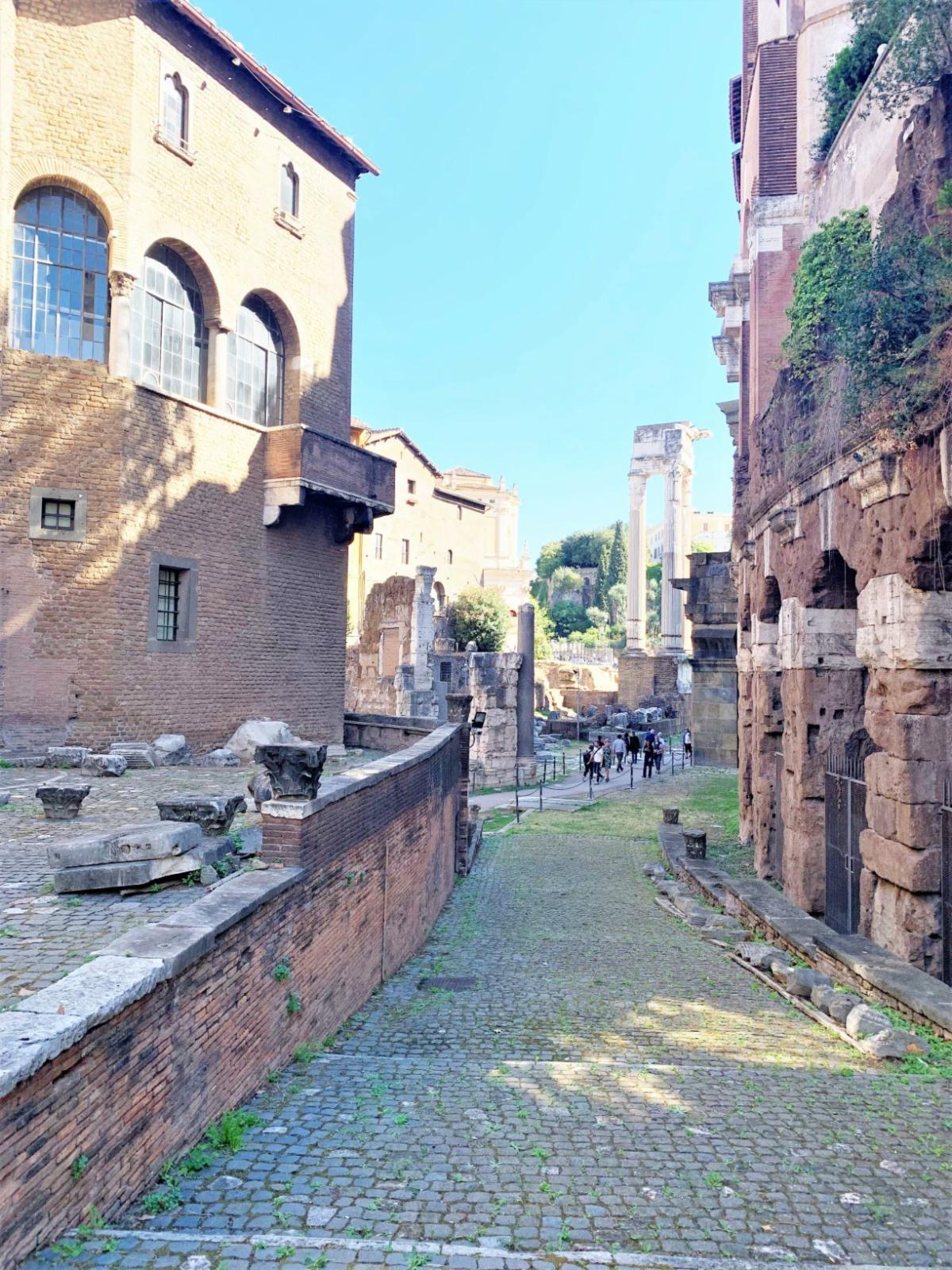 | The Via d. Foro Piscario, which crosses to the north of the Theatre of Marcellus. The three columns from the Temple of Apollo straight ahead. | |
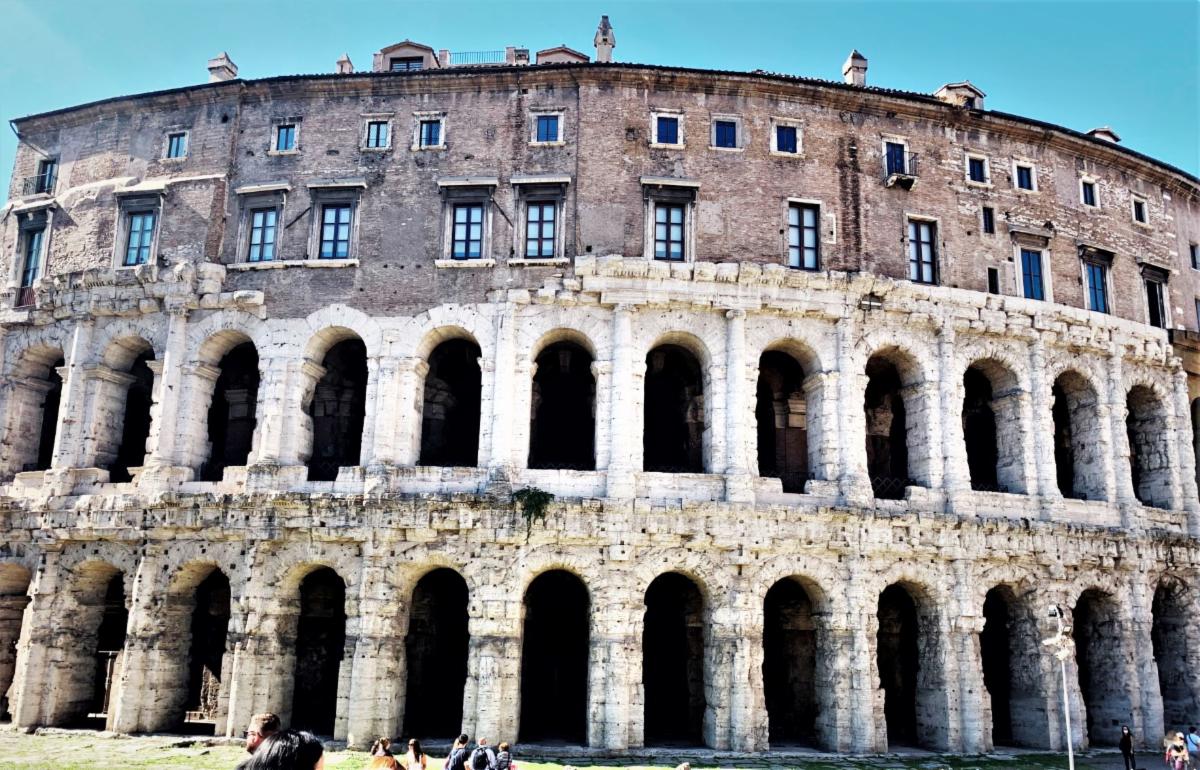
We now pass by the Theatre of Marcellus. This was planned by Julius Caesar to rival Pompey’s theater. Augustus took over at Caesar’s death in 44 BC and named it for Marcellus, Octavia’s son, who was the heir apparent until his death in 23BC. The theatre held over 20,000 spectators and was the most important of Rome’s three theatres. It has a wonderful curving façade with two superimposed arcades, which comprised just a third of the perimeter of the cavea, or seating area. Mussolini’s destructions for the new avenue to the east had one salutary effect—the shops were ejected from the arcades and the footings cleared down to their original level.
The travertine façade has framing semi-columns with Doric on the ground level and Ionic one level up. The now missing attic level probably was a plain wall with flat pilasters. We can still see the apartments that occupy the theater at the remade attic level. Baldassare Peruzzi (1481-1536) made for the Savelli family a semi-palazzo in the ruins, of which these apartments are a part. The family of the Orsini acquired the property from the Savelli and we see their family symbol of the bear on the entry at the end of the Via di Monte Savello.
We think the stage of the theatre survived until 421 and the colonnaded hall on the south end was still standing in 1575; today one travertine pier and a Doric column astride the palazzo gate are all that is left.
We can see to the east of the Porticus and just metres north of the theater what remains of the Temple of Apollo Medicus Sosianus: three white marble columns raised on a modern travertine and tufa base. This temple was probably put up late 1C BC by Gaius Sosius, who shared the defeat with Antony at Actium in 31 BC. Augustus pardoned him, and so the temple. The columns are Italian luna, with a Corinthian order some 50 feet high. These are beautifully done with a “rope-like decoration on the bases and alternately wide and narrow fluting on the shafts.” Amanda Claridge. Apollo’s attributes included the sprigs of laurel we see here, they are paired with fantastic flowerheads under the volutes. And then the entablature has a frieze of laurel branches “strung between bulls’ skulls and candelabra with tripod bases.”
|  | |
If you look under the theatre arcades you will see pieces of the front of the temple, including the apex of the pediment. The numerous fragments of Greek statuary from the pediment found in 1937-38 are now kept on display in the Capitoline Museums. The Palazzo dei Conservatori has a frieze from the cella showing a triumphal procession. On the ground you can see some of the dazzling marble of the temple: Phrygian purple, Numidian yellow, Lucullan red/black, Chian pink/red.
We now visit the station church (Saturday of the Fourth Week) of Saint Nicholas in Prison, on the southern most point of the Rione. Saint Nicholas (270-343) was bishop of Myra in Asia Minor, persecuted under Diocletian, participant at the Council of Nicea in defense of the Trinity, and the inspiration for Santa Claus! Nicholas was not imprisoned here, the name comes from the assumption that this area was once home to a prison. The church does reside in ancient temples-- Juno, Janus, and Spes. Three columns from Juno are in the frontal façade, while columns of Janus are on the northern wall, and six columns from Spes are in the southern wall. Pio Nono (Pius IX) had copies of Guercino’s Trinity and Caracci’s Assumption painted here.
We end our visit to the Rione with a stop at San Gregorio della Divinta Pieta, which is just to the right of the Synagogue. This church sits on the legendary site of Gregory the Great’s birthplace, a property owned by the Anicia family. The church was dedicated to helping formerly rich families who had become destitute. On the north wall see if you can find an alms slot with an Italian inscription reading: “Alms for poor, honorable and ashamed families.” A not so nice aspect here is the inscription from Pius IX, who was otherwise a kind man to the Jews of Rome, but who rebukes them here as a “rebellious people.”
Our next walk will take us through the Ripa Rione, which includes the Bocca Verita, the Arch of the Silversmiths, and the precious Nasone drinking fountain, and the early Christian Churches of Santa Maria n Cosmedin, San Teodoro, and San Giorgio in Velabro. We will see the spectacular Cosmati mosaic artisans and Pietro Cavallini.
Copyright 2023 Greg Pulles. All rights reserved.
| | | | |