|
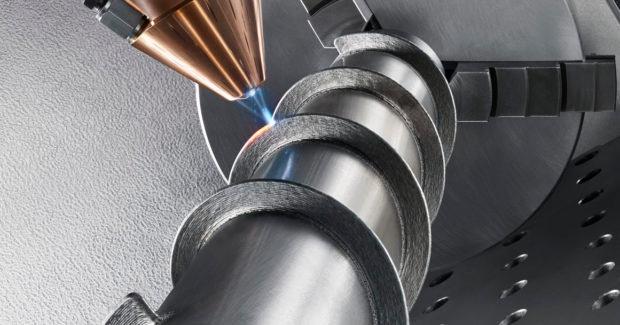
Laser Metal Deposition, Laser Metal Fusion
|
|
From the Executive Director
|

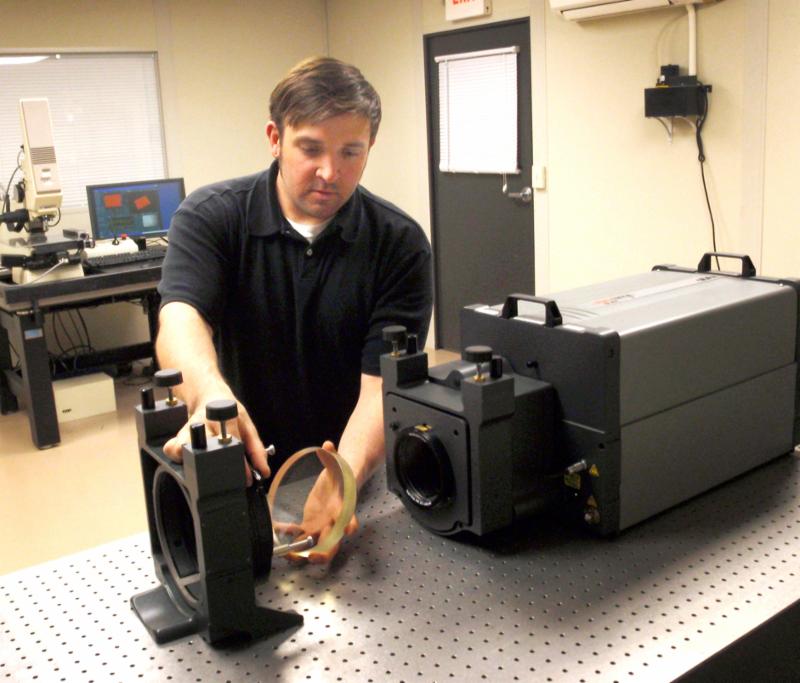
The lead image in the month's newsletter is a good reminder of emerging developments in laser materials processing (LMP). In the next few months, MPEC will be releasing up-to-date teaching materials on this subject. In early August, MPEC will be offering a five-day LMP workshop for interested faculty, which will include industry tours. Contact Greg Kepner or visit the MPEC website for more information.
Other areas of development highlighted in this newsletter are photonics applications emerging in Digital Cinema Technology as described in the first article; also in defense applications exhibited at the SPIE Defense & Commercial Sensing Conference attended by a group of LASER-TEC students and faculty.
As the winter/spring semesters close, faculty have an opportunity to "catch-up" on maintenance of labs, student recruitment and records of student completers and placements. Please continue to send Christine Dossey information on enrollment, completers and placement of your students. OP-TEC needs this information to support the work of the center and project funding grants. OPCN Coordinator Semiannual Reports are due this month.
Summer is also a great time to reorganize and clean up your labs-and to assure that you have all the important laser safety equipment, signs and procedures in place.
Do you need more strategies for student recruitment?
See the OP-TEC monograph
Using Current Photonic Students to Recruit New Students by clicking
here.
Have you made plans to attend the OPCN meetings and tours at the HI-TEC Conference in Miami, July 23-26? Contact Christine Dossey at OP-TEC if you need help.
Dan Hull
|
 |
|
|
Emerging Digital Cinema Technology
|
High Definition Television (HDTV) technology, offering up to 1920x1080 pixels in our homes, is now approaching the image quality of lamp-based digital micro-mirror projectors (DMDs) currently being used in theaters. As home television technology continues to advance, theater projection technology is in danger of falling behind. According to Chris Chinnock, president and founder of Insight Media in Norwalk, Conn., "Today's digital theater projectors can't match the contrast, color palettes and luminance of the latest home HDTVs with high dynamic range. Theater owners are upgrading seating and food service, but they must also keep up in image quality."
In response, manufacturers have identified three technologies that will compete for next-generation theater technology:
1. RGB Laser Light Source
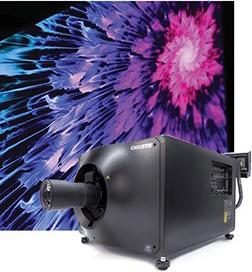
A projector that uses separate red, green and blue lasers to illuminate three micro-mirror arrays with projection optics combining the images and projecting them onto a screen.
+ Excellent color gamut
+ High Brightness
+ Contrast: 1,000,000 to 1
- High Cost
|
2. Laser Phosphor Light Source
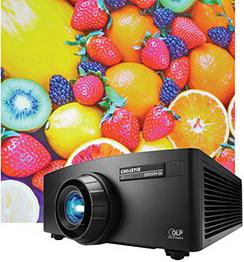
A projector that uses blue lasers to illuminate phosphors generating red and green, and also to provide the blue light for three micro-mirror arrays, with projection optics combining the images and focusing them on the screen.
+ Low Capital Cost
+ Very Good Color Gamut
+ Much Longer Lifetime than Lamps
- Quality Similar to Lamps
|
3. Emissive LED Screens

The third eliminates the projector and replaces the reflective screen with a super-sized emissive LED screen.
+ High Peak Luminance
+ Excellent Color Gamut
+ Blackest Blacks
+ Excellent Contrast
- Very High Cost
|
Both of the laser-based projector technologies use long life primary color lasers in place of bulbs and will work with many of the micro-mirror arrays currently used in bulb projectors. These arrays come in two standard sizes: 2K with 2048×1080 mirror elements, and 4K with 4096×2160 mirrors, which produce images slightly wider than the HDTV and UHDTV digital television standards. Optics and Photonics (the source of this piece) has put together the following comparison chart.
All three support 3-D and many cinemas will likely keep running their lamp-projectors until replacement is required.
|
|
|
|
Laser Laboratory Maintenance and Safety
|
Periodic review and refreshment of laboratories is important but often overlooked. Here's a checklist to remind you of lab maintenance essentials:
- Are your labs and the
 storage of equipment, components, and/or supplies well organized? See pp. 23-28, OP-TEC Photonics Systems Technician Curriculum Guide, click here to request a copy.
- Are laser safety signs and safe access to labs in place?
- Are electrical safety equipment and requirements in place?
- Are appropriate laser safety goggles available and identified?
- Do you have an up-to-date copy of the ANSI Z136.5 Standard for the Safe Use of Lasers in Educational Environments?
- Does your organization have a designated Laser Safety Officer (LSO)?
- Is the LSO trained and certified?
Dr. Fred Seeber, laser program chair at Camden County College, is available to answer questions you may have regarding laser safety (fredpseeber@comcast.net).
Mr. Frank Reed, laser program chair at Indian Hills Community College is available to answer questions regarding laser lab organization and equipment/component storage, as well as selection of lab equipment (
Frank.Reed@indianhills.edu)
The Laser Institute of America (LIA)
is
 the
technical association that provides laser safety signs,
ANSI Safety standards and training/certification
for LSO's. LIA also offers an online training course for LSOs. See
www.lia.org
.
|
|
|
|
LASER-TEC Students Attend SPIE Defense
+ Commercial Sensing Conference
|
|
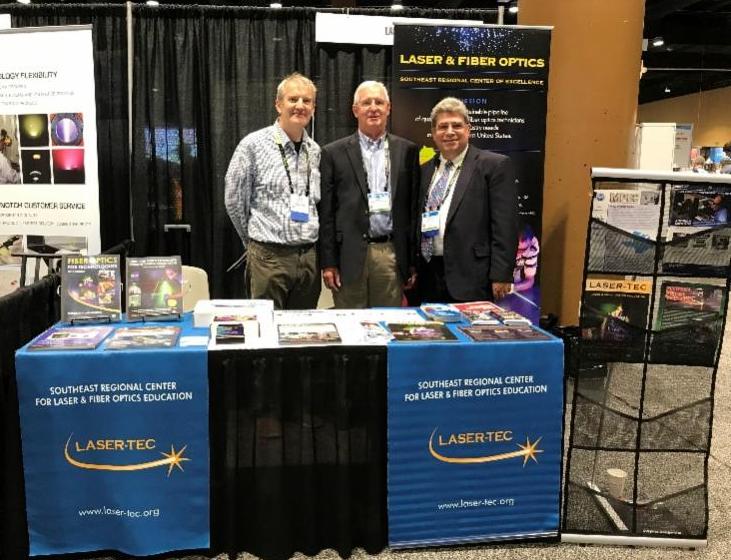
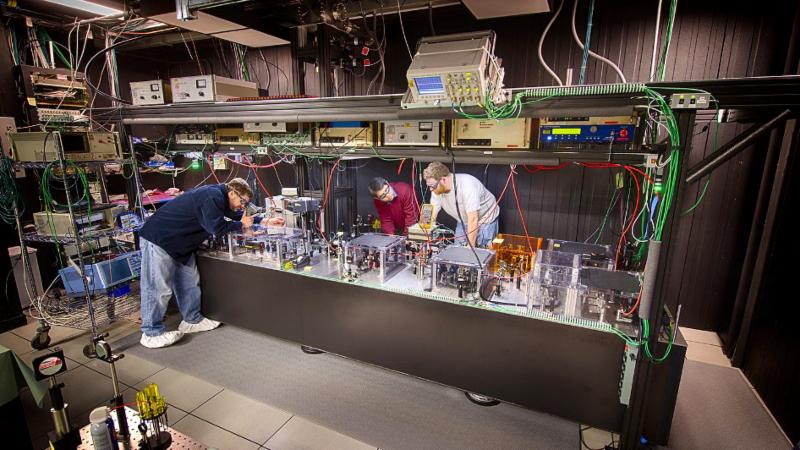
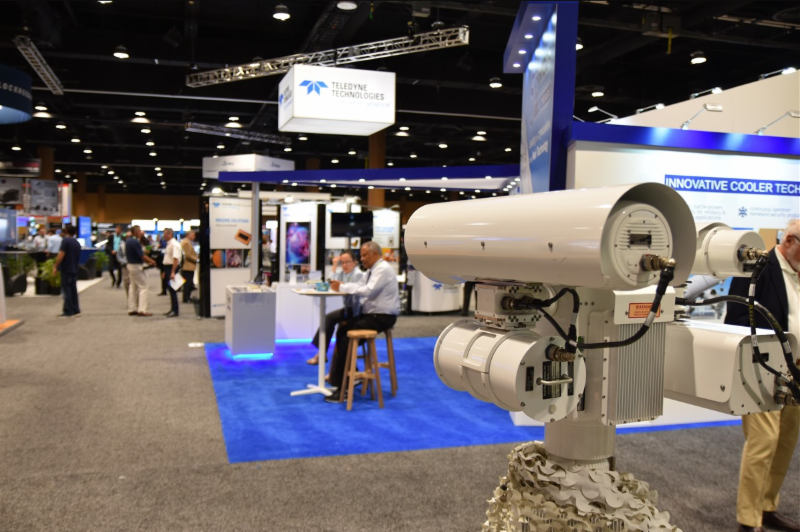
Students and faculty from the Robotics and Photonics Institute at Indian River State College and the Laser and Photonics Technology Program at Central Carolina Community College had a great and rare opportunity to attend the SPIE Defense + Commercial Sensing Conference in Orlando, Florida on April 17, 2018. The trip was sponsored and organized by the Southeast Regional Center for Laser and Fiber Optics Education, LASER-TEC.
Every year, the SPIE Defense + Commercial Sensing Conference brings together over 4,500 attendees. It is a major event for the photonics industry focused on sensors, infrared technology, laser systems, spectral imaging, radar, LIDAR, and other photonics technologies specific for defense and commercial applications.
Together with 400 vendors, LASER-TEC exhibited at the conference. The group networked with researchers, engineers, and products developers who specialize in optics and photonics. The students attended technical sessions as well as the job fair hosted by the conference. The following day, they joined the open house event of CREOL, the College of Optics and Photonics at the University Central Florida.
"It was an eye-opening experience", says Heather Hunt-Gonzalez, a student of the IRSC Robotics and Photonics Institute. "It was exciting to see and learn about the latest photonics technologies serving multiple industry sectors. It was extremely helpful for me to be exposed to it while I am still in college."
|
|
|
|
MPEC to Offer Professional Development
|
MPEC will be offering three professional development opportunities this summer. Registration is free for all three activities and travel expenses will be provided for participants.
A two-day Fundamentals of Photonics workshop will be offered July 30-31, 2018 and a five-day Laser Material Processing (LMP) workshop will be offered August 6-10, 2018 at Indian Hills Community College in Ottumwa, IA. LMP participants will also tour local manufacturers to observe live laser based manufacturing processes. Both of these workshops are complete with curriculum material presented and laboratory activities all included within the workshop timeframe. These workshops qualify for CEUs and also for recertification credits through the regional (GPAEA) Great Prairie Area Education Agency.
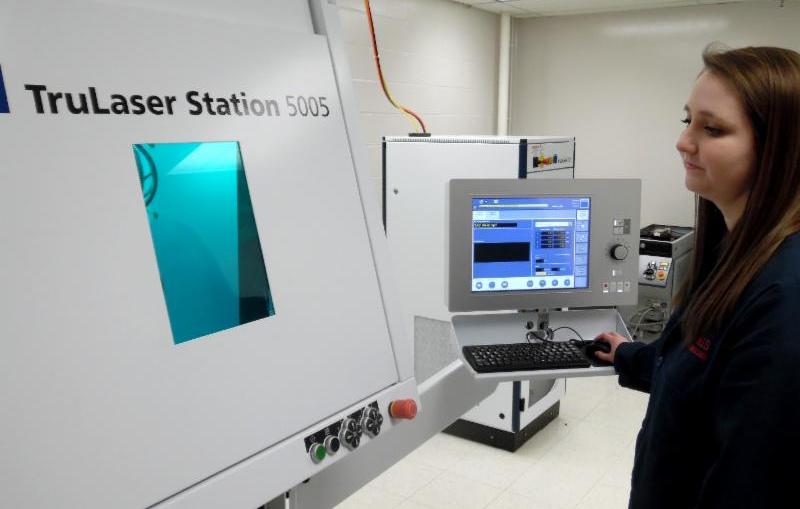
An open entry Hybrid Online Laser Material Processing course will be offered from now until July 9 with the on-site laboratory activities being held at IHCC on July 9-13, 2018. This LMP course includes 10 units of coursework with online lectures, PowerPoint presentations, and quizzes.
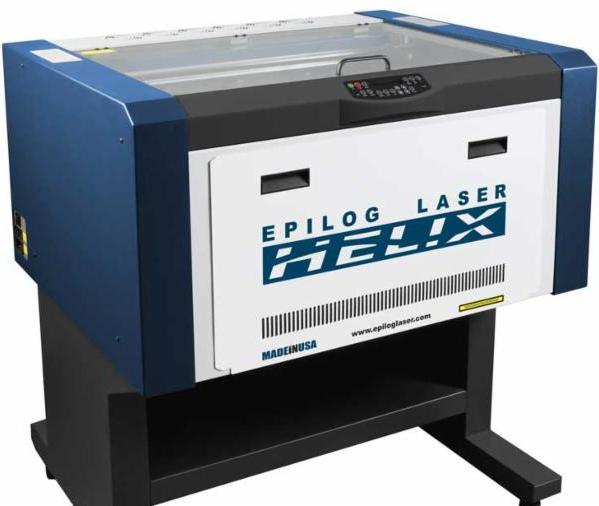 Attendees will perform laboratory activities with a variety of laser based equipment including a TRUMPF TruLaser Station 5005 welding system, an Epilog Laser Helix engraving/marking system, and an IPG Photonics Fiber Laser.
|
|
|
06/18/18 - 06/20/18
Course 1 Faculty Capstone
Indian
Hills Community College
|
06/20/18 - 06/22/18
Course 2 Faculty Capstone
Indian
Hills Community College
|
06/24/18 - 06/27/18
Salt Lake City, UT
|
|
Indian Hills Community College
Ottumwa, IA
|
08/06/18 - 08/10/18
MPEC Laser Material Processing
Indian Hills Community College
Ottumwa, IA
|
Preparing Forms for your NSF ATE Proposal
Thursday, May
10, 2018
12:00 PM - 1:30 PM CDT
Each year, the Mentor-Connect project team produces a cost-free webinar that highlights the process for filling out various forms that are
required in the National Science Foundation (NSF) Advanced Technological out various forms that are Education (ATE) grant
proposal process.
Participants will:
- Know the purpose of various forms associated with NSF ATE proposals
- Know information to enter into each form associated with NSF ATE proposals
- Learn about the importance of providing consistent information on forms and other components of a proposal
- Be alerted to common errors that can be avoided
- Get answers to questions on completing required proposal forms
|
|
|
|
How to Achieve the Most Accurate Laser Energy Measurements
Measuring a pulsed laser is complex. Besides power, you also need to worry about pulse energy, frequency, and pulse width. In this Photonics Media webinar, you will learn how laser energy measurement works and how to do it right. Anyone involved in laser applications who needs clarity on how to correctly and accurately measure laser energy will benefit!
Tuesday, May 15, 2018 12:00-1:00 PM CDT
|
|
|
|
OP-TEC Provides Online Faculty Development for Fundamentals of Light and Lasers and Laser Systems and Applications
OP-TEC's online professional development courses prepare faculty and laboratory staff to teach with Fundamentals of Light and Lasers (Course 1)
or Laser Systems and Applications (Course 2).
The open entry/open exit courses are available through the Canvas online learning management system 24/7 through May 31. Participants who successfully complete their online course will be invited to a hands-on laboratory capstone experience during the week of June 18-22 at Indian Hills Community College in Ottumwa, Iowa.
|
|
|
The national and regional photonics centers will host the next annual in-person OPCN network meetings and photonics industry site visits at the HI-TEC Conference, July 23-26, 2018 in Miami, FL.
The HI-TEC Conference provides a wonderful opportunity for educators to learn, network, give presentations, share best practices, and disseminate project resources with other STEM educators.
OPCN events are being planned for the HI-TEC Preconference on Monday and Tuesday, July 23-24. The general conference keynotes, presentation sessions, and exhibits will take place on Wednesday and Thursday, July 25-26.
As in previous years,
OP-TEC will be offering conference registration codes for OPCN representatives to attend. OPCN Coordinators and Members will receive priority for these free registrations. Actively reporting OPCN coordinators may also request reimbursement for airfares following OP-TEC guidelines.
We hope that all OPCN members will be able to attend July 23-26 in Miami!
|
|
|
|
John Crawford learned about photonics while studying engineering at Pennsylvania State University. After having lunch with a student from Indiana University of Pennsylvania (IUP), and then working with him for the next year on a project utilizing a High-Definition Survey System to model physical structures, John decided to study electro-optics at IUP. That one conversation has led John to a rewarding career in optics as an optical engineer at Primatec Advanced Ceramics.
Challenges John faced as he continued his education at IUP included coming into the field with no previous experience and then deciding which specialty to focus on. "The photonics industry is so diverse and specialized that I felt I needed to be completely competent in a specific component before I entered the workforce."
John continues to rise to the challenges of his job's fast-paced environment. One particular achievement that John takes pride in is the completion of a nine-inch, conventionally polished, ceramic parabolic mirror. "Using a spindle and lapping tool is not the easiest way to produce an aspheric mirror, but the end result is astonishing."
In the future, John would like to work on optics projects for astronomical telescopes. "In the past, I have worked with optical technicians and engineers who have worked on some exciting projects like the James Web Space Telescope." A career in optics that started out as a lunch conversation may one day allow John to reach the stars.
|
|
|
The Committees of the Optics and Photonics College Network are dedicated to sharing expertise, best practices, resources, and advice on issues of importance to photonics technician educators at colleges throughout the United States.
|
Professional
Development
Committee
Anca Sala, Chair
|
Student Recruiting
Committee
TBD
|
Program Assistance Committee
Gary Beasley, Chair
|
Equipment Committee
Frank Reed, Chair
|
For Previous Issues of the OPEN Newsletter please visit OP-TEC's
News Page.
|
|
|
|