|
Wearable Optical Fibers and Sensors
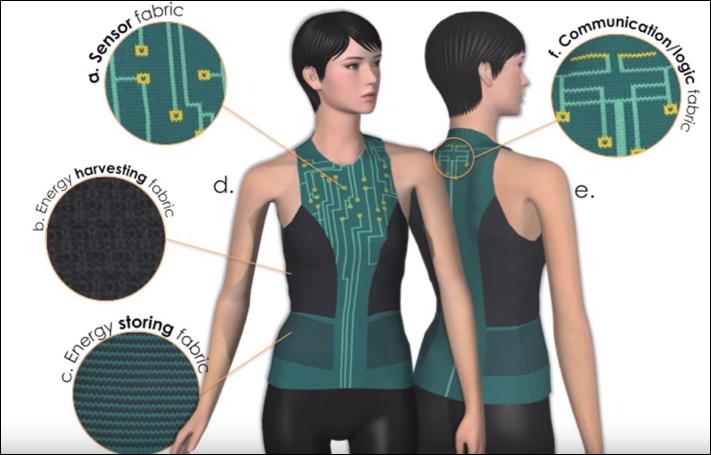
The market for wearable sensors is predicted to grow to $5.5 billion by 2025, impacting global health in unprecedented ways. Optics and photonics will play a key role in the future of these wearable technologies, enabling highly sensitive measurements of otherwise invisible information and parameters about our health and surrounding environment.
Source:
https://link.springer.com/chapter/10.1007/978-3-319-51394-2_16
|
|
From the Executive Director
|

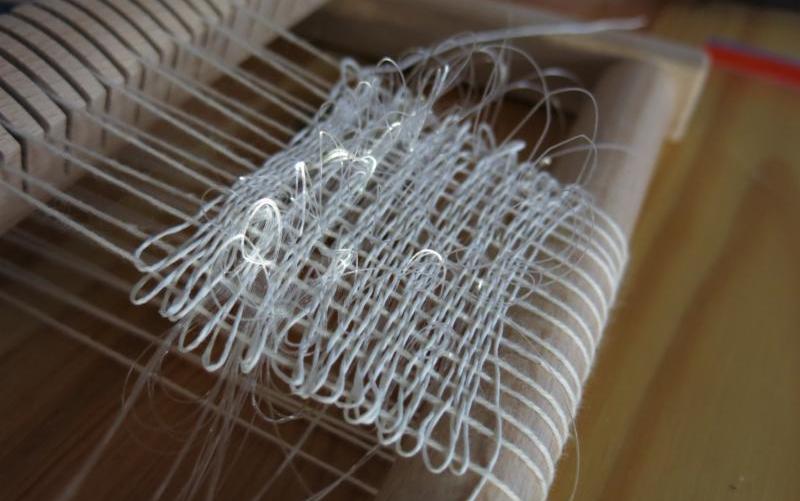
The lead pictures in this issue remind us of the rapidly emerging market of wearable fibers, and the essential applications of optics and photonics to this field. Downloading and reading the referenced article is worthwhile.
Another interesting scientific breakthrough is Lightcone Transform (LCT) Reconstruction which enables non-line-of-sight (NLOS) imaging in LIDAR systems, so that they can "see around corners".
The articles by MPEC and LASER-TEC provide excellent strategies for outreach and student recruitment. Strategic, focused recruitment efforts are critical to maintaining high student enrollments in existing photonics technician education programs. OP-TEC's
Using Current Photonics Students to Recruit New Students monograph describes the use of current students for outreach and recruitment.
I recommend that faculty review the power point slides of figures used in OP-TEC student textbooks,
Quality Assurance of Precision Optics and
Metrology of Optical Systems. Some of these figures are also useful in other photonics courses.
Please plan to attend the HI-TEC Conference, which will be held in Miami FL, July 23-26. OPCN meetings and tours will be held July 23-24. OP-TEC is an Executive Sponsor, and receives registrations which we will provide, along with travel reimbursments, to OPCN coordinators.
Dan Hull
|
 |
|
|
Using Lasers to See Around Corners
|
|
A revolutionary improvement of a highly successful laser technology is emerging that would enable cars to see around corners.
Autonomous vehicles today use LIDAR (Light Imaging, Detection And Ranging) technology for imaging, detection and ranging (echolocation). LIDAR systems emit laser pulses to illuminate objects; and then analyze light that bounces back to determine distance and visualize what objects looks like.
LIDAR works great for objects within direct line of site. Researchers at Stanford University have recently taken the process one step further in the development of a highly sensitive laser technology that could be able to see objects around corners. Using non-line-of-sight (NLOS) imaging, researchers have demonstrated the reconstruction of size, shape and distance of
hidden objects by analyzing scattered light.
In a recent demonstration using a confocal scanning procedure, a laser was placed next to a highly sensitive photon detector capable of recording reflected particles of light. The laser was aimed to direct invisible pulses at a diffuse-reflecting wall. The laser pulses reflected from the wall bounced off objects around the corner and then bounced back to the wall and into the detector.
After finishing the scan, a new computer algorithm untangled the paths of the captured photons in (what once took 2-60 minutes) fractions of a second and reconstructed the shape, size and distance of the objects behind the wall. This method, called Lightcone Transform (LCT) Reconstruction, requires much smaller computational and memory resources than previous reconstruction methods do for hidden objects. It also provides unprecedented resolution.
Work continues to fine tune the technology, developing a system that will work better with moving objects and in daylight.
Sources:
|
|
|
|
College Immersion Experience
|
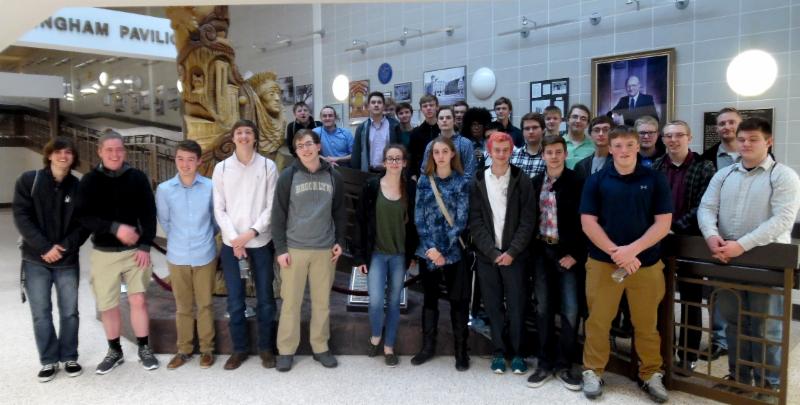
The Midwest Photonics Education Center at Indian Hills Community College (IHCC) hosted 28 students from the Columbia Area Career Center (CACC) for a College Immersion Experience on Wednesday, February 28th and Thursday, March 1st. The purpose of this event was to introduce the students to college life through a variety of on-campus activities.
On Wednesday, the students learned about the college admissions process, financial aid options, Job Corps opportunities, residence hall life, and toured the entire IHCC campus including residence halls. Three current IHCC Laser program students (former CACC students) shared their college experiences and Laser Club opportunities with the visiting students. IHCC Instructor Michael Shay shared information about the Laser & Optics Technology program, job opportunities and placement, and program expectations. The students had meals at both campus dining facilities during the visit.
On Thursday morning, the visitors experienced the highlight of the trip in the Laser Program laboratory, where they participated in 8 different hands-on activities. The CACC students worked with the IHCC students in the laboratory on a variety of laser and optics applications and experiments including laser cutting and etching with an Epilog Laser, laser welding with a Trumpf Trulaser Station 5005, laser drilling with an IPG Fiber Laser, and a variety of laser and optics alignment processes.
|
|
|
Girls Explore Photonics Technologies at 2nd Annual
Tech Like a Girl
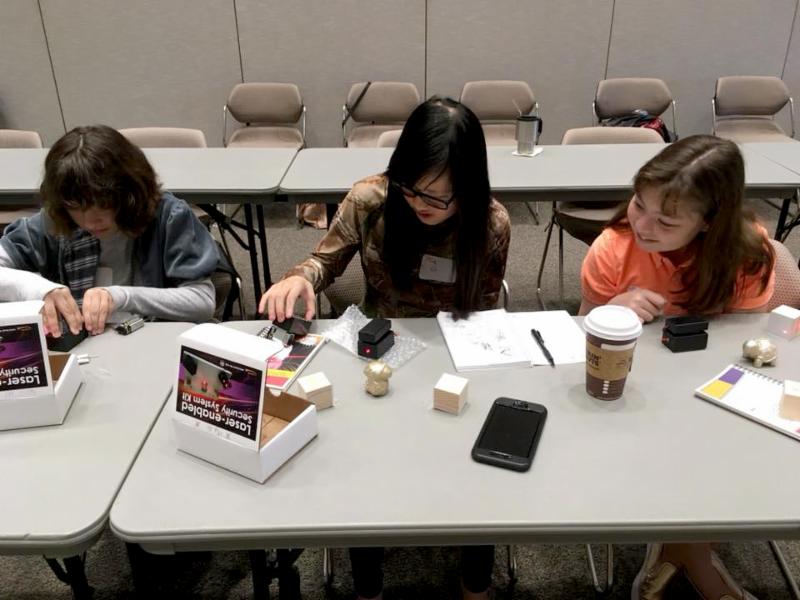
LASER-TEC and AAUW (American Association of University Women) offered a four-Saturday STEM camp for middle and high school girls in central Florida. This initiative was designed to interest girls in the areas of STEM and to increase awareness of the high-tech, high-paying career opportunities, both locally and throughout the country, where lasers an
d fiber optics are used. Campers were also advised of the courses they need to take in high school to prepare them for a successful career pathway.
The first session featured successful women who have careers in photonics related STEM fields. Campers were introduced to four inspiring and dynamic women who spoke about their photonics careers and the emerging technologies that lie within their profession. Heather Hunt-Gonzalez, a student from the Robotics & Photonics Institute at Indian River State College, also spoke to the girls about her decision to study at the Robotics and Photonics Institute of IRSC.
In the second and third sessions, girls experienced hands-on activities by making a DIY Fiber Optics Lamp with the choice of a primary or secondary LED light color. This taught the girls about light, fiber optics and electronics. Another project was to build their own Laser Enabled Security System. Campers also learned to identify an array of electronics components and how to solder those components on to a circuit board.
Throughout all four sessions, girls were also taught to design a website and use it as a portfolio to convey all that they learned from the camp. They populated their sites with information they learned about various STEM technologies, photos that they took while attending, and their overall thoughts on each session of the camp. During the final session, girls presented the websites they created and set up their security systems to show to family and friends after the presentation.
|
|
|
Figures and Images for Instructors (PowerPoint and PDF):
One download contains separate files for each module, allowing for easy use and organization.
|
|
|
04/28/18 - 05/01/18
Dallas, TX
|
06/18/18 - 06/20/18
Course 1 Faculty Capstone
Indian
Hills Community College
|
06/20/18 - 06/22/18
Course 2 Faculty Capstone
Indian
Hills Community College
|
06/24/18 - 06/27/18
Salt Lake City, UT
|
|
Indian Hills Community College
Ottumwa, IA
|
|
Indian Hills Community College
Ottumwa, IA
|
|
OP-TEC Provides Online Faculty Development for Fundamentals of Light and Lasers and Laser Systems and Applications
There is still plenty of time this semester to complete one of OP-TEC's online professional development courses that prepare faculty and laboratory staff to teach with Fundamentals of Light and Lasers (Course 1)
or Laser Systems and Applications (Course 2).
The open entry/open exit courses are available through the Canvas online learning management system 24/7 through May 31. Participants who successfully complete their online course will be invited to a hands-on laboratory capstone experience during the week of June 18-22 at Indian Hills Community College in Ottumwa, Iowa.
For more information or to enroll in Course 1, visit
|
|
|
|
The national and regional photonics centers will host the next annual in-person OPCN network meetings and photonics industry site visits at the HI-TEC Conference, July 23-26, 2018 in Miami, FL.
The HI-TEC Conference provides a wonderful opportunity for educators to learn, network, give presentations, share best practices, and disseminate project resources with other STEM educators.
OPCN events are being planned for the HI-TEC Preconference on Monday and Tuesday, July 23-24. The general conference keynotes, presentation sessions, and exhibits will take place on Wednesday and Thursday, July 25-26.
As in previous years,
OP-TEC will be offering conference registration codes for OPCN representatives. OPCN Coordinators and Members will receive priority for these free registrations. As in previous years, OPCN coordinators will be reimbursed for their airfares post-conference.
We hope that all OPCN members will be able to attend July 23-26 in Miami!
|
|
|
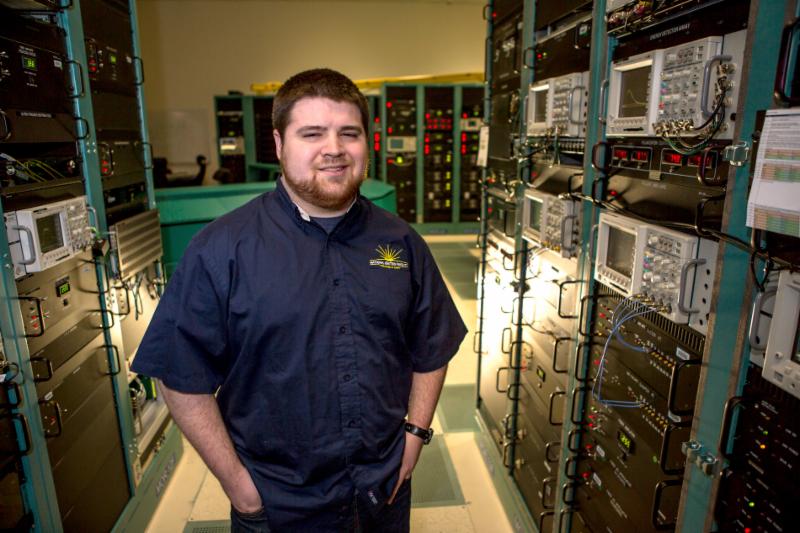
After taking an Introduction to Lasers class in high school,
Tyler Dumbacher became fascinated in the field of photonics. Knowing the rewarding and exciting field of photonics would take him where he wanted to go in life. Tyler did some research online and visited the Laser and Optics Technology program at Indian Hills Community College (IHCC) in Ottumwa, Iowa.
Tyler had a solid foundation in math and science, which helped him when he was faced with difficult course work. Tyler didn't cut corners; he saw difficult subjects as a challenge and an opportunity to better himself and improve in areas that might need work.
Tyler graduated from IHCC with an associate of applied science degree in laser and optics technology. Tyler is a laser technician for Akima Infrastructures, a contractor company working with the Lawrence Livermore National Laboratory at the National Ignition Facility (NIF) in California. NIF is the world's largest and most energetic laser facility. Tyler works in the injection laser subsystem (ILS), where he operates, maintains, and troubleshoots laser systems. For Tyler, the best part of his work as a laser technician is being on the forefront of cutting-edge technology and having the potential to help making scientific history.
Tyler believes that students who enjoy hands-on work and problem solving and are willing to work hard and put in the necessary time will find a career in photonics very rewarding. "This is a growing field," he says, "and there are more opportunities than laser technicians to take them all. It's definitely worth it!"
|
|
|
The Committees of the Optics and Photonics College Network are dedicated to sharing expertise, best practices, resources, and advice on issues of importance to photonics technician educators at colleges throughout the United States.
|
Professional
Development
Committee
Anca Sala, Chair
|
Student Recruiting
Committee
A.J. Gevock
|
Program Assistance Committee
Gary Beasley, Chair
|
Equipment Committee
Frank Reed, Chair
|
For Previous Issues of the OPEN Newsletter please visit OP-TEC's
News Page.
|
|
|
|