|
OPCN Visits Tower Optical Corporation
|
|
From the Executive Director
|
| 
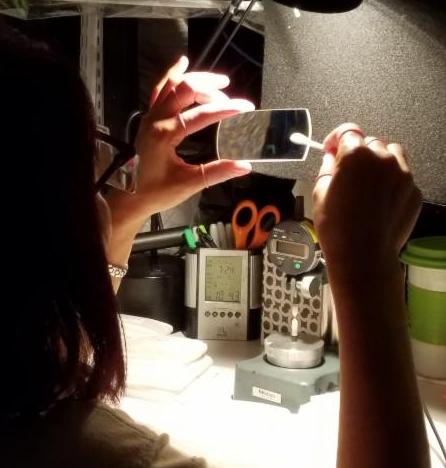
One of the highlights of the OPCN meetings at the recent HI-TEC Conference in Miami, was the tour of Tower Optical Corporation's precision optics manufacturing facility in Boynton Beach. Thanks to Tower Optical's CEO, Mel Kantor, for this interesting experience, and the opportunity to visit with the technicians working there.
In the meetings and networking time among the OPCN educators, we learned of changes, program improvements and successful practices, as well as new resources available from OP-TEC and the regional photonics centers. A suggestion was made to consider forming an "OPCN LinkedIn Network" to increase the interaction among members. The plan for this (which is already underway) is described below.
I strongly recommend that all photonics faculty members review and consider using the resources for teaching OP-TEC's Course #1 and #2, described in the last article, Faculty Resources. These resources, which are available to all photonics faculty, will not only make your course preparation more efficient, they will also enable all your students to be successful in these courses.
Dan Hull |
 |
|
|
OPCN Faculty Meetings at HI-TEC
|
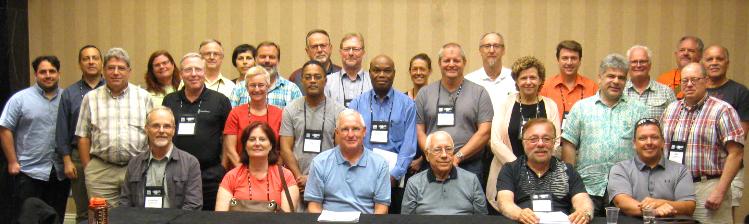
Optics and Photonics College Network members, colleagues, and educators interested in optics and photonics education traveled to Miami in July to attend the annual in-person meetings of the Optics and Photonics College Network (OPCN) at the 2018 HI-TEC Conference.
More than 30 faculty members and administrators from 22 colleges met July 23-24 to network together, share best practices and program updates, and review the services and resources offered by the three NSF ATE photonics centers. In the two scheduled OPCN meetings, attendees were provided descriptions and copies of new and revised teaching and recruiting materials prepared by OP-TEC, LASER-TEC, and MPEC. Members discussed innovative organizational strategies to accomplish the work of the four OPCN committees (Program Assistance, Equipment, Professional Development, and Student Recruiting). Gordon Snyder (OP-TEC), Gary Beasley (CCC), Greg Kepner (IHCC) and Chrys Panayiotou (IRSC) led a panel discussion on "Effective Teaching and Student Retention."
On Tuesday, attendees travelled to a site visit at Tower Optical Corporation, a renowned manufacturer of custom precision optics and optical assemblies.
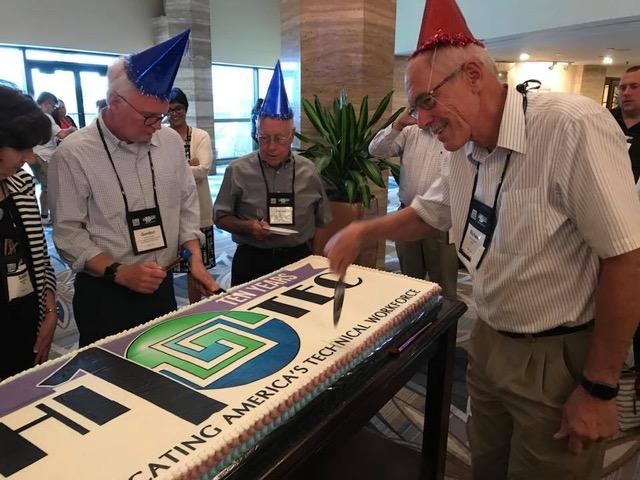
The HI-TEC Conference on Wednesday and Thursday was attended by over 537 educators, and included general sessions, dozens of presentations, and an exhibit hall where the three photonics centers hosted a photonics outreach booth and celebrated the tenth HI-TEC conference complete with a giant birthday cake and party hats.
 |
|
HI-TEC founders Gordon Snyder, Dan Hull, and Mike Lesiecki cut the ten year anniversary cake with conference manager Sheila Wilson
|
OPCN members agreed to convene again March 14-15, 2019, at the CREOL Industrial Affiliates Symposium at the University of Central Florida in Orlando. Planning is also underway for the OPCN meetings scheduled at the annual HI-TEC conference in St. Louis, Missouri, July 22-25, 2019. OP-TEC will offer travel assistance for OPCN Coordinators to attend both of these meetings.
|
|
|
|
OPCN Establishes LinkedIn Professional
Networking Group
|
by Gordon Snyder and Jonathan Friedman

It was nice to see so many OPCN members at the HI-TEC Conference in Miami a couple of weeks ago! At one of the OPCN meetings we had an interesting conversation about communication tools for OPCN and its committees. A LinkedIn Group was suggested as something we should try, and Jonathan Friedman (PRPI) set up a professional networking group for OPCN members.
Why an OPCN LinkedIn Group?
Maybe you've never used LinkedIn, or perhaps you've set up an account that you rarely access. If you're asking, "What is a LinkedIn Group and how can I participate?" you might want to read a useful summary posted on the Constant Contact blog by social media specialist, Kristen Curtiss,
How to Use LinkedIn Groups to Build Relationships for Your Business. We've tweaked her list of reasons for using LinkedIn to apply it to the new OPCN Group.
* The OPCN LinkedIn Group is a virtual meeting room (or forum)
where members with similar interests can post and hold
conversations around topics they want to share or learn more
about.
|
* Participating in the OPCN LinkedIn Group allows you to share
your expertise around a subject and start to grow relationships
with like-minded faculty from other colleges.
|
* Members are colleagues, who could offer solutions to certain
challenges you've been facing, or could provide partnership
opportunities to help you grow your program in the future.
|
* By sharing your expertise, participating in conversations, and
being a reliable source of information within the Group, you'll
have the opportunity to build valuable relationships to help you
with your program.
|
How do you join the OPCN LinkedIn Group?
You need to have a LinkedIn account before you can join the OPCN Group. If you do not have a LinkedIn account, Red Rocks Community College has posted an 80-second instructional video on YouTube that can help walk you through the process of creating one; see
https://www.youtube.com/watch?v=fuy4DjBWN_k&feature=youtu.be.
On LinkedIn there are both Public Groups and Private Groups. If they're public, all you need to do to join is to hit the "Ask to Join" button when you find a Group you're interested in, and you'll gain access instantly. The OPCN Group has been set up as a Private Group which requires you to join by invitation from a manager of the group to get access. Jonathan is in the process of messaging OPCN members who have LinkedIn accounts; if you get his message be sure to join. If you do not have a LinkedIn account, set one up and send a quick message or email to
gordonfsnyder@gmail.com or
jsfriedman@suagm.edu requesting to join.
We'll be writing more about using LinkedIn in future newsletters. For now, give it a try. LinkedIn can be a wonderful way to stay connected with OPCN members and other professionals. Thanks Jonathan for setting this up!
|
|
|
|
|
LASER-TEC and Corning Train Fiber Optic College Instructors
|
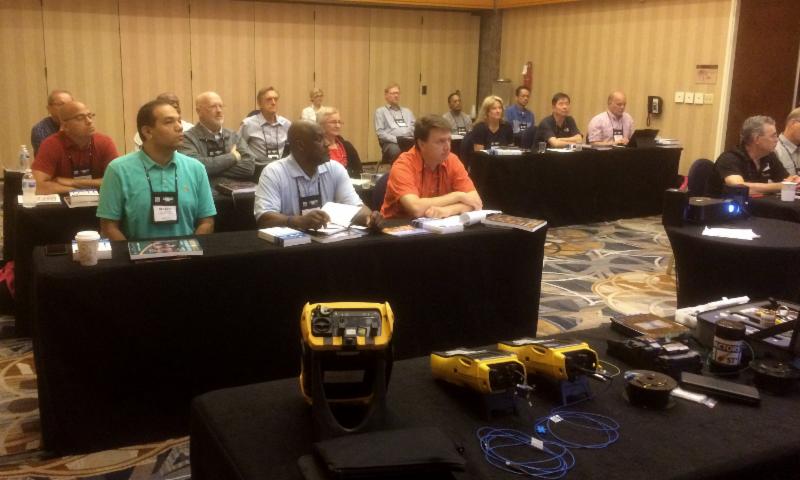
To satisfy the increasing need for bandwidth, companies and countries around the world are adding more single-mode fiber to their networks. Today there are 113,000 miles of installed fiber optic cable in the U.S.A., and many more thousands of miles are added daily. Verizon alone, agreed to buy 12.4 million miles of optical cable from Corning between 2018 and 2020 to expand their network. Companies that install and maintain fiber optic networks have difficulty finding trained technicians with up-to-date skills. To respond to this need, LASER-TEC and Corning Optical Communications collaborated to offer a half day workshop/seminar on the basics of fiber optics, for community college instructors attending the HI-TEC Conference, in Miami, Florida, on July 23rd.
Twenty instructors from fourteen different states attended the seminar which was taught by Robert Sinex, a Corning subject matter expert. The seminar covered the basics of fiber optic technology, including demonstrations of single mode cable termination, testing with optical power meter and visual fault indicator, and use of the OTDR (optical time domain reflectometer). Participants learned how to use the Uni-cam system to make ST and SC single mode terminations. Corning provided a fiber optic cable sample kit and LASER-TEC the "Fiber Optics for Technologists" book to each participant.
Corning (
www.corning.com) is one of the world's leading innovators in materials science, with a more than 165-year track record of life-changing inventions. Corning applies its expertise in g
lass science, ceramic science, and optical physics to develop fiber optics products that transform industries and enhance Internet use.
For more information contact LASER-TEC, please contact Dr. Chrys Panayiotou at 772-462-7621 or
cpanayio@irsc.edu.

|
|
|
|
MPEC hosts Latino Photonics Camp 2018
|
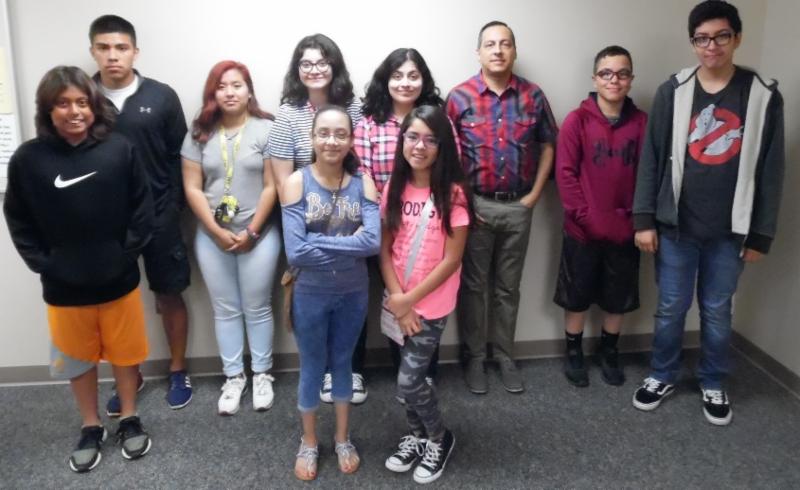
The Midwest Photonics Education Center hosted its third annual Latino Photonics Camp at Indian Hills Community College in July.
Dr. Andres Diaz of the Puerto Rico Photonics Institute provided instruction for the two day camp. Nine Latino students from Mexico, Central, and South America attended the camp this year. Dr. Diaz conducted the camp in Spanish which was pleasing to the parents and campers. On the first day of the camp, students learned about the nature and composition of light, waves, polarization, light interaction, fiber optics, and light energy. Students performed several hands on activities using LightBlox and the OSA Optics Suitcase.
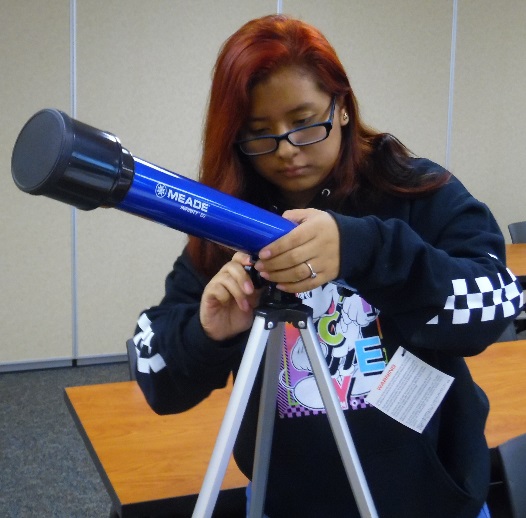
On the second day, students learned more about optics and then assembled their own Meade Instruments Infinity 50 telescopes. Dr. Diaz explained how the optics interact to produce the images seen through the telescope. After assembling the telescopes, the students tested them and aligned the viewfinder lens for optimum viewing. The final activity of the camp was balloon popping with a laser. Students observed the laser light being reflected by white balloons and were delighted when black balloons quickly popped with exposure to the laser. Dr. Diaz also shared information about career and educational opportunities in photonics. After attending the camp for two years in a row, one of the students has decided to enroll in the IHCC Laser & Optics Technology Program. Dr. Diaz has done a great job with the students. When asked for feedback about the camp, one student responded "Honestly? I loved every second of it, no doubt about it."
Pictured below are the participants (left) and a student assembling a telescope (right).
|
|
|
Fiber Optic Signal Modulation
|
| by Gordon Snyder Quadrature Amplitude Modulation (QAM)
One of my all-time favorite television commercials is this one from Verizon back in 2007. I don't know how many times I've used it in a course to introduce Quadrature Amplitude Modulation (QAM) to my students.
Analog modems have used a form of QAM for years to move information from device to device across the Public Switched Telephone Network (PSTN) or voice network. QAM is also used by cable modems, ADSL modems, WiFi access points and optical fiber to modulate (convert digital signals to analog) and demodulate (convert analog signals back to digital) communications signals.
Let's try to get a basic understanding of how QAM works - without any math! Computing devices use digital signals (1's and 0's) to process, store and manipulate information. Sending this information over long distances though typically involves a conversion or modulation of digital signals to analog signals on the sending device and a conversion or demodulation of analog signals to digital signals on the receiving device. QAM has been the method of choice for transmitting signals this way for years.
QAM combines amplitude modulation (think height of a sine wave) and phase shift (think of a sine wave moving along the x-axis relative to a zero-degree reference) and allows multiple bits (combinations of binary 1's and 0's) to be transmitted for each cycle of a sine wave. I like to use the term multiple bits per cycle when I describe QAM.
QAM is categorized by the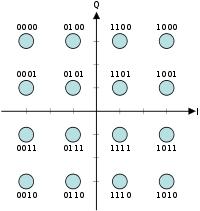 number of bits that can be transmitted in one sine wave cycle. To get a simple understanding let's take a look at 16-QAM. 16-QAM is considered rectangular QAM - the square root of 16 is 4 and this indicates that each cycle of a 16-QAM waveform can represent a 4 bit binary (1 and 0) pattern. Here's a nice diagram showing 16 QAM spectral pattern I found on Wikipedia. I've found it really helps if students have a basic understanding of phasors prior to covering a topic like QAM.
Using the same method we can calculate 64-QAM represents an 8 bit binary (1 and 0) pattern because the square root of 64 is 8. 256-QAM can represent a 16 bit binary (1 and 0) pattern because the square root of 256 is 16, etc.
Now back to that Verizon commercial - who can forget the best line "Nice truck!"
|
|
Faculty Resources for Teaching Course 1: Fundamentals of Light and Lasers and Course 2: Laser Systems and Applications
As a faculty member, preparing for fall photonics classes, which will begin in the next few weeks, you are likely compiling and organizing teaching resources that will enable all your students to be successful. Consider the following resources for OP-TEC Courses 1 and 2, which can be found, reviewed and provided through the OP-TEC store at
www.optecstore.org.
For Course 1, Fundamentals of Light and Lasers:
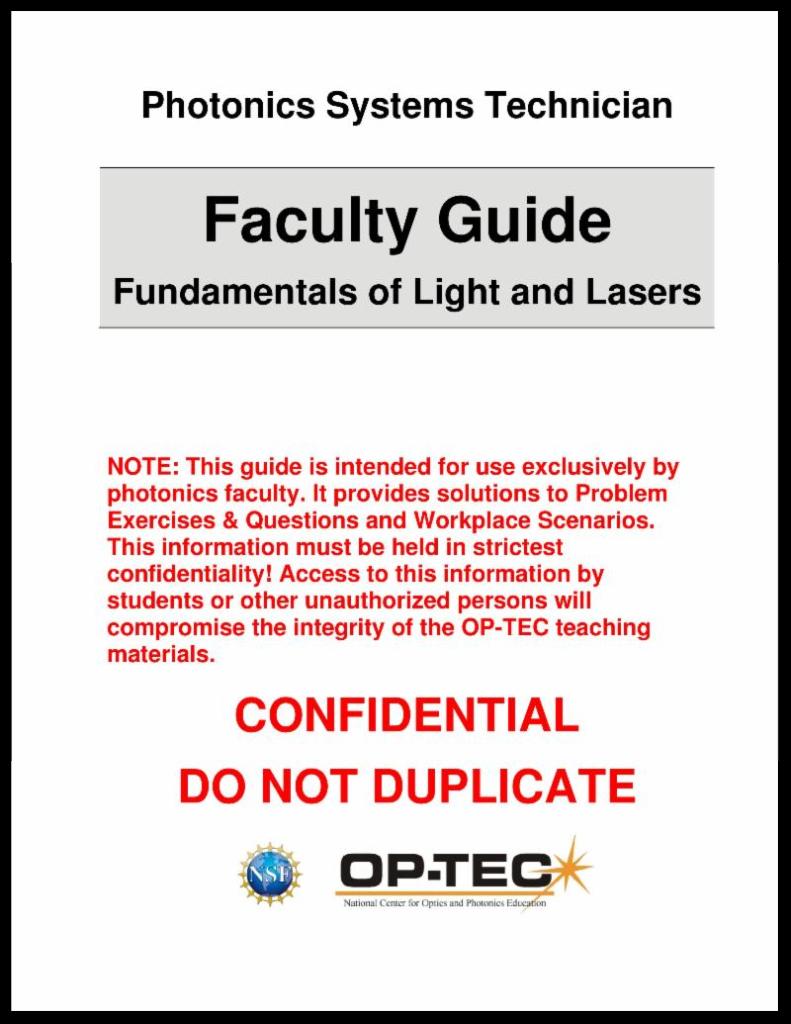
- Faculty Guide solutions to problem exercises and questions
- Figures and Images from the text (presentation slides for faculty use in class presentations)
- Glossary of Terms used in the text
- Videos
- 11 Math Tutorials
- 6 Photonics Concept Tutorials
- Introductions to all labs
- 94 interactive applets and widgets for understanding
optics & photonics concepts
For Course 2, Laser Systems and Applications:
- Faculty Guide solutions to problem exercises and questions
- Figures and Images from the text (presentation slides for faculty use in class presentations)
- Videos to introduce all labs & equipment
- 16 Photonics-Enabled Technologies (PET) Modules describing laser applications
- YouTube videos and problem assignments on laser applications.
|
|
|
|
Indian Hills Community College
Ottumwa, IA
|
|
10/10/18 - 10/12/18
Louisville, KY
|
03/14/19 - 3/15/19
OPCN Meeting
CREOL Industrial Affiliates Symposium
Orlando, FL
|
| Online Faculty Development |
2018-2019 Online Faculty Development Courses Begin Soon
OP-TEC is accepting applications for the 2018-2019 online professional development courses that prepare faculty, adjuncts, and laboratory staff to teach with the Fundamentals of Light and Lasers (Course 1) and Laser Systems and Applications (Course 2) textbooks.
These Open Entry/Open Exit courses have been developed for faculty whose schedules demand a more flexible course timeline. They are perfect for busy faculty who might have difficulty keeping up with weekly assignments in a "scheduled" course, but who would have a period or periods of time during the semester or school year that would allow them to complete assignments and exams independently and at their own pace. The Fundamentals of Light and Lasers course is also an excellent opportunity for junior faculty, adjunct faculty, and lab technicians who may need to prepare to teach a college level or dual credit introductory photonics, optics, or lasers course.
OP-TEC highly encourages all colleges with photonics programs to maintain at least two highly trained and experienced photonics instructors.
The courses are offered through the Canvas online learning management system 24/7 through May 31, 2019. They are facilitated by instructors experienced in teaching photonics concepts at the college level and will require a high level of independent self-paced instruction.
Participants who successfully complete their online course will be invited to an optional (but very highly recommended) hands-on laboratory capstone experience to be held in June 2019 at Indian Hills Community College in Ottumwa, Iowa. The capstone will provide participants the opportunity to conduct most of the laboratory experiments included in the course and discuss with experienced instructors best practices for teaching the materials. Participants who successfully complete the online course and the 3-day hands-on laboratory session will receive a certificate of completion and may apply for CEUs.
These courses are being offered at no charge to U.S. high school, community college and technical college faculty interested in teaching a basic photonics course. Participants will be responsible for travel, lodging, and some meals to attend the optional 3-day laboratory capstone session.
For general information and online applications, please visit:
For questions about the course or capstone, please contact Christine Dossey
cdossey@op-tec.org.
|
|
|
| Request Free Photonics Posters for Your Classrooms |
| 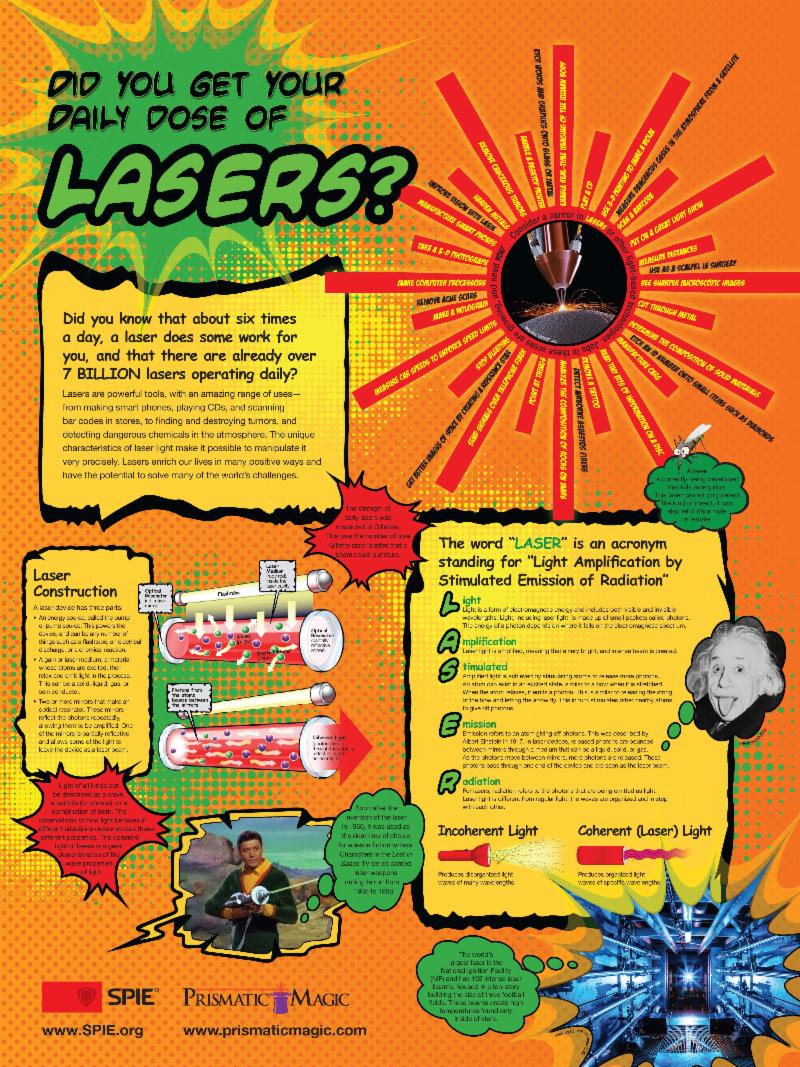
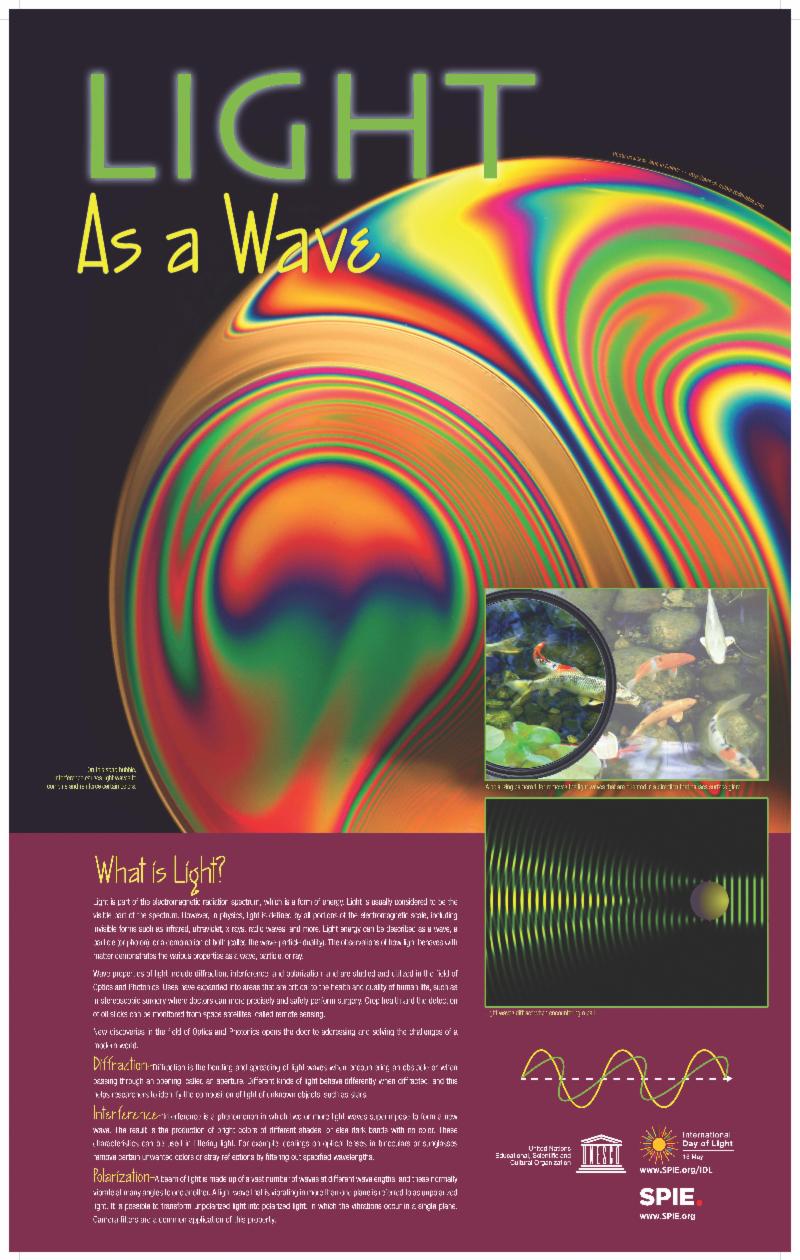
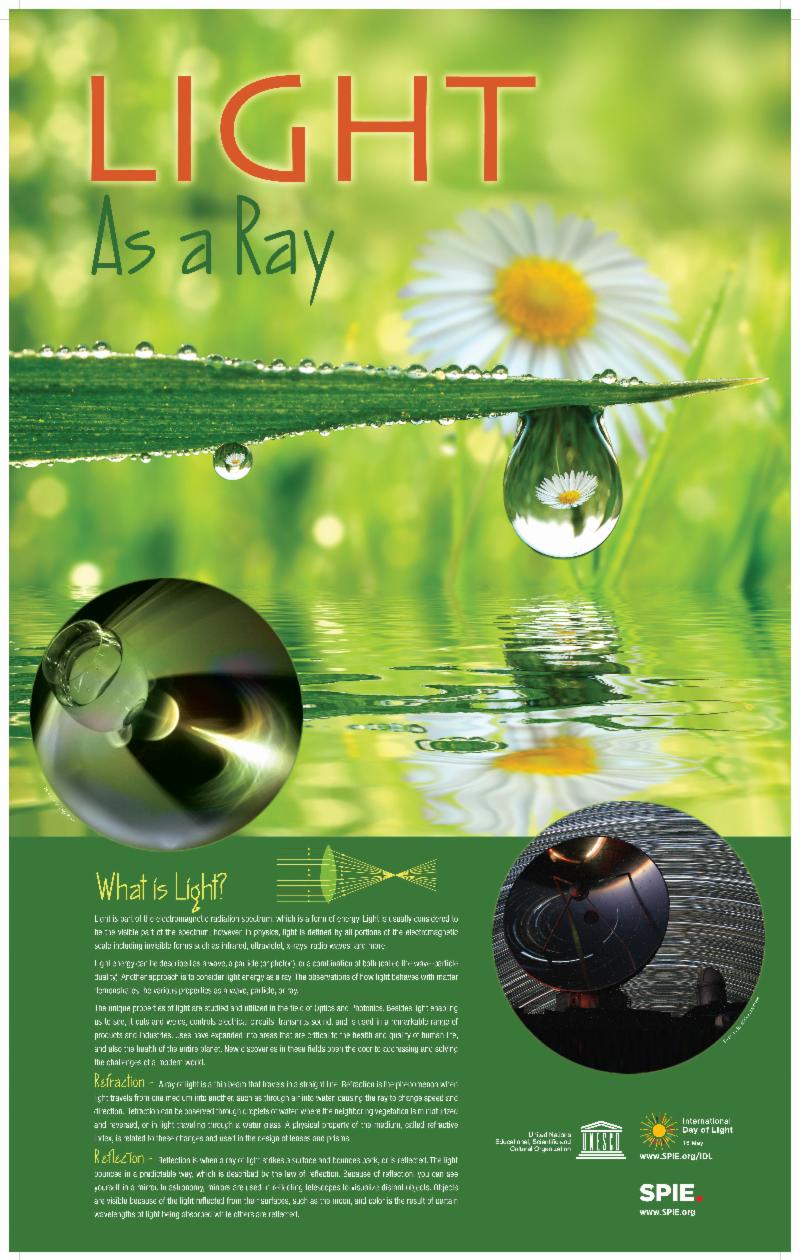
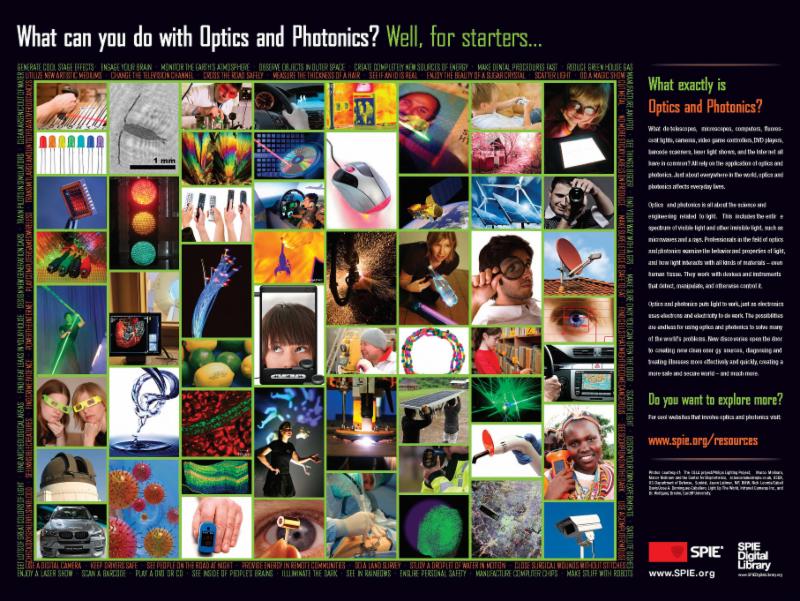
SPIE, the international society for optics and photonics, offers complimentary optics and photonics posters for a fun visual way to share information and increase awareness of optics and photonics technologies.
Requests for five (5) or fewer posters will be shipped at SPIE's cost; a shipping fee will be applied for quantities greater than five (5). Please send your poster request and mailing address to Ms. Pascale Barnett at
pascale@spie.org.
Posters are also available for download, under the Creative Commons Attribution + Noncommercial + No Derivitives license.
|
|
|
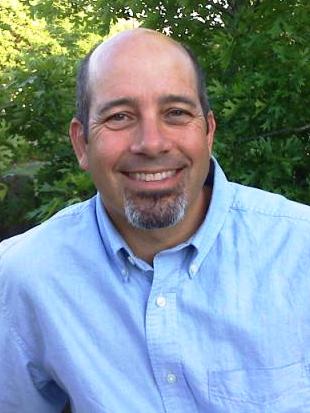
Darrell M. Hull's success may have come about partially by accident. He holds degrees in laser technology, business, and educational psychology. How did he start on this path...by messing up!
Darrell recalls, "I discovered I liked working more than going to school, so I ended up blowing my GPA while working at a psychiatric hospital." Leaving school, he went to work for Engineering Technology Institute (ETI), which created professional-development courses for physicists and engineers in lasers and optics. However, Darrell's employer decided that if he was going to be working with people who use laser and optics equipment, he had to go back to school.
At Texas State Technical College (TSTC), Darrell enrolled in the laser electro-optics technology (LEOT) program. After completing his associate degree, Darrell was offered a job at Texas Instruments (TI) in quality control, but was soon placed to work on secret military optics applications, specifically the forward-looking infrared (FLIR) systems. Darrell says, "One part of the job was testing the coatings until they failed. I got to go to work and blow stuff up!"
While working on his third degree, Darrell helped develop laser-safety standards for photonics educators. After completing his master's degree, he helped develop skill standards in optics and photonics and helped create OP-TEC, the National Center for Optics and Photonics Education.
Darrell's penchant for education led him to pursue a doctorate in educational psychology. Darrell currently teaches doctoral students at the University of North Texas how to develop research designs and how to analyze them with statistics.
Earning four degrees while working full time, Darrel has gone from struggling student to professor and his career is a reminder that it is always possible to forge your own path, even if it takes some sharp turns along the way.
|
|
|
The Committees of the Optics and Photonics College Network are dedicated to sharing expertise, best practices, resources, and advice on issues of importance to photonics technician educators at colleges throughout the United States.
|
Professional
Development
Committee
Anca Sala, Chair
|
Student Recruiting
Committee
Chair TBD
|
Program Assistance Committee
Gary Beasley, Chair
|
Equipment Committee
Frank Reed, Chair
|
For Previous Issues of the OPEN Newsletter please visit OP-TEC's
News Page.
|
|
|
|