|
Optical Tweezers Bring Micromachines to Biology
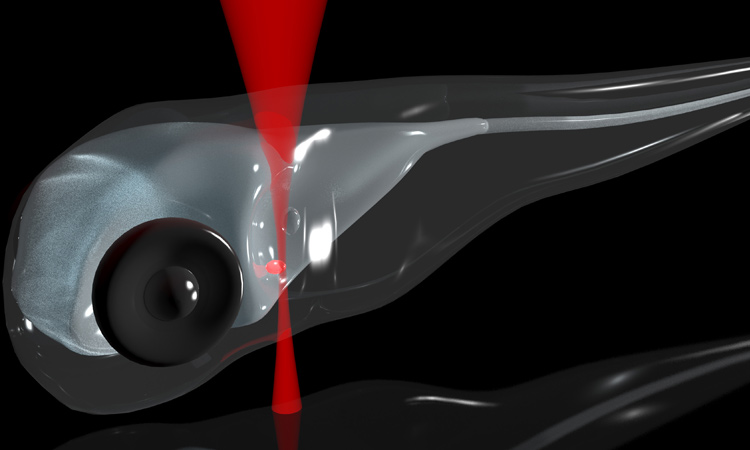
If a material refracts, reflects or absorbs light, it is subject to optical forces, due to the transfer of momentum from the light to the material. It follows that light can trap and move small objects; similarly, the transfer of angular momentum results in optical torques that can rotate or align trapped particles. The optical forces or torques themselves are quite small; however, and are commonly swamped by other mechanical or thermal forces in the system. Thus, controlling microscopic objects and machines with optical forces requires powerful sources of light-such as lasers.
Optical tweezers, using focused laser beams to manipulate objects on the nano- and microscale, have been used to trap and manipulate the tiny, 55-μm otoliths, or ear stones, in zebrafish larvae, and to study how vertebrates use those structures to detect and respond to acceleration.
See Optics and Photonics News April 2018:
www.osa-opn.org/home/articles/volume_29/april_2018,
Nature Photonics www.nature.com/articles/s41566-018-0134-3.
|
 |
|
From the Executive Director
|
The two briefings on Optical Tweezers and Data Center Photonics are examples of the broad impact of optics and photonics applications that are rapidly emerging. Public awareness of this emergence will be emphasized in the international celebrations of the
International Day of Light. I encourage photonics faculty from each college to organize and/or participate in a local celebration. Perhaps local photonics employers will partner with you to plan/conduct these events.
Remarkable events are occurring at colleges with photonics programs, as exemplified in the articles from MPEC and
LASER-TEC.
Do you need advice, plans, strategies and resources for improved student recruitment? Contact OP-TEC.
Please make plans to attend the OPCN meetings held at the
HI- TEC conference, July 23-26 in Miami FL. Registrations and travel support for OPCN coordinators are being coordinated by
OP-TEC, LASER-TEC and MPEC.
Dan Hull
|
|
Data Center Photonics: Enabling More Data at Lower Cost and Less Energy
|
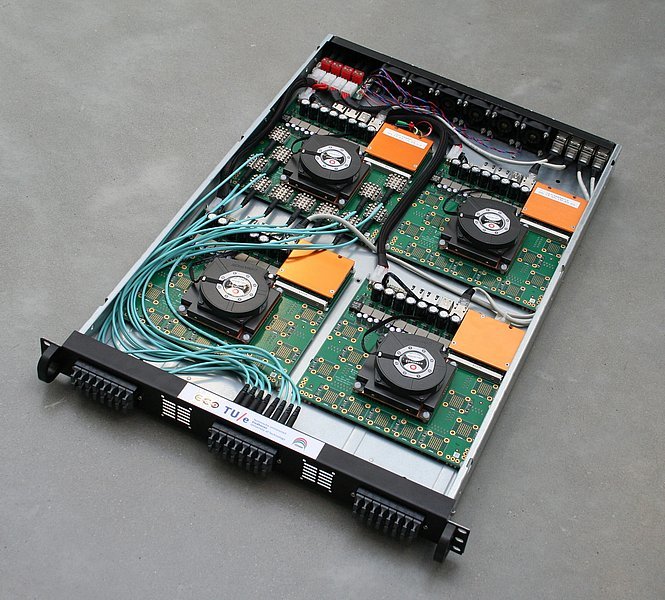 The speed and number of interconnects in data centers continues to increase exponentially. Architectures for data centers are being reevaluated to enable the move to "Exa-scale computing". A major challenge is to come up with high speed, low cost and low power solutions for both computer networking and interconnects.
In response to these challenges, Gonzalo Guelbenzu has prototyped a fully-functional, small-sized hybrid datacenter. His highly compact data center switches can process four times as much data while consuming only twice the amount of energy of a typical data center switch. Gonzalo's prototype uses optical switching and wavelength-division multiplexing technologies, as well as onboard transceivers that are positioned as close to the switch processors as possible to minimize transmission delays. The optical switches in the prototype enable the selective switching of signals from one circuit to another by exploiting nonlinear material properties to steer light.
In addition to his prototype, Gonzalo
Guelbenzu has developed an analytical software model that compares different network configurations in terms of power consumption, cost, and the needed number of switches, transceivers and fibers. Most data centers today are using 25 Gigabit per second switches. By replacing current versions of these switches with a maximum number of optical switches, Guelbenzu estimates savings of 45 percent in switches, 60 percent in transceivers, 50 percent in fibers, 55 percent in power consumption, and 48 percent in cost.
Light Reading has an excellent tutorial on optical switching. The tutorial explains the various types, how they differ from electronic switches, where they sit in networks, what functions they perform, how they are controlled, and performance abilities.
Click
here for
Switching Gears Toward Efficient Datacenters with Photonics.
A tutorial on All Optical Switching is linked
here.
|
|
|
|
International Day of Light
|
Celebrate the International Day of Light on May 16, 2018
The International Day of Light is a global initiative that provides an annual focal point for the continued appreciation of light and the role it plays in science, culture and art, education, and sustainable development, and in fields as diverse as medicine, communications, and energy.
|
|
IHCC Hosts Presentation and Interview Week
|
Indian Hills Community College hosted its annual Presentation and Interview (P&I) week with thirteen employers during the weeks of March 5-8 and March 12-15, 2018. Representatives from each company gave morning presentations for the seventeen graduating Laser & Optics Technology students and then interviewed the students individually for the remainder of the day. Four of the days included two separate company presentations and the other four days included single company presentations.
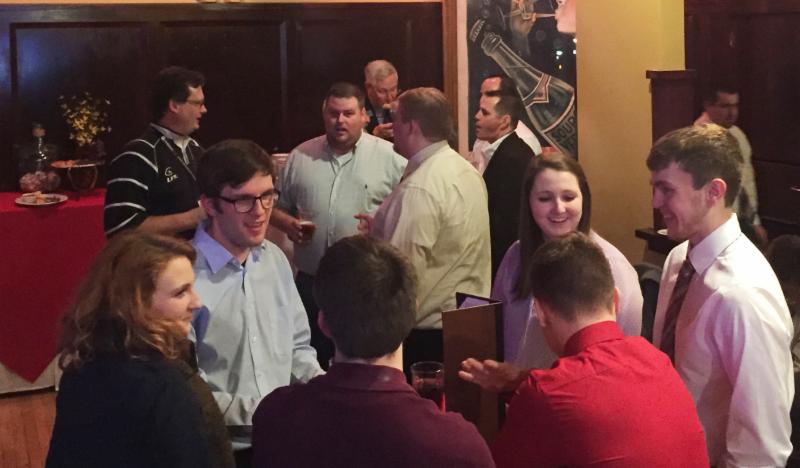
Since the P&I week, several of the graduating students have accepted job offers and others are waiting and considering their options. The average salary is $55,300 so far with a high of $60,000. The companies that participated in P&I week include LSP Technologies, Zygo, L-3 Communications, Lumenis, Sightpath Medical, BAE Systems, MC Machinery, Mazak, Lawrence Livermore National Laboratory, Rudolph Technologies, Medtronic, Nuburu, and IAM AgTech. These companies come from all over the United States including California, Colorado, Minnesota, Iowa, Illinois, Ohio, New Jersey and New Hampshire.
Several of the companies indicated that they had multiple job openings with a variety of technician opportunities. While they were on campus, MPEC took the opportunity to meet with the companies to learn more about their employee demand, their long and short term outlook and where they see future growth and opportunities. Graduates typically have about 4-6 job opportunities per person and some receive multiple job offers.
|
|
|
|
Photonics Workshop for STEM Teachers
|
The Central Carolina Community College (CCCC) Laser and Photonics Technology (LPT) program teamed with LASER-TEC, and the Kenan Fellows program to conduct a K-12 STEM Teacher Photonics Workshop on Saturday March 24, 2018.
The Kenan Fellows STEM teachers experienced hands-on labs, to demonstrate properties of light, such as reflection, refraction, polarization, color mixing and diffraction. In addition, they also learned how to form various diffraction and interference patterns, how to measure the wavelength of light, and how to measure the speed of light. Each participant received a LASER-TEC equipment kit. The Kenan Fellows also learned about some of the exciting careers in photonics, including the rewarding careers in lasers and fiber optics technology. Gary Beasley described the careers of several of his former students. Using the kits, and what they learned, the Kenan Fellows will be able to share this knowledge with their students, encouraging those who are interested to pursue education leading to careers in photonics.
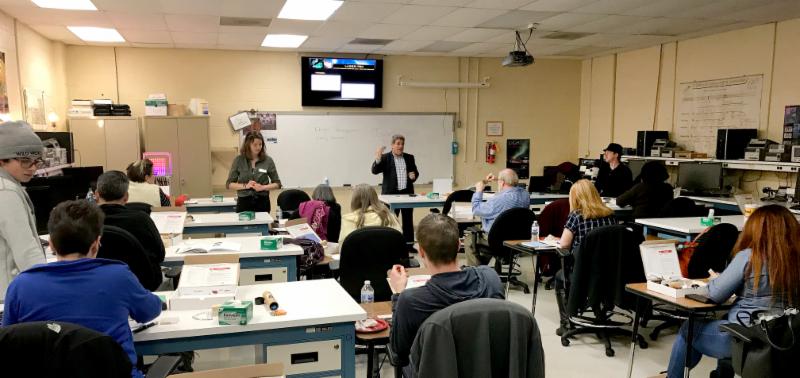
The workshop was conducted by the Laser Photonics Technology (LPT) program at the CCCC Lillington, NC campus, where the Kenan Fellows toured the high-energy laser labs and electronics labs used by students during their two-year associate degree studies leading to a high-tech career. Current CCCC LPT students assisted with the workshop, helping Kenan Fellows with experimental set-ups and conducting tours of the high energy labs. In addition, a student, Isabelle Karis presented at the workshop on topics, including why she selected the CCCC LPT program after graduating from Jack Britt STEM Academy in Fayetteville, NC, and how she looks forward to a career as a laser technician.
The workshop was led by Dr. Chrys Panayiotou, PI of
LASER-TEC, and Mr. Gary Beasley, Lead Instructor of the CCCC LPT program. Ms. Lisa Hibler, Kenan Fellows Associate Director of Program Operations, who oversees the selection of Fellows and organizes the Professional Development institutes, worked with Chrys and Gary to fill the workshop seats with interested K-12 STEM educators.
Kenan Fellows program is part of the Kenan Institute of Engineering, Technology and Science at North Carolina State University. Founded in 2000, the Kenan Fellows Program for Teacher Leadership addresses the critical need for high-quality professional development for educators, and is the largest (science, technology, engineering and math) STEM-focused teacher leadership program in North Carolina. The Kenan Fellows mission is to advance K-12 STEM education by providing educators with relevant, real-world professional learning and leadership development, through innovative collaborations with partners committed to 21st century education and workforce preparation. To learn more about the Kenan fellows program visit
https://kenanfellows.org/.
|
|
|
Mentor-Connect to Offer Webinar for Potential
NSF ATE Grantees |
|
Acquire the knowledge you need to complete your proposal
Forms can make up two-thirds of a final proposal submission and impact its quality and accuracy. Mentor-Connect is offering a no-cost webinar for proposers on May 10, about how to correctly complete the forms required in a National Science Foundation (NSF) Advanced Technological Education (ATE) grant proposal.
Webinar participants will:
- Know the purpose of various forms associated with NSF ATE proposals.
- Know what data to enter into each form associated with NSF ATE proposals.
- Learn the importance of providing consistent information on forms and other components of a proposal.
- Be alerted to common errors that can be avoided.
- Get answers to questions on completing required proposal forms.
Mentor-Connect broadens the impact of the NSF ATE Program by supporting potential, current and former grantees through
one-on-one mentoring, faculty and leadership development, technical assistance, and other resources. The project is funded through the NSF ATE program and is formed out of Florence-Darlington Technical College's South Carolina Advanced Technological Education Center of Excellence (SC ATE) National Resource Center in Florence, South Carolina.
Preparing Forms for your  NSF ATE Proposal
Thursday, May 10, 2018
1:00 - 2:30 p.m. EST
No-cost Webinar
Registration is required
http://bit.ly/2CSDuBl
|
|
|
|
04/28/18 - 05/01/18
Dallas, TX
|
06/18/18 - 06/20/18
Course 1 Faculty Capstone
Indian
Hills Community College
|
06/20/18 - 06/22/18
Course 2 Faculty Capstone
Indian
Hills Community College
|
06/24/18 - 06/27/18
Salt Lake City, UT
|
|
Indian Hills Community College
Ottumwa, IA
|
|
Indian Hills Community College
Ottumwa, IA
|
|
OP-TEC Provides Online Faculty Development for Fundamentals of Light and Lasers and Laser Systems and Applications
There is still plenty of time this semester to complete one of OP-TEC's online professional development courses that prepare faculty and laboratory staff to teach with Fundamentals of Light and Lasers (Course 1)
or Laser Systems and Applications (Course 2).
The open entry/open exit courses are available through the Canvas online learning management system 24/7 through May 31. Participants who successfully complete their online course will be invited to a hands-on laboratory capstone experience during the week of June 18-22 at Indian Hills Community College in Ottumwa, Iowa.
For more information or to enroll in Course 1, visit
|
|
|
|
The national and regional photonics centers will host the next annual in-person OPCN network meetings and photonics industry site visits at the HI-TEC Conference, July 23-26, 2018 in Miami, FL.
The HI-TEC Conference provides a wonderful opportunity for educators to learn, network, give presentations, share best practices, and disseminate project resources with other STEM educators.
OPCN events are being planned for the HI-TEC Preconference on Monday and Tuesday, July 23-24. The general conference keynotes, presentation sessions, and exhibits will take place on Wednesday and Thursday, July 25-26.
As in previous years,
OP-TEC will be offering conference registration codes for OPCN representatives to attend. OPCN Coordinators and Members will receive priority for these free registrations. Actively reporting OPCN coordinators may also request reimbursement for airfares following OP-TEC guidelines.
We hope that all OPCN members will be able to attend July 23-26 in Miami!
|
|
|
|
Photonics Systems Technician Curriculum Guide
Most colleges teaching photonics have created or adapted their curriculum to prepare Photonics Systems Technicians (PSTs). PSTs are preferred by over 80% of employers; they integrate, install, adapt and maintain lasers and electro-optical systems and components.
The PST curriculum structure contains 3-6 photonics courses, built on a technical core that supports other technical specialties, such as robotics, mechatronics, telecommunications etc.
The rationale, curriculum model(s), course descriptions, lab/equipment requirements, equipment suppliers and teaching enhancement tools are provided in the OP-TEC Photonics Systems Technician Curriculum Guide.
Recently, the PST Guide has been updated to reflect changes in equipment and suppliers. Glossaries of technical terms and acronyms have also been added. Faculty are strongly recommended to obtain a copy of the revised PST Guide by clicking here.
|
|
|
After working for twelve years in industrial construction, Jeremy Knoll realized he needed to find a career that allowed him to spend more time with his family. He heard about the Laser and Photonics Technology program at Central Carolina Community College (CCCC) through a family friend. Jeremy researched the growth of the laser and photonics industry and jobs in the field. He met with Professor Gary Beasley, and checked out the program. Jeremy liked what he saw and enrolled in the program.
Having no difficulties adjusting to college, Jeremy found his classes reasonable and challenging in a good way, and went on to earn an associate of applied science degree in lasers and photonics technology. Interning for MegaWatt Lasers Inc. in South Carolina his last semester at CCCC enabled Jeremy to achieve his goal and upon graduation, accepted a full time position as a laser technician at MegaWatt Lasers Inc.
Working for MegaWatt Lasers Inc., has given Jeremy an opportunity to take on more of an engineering role than a technician role. He says. "There is no set book I can turn to figure out how to solve any fickle problem that may arise in the day. I'm constantly learning new things." He has also adopted other roles in the company such as being in charge of information technology for the company. Jeremy enjoys all aspects of working with solid state lasers, from research and development to testing and maintenance.
When Jeremy looks to the future, he sees himself continuing his education and is considering pursuing a bachelor's degree in either electrical engineering or software engineering.
|
|
|
The Committees of the Optics and Photonics College Network are dedicated to sharing expertise, best practices, resources, and advice on issues of importance to photonics technician educators at colleges throughout the United States.
|
Professional
Development
Committee
Anca Sala, Chair
|
Student Recruiting
Committee
A.J. Gevock
|
Program Assistance Committee
Gary Beasley, Chair
|
Equipment Committee
Frank Reed, Chair
|
For Previous Issues of the OPEN Newsletter please visit OP-TEC's
News Page.
|
|
|
|