Campaigning for Democracy And Socialism |
|
May 31, 2024: The Week in Review
One Down, Three To Go:
Trump's Road To Turmoil Ahead
|
|
The lesson of the week is how small matters can have unforeseen and large consequences.
When Trump first eyed Stormy Daniels at a golf tournament and decided to get her into his bed, it was not the first time for such trysts nor the last.
For men of Trump's wealth and notoriety, such beddings were the norm, the prerogative of male and class privilege. It was no big deal. JFK, RFK, LBJ, Nelson Rockefeller, among many more, were notorious for philandering, in small numbers or large. And in their time, by a 'gentleman's agreement' among news reporters, such things were considered not worthy of print. Even many women were drawn to such men. As Henry Kissinger once quipped, 'Power is the ultimate aphrodisiac.'
But things had changed a bit during Stormy Daniel's time. Neo-liberal commodification's reach had expanded, and many more things were for sale, one way or another. Her success in the 'adult entertainment' business was a case in point. Now she had a valuable story to tell, and was shopping for a buyer. And now, men like Trump had to work harder at keeping their X-rated travails out of the tabloids. The publishers of the National Enquirer often came to the rescue with two new weapons: 'buy and kill' and 'NDA,' or non-disclosure agreements. they would buy Stormy's story with exclusive rights, get her to sign a non-disclosure agreement, then bury the story in a private swamp. They would find a way for Trump to return the favor, and also in this case, a payment of $130,000 to Daniels was due.
So far, even if tawdry, all this was legal. And if Trump simply handed the cash over to Stormy, that would be the end of it. But Trump had other things in mind. He wanted deniability. He was running for President, and he wanted no direct connection to the matter. So he got his 'fixer' to do it for him, even if the latter had to take out a loan against his house to get the cash. Now Trump was on the cusp of crime. To repay his fixer, and still maintain a fiction of deniability, he had to create false records to hide it as 'legal expenses.' Even here, in New York law, this was only a misdemeanor, save for one thing: Trump's main intent. The prosecutors wisely saw the truth, that Trump was doing this to avoid a negative impact in the pending election, in violation of elkection laws. This turned his efforts into more than business record falsehoods, and hence turned the misdemeanors into felonies.
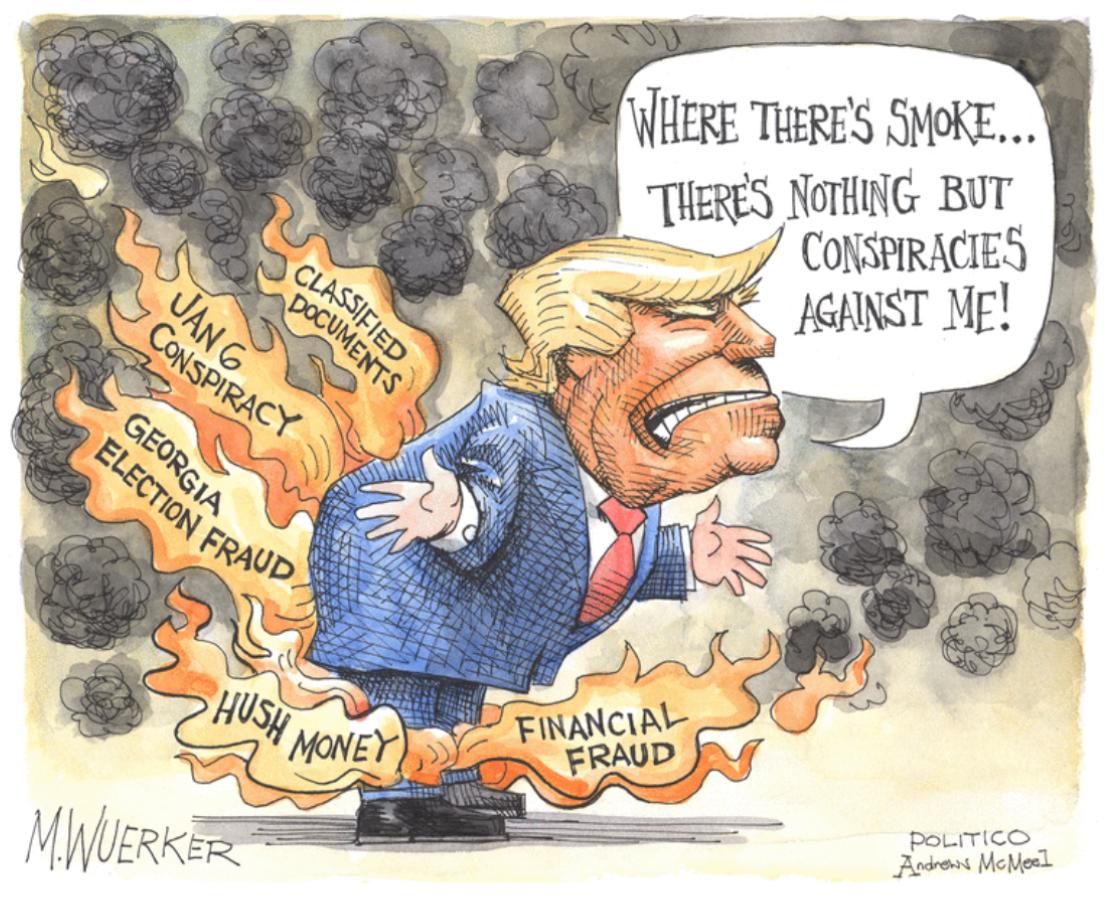
Given all Trump's other pending trials--buying 11,000 votes in Georgia, seizing national security documents for his own use, organizing a violent attempt to stop Congress from certifying Biden's victory--this one seemed trivial in comparison.
Perhaps so. But it had the unnoticed value of being first. And in an immensely mediated world of spectacle, being first is often a very big deal, as we can see in all the headlines today.
But we also have a big problem. We no longer live in a world of a more-or-less unified mass media. Ours is a world of diverse media silos, information containers where people living on the same block or building can view their lifeworld in entirely opposing ways, even if their material circumstances are much the same. It's one thing to view Trump's verdicts on MSNBC and CNN, but it's quite another to view them on Fox or OAN. The latter would take us down the rabbithole of an alternate reality where Trump isn't guilty at all, and the whole trial was a fake effort orchestrated by Biden and the Deep State. Don't take our word for it. Tune in to OAN for 15 minutes and see it yourself.
Having sowed the wind, we now face a whirlwind. The Trump media will encourage its viewers into action around the upcoming election. We can expect every effort to purge the voting rolls, add undue restrictions, and organize thugs to intimidate people from going to the polls. This has to be met with determination and serious organization on our part. We will not only have to increase and secure the vote, but we will also have to be ready to protect voters from violence or the threat of it. It can be done, but don't wait until the day before. Get ready now.
|
|
|
|
 |
WE ARE INVITING FEEDBACK!
Please send us your letters, comments, queries, complaints, new ideas. Just keep them short and civil. Longer commentaries and be submitted as articles.
DIFFICULTY READING US?
|
We're going to try something new, and you are all invited.
Saturday Morning Coffee!
Started in August 2022, then going forward every week.
It will be more of a hangout than a formal setting. We can review the news in the previous days' LeftLinks or add a new topic. We can invite guests or carry on with those who show up. We'll try to have a progressive stack keeper should we need one.
Most of all, we will try to be interesting and a good sounding board. If you have a point you would like to make or a guest to invite, send an email to Carl Davidson, carld717@gmail.com
Continuing weekly, 10:30 to Noon, EDT.
The Zoom link will also be available on our Facebook Page.
Meeting ID: 868 9706 5843
Let's see what happens!
|
Working Families
Party Newsletter
Join us to make calls to re-elect Jamaal Bowman to Congress! In April we threw down for Summer Lee making nearly 60,000 phone calls and helping her win big- now its time for us to show our power again and keep Jamaal in the house fighting for all of us.
Jamaal Bowman is running a grassroots campaign and is up against big GOP money and attacks from groups like AIPAC. In his time in congress he has consistently delivered for his district including $1 billion in and critical and historic investments in gun violence prevention, health care, and climate action.
Never made calls before? Don't worry, you'll get all of the training you need to call with confidence. All you need is a computer or internet-connected device and a phone.
|
April 28, May 5,
May 19, & June 2
4-6:30pm eastern
1-3:30pm pacific
Suggested registration fee: $80-$330 any amount accepted
NO ONE WILL BE TURNED AWAY FOR LACK OF FUNDS
*Sessions will be recorded. Live attendance is not mandatory.*
|
|
|
|
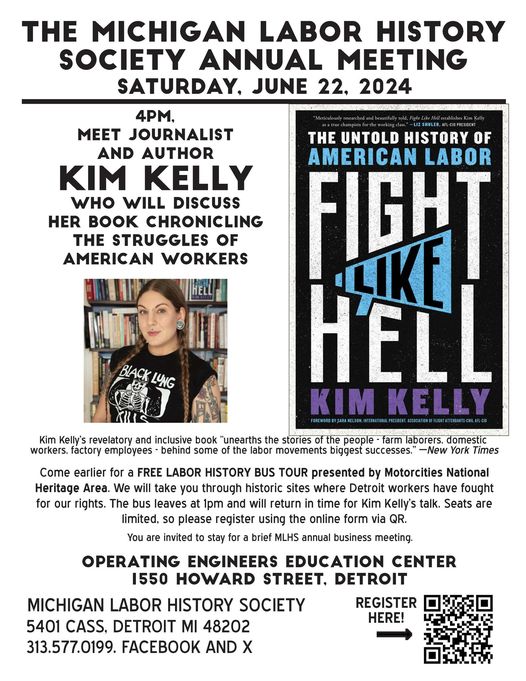
Mark your calendar for
4 p.m. on Saturday,
June 22, 2024
to hear journalist KIM KELLY, author of "Fight Like Hell: The Untold History of American Labor" at the annual meeting of the Michigan Labor History Society.
|
Naomi Klein and Yanis Varoufakis
THE WRONG LESSON
FROM HISTORY
A New Podcast
|
Thanks for Reading Liberation Road!
Global Capital's Financial Shells
Offshore tax havens, and what they tell us about what is really going on
LIBERATION ROAD and Jerry Harris
MAY 30, 2024
In 2022, the Netherlands ranked number two in the world for foreign direct investments (FDI). Over $3.2 trillion in capital flowed out of the small country into investments all around the world, outranking everybody but the U.S.
Moreover, in 2022 the Netherlands received more incoming FDI from the U.S. than any country other than the UK, some $944 billion. In fact, between 2012 and 2017 it ranked between number one and four each year for incoming foreign direct investments–a better record than China’s.
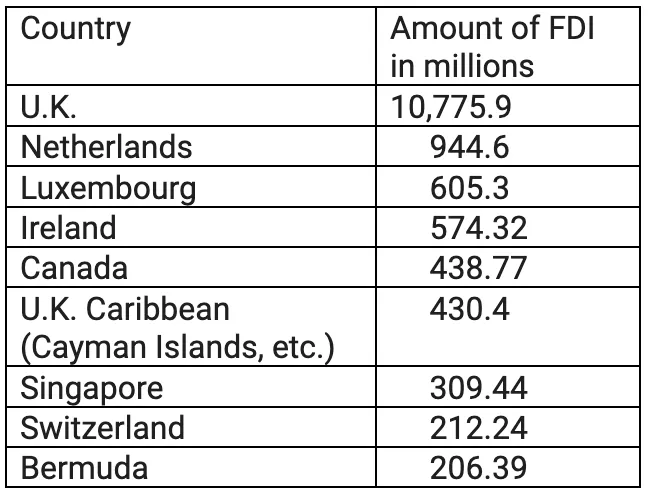
Besides the Netherlands, where would you assume most U.S. capital is invested? Maybe China, Mexico, Brazil, Germany, or Saudi Arabia? You would be wrong on all accounts. Here are the top nine countries that received FDI outflows from the U.S. in 2022: (Chart above).
So, what is going on and what does this tell us about global capitalism? Most of this money is not going into these countries to acquire or build factories. It comprises capital flows into financial shells and firms that flow out into other investments. This money also includes profits that sit in financial institutions to avoid taxes.
This goes back to my first column on offshore finance known as non-resident capital–that constructed world for transnational capital, with its own rules operating in offshore financial centers (OFC). These centers capture the largest percentage of offshore capital stocks and flows globally. Some, like the Cayman Islands, attract capital mainly from investment funds and banks, while the Netherlands and Luxembourg act as gateways for transnational corporations. Hong Kong gives access to China. The system functions as an integrated offshore world in which global financial institutions and a handful of powerful law and accounting firms keep the legal mechanisms, treaties, and data operating. ...Read More
|
Please join the NLG D.C. chapter, the NLG Mass Incarceration Committee, Jailhouse Lawyers Speak, and Muslim Counterpublics Lab for this inside look at the current state of the U.S. prison system.
Lyle May has spent over twenty years residing on death row in North Carolina. In the release of his book by Haymarket Books, he tells his story, offering a scathing critique of the carceral system through an abolitionist lens. Please join us to hear directly from Lyle, who will call in from death row for fifteen minute increments, recounting his journey and discussing his important book which Mariame Kaba calls “essential reading.”
Lyle has earned a certificate in paralegal studies and is currently finishing a degree in criminal justice at Ohio University. He is a journalist, activist, and speaker. Sundiata Jawanza of Jailhouse Lawyers Speak, will also be in attendance.
|
|
|
|
Last Week's Saturday Morning Coffee
|
|
News of the Week, Plus More
|
|
No One Is Above the Law – Trump Guilty
on 34 Counts – Now a Convicted Felon
Today a jury found ex-president Donald Trump guilty on 34 felony counts of falsifying business records in an effort to subvert the 2016 election. Trump called it a rigged trial, by a corrupt judge. He also called the 2016 and 2020 elections rigged.
By Hafiz Rashid
The New Republic via Portside
May 30, 2024 - After a Manhattan jury found him guilty on all 34 felony charges in his hush-money trial in New York Thursday, Donald Trump said that the whole thing was rigged against him.
Someone remind him the trial isn’t completely over.
“This was a disgrace, this was a rigged trial by a conflicted judge who was corrupt. It’s a rigged trial, a disgrace,” Trump said to reporters as he left the Manhattan courtroom.
“They wouldn’t give us a venue change, we were at 5 percent or 6 percent in this district, in this area. This was a rigged, disgraceful trial. The real verdict is going to be November 5 by the people, and they know what happened here and everybody knows what happened here,” Trump added.
Trump went on to blame District Attorney Alvin Bragg, calling him Soros-backed, and accused the Biden administration of trying to weaken him to win the election.
The former president’s sentencing is scheduled to take place by Judge Juan Merchan on July 11 at 10 a.m., just four days before the Republican National Convention begins in Milwaukee, Wisconsin. His post-trial remarks could affect his sentencing, as a lack of remorse is often considered by judges in criminal cases.
Immediately after the trial, Trump also sent a fundraising email to his followers where he declared himself a political prisoner.
In the event Trump is sentenced to prison time, it’s uncertain how the presumptive Republican presidential nominee will attempt to continue his campaign from behind bars—which some of his followers falsely claim has already been explored by the Secret Service. Trump does have the option to appeal the guilty verdict, which could mean that he wouldn’t have to start serving any sentence until an appeals court makes a decision. An appeal could push the possibility of jail time until after the election.
Read Trump’s full remarks on his guilty verdict below:
- This was a disgrace, this was a rigged trial by a conflicted judge who was corrupt. It’s a rigged trial, a disgrace. They wouldn’t give us a venue change, we were at 5 percent or 6 percent in this district, in this area. This was a rigged, disgraceful trial. The real verdict is going to be November 5 by the people, and they know what happened here and everybody knows what happened here. You have a Soros-backed DA, and the whole thing, we didn’t do a thing wrong.
- I’m a very innocent man, and it’s OK, I’m fighting for our country, I’m fighting for our Constitution, our whole country is being rigged right now. This was being done by the Biden administration in order to wound or hurt an opponent, a political opponent, and I think it’s just a disgrace and we’ll keep fighting, we’ll fight till the end and we’ll win because our country’s gone to hell.
- We don’t have the same country anymore. We have a divided mess, we’re a nation in decline, serious decline, millions and millions of people pouring into our country right now. From prisons and from mental institutions, terrorists and they’re taking over our country. We have a country that’s in big trouble, but this was a rigged decision right from day one with a conflicted judge who should have never been allowed to try this case. Never. And we fight for our Constitution. This is long from over. Thank you very much.
[Hafiz Rashid is an associate writer at The New Republic.] ...Read More
|
|
'Bungled': Legal Expert Breaks Down the 'Significant Strategic and Tactical Errors' That Doomed Trump
By Alex Henderson
Alternet
May 31, 2024 - When jury deliberations in Donald Trump's criminal hush money/falsified business records trial got underway in a Lower Manhattan courthouse on Wednesday, May 29, some legal experts expected deliberations to continue into June. But the following day, late in the afternoon, the jurors handed down their verdict and found Trump guilty on all 34 of Manhattan District Attorney Alvin Bragg Jr.'s criminal counts.
Trump is now the first former president in United States history to be convicted on criminal charges. Justice Juan Merchan has set July 11 — only four days before the start of the Republican National Convention in Milwaukee — for sentencing.
Politico's Ankush Khardori, in an article published on May 31, emphasizes that Trump and his legal team, including attorney Todd Blanche, "bungled" a case they could have won.
- "A conviction was not inevitable," Khardori argues. "The legal issues were intricate and in some key respects novel, and some of them will credibly be at issue on appeal. The state's evidence was voluminous but far from airtight, and there were weaknesses and gaps in the prosecution's evidence as the case unfolded."
- The legal journalist continues, "In fact, this was probably a winnable case — not in the form of an acquittal perhaps, but in the form of a hung jury that could have resulted by persuading one or more jurors that a case built around Michael Cohen — the former Trump lawyer/fixer turned convicted felon turned media personality — was simply not strong or reliable enough to warrant this watershed moment in American history.
- Trump also probably could have gotten off with convictions on misdemeanor counts of falsifying his company's business records instead of felonies, but he never asked the judge to instruct the jurors on that point, perhaps fearing that the request might make him look weak — the worst offense of them all, in his mind."
Khardori goes on to write that Trump and his attorneys "bungled this trial" by making " a series of significant strategic and tactical errors before Cohen even took the stand."
According to Khardori, "They foolishly claimed that the porn star Stormy Daniels had fabricated her story in the run-up to the 2016 election, then pilloried her ineffectively during cross-examination. They elevated peripheral witnesses, like Daniels' lawyer, through drawn-out cross-examinations when they should have downplayed their actual relevance to the charges."
Khardori describes "legal Trumpism" as a strategy of "deny everything, attack indiscriminately" — which, according to the Politico journalist, did not serve Trump or defense attorney Todd Blanche well.
"Blanche repeated many of the mistakes that he and his co-counsel made throughout the trial," Khardori notes. "He again denied Daniels' story, ridiculously. He spent an inordinate amount of time arguing that Cohen was not reimbursed for the payment to Daniels but had actually been put on a monthly retainer that just so happened to correlate to the Daniels payout, plus the tens of thousands of dollars that Cohen stole from his client." ...Read More
|
|
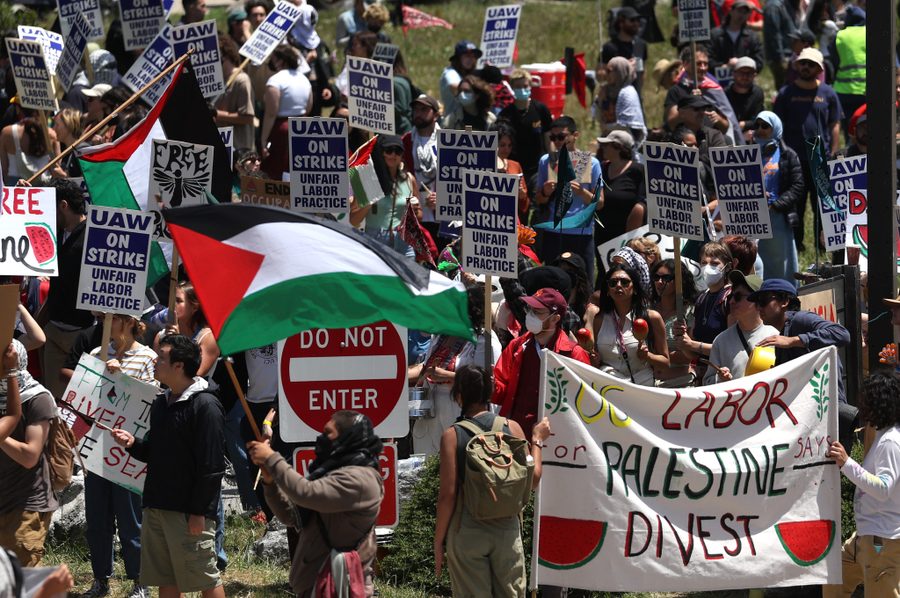
Photo: About 2,000 members of Local 4811 at UC Santa Cruz went on strike last week, the first of 10 UC campuses that may be involved in the Stand-Up Strike. UCLA and UC Davis will strike on Tuesday, May 28. BY JUSTIN SULLIVAN/GETTY IMAGES
In an Historic Show of Labor Solidarity with Palestine,
UAW Local 4811's Stand-up Strike Grows by 12,000
The academic workers at UCLA and UC Davis will join 2,000 already on strike at UC Santa Cruz.
By Hannah Bowlus
In These Times
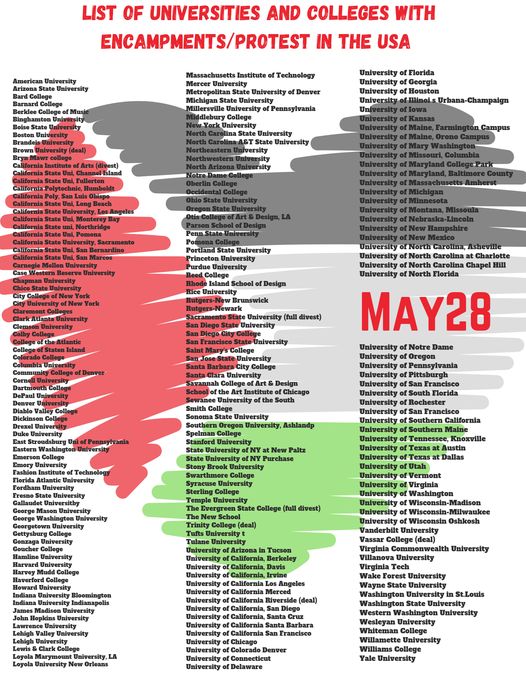
MAY 28, 2024 - Twelve thousand academic workers at UCLA and UC Davis are poised to walk off the job Tuesday morning as part of an historic strike in solidarity with Palestine.
The workers — 6,400 at the University of California, Los Angeles and 5,700 at the University of California, Davis — are members of United Auto Workers Local 4811, which represents 48,000 academic workers across the University of California (UC) system.
“We’re taking this … unprecedented action because of the university’s serious, unfair labor practices (ULP), which really go to the heart of our rights for freedom of speech and protest, and the ability to take collective action,” Local 4811 President Rafael Jaime told In These Times ahead of Tuesday’s walkout.
The surge in the number of UC academic workers going on strike comes amid international outcry over an Israeli military attack this weekend targeting a refugee camp made up of tents housing displaced Palestinians in Rafah, a city in southern Gaza. At least 45 Palestinians were killed in the assault, including children, with many others injured. Fires caused by the assault engulfed the refugee camp, burning refugees sheltering there.
The ULP charge was first filed on May 3, according to the Local 4811 website, and was in response to events on May 1 and 2 when ?“police in riot gear arrested more than 200 peaceful student protesters and academic workers exercising their legal right to demonstrate against the death, destruction and human suffering directed at the people of Gaza.”
Local 4811 noted that ?“many of those arrested had spent the previous night seeking medical care or hospitalization after being physically attacked and maced by a group of anti-Palestinian counter-protesters” and added that ?“though UCLA and LAPD were on noice of the attacks, they deliberately failed to respond.”
The charges would then be amended on May 10, May 17 and May 21 to add additional violations, including those at other campuses across the UC system including UCSD and UCI.
UAW Local 4811 is modeling the walkout after the rolling Stand-Up Strike model that was made famous by the UAW and President Shawn Fain during the fall strike against Detroit’s Big Three automakers. The strike officially began about a week ago when some 2,000 academic workers walked off the job at UC Santa Cruz.
“Obviously, it was not something we did lightly,” Jaime said about filing the ULP charges. He said that the university violated workers’ rights ?“by allowing a violent mob to attack workers, to brutalize them, mace them, burn their skin with fireworks. And then the very next day sending in … cops to violently suppress the peaceful protests using rubber bullets and flash-bang grenades.”
The UC-AFT, which represents 6,500 librarians and teaching faculty across the university system, also filed a ULP in May, writing in a news release that ?“charges include the university’s failure to maintain safe working conditions, disregarding the free speech rights of its employees, and unilateral decision making regarding changes in their working conditions in responding to recent campus protests at UCLA and UCSD.”
"Several union members were arrested while attempting to protect their students against violent police responses to the encampments."
Hannah Appel, a professor at UCLA, told In These Times that the strike and its justifications were historic and that the political and legal bases for the strike are yoked together.
“Being beat up by mobs at your place of work; being beat up by the cops at your place of work when you are expressing pro-Palestinian speech, are unequivocally unfair labor practices,” Appel said. ?“If, in the United States, we’re not allowed to participate in pro-Palestinian speech on campus, then those can become unfair labor practices, and can deepen and build the power of the Palestinian solidarity movement.”
UC administration has maintained that the strike is illegal and unsuccessfully tried to get a state labor board to immediately stop it. The UC has also threatened striking workers with ?“corrective action.”
UCLA law professor Noah Zatz wrote in an opinion article for UCLA’s student newspaper, The Daily Bruin, that those attempts by UC administrators’ to halt the strike are unfounded. Requests for comment from UCLA and UC administration were not returned. ...Read More
|
|
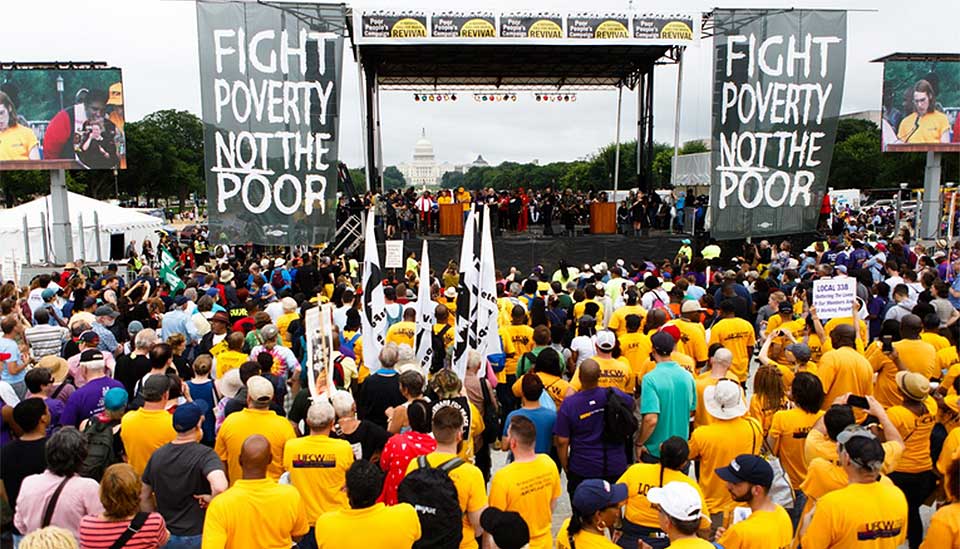
Photo: Poor People’s Campaign, Repairers of the Breach provides leadership, organizing, policy, strategy, media, cultural arts, and partnerships support to the Campaign.
Planning Underway for June 29
Poor People’s Mass March in D.C.
By Mark Gruenberg
People's World
May 28, 2024 - WASHINGTON—Planning is underway for the June 29 Poor People’s Campaign’s mass march in D.C., with a turnout expected in the tens of thousands to elevate elimination of poverty to the top of the nation’s political agenda.
The march, which will begin at 10 a.m. that day, will also be the kickoff of an intensified campaign to convince millions more of the nation’s 140 million poor and low-wealth people—now at least 30% of the population of each state—to register and vote this fall, says Poor People’s Campaign Co-Chair, the Rev. William Barber II.
“In many, many states, it would take only two or three percent” of the poor and low-wealth people the campaign will try to reach this year “to change the outcome” of elections. The campaign aims to reach at least 15 million people, double its figure of 2020.
The key theme of the campaign will be poverty, its costs, and how its eradication would enrich not just the poor and low-wealth people, but the entire nation, by making use of the full extent of their skills, brains, and talents and by raising their incomes and share of the economy.
Poverty is the fourth-leading cause of death in the U.S., though it’s often disguised via diseases and ailments the poor suffer from, inadequate health care, malnutrition, and substandard housing, the campaign points out.
Solving those problems, plus enacting stronger worker rights, restoring and strengthening voting rights, crafting a living wage, converting “the war economy” to spending on education, housing, and health care, and exposing false preachers who equate Christianity with right-wing politics are also march aims.
“We’ll have a casket decorated with the names of people” who died from poverty, Barber said. “The people speaking will be impacted folk. We have to make people understand that poverty costs lives.”
The June 29 march and subsequent action have strong labor support. “The entire AFL-CIO will mobilize with us on June 29,” Barber told the planning meeting. “The same people who are against voting rights are against workers’ rights,” he pointed out—paraphrasing a 1961 statement from the Rev. Dr. Martin Luther King Jr.
The Service Employees, Black Voters Matter, the Union of Southern Service Workers, Reform Jews, U.S. Muslims, and the Presbyterian Church will also lead the organizing, Barber added.
Campaign co-chair the Rev. Liz Theoharis said Poor People’s Campaign canvassers will also take the march’s message to housing authorities and coalitions that aid the homeless.
The campaign will also post and circulate organizing videos, take to social media, and urge “every progressive house of worship” to post pro-march banners out front, he said. There’ll be video trucks roaming streets of major cities, “especially on weekends where people can see” tapes from the campaign’s prior marches in D.C. and at state capitals.
Doing it before the conventions
“We’re doing this before the conventions” of both major political parties “because we don’t endorse candidates, we endorse issues,” Barber said. Theoharis added change “won’t happen if we are silent.”
The march is needed, as Barber often says, because poor and low-wealth people don’t vote because candidates for office—from the presidency on down—don’t discuss poverty on the campaign trail.
In the 2020 presidential campaign, he said, there were 30 debates between presidential hopefuls, and not one of them mentioned poverty. The only occurrence came when Democratic hopeful Joe Biden, now the president, addressed a Poor People’s Campaign conference in North Carolina.
There may be a rerun of this disinterest in poverty just before the march: The first debate between Biden, again the Democratic nominee, and Republican ex-president Donald Trump has just been scheduled for June 27, NBC News reported. Trump is the GOP nominee again.
“We have to mobilize in a way that people pay attention. We can’t have an election season where every day is a trial in New York,” Barber warned, a reference to Trump’s hush-money cover-up trial now winding up in the Big Apple.
That’s the sole trial, of four trials Trump faces, where voters will know the verdict before the November balloting. Trials in Georgia and D.C. cover his seven attempts to steal the 2020 election, while a Florida federal trial would tackle Trump’s stolen secret papers from the White House. All have been postponed via Trump lawyers’ maneuvers.
The Poor People’s Campaign is recruiting volunteers to place leaflets and flyers promoting the march in houses of worship, on bulletin boards, in barber shops, pool halls, and beauty salons, outside meeting halls, and in contacting religious leaders to urge them to publicize it, too. ...Read More
|
|
Photo: Khaled Al Serr in a selfie taken in front of Nasser Hospital in Khan Younis, Gaza Strip, in Jan. 2018. Courtesy: Healthcare Workers Watch – Palestine
Gaza’s Stolen Healers
Hundreds of Palestinian Doctors Disappeared Into Israeli Detention
By Kavitha Chekuru
The Intercept
May 24 2024 - IT’S BEEN TWO months since Osaid Alser has heard from his cousin, Khaled Al Serr, a surgeon at Nasser Hospital in the southern Gaza Strip city of Khan Younis.
Before late March, they had been in regular contact — or as regular as the shredded communication infrastructure would allow. Al Serr had created a telemedicine WhatsApp group where he and Osaid, a surgical resident in the U.S., recruited doctors from stateside, the U.K., and Europe to give advice to their overstretched colleagues in Gaza.
“He reported on a gunshot injury in a 70-year old,” Osaid said, of Al Serr. “It was in her head. And really, there were no neurosurgeons at that time.”
“He was sharing those cases, and he was asking for help,” Osaid went on. “It was like, ‘Is there any neurosurgeon that can help me? How can I fix this?’”
Al Serr was a natural vessel for the collective medical knowledge of the group chat. “He always wanted to help out, always liked to use his hands, to kind of fix a problem and have an immediate impact,” according to Osaid.
In February, the Israeli military invaded Nasser Hospital. The attack left the hospital hollowed out, just one of the destroyed healthcare centers in a medical system savaged by an overwhelming caseload and a relentless military assault by Israel.
Still, Al Serr maintained some optimism. His last post on Instagram was uploaded in mid-March, a short video showing the exterior of the hospital from the day before, captioned with a triumphant message:
Finally!! After more than a month of cutting electricity in Naser hospital, our staff was able to fix the generator and get the electricity again to Nasser Hospital. For the last two weeks, we are trying to clean and prepare the hospital’s departments to reopen the hospital again.
Six days later, on March 24, Israeli forces stormed the hospital again. Osaid had asked a few days earlier if Al Serr was alright. No response ever came. It was their last exchange.
His relatives believe that Khaled Al Serr, along with what was left of the hospital’s dwindling staff, was taken prisoner by Israel.
AS EARLY AS November, reports emerged of doctors being detained and going missing in north Gaza. According to the World Health Organization, at least 214 medical staff from Gaza have been detained by the Israeli military. In early May, the detention and alleged torture of medical staff from Gaza made headlines when Israeli authorities announced the death of Adnan Al-Bursh, a well-known surgeon and the head of orthopedics at Al-Shifa Hospital. After being taken into custody in December, officials said Al-Bursh died in April while in Ofer Prison, an Israeli detention facility in the occupied West Bank.
“Dr. Adnan’s case raises serious concerns that he died following torture at the hands of Israeli authorities. His death demands an independent international investigation,” Tlaleng Mofokeng, the United Nations special rapporteur on the right to health, said in a statement last week. “The killing and detention of healthcare workers is not a legitimate method of warfare. They have a legitimate and essential role to care for sick and wounded persons during times of conflict.”
IDF Sent in Handcuffed Prisoner to Evacuate
Hospital, Then Killed Him When He Left
Al-Bursh is one of at least 493 Palestinian medical workers who have been killed in Gaza since October 7, according to the Ministry of Health. The Israel Defense Forces has systematically targeted hospitals from the north to the south of the strip, claiming that Hamas operates in the facilities. Medical staff in Gaza’s hospitals have repeatedly denied this claim. This week, Israeli forces have launched new attacks on Kamal Adwan Hospital and Al-Awda Hospital in the north, with reports on Wednesday and Thursday of medical staff being detained from Al Awda.
As ground troops made their way into southern Gaza by the end of the year, attacks on hospitals in the southern city of Khan Younis ramped up. In February, when the Israeli military was laying siege to Nasser Hospital, Al Serr was the only general surgeon there.
“He’s a very dedicated doctor,” Ahmed Moghrabi, a plastic surgeon who previously worked at Nasser Hospital, said of Al Serr.
Both doctors frequently posted to social media about the horrific cases that were flooding into Nasser Hospital, especially as attacks on the facility increased and international media coverage was scarce.
“I saw children, women in torn pieces,” Moghrabi told The Intercept, explaining why he began posting on social media. “I wanted to show the world what is going on on the ground.”
The last time he saw Al Serr was in February. “They” — the Israeli military — “surrounded the hospital and we were trapped,” Moghrabi recalled. “And the hospital came under siege for three weeks. We couldn’t really move from one building to another. We couldn’t have a look through the windows. Otherwise the snipers could shoot us.” ...Read More
|
|
A photo taken in about 1905 of female students and several sisters at St. Paul in Hays, Mont. (Montana Historical Society Library and Archives)
‘In the Name of God’
For decades, Catholic priests, brothers and sisters raped or molested Native American children who were taken from their homes by the U.S. government and forced to live at remote boarding schools, a Post investigation found.
By Sari Horwitz, Dana Hedgpeth, Emmanuel Martinez, Scott Higham and Salwan Georges
Washington Post
May 29, 2024 - Clarita Vargas was 8 when she was forced to live at St. Mary’s Mission, a Catholic-run Indian boarding school in Omak, Wash., that was created under a U.S. government policy to strip Native American children of their identities. A priest took her and other girls to his office to watch a TV movie, then groped and fondled her as she sat on his lap — the beginning of three years of sexual abuse, she said.
“It haunted me my entire life,” said Vargas, now 64.
Jay, a 70-year-old member of the Assiniboine and Gros Ventre tribes whose surname is not being used to protect his privacy, was sent to St. Paul Mission and Boarding School in Hays, Mont. When he was 11, Jay said, a Jesuit brother raped him in a shack next to the pine grove where the priests cut down Christmas trees.
“He said if I ever told anybody that I would go to hell,” Jay recalled.
Geraldine Charbonneau Dubourt was one of nine sisters who said they were sexually or physically abused by priests at an Indian boarding school in Marty, S.D. She said that she was 16 when a Catholic priest repeatedly raped her in a church basement and that a doctor and several Catholic sisters later forced her to undergo an abortion.
“If somebody says you get over the abuse, trust me, you don’t get over it,” said Dubourt, 75.
These firsthand accounts and other evidence documented by The Washington Post reveal the brutality and sexual abuse inflicted upon children who were taken from their families under a systematic effort by the federal government to destroy Native American culture, assimilate children into White society and seize tribal lands.
From 1819 to 1969, tens of thousands of children were sent to more than 500 boarding schools across the country, the majority run or funded by the U.S. government. Children were stripped of their names, their long hair was cut, and they were beaten for speaking their languages, leaving deep emotional scars on Native American families and communities. By 1900, 1 out of 5 Native American school-age children attended a boarding school. At least 80 of the schools were operated by the Catholic Church or its religious affiliates.
The Post investigation reveals a portrait of pervasive sexual abuse endured by Native American children at Catholic-run schools in remote regions of the Midwest and Pacific Northwest, including Alaska.
At least 122 priests, sisters and brothers assigned to 22 boarding schools since the 1890s were later accused of sexually abusing Native American children under their care, The Post found. Most of the documented abuse occurred in the 1950s and 1960s and involved more than 1,000 children.
“A national crime scene” is how Deborah Parker, a citizen of the Tulalip Tribes and the chief executive of the National Native American Boarding School Healing Coalition, described the network of church-run Indian boarding schools.
“They committed crimes under the cloak,” said Parker, whose grandmother and other family members were sent to boarding schools. “They did it in the name of God.”
To investigate, The Post examined the work histories of priests named on lists, disclosed by Catholic entities, as having faced a “credible claim of sexual abuse.” Using those lists from dioceses and religious orders, The Post then identified which abusers worked at Indian boarding schools. Reporters also reviewed lawsuits, sworn affidavits, oral histories and thousands of boarding school records, and conducted interviews with former students.
The Post’s findings come at a time when the country’s first Native American cabinet secretary, Deb Haaland — whose own relatives were sent to boarding schools — is scrutinizing the history of the schools that were operated or supported by the U.S. Interior Department, the agency she now leads.
As with past government inquiries into the boarding schools, Haaland’s investigation has not delved into the sexual abuse of Native American children at church-run schools. A 2022 report by her department blamed the U.S. government for the boarding school system and cited the “rampant physical, sexual, and emotional abuse” of the children. But the report did not detail the schools where sexual abuse happened, the number of children raped or molested, or the names of priests and other religious members who abused them.
“We care deeply about this issue, but it’s outside the scope of what we sought to do with the investigative reports,” said an Interior Department official who spoke on the condition of anonymity because she was not authorized to speak publicly. The official said the department did not seek records from the Catholic Church because its investigation was focused solely on the U.S. government’s role and reviewed only federal government documents.
Experts say The Post’s findings are a window into the widespread sexual abuse at Indian boarding schools. But the extent of the abuse was probably far worse, because the lists of accused priests are inconsistent and incomplete, and many survivors have not come forward. Others are aging and in poor health, or, like their abusers, have died.
The chances to document their testimonies are disappearing.
“I’ve been waiting 67 years to tell this story,” said Jim LaBelle, 77, an Iñupiaq from Fairbanks, Alaska, who spent six years at the Wrangell Institute, a government-run school in the state, 700 miles from his home. He was forbidden to use his Alaska Native name. From the time he was 8, he was instead identified by number, a new one assigned each year.
The abuse of Native American children predated by decades the revelations that priests at Catholic churches had sexually abused thousands of minors in the United States and other countries. Those scandals of the early 2000s gave Native Americans the courage to come forward with their own stories of abuse and seek accountability through lawsuits.
“It showed that people could stand up against a powerful entity like the church and that people could be held accountable,” said Vito de la Cruz, a Native American and Chicano lawyer who has represented boarding school survivors.
An attempt to sue the federal government failed, but some survivors of sexual abuse have successfully sued Catholic dioceses and religious orders and received settlements.
Unlike children abused by priests at churches in Boston and other big cities while they were living at home, Native American children were put into the care of alleged abusers at remote boarding schools, sometimes hundreds of miles from home... ...Read More
|
|
The Dangerous Anti-Democracy Coalition
American oligarchs are joining Trump and his faux working-class MAGA movement
By Robert Reich
robertreich.substack.com
MAY 28, 2024 - Friends, Elon Musk and entrepreneur and investor David Sacks reportedly held a secret billionaire dinner party in Hollywood last month. Its purpose: to defeat Joe Biden and reinstall Donald Trump in the White House. The guest list included Peter Thiel, Rupert Murdoch, Michael Milken, Travis Kalanick, and Steven Mnuchin, Trump’s Treasury secretary.
Meanwhile, Musk is turning up the volume and frequency of his anti-Biden harangues on his X platform.
According to an analysis by the New York Times, Musk has posted about President Biden at least seven times a month, on average, this year. He has criticized Biden on issues ranging from Biden's age to his policies on heath and immigration, calling Biden "a tragic front for a far left political machine.”
The Times analysis showed that over the same period of time, Musk has posted more than 20 times in favor of Trump, claiming that the criminal cases Trump now faces are the result of media and prosecutorial bias.
This is no small matter. Musk has 184 million followers on X, and because he owns the platform he’s able to manipulate the algorithm to maximize the number of people who see his posts.
No other leader of a social media firm has gone as far as Musk in supporting authoritarian leaders around the world. In addition to Trump, Musk has used his platform in support of India's Narendra Modi, Argentina's Javier Milei, and Brazil's Jair Bolsonaro.
Some of this helps Musk’s business interests. In India, he has secured lower import tariffs for Tesla vehicles. In Brazil, he has opened a major new market for Starlink, SpaceX’s satellite internet service. In Argentina, he has solidified access to lithium, the mineral most crucial to Tesla’s batteries.
Musk has slammed Biden for his decisions on electric vehicle promotion and subsidies, most of which have favored unionized U.S. auto manufacturers. Musk and his Tesla are viciously anti-union.
But something deeper is going on. Musk, Thiel, Murdoch, and their cronies are backing a movement against democracy.
Peter Thiel, the billionaire tech financier, has written, “I no longer believe that freedom and democracy are compatible.”
Hello? If freedom is not compatible with democracy, what is it compatible with?
Thiel donated $15 million to the successful Republican Ohio senatorial campaign of J.D. Vance, who alleged that the 2020 election was stolen and that Biden’s immigration policy meant “more Democrat voters pouring into this country.” (Vance is now high on the list of Trump vice presidential possibilities.)
Thiel also donated at least $10 million to the Arizona Republican primary race of Blake Masters, who also claimed Trump won the 2020 election and admires Lee Kuan Yew, the authoritarian founder of modern Singapore.
Billionaire money is now gushing into the 2024 election. Just 50 families have already injected more than $600 million into the 2024 election cycle, according to a new report from Americans for Tax Fairness. Most of it is going to the Trump Republican Party.
Stephen A. Schwarzman, the billionaire chairman and chief executive of the Blackstone Group — who had called the January 6 attack on the U.S. Capitol an “insurrection” and “an affront to the democratic values we hold dear” — is backing Trump because he believes “our economic, immigration and foreign policies are taking the country in the wrong direction.”
Trump recently solicited a group of top oil executives to raise $1 billion for his campaign, promising that if elected he would “immediately” reverse dozens of environmental rules and green energy policies adopted by President Biden. According to The Washington Post, Trump said this would be a “deal” for them “because of the taxation and regulation they would avoid thanks to him.”
Speaking from the World Economic Forum’s confab last January in Davos, Switzerland, Jamie Dimon — chair and CEO of JPMorgan Chase, the largest and most profitable bank in the United States, and one of the most influential CEOs in the world — heaped praise on Trump’s policies while president. “Take a step back, be honest,” Dimon said. Trump “grew the economy quite well. Tax reform worked.”
Rubbish. Under Trump the economy lost 2.9 million jobs. Even before the pandemic, job growth under Trump was slower than it’s been under Biden.
Most of the benefits of Trump’s tax cut went to big corporations like JPMorgan Chase and wealthy individuals like Dimon, while the costs blew a giant hole in the budget deficit. If not for those Trump tax cuts, along with the Bush tax cuts and their extensions, the ratio of the federal debt to the national economy would now be declining.
Clearly, some of the increasing flow of billionaire money to Trump and his Republican Party is motivated by the prospect of additional tax cuts and regulatory rollbacks under Trump.
But not all. A larger goal of these American oligarchs is to roll back democracy.
When asked if he was becoming more political, Musk admitted (in a podcast in November), “if you consider fighting the woke mind virus, which I consider to be a civilizational threat, to be political, then yes. Woke mind virus is communism rebranded.”
Communism rebranded?
A former generation of wealthy American conservatives backed candidates like Barry Goldwater because they wanted to conserve American institutions.
Musk, Thiel, Murdoch, and other billionaires now backing the anti-democracy movement don’t want to conserve much of anything — at least not anything that occurred after the 1920s, including Social Security, civil rights, and even women’s right to vote. As Thiel wrote:
“The 1920s were the last decade in American history during which one could be genuinely optimistic about politics. Since 1920, the vast increase in welfare beneficiaries and the extension of the franchise to women — two constituencies that are notoriously tough for libertarians — have rendered the notion of ‘capitalist democracy’ into an oxymoron.”
If “capitalist democracy” is becoming an oxymoron, it’s not because of public assistance or because women got the right to vote. It’s because billionaire capitalists like Musk and Thiel are intent on killing democracy by supporting Trump and the neofascists surrounding him.
Not incidentally, the 1920s marked the last gasp of the Gilded Age, when America’s robber barons ripped off so much of the nation’s wealth that the rest of America had to go deep into debt both to maintain their standard of living and to maintain overall demand for the goods and services the nation produced.
When that debt bubble burst in 1929, we got the Great Depression. Benito Mussolini and Adolf Hitler then emerged to create the worst threats to freedom and democracy the modern world had ever witnessed.
If America learned anything from the first Gilded Age and the fascism that grew like a cancer in the 1930s, it should have been that gross inequalities of income and wealth fuel gross inequalities of political power — as Musk, Thiel, and other billionaires are now putting on full display. Inequalities of power in turn generate strongmen who destroy both democracy and freedom.
Under fascist strongmen, no one is safe — not even oligarchs.
If we want to guard what’s left of our freedom, we must meet the anti-democracy movement head on with a bold pro-democracy movement that protects the institutions of self-government from oligarchs like Musk and Thiel and neofascists like Trump. ...Read More
|
|
Digging Deeper into the Current Conjuncture: |
|
|
Almost 6,000 Dead in
6 Years: How Baltimore Became the U.S. Overdose Capital
The city was once hailed for its response to addiction. But as fentanyl flooded the streets and officials shifted priorities, deaths hit unprecedented heights.
By Alissa Zhu, Nick Thieme
and Jessica Gallagher
The New York Times
May 24, 2024 - People in Baltimore have been dying of overdoses at a rate never before seen in a major American city.
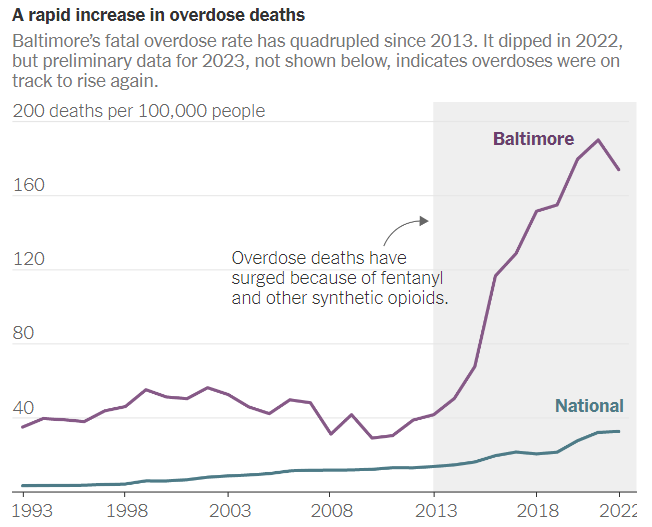
In the past six years, nearly 6,000 lives have been lost. The death rate from 2018 to 2022 was nearly double that of any other large city, and higher than nearly all of Appalachia during the prescription pill crisis, the Midwest during the height of rural meth labs or New York during the crack epidemic.
A decade ago, 700 fewer people here were being killed by drugs each year. And when fatalities began to rise from the synthetic opioid fentanyl, so potent that even minuscule doses are deadly, Baltimore’s initial response was hailed as a national model. The city set ambitious goals, distributed Narcan widely, experimented with ways to steer people into treatment and ratcheted up campaigns to alert the public.
But then city leaders became preoccupied with other crises, including gun violence and the pandemic. Many of those efforts to fight overdoses stalled, an examination by The New York Times and The Baltimore Banner has found.
Health officials began publicly sharing less data. City Council members rarely addressed or inquired about the growing number of overdoses. The fact that the city’s status became so much worse than any other of its size was not known to the mayor, the deputy mayor — who had been the health commissioner during some of those years — or multiple council members until they were recently shown data compiled by Times/Banner reporters. In effect, they were flying blind.
A rapid increase in overdose deaths
Baltimore’s fatal overdose rate has quadrupled since 2013. It dipped in 2022, but preliminary data for 2023, indicates overdoses were on track to rise again.
In an interview, Mayor Brandon Scott defended the city’s response. He knows that Baltimore has had a severe problem with drug addiction for decades, he said, and while the analysis may provide a better understanding of its scale, it will not change his administration’s approach.
“This is an issue that we’re doing a lot of work on and that we can and will do more work on,” Mr. Scott said, “but we also know requires a lot, lot more resources” than the city has.
When shown the mortality figures, other city leaders and health experts reacted with alarm.
It’s “really shocking,” said Dr. Joshua Sharfstein, a former Baltimore health commissioner and now a vice dean at the Johns Hopkins Bloomberg School of Public Health, adding that the deaths were “unprecedented in the city’s history.”
The numbers are “horrifying,” said Dr. Laura Herrera Scott, Maryland’s health secretary since 2023, adding, “We haven’t deployed the right resources in the right places.”
To examine Baltimore’s response to overdoses, journalists for The Times and The Banner reviewed thousands of pages of government documents and interviewed more than 100 health officials, treatment providers and people who have been addicted to drugs. Taken together, the records and interviews reveal the extent to which the city’s leaders failed to grapple with the enormity of the crisis.
State and city agencies track deaths, reporting the overall count to the U.S. Centers for Disease Control and Prevention. But Maryland and Baltimore officials, often citing medical privacy concerns, have not published more detailed information on overdoses that is readily available elsewhere. ...Read More
|
|
|
|
Voters Remember the Pain, not the Gain
Wage gains are finally outstripping health plans' rising premiums, co-pays and deductibles. Who cares when families still can't afford it?
By Merrill Goozner
Gooznews
MAY 28, 2024 - Here’s another problem for President Biden’s reelection team. In in policy arena that should be a strength for an incumbent who has lowered the uninsured rate to the lowest ever, voters — when asked about health care issues they are most concerned about — choose rising health care costs, specifically, the rising sums they must pay out-of-pocket despite being insured.
The latest Kaiser Family Foundation poll of registered voters showed nearly half (48%) of the public rated “lowering out-of-pocket costs” their number one health care concern. That’s nearly triple the number who worried most about Medicare’s fiscal sustainability (18%) or getting more bang for their health care buck (18%).
As KFF president Drew Altman wrote in a column in February when the poll was released:
Between a quarter and a half of all Americans report real problems paying their medical bills depending on how sick they are. People are not economists, and they don’t think about out-of-pocket costs as a share of spending. People experience them as bills they often can’t afford to pay.
The key phrase in that quote is “depending on how sick they are.” It’s always important to keep in mind health care’s 20-80 rule: 20% of the population accounts for 80% of health care spending in any given year.
If you are well off and relatively healthy (thus in the 20%), then the occasional $20 co-pay for an office visit or $150 for an expensive test doesn’t make much of a dent in your monthly budget. But if you’re not well off and prone to the many ailments that strike working class people like hypertension, diabetes and workplace-related stresses and strains; or if your child has asthma, food allergies or ADHD; those bills can mount up quickly. When you’re in the lower half of the income distribution, even a few hundred dollars in co-pays can throw your monthly budget out of whack.
A research brief published today in JAMA Internal Medicine documents how rising out-of-pocket costs over the past decade-and-a-half hit less well-off people the hardest. A team of researchers led by Dr. Rishi K. Wadhera of Beth Israel Deaconess Medical Center in Boston reviewed out-of-pocket spending for a representative sample (just under 100,000 families) of the 180 million people under 65 who have private insurance plans. The OOP spending included not just co-premiums, which are usually deducted from paychecks, but also co-pays and deductibles, which are only incurred when one visits the doctor, is hospitalized, picks up a prescription or uses some other medical service. It was also a period when a rising number of workers chose high-deductible plans from their employers’ options because they cost less in co-premiums.
They found mean spending paid out-of-pocket (half of families paid more; half less) rose 25.2% after adjusting for inflation between 2007 and 2019. Most of the increase came from co-premiums, not co-pays and deductibles (despite the rise of high-deductible plans in recent decades). That was twice the rate of underlying inflation in most of those years.
The health care tax on the poor
Lower income families suffered the most when the premiums deducted from paychecks rose faster than inflation. Their out-of-pocket expenses in 2019 ate up 26.4% of their “post-subsistence” income (not including food expenses) compared to 23.6% in 2007. For higher income families, out-of-pocket health spending took just 5.4% of income at the beginning of the study period and slight over 6% at the end, according to the study. ...Read More
|
|
|
|
Photo: This ever-growing permafrost-destroying 'sink hole' was originally a small gully in the 1960s. Murton et al/Permafrost Periglacial Processes
Earth's 'Gateway to Hell' is growing by 35 million cubic feet each year
By Bronwyn Thompson
New Atlas
May 08, 2024 - Whether you're a John Carpenter fan or a biology enthusiast, you shouldn't need much convincing to know that the melting of subterranean permafrost at the poles is not a good thing.
Last year, scientists gave us one more thing to lose sleep over, reviving a 48,500-year-old 'zombie virus' unearthed from Arctic permafrost – and it was not the first time. It's one more sting in the tail of climate change – the threat of ancient diseases that have lain frozen and dormant for millennia.
Now, new research has detailed the rate at which Siberia's massive Batagaika crater is devouring the surface of the Earth, expanding at a rate of 35 million cubic feet each year. Currently, it measures around 1 km (0.6 mi) long and 800 m (0.5 mi) across at its widest point. And it's speeding up.
Batagaika crater, located in the Chersky Range in northeastern Siberia, is not actually a crater but a thermokarst depression – a kind of sinkhole or 'mega-slump' driven by the collapse and fracturing of land due to permafrost loss. It was only discovered in 1991, after this underground opening split further and took with it a large section of hillside.
Permafrost, despite its name, is not actually permanent; it's essentially ground that's remained at 32°F (0°C) or colder for more than two years. A quarter of the Northern Hemisphere's land surface is made up of this rock-hard frozen dirt that can vary between a a few feet deep to almost a mile.
So why is Batagaika – which is in a fairly remote area of Siberia – causing such alarm? Its rapid expansion is now fueled by warming air temperatures, which has set off a positive feedback loop that's unlikely to slow down as long as there's ice to thaw.
When the permafrost layer degrades, or melts, it goes from concrete consistency to a muddy mass, which is unable to support the vegetation on the surface. As the edges of the expanse collapse into it, the ground loses the canopies of trees shielding it from the sun (and heat). At this point, newly-exposed organic matter, no longer preserved in ice, breaks down and releases carbon into the atmosphere to further fuel atmospheric warming. This, of course, results in increasingly more permafrost loss.
As for the ancient bugs, we don't know whether they're equipped to survive for long when exposed to the Earth's atmosphere – but nor do we know if our modern biology and medicine is equipped to deal with novel viruses returning from 50,000 years of dormancy. In 2016, it's believed a permafrost thaw released the anthrax-causing Bacillus anthracis, which killed 2,649 reindeer, and resulted in dozens of sick locals and the death of one child.
The dramatic Batagaika crater formation – which has earned it the nicknames of 'gateway to the underworld' and 'gateway to Hell' – has steep cliff-like edges revealing permafrost estimated to have been frozen for 650,000 years. It's currently around 50 m (164 ft) deep, with areas dropping down 100 meters (328 feet).
And the good news? Well, it has become somewhat of a tourist attraction... ...Read More
|
|
Illustration By Mel Haasch
Off Leash: Inside the Secret, Global, Far-Right Group Chat
Military contractor Erik Prince started a private WhatsApp group for his close associates that includes a menagerie of right-wing government officials, intelligence operatives, arms traffickers, and journalists. We got their messages.
By Ken Silverstein
The New Republic
May 30, 2024 - In his book In the Garden of Beasts: Love, Terror, and an American Family in Hitler’s Berlin, Erik Larson cites a cable sent to the State Department in June 1933 by a U.S. diplomat posted in Germany that provided a far more candid assessment of the Nazi leadership than the one that President Franklin Delano Roosevelt’s administration was then conveying to the public.
“With few exceptions, the men who are running this Government are of a mentality that you and I cannot understand,” read the cable, which was written five months after Adolf Hitler was appointed chancellor. “Some of them are psychopathic cases and would ordinarily be receiving treatment somewhere.”
I’ve thought about that passage from the cable many times over the past several weeks as I’ve been reading excerpts from a private WhatsApp group chat established last December by Erik Prince, the founder of the military contractor Blackwater. Prince is the younger brother of Betsy DeVos, the secretary of education during President Donald Trump’s administration, who invited around 650 of his contacts in the United States and around the world to join.
Prince, who has a long track record of financing conservative candidates and causes and extensive ties to right-wing regimes around the world, named the group—which currently has around 400 members—“Off Leash,” the same name as the new podcast that he’d launched the month before.
Among the group’s hottest topics:
• The “Biden Regime,” which a consensus of Off Leash participants who weighed in view as an ally of Islamic terrorists and other anti-American forces that needs to be crushed along with them and its partners in the deep state, such as former Joint Chiefs of Staff Chairman Mark Milley, who “deserves to burn in hell,” Lara Logan shared with the group chat.
• The shortcomings of democracy that invariably resulted from extending the franchise to ordinary citizens, who are easily manipulated by Marxists and populists. “The West is at best a beautiful cemetery,” lamented Sven von Storch, whose aristocratic German family fled the country after World War II to Chile, where their son was raised before returning to the land of his ancestors, where he married the granddaughter of the Third Reich’s last de facto head of state, who was convicted at Nuremberg.
• Israel-Palestine, a problem that Michael Yudelson, Prince’s business partner at Unplugged, which markets an allegedly supersecure smartphone, said should be handled by napalming Hamas’s tunnel network. “I would burn all those bastards, and have everything above ground, everything left of Gaza, collapse into this fiery hell pit and burn!” he wrote.
• The Houthi rebels in Yemen, whom Yoav Goldhorn, who was an Israeli intelligence officer until last year and now works for a Tel Aviv–based security contractor headed by former senior national security veterans, thinks should be “dealt with” as soon as possible to ensure they don’t grow from “an inconvenience to a festering mess [that] will eventually require an entire limb to be amputated.”
• And most of all, Iran, which participants agreed, with a few exceptions, also needed to be wiped out. Saghar Erica Kasraie, a former staffer for Republican Representative Trent Franks when he served on the House Armed Services Committee and whom, according to her LinkedIn profile, she advised on Middle East issues, urged that the Islamic Republic’s clerical leaders be targeted by weaponized drones that “take them out like flys ??.”
Not all of the group’s members are conspiracy theorists in the mold of Logan, the former CBS correspondent. I know many people who are in roughly the same political ballpark as the average Off Leash participant, including some of the chat group’s members, who are razor-sharp, even if I strongly disagree with a lot of their opinions. I don’t know Prince other than having been in the same room with him on a few occasions, but we have mutual acquaintances who say he’s not a one-dimensional evil mercenary as typically portrayed but brilliant and funny, and over drinks greatly prefers to discuss business and history rather than expound upon the latest developments in right-wing political circles.
Frank Gallagher, a former Marine who once provided security for Henry Kissinger and who worked in a high-level position at Blackwater in Iraq following the 2003 U.S.-led invasion, isn’t a fan of Prince but offered a similar assessment. “We had issues from time to time, but I can’t deny that he’s extraordinarily smart,” he recounted. “When he came to Iraq, he’d cover 10 topics, and he had command over all of them.”
All of which makes Off Leash arguably more concerning, because the group can’t be dismissed as merely a collection of harmless cranks. Many of the participants, though not all household names, are wealthy and politically wired—which makes their incessant whining in the group chat about being crushed under the bootheel of the deep state particularly grating—and they will collectively become wealthier and more influential if Trump wins the November election.
That’s especially true of the Americans in the group, but the same holds for the international figures because the global right will become immensely more powerful and emboldened if the former president returns to the White House. That prospect is a source of great hope to Off Leash participants. “Trump, Orban, Milei, it’s happening,” former Blackwater executive John LaDelfa posted to the group during a trip to Argentina on December 4, two days after Prince created it. “Around the Globe, we are the sensible, the rational, the majority. Don’t give in to fear. We will defeat the Marxists.”
His hopes were shared by many other Off Leash participants, among them Horatiu Potra, a Romanian mercenary who has recently been operating in the mineral-rich, conflict-plagued Democratic Republic of Congo. “The globalists want to control the entire planet [and] the only chance to get rid of them is a spark from a great power (the USA),” Potra wrote. “Surely there will be a strong man like Erik who will initiate it, otherwise there is no chance of regaining our freedom. If this spark is started, all countries will follow suit.… We were waiting for the signal, the spark!!”
A December 2023 United Nations report alleged that Potra owns a company that has provided combat support and fighters to Congolese government troops fighting a vicious rebel insurgency. Prince unsuccessfully sought to negotiate a deal with the DRC government to fly 2,500 mercenaries from Colombia, Argentina, and Mexico into the country to fight alongside Potra’s men, the report said.
About three-quarters of the people Prince invited to the group chat are from the U.S. or live here. The largest overseas blocs are from Israel (32 members), the United Arab Emirates (20 members), and the United Kingdom (20). There are smaller contingents, sometimes a single person, from 33 other countries in Africa, Asia, Europe, Latin America, and the Middle East.
Collectively, Off Leash provides an informal virtual gathering place for current and former political officials, national security operatives, activists, journalists, soldiers of fortune, weapons brokers, black bag operators, grifters, convicted criminals, and other elements in the U.S. and global far right. The roster of invitees includes:
• Icons of the MAGA ecosphere such as Tucker Carlson, the most revered figure among group chat participants, with the exception of the Supreme Leader himself; Kimberly Guilfoyle, the longtime fiancée of Donald Trump Jr.; and retired Lieutenant General Michael Flynn, Trump’s convicted-then-pardoned first national security adviser. Flynn has participated, Carlson only minimally, and Guilfoyle not at all.
• Current and former lawmakers and aides, such as Tennessee Congressman Mark Green of the House Freedom Caucus; Vish Burra, who was director of operations for Congressman George Santos; and Stuart Seldowitz, a national security adviser to Barack Obama from 2009 to 2011 who was arrested last November after harassing an Egyptian halal street cart vendor in New York City for two weeks, during which time he called him a “terrorist” and said, “If we killed 4,000 Palestinian kids, it wasn’t enough.”
Prominent figures in the Off Leash crew are well known for their paleoconservative political views, but the private opinions expressed in the group chat are even more extreme and jarring than we normally see voiced publicly. Participants chirpily discussed the desirability of clamping down on democracy to deal with their enemies at home and regime change, bombings, assassinations, and covert action to take care of those abroad.
The group’s overall bloodlust periodically proved to be too much for a few more judicious individual members, who in almost any other setting would be considered ultraconservatives but in the context of Off Leash sound like hippie peaceniks. One of the dissidents—a National Rifle Association firearms instructor who runs a weapons company—joked that he was worried about an “unsupervised” subgroup of especially enthusiastic military adventurers that formed to discuss topics too “hot” for WhatsApp, saying, “I imagine their ‘to be bombed’ list is over 49 countries and growing.”
Many other Off Leash participants have also stated that they don’t view the group chat as merely a forum to exchange ideas but want it to become a vehicle to put their theories into action. “If we band together … we can damage the other side like no one has ever seen before!” exclaimed Jeff Sloat, who worked with a U.S. Army psyops unit in Central America during the Reagan era.
I don’t want to disclose much about how I learned of the group chat and the nature of its discussions, but I will say that multiple sources in the U.S. and elsewhere shared information, including two journalists who I discovered had learned about Off Leash, which nearly gave me a heart attack for fear I’d lose my scoop. Participants did occasionally express concerns about security, but their worries were mostly centered on the possibility that their conversation was vulnerable to hackers. It apparently never occurred to any of them that their confidentiality might be compromised not by sophisticated cyberwarfare specialists but by old-fashioned leakers, which was virtually inevitable given the group’s size.
Off Leash was still active as of Wednesday, though I expect it won’t be, at least in its current form, for much longer, given that the conversation Wednesday included much discussion about their security being breached, which became evident after I reached out to participants for comment. Fortunately, I obtained details about a large slice of the chat group’s discussions over the past six months. Here’s some of what they discussed.
Solving the Middle East Crisis: Nukes, Napalm, and Other “Extreme Measures”
Off Leash was launched less than two months after Israel commenced its assault on Gaza following Hamas’s deadly October 7 attack on Israel, and that topic has been one of the group chat’s main concerns since it was established by Prince on December 2. Five days later, Omer Laviv, an executive with the Mer Group, a private security company with many former Israeli intelligence officials in its senior ranks, posted a story to the group that ran two days earlier in The Times of London and reported Prince had been seeking to sell the Israel Defense Forces equipment for a plan he’d devised to flood Hamas tunnels with seawater.
“I was involved,” remarked Moti Kahana, the Israeli American businessman who runs GDC, the firm where Off Leash member Stuart Seldowitz previously worked. Kahana pointedly added that at least one part of The Times’ story was false—for example, Prince had offered to donate the equipment, not sell it, he said.
“Why do you expect accuracy from journalists?” retorted Laviv, who during the Trump administration retained 27 U.S. lobbyists and consultants to run a $9.5 million lobbying campaign on behalf of President Joseph Kabila, the corrupt, brutal leader of the Democratic Republic of Congo, who used surveillance equipment supplied by the Mer Group to monitor his regime’s opponents. Among those Laviv involved were Rudy Giuliani, Trump’s former personal lawyer, fixer, and dirt-digger, and Robert Stryk, whose clients have included Saudi Arabia and El Salvador’s state intelligence agency under crypto-fascist President Nayib Bukele.
Yudelson, who also reportedly partnered with Prince in an attempt to buy weapons for resale from Belarus dictator Aleksandr Lukashenko (whom the two men praised for bringing “peace, stability, and prosperity to your country”), predicted the tunnel-flooding proposal would be shot down by the “Israeli left,” a force he labeled the country’s “biggest enemy,” ahead of Hamas and Iran, over concerns about the environmental impact in Gaza. “Who gives a shit about that,” Yudelson posted to the group. “If it was up to me … I would flood them with Napalm! I would burn all those bastards, and have everything above ground, everything left of Gaza, collapse into this fiery hell pit and burn!” ...Read More
|
|
New Journals and Books for Radical Education...
Use Changemaker for Your Holiday Gifts,
Thus Lending Us a Hand, Too!
|
|
From Upton
Sinclair's 'Goose Step' to the Neoliberal University
Essays on the Ongoing Transformation of Higher Education
Paperback USD 17.00
This is a unique collection of 15 essays by two Purdue University professors who use their institution as a case-in-point study of the changing nature of the American 'multiversity.' They take a book from an earlier time, Upton Sinclair's 'The Goose-Step A Study of American Education' from 1923, which exposed the capitalist corruption of the ivory tower back then and brought it up to date with more far-reaching changes today. time. They also include, as an appendix, a 1967 essay by SDS leader Carl Davidson, who broke some of the original ground on the subject.
|
|
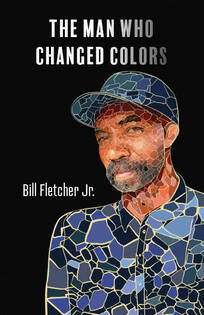
The Man Who Changed Colors
By Bill Fletcher, Jr.
When a dockworker falls to his death under strange circumstances, investigative journalist David Gomes is on the case. His dogged pursuit of the truth puts his life in danger and upends the scrappy Cape Cod newspaper he works for.
Spend a season on the Cape with this gripping, provocative tale that delves into the
complicated relationships between Cape Verdean Americans and African Americans, Portuguese fascist gangs, and abusive shipyard working conditions. From the author of The Man Who Fell From The Sky.
“Bill Fletcher is a truth seeker and a truth teller – even when he’s writing fiction. Not unlike Bill, his character David Gomes is willing to put his life and career in peril to expose the truth. A thrilling read!” − Tavis Smiley, Broadcaster & NY TIMES Bestselling Author
|
|
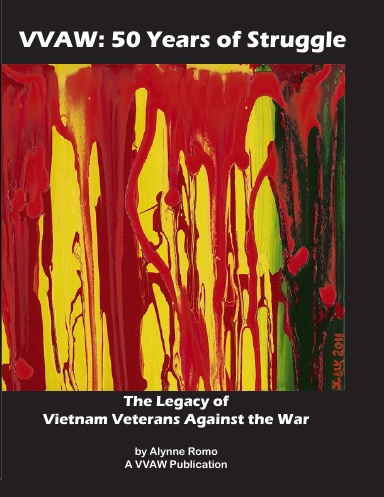
VVAW: 50 Years
of Struggle
By Alynne Romo
While most books about VVAW focus on the 1960s and 1970s, this photo-with-text book provides a look at many of actions of VVAW over five decades. Some of VVAW’s events and its stands on issues are highlighted here in stories. Others show up in the running timelines which also include relevant events around the nation or the world. Examples of events are the riots in America’s urban centers, the murders of civil rights leaders or the largely failed missions in Vietnam.
Paul Tabone: This is a must read for anyone who was in the war, who had a loved one in the war, who is interested in history in general or probably more importantly for anyone who wants to see how we repeat history over and over again given the incredible idiot and his minions that currently occupy the White House. To my fellow Viet Nam veterans I say "Welcome Home Brothers". A must read for everyone who considers them self an American. Bravo.
|
|
|
A China Reader
Edited by Duncan McFarland
A project of the CCDS Socialist Education Project & Online University of the Left
244 pages, $20 (discounts available for quantity orders from carld717@gmail.com), or order at :
The book is a selection of essays offering keen insight into the nature of China and its social system, its internal debates, and its history. It includes several articles on the US and China and the growing efforts of friendship between the Chinese and American peoples.
|
|
|
|
Taking Down
White Supremacy
Edited by the CCDS
Socialist Education Project
This collection of 20 essays brings together a variety of articles-theoretical, historical, and experiential-that address multi-racial, multi-national unity. The book provides examples theoretically and historically, of efforts to build multi-racial unity in the twentieth century.
166 pages, $12.50 (discounts available for quantity), order at :
|
|
|
|
The Press: What Has Happened To
The Lifeblood of our Democracy?
How did America reach this point where about half
our country thinks up is down, black is white,
and Republicans are best trusted with
our money and national security?
By Thom Hartmann
The Hartmann Report
MAY 28, 2024 - The fifteen or twenty percent of Americans who follow actual news reporting are dumbfounded:
— Only about half of Americans know that Trump set up and wanted the end of Roe v Wade while one-in-five think President Biden is responsible for it,
— More trust Republicans with the economy than Democrats and 46% say Trump can fix the economy compared to 32% for Biden,
— Only a third of Americans know that Republicans appointed the majority on the Supreme Court,
— 46% of Americans say a second Biden presidency will weaken American democracy,
— More than half (55%) of Americans believe the economy is shrinking and we’re in a recession (when it’s growing faster than under any president since FDR and has been for three-plus years),
— When President Biden came into office in 2021, almost two-thirds of Americans approved of his handling the economy and foreign affairs; today that number is fewer than a third,
— Almost half (49%) think the stock market is down for the year when in fact the S&P 500 was up 24% last year and is up more than 12% this year,
— About three-quarters (72%) are sure that inflation is up right now, when the rate has fallen from 9.1% to a current low of 3.4%, far better than the lowest inflation number Reagan had at 4.1% in his entire 8 years in office,
— While unemployment is lower than it’s been in over 50 years, half of Americans (49%) say “unemployment is at a 50-year high,”
— Only 34% of Americans can name the three branches of government while 69% of Republicans believe the 2020 election was stolen from Trump,
— As violent weather tears apart America, only 23% of Republicans consider climate change a major threat to our nation’s well-being,
— Today, 58% of Americans say the economy is getting worse daily because of mismanagement by Biden and Democrats in Congress,
— Almost half of Americans (44%) think Social Security will be gone by the time they retire,
— Fully 44% of Americans say the media and politicians are “making too much” of the January 6th assault on our capitol.
How did America reach this point where about half our country thinks up is down, black is white, and Republicans are best trusted with our money and national security?
The first imperative for any dictatorial regime is to seize control of the press. Hitler not only shut down all the opposition press and turned all of Germany’s newspapers into propaganda outlets, but ordered Leni Riefenstahl’s propaganda masterpiece Triumph of the Will played in every theater in Germany before every movie. The first thing his soldiers did upon occupying every country he conquered was to seize the offices of the local newspapers and radio stations.
Orbán destroyed the free press in Hungary by changing that nation’s libel and defamation laws in the same way Trump is today advocating, setting up libel lawsuits against virtually every press outlet that had ever criticized him and bankrupting them and their owners and editors with lawsuits. His oligarch buddies then bought the media properties out of bankruptcy for pennies on the dollar.
Putin did the same in Russia, and Modi is pursuing a similar effort in India.
Here in America, though, the rightwing billionaires who overwhelmingly own our media didn’t need the heavy hand of libel laws to seize control of this nation’s news and information channels (although Trump promises to do so anyway).
Zuckerberg built Facebook by buying out and shutting down or taking over his competitors in defiance of anti-trust laws that haven’t been used (until recently) since Reagan’s famous 1983 order to stop their enforcement.
Musk brought in cash from Saudi Arabia to help finance his purchase of Twitter, turning it into a rightwing cesspool that has become one of America’s premier sources of misinformation tilted toward Trump and hard-right Republicans.
Billionaire Jeff Bezos owns The Washington Post, and the wealthy owner of The New York Times, some argue, is pushing that paper to hammer Biden’s age because the president won’t do a sit-down interview with him.
From the 1930s, media monopoly laws prevented the consolidation of TV and radio stations and newspapers into a few rich hands. That ended when Bill Clinton signed the Telecommunications Act of 1996, which discarded those ownership restrictions: within a decade virtually all of America’s media (in terms of reach) was in the hands of fewer than a dozen corporations.
A few years ago, I met with the billionaire owner of 900 or so radio stations, many of them carrying rightwing talk radio. We were in the offices of a U.S .Senator, who pointed out to the billionaire that my show was regularly beating Rush Limbaugh in the ratings and asked the media mogul if he’d ever considered balancing his programming with some progressive shows, which make just as much money for their stations as do conservative hosts.
The billionaire laughed at the senator and said, simply, “I’ll never put anybody on the air who wants to raise my taxes.”
Ever since Reagan’s deregulation of the financial sector legalized the private equity scam, these predatory companies have bought up, sucked dry, and driven into bankruptcy more than half of America’s small local newspapers.
It’s the same strategy they used to drain hundreds of billions from Red Lobster, J.Crew, Neiman Marcus, Toys “R” Us, Sears, 24 Hour Fitness, Aeropostale, American Apparel, Brookstone, Charlotte Russe, Claire’s, David’s Bridal, Clear Channel, Deadspin, Fairway, Gymboree, Hertz, KB Toys, Linens ’n Things, Mervyn’s, Mattress Firm, Musicland, Nine West, Payless ShoeSource, RadioShack, Shopko, Sports Authority, Rockport, True Religion, and Wickes Furniture (among hundreds of others).
The fact that information is the lifeblood of democracy and news media is the only industry explicitly named and protected by the Constitution is as irrelevant to these parasites as it is to Supreme Court justices Alito and Thomas, who the billionaire owners of such firms regularly spiff with luxury vacations and other gifts.
Political and economic commentators seem baffled. Last week, Steve Rattner did a long-form charts-and-graphs presentation for Joe Scarborough’s show demonstrating how the economy, by almost every measure, is better than any time since World War II but — bafflingly — Americans are convinced it’s in the tank and getting worse. He didn’t once, however, mention the role played by the media.
When large numbers of the people of any nation believe things that are objectively untrue, it’s a huge warning sign that something is awry with that nation’s media.
Almost half of Americans get all or most of their news from social media, which is dominated by two rightwing billionaires and the Chinese Communist Party, all of them apparently fans of Trump and his dreamed-of autocracy.
The rest of us get our news from radio, TV, cable, and other online sources, again dominated by billionaire interests who put keeping their tax rates low above threats to our democratic system of government.
Back in the 1980s, when the media told the truth about Reagan’s massive tax cuts, deregulation, gutting public education, and selling off public lands for pennies on the dollar, rightwing strategists began a unified chant about “liberal media bias.” Other than being unhappy about news outlets telling the truth, the one twig they could hang onto was the fact that most journalists were college graduates and colleges were then considered bastions of liberalism.
Rush Limbaugh debuted in 1988, claiming his show was a necessary antidote to liberal media bias even though it was the “liberal media” that made him famous and promoted his show to the top of the ratings. By the end of the ’80s the “liberal media” had become the GOP’s go-to meme under almost all circumstances.
At the 1992 Republican nominating convention, everybody from Barbara Bush to Marilyn Quayle was trashing the so-called leftwing media. GOP Chairman Rich Bond told The Washington Post that this was, in fact, a coordinated effort to influence coverage by intimidating reporters and their editors:
“But there is some strategy to it. I’m a coach of kids’ basketball and Little League teams. If you watch any great coach, what they try to do is ‘work the refs’ — meaning the media. Maybe the ref will cut you a little slack on the next one.”
It’s high time for Democrats and advocates for democracy to begin working the refs, and pushing for legislation to outlaw media monopolies, eliminate Section 230 liability limitations on social media, and end the destruction of local news by private equity.
If we don’t, America will continue to look more and more like Hungary or Russia and it could soon be too late to do anything about it. ...Read More
|
|
CHANGEMAKER PUBLICATIONS: Recent works on new paths to socialism and the solidarity economy
Remember Us for Gift Giving and Study Groups
Interested in Studying Gramsci? In a Serious way? We have a group that meets Sundays via Zoom, 11am-12:30pm, facilitated by Piruz Alemi. We go paragraph by paragraph, even line by line, reading aloud, then discussing, through The Prison Notebooks, using an online PDF. If you are interested contact Carl Davidson at carld717@gmail.com
HERE'S ONE OF THE LATEST FROM CHANGEMAKER:
|
|
Treat someone to a wonderful book.
And treat yourself, too!
Powerful stories, wonderful gifts.
As they stand up, slow down, form unions, leave an abusive relationship or just stir up good trouble, the characters in this multi-generation novel entertain and enlighten, make us laugh and rage, and encourage us to love deeply, that we may continue the fight for justice.
"So much fiction is about escape and fantasy, but these powerful Tales of Struggle will enrich our real and daily lives." ─ Gloria Steinem
“What a wonderful story of class, class struggle and regular people. The story is about struggle and change, but also about joy and humor. Great work! ─ Bill Fletcher, Jr., author of Solidarity Divided
Price: $15.00
|
|
Photo: Looming large on Philadelphia’s Broad Street, a ten-foot-high statue—a gift to the city from the Pennsylvania Freemasons—shows young Benjamin Franklin at his printing press.
History Lesson of the Week: Fred Trump, the Ku Klux Klan and Grassroots Redlining in Interwar America
Journal of Urban History
The arrest of Fred Trump during a Ku Klux Klan (KKK) rally in New York City in 1927 came to light during the 2016 election campaign, but no one grasped its full historical significance. This article sets this contentious episode within the larger history of the Klan and the racial contests that scarred life in the interwar metropolitan fringe to produce a new account of how racially segregated communities were formed.
The article finds a decade-long contested process of overlapping layers, driven by debates over race and national identity; tense relationships between community groups; the political machinery of city, state and federal governments; competition between civic groups for access to services; and all set against a turbulent speculative world of interwar real estate.
The article argues racially redlined communities were created by a decade-long grassroots battle fought from below just as much as they were imposed from above by political decision-makers.
In another year, with another candidate, the revelation could have been devastating. On 9 September 2015, the website and blog Boing Boing reported Donald Trump’s father, Fred, was arrested in a “KKK brawl with cops.” The writer, Matt Blum, had unearthed a tantalizing snippet from the New York Times from June 1927 that named Fred as one of seven arrested during a violent confrontation between police and Klansmen during New York City’s Memorial Day Parade. Fred lived on Devonshire Road in Jamaica, Queens, near where the fighting took place, and would have been 21-years-old at the time.1
When the revelation broke, Donald responded with a denial that was forceful, repetitive and contradictory: “It never happened … I saw that it was on one little website that said it. It never happened. And they said there were no charges, no nothing.” Jason Horowitz, the interviewer from the New York Times who put the story to him, had first got Donald to confirm his father lived at the same address, although he claimed in the next breath that “I don’t think my father ever lived on Devonshire.”2 For a media often accused of creating “fake news,” the initial handling of the story was quite careful. Blum cautioned the story was “not proof” Trump was a Ku Klux Klan (KKK) member and left open the possibility he could have been “an innocent bystander.” The story was followed up by Vice, who found corroborating evidence Fred was arrested and was “dismissed on a charge of refusing to disperse from a parade,” while unearthing another article containing the explosive description of seven arrested “berobed marchers.” On the other side of the political spectrum, alt-right outlets branded the story a “fraudulent smear” by the “lying mainstream media.”3
Completely missing from this short-lived media scrum, however, was any sense of the bigger and ultimately more important historical story that lurked not far from the surface. Although the limitations of evidence mean the waters surrounding Trump’s arrest remain muddy (like much else related to the 2016 election), this article shows the 1927 Memorial Day Parade and its aftermath serves another historical purpose. By analyzing the contentious events of that day, setting them within the larger history of the Klan in Queens and amidst the racial contests that scarred life in the metropolitan fringe in the interwar period more broadly, we are afforded a new perspective of one of the most important processes in twentieth-century U.S. urban history: racial segregation and the origins of redlining. ...Read More
|
|
Getting to 'Yes' to Migrants
Mexico Solidarity Project from May 29, 2024
|
|
At Arizona Luminaria in Tucson, AZ, a community-focused media outlet, John Washington writes about the border, climate change, democracy, and more. His articles have been published in The New York Review of Books, The Atlantic, The Washington Post, The Nation, The Intercept and other outlets. He’s the author of The Dispossessed: A Story of Asylum at the US-Mexico Border and Beyond. A prolific translator, he co-translated with Daniela Ugaz Blood Barrios by Alberto Arce, which won a PEN Translates Award. Find him on Twitter (X) or Substack. Most recently, his article “11 Arguments for Open Borders” appeared in The Nation.
Lots of issues in the US concern us — the lack of affordable housing, mounting “natural” disasters, and so on. But migration is the all-consuming issue of this election, even though it affects very few. Why?
Creating fear of migrants is a winning campaign strategy. It worked well for Trump in 2016. The same drumbeat is sounding during this election season, and Biden has chosen to join it, not fight it. “Let’s see who can look tougher!” The fear-stoking employs false assertions that the data easily refutes — for example, that immigrants are a drain on the US economy — but then, this is not about facts.
It’s a propaganda war, and language is the weapon. They say migrants are “invading” the US, conjuring images of bandits taking over our country by force. But go to the border, as I did recently, where I talked with a typical migrant — a Guatemalan mom with three small kids, who was nervous, exhausted and grateful to hear the kind voice of the humanitarian aid worker who greeted her. Invaders?!
But that’s not to say immigration has a zero effect on US citizens. For example, in New York City, initially sympathetic mayor Eric Adams says that costs from the surge of migrants will force him to cut city services.
Local jurisdictions are hamstrung by federal laws that make it exceedingly difficult for migrants to work. Yet the US needs workers. At this point, the birth rate has fallen below replacement levels, which means the proportion of elders is growing in relation to working-age people. The US needs migrant workers to stave off the crisis. It’s simple: let them come, let them work!
Government officials are spending so much public money stupidly. The Texas governor Greg Abbott, to make a political point, put migrants on buses and sent them to blue states where they knew no one. What a waste! They could have been sent to the homes of relatives who would welcome them. But it did create the desired political result — pressure on Democratic leaders like Adams, who had to expend city dollars on housing them in shelters and hotels. ...Read More
|
|
New Liberation Road
Booklets supporting the Mexico Solidarity Project
By Bill Gallegos
Liberation Road is the only major US revolutionary socialist organization that has a developed position on Chicano Liberation, and one of the few that understands and works to build solidarity with the socialist movements and revolutionaries of Mexico. Now we have something that explains those positions - a series of Liberation Road pamphlets entitled Adelante! (Forward!). The pamphlets were developed collectively by several comrades, with support from comrades outside the organization.
The articles are enhanced and enriched by the powerful art and culture that is a major component of the pamphlets. While Adelante! was introduced at the recent Mexico Solidarity tour of the Mexico Solidarity Project they are meant as important resources for all comrades of Liberation Road — to better understand our strategic perspectives on Chicano Liberation and Mexico Solidarity (internationalism), and to help us promote those perspectives in all of our mass and red work.
This has always been an important task for our organization, but now more than ever as the New Confederacy seems to have made immigration the center of their attack on democracy, equity, and social justice. In order to support comrades in understanding and advancing our strategic perspectives we are going to be conducting at least one webinar to discuss our line and how to integrate Adelante! in your work. Adelante! is a product of love comrades, an expression of the spirit element that Che Guevarra insisted is at the heart of every true revolutionary’s work. A link to download the booklets will be available by next week. Meanwhile, contact Bill Gallegos at billg4@gmail.com
|
|
|
Our Amazing Resource for Radical Education
From the settlers to the present, and how its consciousness is conflicted. Prepared by Carl Davidson and Rebecca Tarlau,
with some help from the DSA Rust Belt group.
|
There are hundreds of video courses here, along with study guides, downloadable books and links to hundreds of other resources for study groups or individuals.
Nearly 10,000 people have signed on to the OUL for daily updates, and more than 150,000 have visited us at least once.
Karl Marx's ideas are a common touchstone for many people working for change. His historical materialism, his many contributions to political economy and class analysis, all continue to serve his core values--the self-emancipation of the working class and a vision of a classless society. There are naturally many trends in Marxism that have developed over the years, and new ones are on the rise today. All of them and others who want to see this project succeed are welcome here.
|
|
|
|
Video for Learning: Faith & Fascism: Rob Reiner & Dan Partland Tackle Christian Nationalism w/ God & Country Documentary...26 min
|
|
Harry Targ's 'Diary of a Heartland Radical' |
This week's topic:
Higher Education and the New Cold War: Purdue as an Example of Weaponizing Universities
Click the picture to access the blog.
|
|
Tune of the Week: 'The Animals 'We've Gotta Get Out Of This Place' on The Ed Sullivan Show..2:50 min
|
|
Book Review: The Forgotten History of Hitler’s Establishment Enablers
The Nazi leader didn’t seize power; he was given it.
By Adam Gopnik
The New Yorker
March 18, 2024 - The media lords thought that they could control him; political schemers thought that they could outwit him. The mainstream left had become a gerontocracy. And all of them failed to recognize his immunity to shame.
Hitler is so fully imagined a subject—so obsessively present on our televisions and in our bookstores—that to reimagine him seems pointless.
As with the Hollywood fascination with Charles Manson, speculative curiosity gives retrospective glamour to evil. Hitler created a world in which women were transported with their children for days in closed train cars and then had to watch those children die alongside them, naked, gasping for breath in a gas chamber. To ask whether the man responsible for this was motivated by reading Oswald Spengler or merely by meeting him seems to attribute too much complexity of purpose to him, not to mention posthumous dignity. Yet allowing the specifics of his ascent to be clouded by disdain is not much better than allowing his memory to be ennobled by mystery.
So the historian Timothy W. Ryback’s choice to make his new book, “Takeover: Hitler’s Final Rise to Power” (Knopf), an aggressively specific chronicle of a single year, 1932, seems a wise, even an inspired one. Ryback details, week by week, day by day, and sometimes hour by hour, how a country with a functional, if flawed, democratic machinery handed absolute power over to someone who could never claim a majority in an actual election and whom the entire conservative political class regarded as a chaotic clown with a violent following.
Ryback shows how major players thought they could find some ulterior advantage in managing him. Each was sure that, after the passing of a brief storm cloud, so obviously overloaded that it had to expend itself, they would emerge in possession of power. The corporate bosses thought that, if you looked past the strutting and the performative antisemitism, you had someone who would protect your money. Communist ideologues thought that, if you peered deeply enough into the strutting and the performative antisemitism, you could spy the pattern of a popular revolution. The decent right thought that he was too obviously deranged to remain in power long, and the decent left, tempered by earlier fights against different enemies, thought that, if they forcibly stuck to the rule of law, then the law would somehow by itself entrap a lawless leader. In a now familiar paradox, the rational forces stuck to magical thinking, while the irrational ones were more logical, parsing the brute equations of power. And so the storm never passed. In a way, it still has not.
Ryback’s story begins soon after Hitler’s very incomplete victory in the Weimar Republic’s parliamentary elections of July, 1932. Hitler’s party, the National Socialist German Workers’ Party (its German initials were N.S.D.A.P.), emerged with thirty-seven per cent of the vote, and two hundred and thirty out of six hundred and eight seats in the Reichstag, the German parliament—substantially ahead of any of its rivals. In the normal course of events, this would have led the aging warrior Paul von Hindenburg, Germany’s President, to appoint Hitler Chancellor. The equivalent of Prime Minister in other parliamentary systems, the Chancellor was meant to answer to his party, to the Reichstag, and to the President, who appointed him and who could remove him. Yet both Hindenburg and the sitting Chancellor, Franz von Papen, had been firm never-Hitler men, and naïvely entreated Hitler to recognize his own unsuitability for the role. ...Read More
|
|
Film Review: The World Needs More
Works Like 'The Seed of the Sacred Fig'
Mohammad Rasoulof had to flee his native Iran after being sentenced to prison for making films like this courageous drama.
By Richard Lawson
Vanity Fair
MAY 24, 2024 - One kind of artistic bravery involves, say, an actor bearing it all, self-consciousness be damned. And then there is the sort of courage on display—in front of and behind the camera—in The Seed of the Sacred Fig, a slow-burn drama set in turbulent, repressive modern-day Iran that premiered here at the Cannes Film Festival on May 24.
The film’s director, Mohammad Rasoulof, has fled Iran after receiving an eight-year prison sentence for his movies, and the film’s actors have been investigated by the state. These artists knew such an outcome was likely—an inevitable consequence of publicly criticizing the Iranian government—yet they made the film anyway, so committed are they to the urgency of their message.
Sacred Fig is about a family in Tehran, comfortably middle-class but poised to ascend to a new economic stratum. The father, Iman (Missagh Zagreb), works for the country’s judicial system and has been promoted to investigating judge. The position comes with a certain amount of perks and social cachet but also involves the signing of death warrants following hasty, perfunctory investigations.
His doting wife, Najmeh (the remarkable Soheila Golestani), is excited that the family will get to move into a three-bedroom apartment so that her adolescent daughters, Rezvan (Mahsa Rostami) and Sana (Setareh Maleki), won’t have to share a bedroom. Iman is stressed about work, haunted by the mortal weight of his decisions, but otherwise the household seems content enough, a picture of stability.
Yet the noises coming from outside suggest a coming storm. Protestors have taken to the streets following the death of Mahsa Amini, a 22-year-old Kurdish woman who died in 2022 under suspicious circumstances while in police custody, after she was arrested for allegedly improperly wearing a hijab. The subsequent demonstrations were massive, and resulted in the deaths of hundreds of people and the arrests of thousands more. As Iman’s workload grows heavier with each wave of protestor roundups, requiring him to issue countless dire rulings per day, his daughters begin to rebel against the strictures of their home and their country.
Rasoulof unspools this narrative at a deliberate pace, introducing plot elements that initially appear small but gradually spread like cracks on a windshield. When a handgun is first glimpsed—given to Iman for his protection—we’re fairly certain it will have some grim function later on. Same for the classmate whom Rezvan brings home one day, a small-town girl who has moved to Tehran to study and has found herself, either willingly or not, amidst the swell of the uprising. There is some suspense here, but Rasoulof mostly keeps the first half of the film focused on social manners, all the careful negotiation required when living under the glaring eye of a totalitarianism.
He is setting the stage for the second half of Sacred Fig, in which the tenuously maintained order of the family crumbles and the allegorical engine of the film churns into motion. The Seed of the Sacred Fig is about everyday Iranians, particularly women, coming to realize that a monster—or, at least, a functionary of a monstrous entity—is in the house with them. With calm insistence, Rasoulof depicts the shaking awake of perhaps whole swaths of Iranians who have found themselves no longer able to abide or ignore the injustices occurring on their doorsteps—nor those in their communities, or families, who help perpetuate that injustice.
This is a sad and frightening story about a family’s undoing, but Rasoulof ekes out some hope too. He threads in real footage of recent protests throughout the film, most shot in the narrow vertical aspect ratio of cellphone video—perhaps modernity’s most effective tool for documenting state brutality. Many of these clips are horrors: beatings, shootings, young people lying dead in the streets. They are visceral reminders of the fiction of Sacred Fig—a narrative film can only reveal so much, can only make us imagine what Rasoulof then shows us in plain fact.
But the footage is not all crushing. At a crucial moment in the film, Rasoulof cuts to rousing images of women in protest, both solitary and en masse. It’s a poignant act of humility, I think—a solemn acknowledgment that Rasoulof’s allegory has its own purpose, but perhaps best functions as a signal boost for those so bravely clamoring on the front lines of reality. The Seed of the Sacred Fig is a mighty tribute to the filmmaker’s many countrywomen who continue to risk it all in the fight for their lives. ...Read More
|
|
522 Valencia St.
San Francisco, CA 94110
415 863-6637
|
|
|
|
Is the content of this email relevant to you?
|
|
|
|
|
|
|
|
|