The Ohio Water Resources Center Newsletter
Issue 12 | Volume 5 | December 2023
| |
|
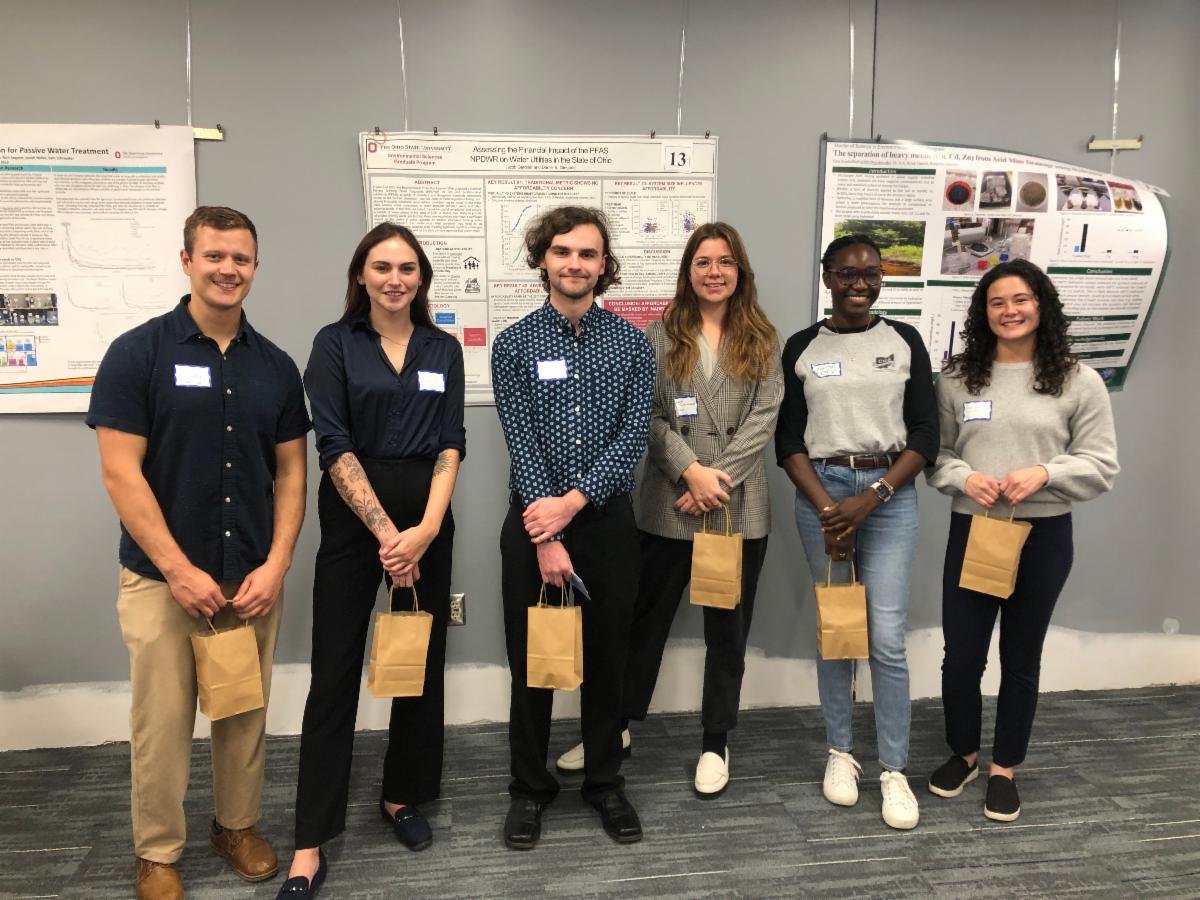
The Ohio Water Resources Center hosted the First Annual Interdisciplinary Water Research Symposium on November 3, 2023. This event was organized by graduate students with the goal of fostering collaboration between students, faculty, and practitioners throughout Ohio interested in water research. The event was kicked off by the chief of OEPA's Division of Drinking and Ground Waters, Amy Klei, who gave the keynote address. Throughout the day, nearly 100 people attended the oral presentations, flash talks, or posters. Thank you to those that helped make the event happen as well as the graduate student committee that put in the time and effort to make the inaugural event hugely successful! We look forward to the event next year!
The winner of the oral presentation session, Harrison Fried, presented his work on a collaborative tool that would aid in creating crucial connections between organizations who manage environmental issues in central Ohio. The Columbus Environmental Networking Tool (CENT) was designed to close these collaborative gaps. Harrison Fried gave an excellent presentation about his research that aligns closely with the event's goal of collaboration within water resources.
| |
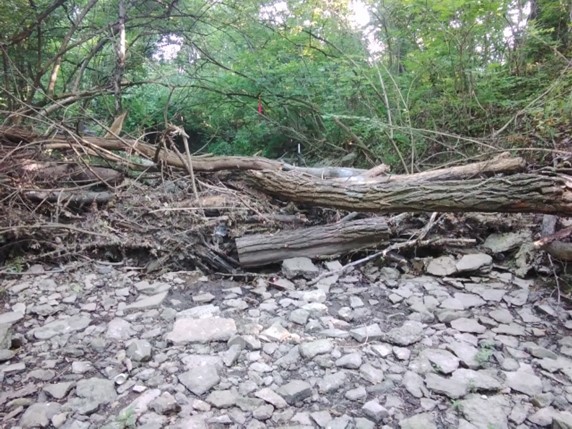
Assessment of large woody debris as a low-cost best management practice for improving water quality in urban headwater streams | |
Dr. Michael Booth, a research assistant professor at the University of Cincinnati, completed an Ohio Water Resources Center funded project via a 104(B) subaward. In stream ecosystems, urbanization may result in environmental and ecological degradation. A leading cause of the physical and biological impacts is frequent erosive flows over impervious surfaces. Damaging erosive flows decrease habitat diversity, widen channels, and increase bedload transport. Traditional stream restoration practices are costly and limited to areas with easy access.
Dr. Booth and his team assessed the ability of large woody debris to decrease erosion, decrease sediment transport, and increase the availability of pool habitat. They installed eight log jams in a headwater stream in Cincinnati, OH. Using a before-after-control-impact study design in four 60-meter reaches, results showed that the large woody debris installations increased pool habitation availability when dams were stable, but little impact was seen on sediment transport.
Dr. Booth's research will aid in urban stream restoration planning. Further, Dr. Booth's research included the training of 26 individuals from 13 groups some of which include USFWS, USEPA, ODNR, and several nonprofit organizations.
| | | |
|
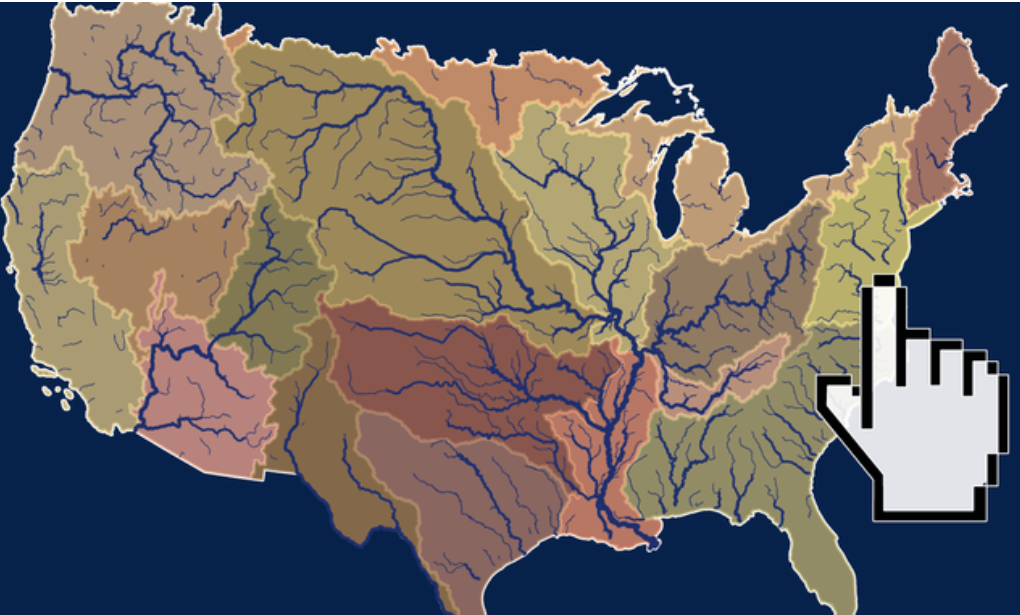
The National Water Census is one of three products associated with the Integrated Water Availability Assessments that the USGS Water Resources Mission Area is producing. Overall, the assessments will aid in water management as imbalances occur between water supply and demand.
The National Water Census will provide information about water quantity, water quality, and the use of surface and groundwater. One objective of the National Water Census is to deliver model-based estimates of water supply and demand over time. Another objective includes providing short- and-long term forecasting to support adaptive management. The National Water Census will include conditions over the past several decades, updated information on current or near-current conditions, and forecasts for the short- and long-term future.
Water availability data will be regularly updated online. Those outside of the USGS are able to access the information using webservices and APIs to use data and model predictions for their own models, map viewers, and other tools. Additionally, users will be able to interactively explore data through mappers and dashboards.
| | | |
|
Akron announces increase to water rates starting next year: See how much more you will be paying
Via WKYC, Nov. 9, 2023
EPA turns attention to EP water surface cleanup
Via Marietta Times, Nov. 22, 2023
EPA releases report submitted to Biden providing an update on East Palestine cleanup
Via The Review, Nov. 13, 2023
Map identified 426 areas where trichloroethylene affects U.S. drinking water
Via WQP, Nov. 13, 2023
A new roadmap to addressing toxic algal blooms in Lake Erie
Via Statehouse News Bureau, Nov. 16, 2023
| |  |
|
5 Ohio communities - including Greenfield- to receive $3.75 million for water, wastewater improvement
Via Highland County Press, Nov. 17, 2023
New Albany's search for water for Intel goes back years, far beyond Granville
Via The Columbus Dispatch, Nov. 19, 2023
Forever chemicals in Ohio's drinking water: Why Cincinnati is better off than Indian Hill
Via Cincinnati Enquirer, Nov. 21, 2023
Five takeaways for Ohio from the National Climate Assessment
Via Statehouse News Bureau, Nov. 21, 2023
| | |
|
Ohio EPA: Interested party review - Section 401 water quality certifications and wetland water quality standards rules
The Ohio EPA Division of Surface Water (DSW) is requesting input regardingthe Agency's draft rules in Ohio Administrative Code (OAC) Chapter 3745-1 and Chapter 3745-32. The Agency is planning amendments to each of the first seven rules listed; the final rule, 3745-32-04, is a new rule created to comply with House Bill 175. Please see the related fact sheets for more information. Comments are due by December 8, 2023 at 5 p.m. to dsw_rulecomments@epa.ohio.gov.
| |
|
Call for Nominations: US EPA 2024 Green Chemistry Challenge Award
The Green Chemistry Challenge Awards promote the environmental and economic benefits of developing and using novel green chemistry. These annual awards recognize chemical technologies that incorporate green chemistry into chemical design, manufacture, and use. More information here. Entries are due by December 8, 2023.
Request for Applications: USGS Ohio-Kentucky-Indiana Water Science Center job opportunity
The USGS Ohio-Kentucky-Indiana Water Science Center is seeking entry level hydrologists through the pathways recent graduate program for multiple positions in Columbus, Ohio, Indianapolis, Indiana and Louisville, Kentucky. Applicants should be strong communicators, be willing to work in all weather conditions, and be able to both work independently and as part of a team. Application instructions can be found here. The vacancy closes December 8th, 2023.
| | |
|
Request for Applications: Undergraduate Summer Research Fellowship at Stone Lab
Stone Laboratory welcomes college undergraduates to apply for its 2024 Research Experience for Undergraduates (REU) Fellowship Program. Students selected receive a $5,500 stipend and free room and meals for the eight-week fellowship experience at Stone Lab, The Ohio State University’s island campus on Lake Erie. Undergraduates from any U.S. college may apply for this competitive research opportunity. The students chosen will learn how to conduct scientific research in the field alongside top scientists. The fellowship runs from June 3 through July 26, 2024. Applications are due by February 26, 2024.
Call for Abstracts: One Water Technical Conference
The OAWWA/OWEA One Water Technical Conference focuses on water and wastewater industries throughout Ohio. Abstracts can be submitted here and the deadline to submit is December 15, 2023.
| | |
|
Webinar: Understanding Relationships between Flow, Habitat, and Biology in Urban Streams
December 13th, 2023 • Virtual
Registration is open for the Water Management Association of Ohio (WMAO) luncheon webinar, hosted by the Ohio Water Resources Center (WRC). Dr. Michael Booth will be discussing his research on the biological response of stream fishes to the flow patterns and considerations for using fish as indicators of habitat recovery, as well as the potential for a low-cost management intervention (wood additions) to improve stream habitat.
Webinar: Freshwater Science: Diverting Nutrients from Aquaculture Facilities into Additional Products
December 14th, 2023 • Virtual
During this webinar, hosted by Ohio Sea Grant, Stone Lab, and the Harmful Algal Bloom Research Initiative, researchers Dr. Silvia Newell and Dr. Kevin Neves, will discuss their development and analysis of a recirculating aquaculture system for perch production that uses nitrogen waste from fish ponds to support production of prawns and tomatoes. Registration is open.
Webinar: Harmful Algal Bloom Research Symposium
January 4-5, 2024 • Virtual
Registration will open soon for the 4th Annual Harmful Algal Bloom Research Symposium, hosted by the Algal Bloom Action Team. Topics will focus on the latest harmful algal bloom research, including effective bloom management and the latest technologies being used.
| |
|
Get in Touch
Email: OhioWRC@osu.edu
Phone: 614-292-2807
Website: https://wrc.osu.edu
Address: 475 Hitchcock Hall
2070 Neil Avenue
Columbus, OH 43210
Follow us on Twitter
| | |
| | | |