July 2024

From the Desk of CEO, Ashley Winslow, PhD

Science at Work

Odylia accelerates therapeutic development for rare diseases. We are scientists discovering and developing the next generation of rare disease treatments and increasing access to transformative treatments for rare disease patients. I’ve written to you before about why we chose to make Odylia a nonprofit in a traditionally for-profit industry. Today, I want to share more about how being a nonprofit supports the way we carry out the science needed for our two pipeline programs, our Brydge Solutions initiative, and what it means for future rare disease drug development.


Six years ago, Odylia was founded through the partnership of scientists and the rare disease community to address an unmet need. The need to move stalled treatments to clinical trials for the patients who need them. We pride ourselves on our team’s deep knowledge of genetics, molecular and cellular biology, and novel drug development, as well as the deep empathy and direct experience we have with rare diseases. These traits are core to the entire organization- the staff, Board of Directors, and our Scientific Advisors, as well as the amazing volunteers that join our efforts. 


Odylia operates as a biotech, developing novel and life-changing therapies for rare diseases - bringing gene therapies from the lab to clinical trials. We leverage our internal scientific expertise and strategic team differently for each program, building critical partnerships as a part of a well-rounded team that addresses the needs of each therapeutic, we have in development. Our scientific and operational strategy allows us to be nimble in the ever-changing environment of drug development. It also allows us to work on programs that are in different phases of development (i.e., discovery, late-stage preclinical studies, clinical planning), or affect different organ systems (i.e., the eye, the brain, systemic tissue overgrowth issues, etc), or using different therapeutic modalities (i.e. gene therapy, small molecules, antisense oligonucleotides).


The technical, hands-on aspects of drug development take time. As scientists, we design the most straightforward set of experiments to bring a therapy from ideation to the clinic, recognizing that discovery rarely proceeds in a linear path. Our team adapts experimental plans to maximize progress and to minimize unnecessary delays or scientific questions not relevant to developing a treatment. Collectively, our scientific strategy defines Odylia and we believe this approach gives rare disease treatments a better chance of success. 


In each newsletter we will spotlight one of our Odylia Team members, so you can meet the people working on the exciting therapies we have in development. We’ve also included a quick poll to get feedback from you about new resources you’d like to see in our library.


As I write this, we are putting the finishing touches on our pre-IND submission for the RPGRIP1 gene therapy and finalizing the next study for the USH1C program, while also evaluating new potential programs and Brydge Solutions partnerships. We are busy and are excited about the future. The overall timeline to get treatments to clinical trials is lengthy and the path is circuitous. Building a nimble and passionate team that can navigate this complex process has been key to Odylia’s success. 


From the beginning, the goal of Odylia has been to bring safe, effective treatments to patients regardless of potential for economic gain.

Odylia Program Updates

Odylia is excited to announce two new partnerships. First with the Smith-Kingsmore Syndrome Foundation, who we will help advance their strategic planning for therapeutic development. Second is the NPHP1 Family Foundation. We will work with them to help develop a gene therapy to treat retinopathy caused by mutations in the NPHP1 gene.


Please check out our video series that aims to address many of the common questions and roadblocks that rare disease patient advocacy groups face. We cover a range of topics including: Where can I find free resources on drug development for rare disease? and What is a drug repurposing screen?


Through the Brydge Solutions initiative, Odylia partners with patient groups, academic institutions, and industry to accelerate therapeutic development for rare diseases.

An independent review committee assessed the progress of our USH1C Gene Therapy Program and were supportive of shifting focus to the next stage which would include regulatory engagement, manufacturing, safety testing, and clinical candidate final selection.


Study 3.0 will end in August and final analyses are expected by the end of the year. These data will enable selection of a vector design to move to the next stage of development and testing.


We are evaluating the impact of delivering a gene therapy in different volumes in the USH1C genetic model system through a new study slated to begin in August.


We are seeking a new dynamic QA specialist to join our team. Please forward any inquiries to Jenny Klein.


USH1C program funding is provided by The Usher2020 Foundation and the FAUN Foundation and we have partnered with University of Tübingen, Institute of Animal Physiology and Genetics, Johannes Gutenberg University.

Odylia was granted $1.5M USD from the Foundation Fighting Blindness to support manufacturing and safety testing of Odylia's RPGRIP1 gene therapy (OT-004).


Our manufacturing partner, Andelyn Biosciences will begin a scale-up run of OT-004 to test how larger batch manufacturing of our gene therapy performs. 


Depending on the outcome of the scale-up, we will evaluate if timelines to toxicology testing can be expedited. 


Odylia’s most recent RPGRIP1 Q&A was held on June 12, 2024. Thank you to all who attended! If you missed it or would like to re-watch it, the recording can be found on our YouTube Channel HERE.


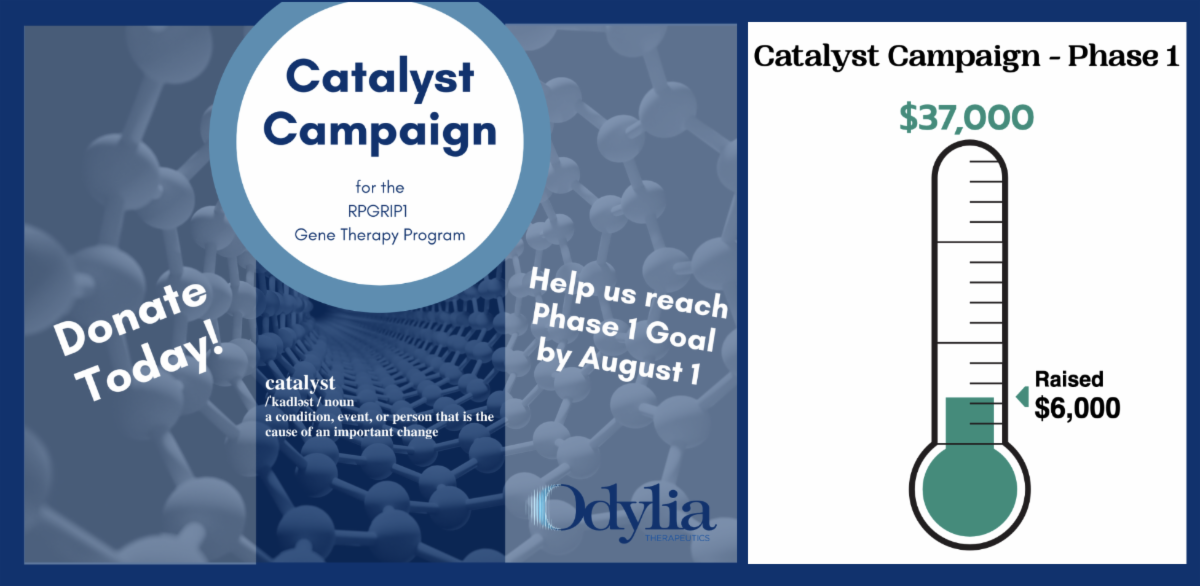
Odylia has launched the Catalyst Campaign to raise funds to move our RPGRIP1 gene therapy to clinical trials. The campaign is broken down into multiple phases. In the first phase, we aim to raise $37,000 by August 1, 2024. To learn more and contribute to the campaign, visit our site.


Program funding is provided through generous donations from the RPGRIP1 community and Odylia supporters, as well as through a grant from the Foundation Fighting Blindness.

Be a Catalyst for Change

Support Odylia by organizing a fundraiser in your community. Hold a 'Dine In' night at a local restaurant. Click HERE for a list of restaurants that will donate a portion of sales to nonprofits like Odylia. Do you have other ideas or questions? Email Heather Greene.

Meet the Odylia Team:

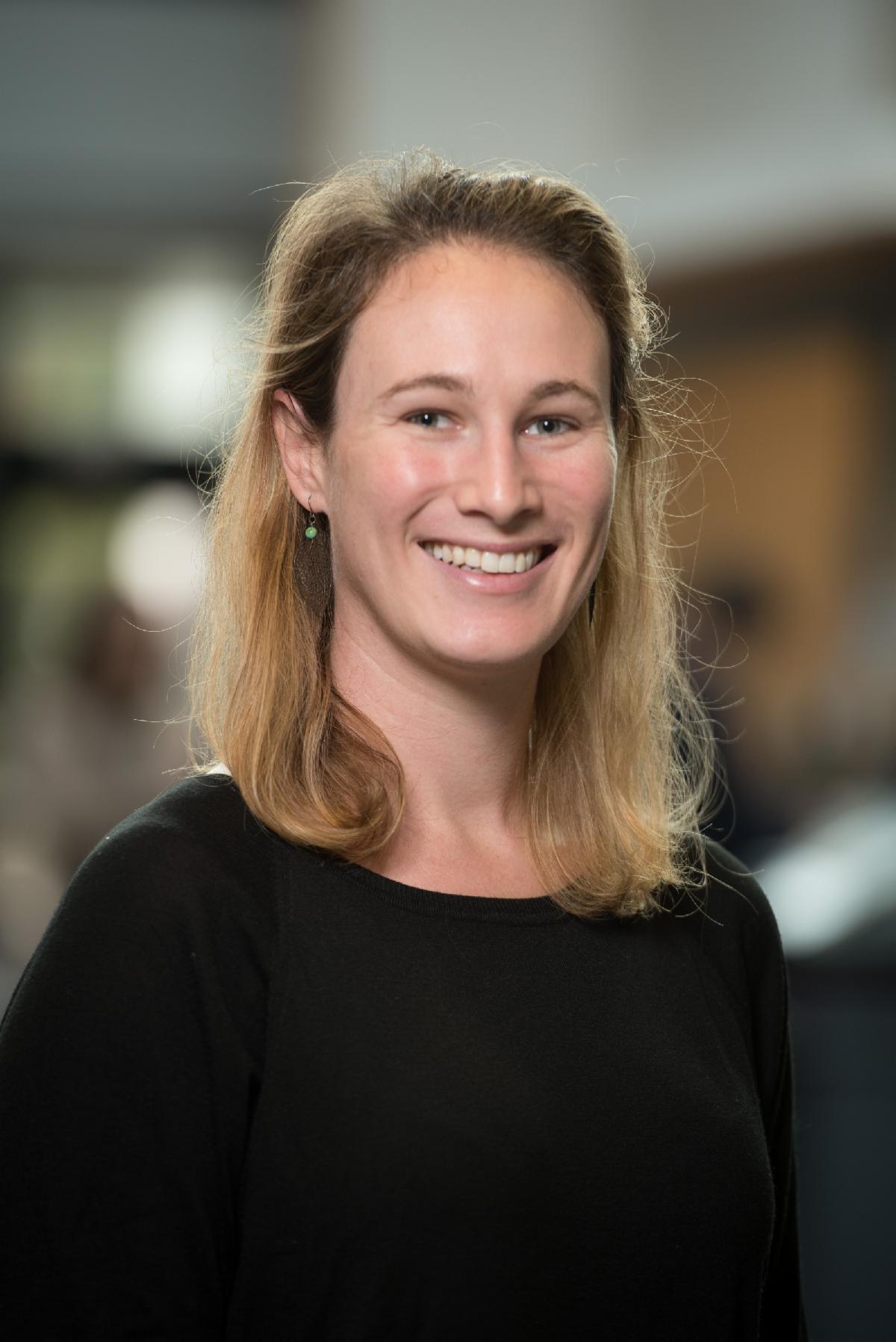
Kathryn Post DeMott, PhD

Title:Scientist, Brydge Solutions Lead


We asked Kathryn to share a little of her history.


Tell us about your path to Odylia:

"I worked in academic research for 13 years prior to joining Odylia. That work began in neurodegeneration studying ALS, Alzheimer’s disease, and other forms of dementia. I then pivoted to focusing on neurodevelopment during my PhD studies where I investigated rare, de novo mutations associated with syndromic forms of Autism Spectrum Disorder. I then worked as a Postdoctoral fellow researching rare genetic mutations found in mitochondrial diseases at the Center for Rare Childhood Disorders at Translational Genomics. Since joining Odylia in 2021, I develop scientific strategies and oversee project execution for our pipeline programs as well as lead the Brydge Solutions program where we work with rare disease groups to advance their therapeutic efforts."


Why is Odylia's mission important to you?

"I grew up with a cousin who has a rare disease. He works hard to overcome obstacles, and he does so with a smile on his face and a purpose of helping others with special needs. I am so proud to know him and to be continually inspired by him. He motivated me to work in science and specifically in rare diseases. At Odylia, we utilize scientific advancements and collaborative drug development to work towards providing life altering and life saving treatments to people with rare diseases."

Kathryn Post DeMott, PhD


  • B.A., Neuroscience, Boston University
  • PhD., Neuroscience, University of British Columbia
  • Postdoctoral Fellow, Translational Genomics


Kathryn is originally from Arizona. In her free time she enjoys soccer and spending time with her family.

What new topic would you like us to include in the resource library?
What types of genetic testing exist and how do you interpret the results
How to fundraise as a nonprofit
What to do if a drug development program gets stalled
How to write a call for research proposals
How to best protect the interests of the patient organization
Facebook  Instagram  LinkedIn  YouTube