|
|
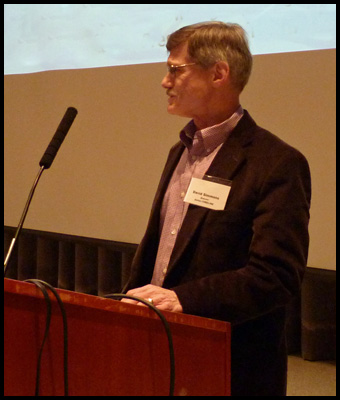
| Robert J. Connor, Associate Prof. of Civil Engineering, Director S-BRITE Center |
|
|
|
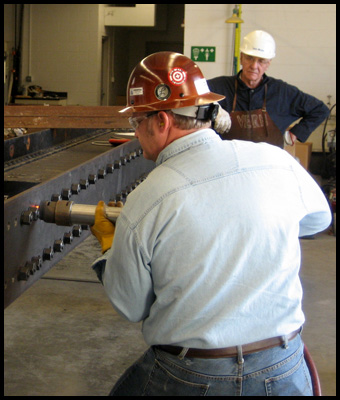
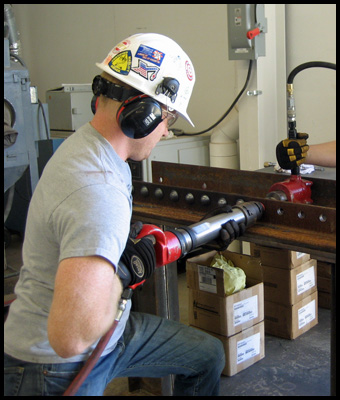
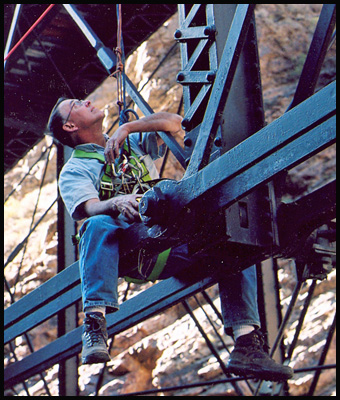
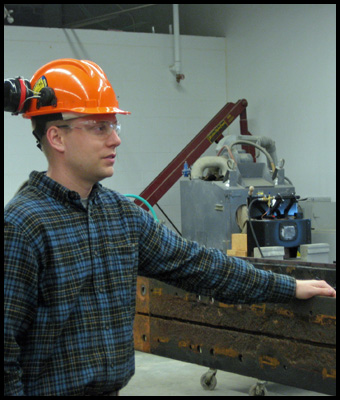
| Dr. Connor drives a rivet with a #80 field riveting hammer |
|
|
|
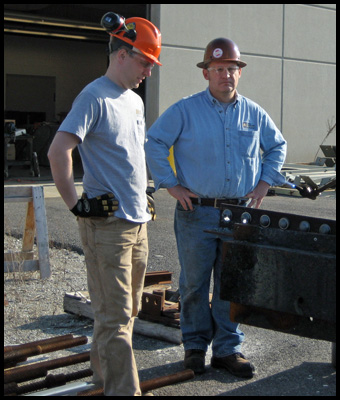
| Ryan Sherman and Dr. Connor |
|
|
|
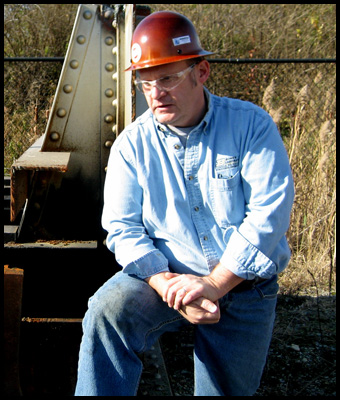
| Jason B. Lloyd, P.E. Research Engineer, S-BRITE Center, Bowen Lab, Purdue University |
|
|
|
| Karl H. Frank, PE, PhD Chief Engineer, Hirschfeld Industries |
|
|
|
|
Matthew Hebdon, PhD, PE
Assistant Professor
Department of Civil & Environmental Engineering
Virginia Tech
|
|
|
|
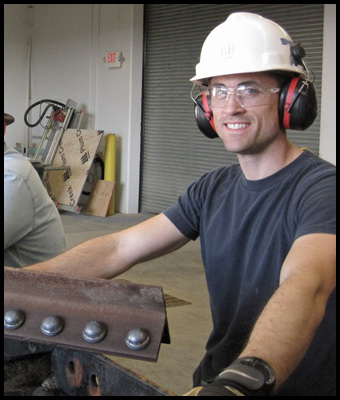
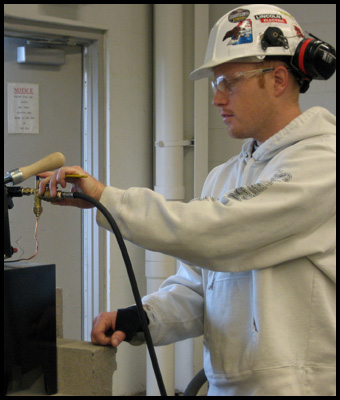
| Hebdon adjusts propane forge for heating rivets. |
|
|
|
| Quentin Collette, PhD, in Vienna, Austria. |
|
|
|
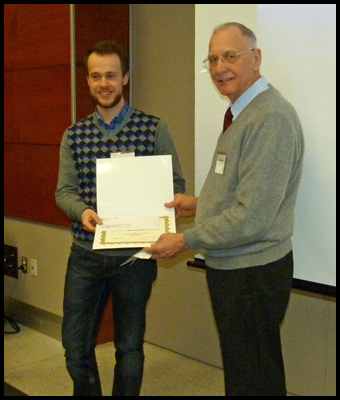
| Quentin Collette receives a 2013 ISPC Program Fund Scholarship |
|
|
|
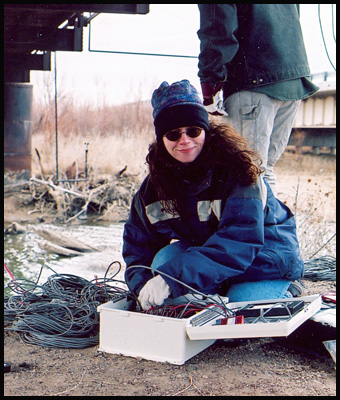
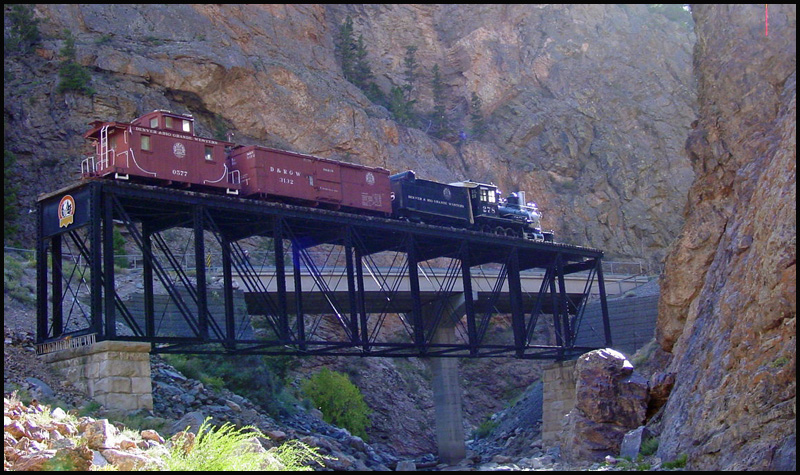
| Student from UC Denver works as data logger for instrumentation for the 1902 Prowers truss bridge. |
|
|
|
| Rutz drives a rivet during the 2013 Iron & Steel Preservation Conference |
|
|
|
| Ryan J. Sherman, PhD Candidate, Purdue University |
|
|
|
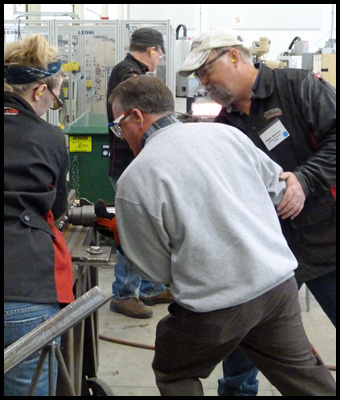
| Ryan Sherman rivet training |
|
|
|
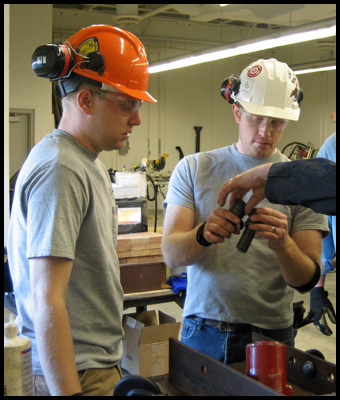
| Ryan Sherman and Matt Hebdon inspect rivets |
|
|
 |
|
Greetings,
This issue of the newsletter is devoted to details about speakers for the 2016 ISP Conference & Workshop, a partnership between Purdue University and Lansing Community College. In addition to the presentations listed below, the Conference includes practical demonstrations on a variety of metal repair and preservation methods, and the Workshop provides hands-on experience in these methods (see October ISP Newsletter for details by clicking link at bottom of this page).
Vern Mesler
Iron & Steel Preservation Coordinator
Lansing Community College
May 2016 Iron & Steel Preservation
Conference & Workshop at Purdue University
Conference: May 18th & 19th $375.00
Workshop: May 20th $175.00
Space is limited. Register early.
Contact Vern Mesler at
meslerv@gmail.com
or 517-614-9868 with any questions about the conference; contact LCC's Business & Community Institute at 517-483-9853 if you need help with the registration process.
|
Robert J. Connor, Associate Prof. of Civil Engineering, Director S-BRITE Center,
Purdue University, Indiana
|
|
Revisiting the Concept of Fracture Critical for the 21st Century
The concepts associated with the term "Fracture Critical" that are in place today were developed in the mid-1970s when shop fabrication & inspection, fatigue design, detailing practices, material toughness, and analytical tools were much different. All of these have evolved and improved substantially over the past 30 to 40 years. Nevertheless, concerns remain regarding the performance of bridges classified as FC should one of the two primary load carrying members completely fracture. Today, experiences suggest that the simple classification approaches used to identify a member as FC may be overly conservative and lack rational justification. This presentation will report on recent and ongoing research into the system performance of bridges and the internal redundancy of built-up members being examined to more rationally invoke the concept of a FCM and set the stage for the remaining presentations for the day.
|
|
|
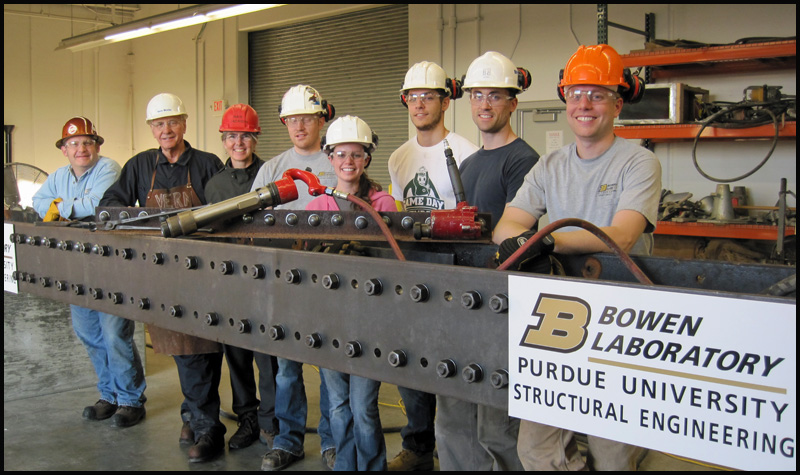
Participants at the 2012 field rivet training at Purdue University
Left to right: Robert Connor, Vern Mesler, Nan Jackson, Matt Hebdon, Teresa Washeleski, Luke Snyder, Jason Lloyd, and Ryan Sherman
|
|
Karl H. Frank, PE, PhD
Chief Engineer, Hirschfeld Industries, Texas
|
The Development of the AASHTO/AWS Fracture Control Plan and How it Relates to Historic Bridges
The present AASHTO/AWS Fracture Control Plan (FCP) was developed in response to failures (i.e., brittle fractures) in nonredundant tension members that occurred in the 1970s. Prior to the FCP, the design of tension members was based solely upon prevention of yielding; there were minimal requirements on steel toughness (i.e., no Charpy V Notch toughness requirements), limited guidance on fatigue design, and less stringent fabrication and shop inspection requirements. In fact, there was no AWS bridge welding code in existence. However, the FCP was primarily developed with welded structures in mind. This presentation will describe the development of the FCP in the context of welded structures and also provide insight and perspective into how it may be rationally applied to structures fabricated using historic materials and built-up construction.
|
Matthew H. Hebdon, Assistant Professor of Civil & Environmental Engineering, Virginia Tech
|
Understanding Resilience and Remaining Capacity of Riveted Girders
Riveted built-up members were used extensively in the construction of the transportation infrastructure up until the early 1960s. However, as steel structures in the U.S. transportation infrastructure age, the ability to conservatively extend the functional life of historical bridge structures is becoming more of a concern. The fracture resilience of built-up steel members was investigated to better understand the way that total member collapse is prevented through the use of multiple components mechanically fastened together. In addition, members with partially failed cross-sections were cyclically loaded to determine their fatigue life after a component failure. Both historical and newly constructed specimens were tested. Pneumatically hot-driven rivets were used in the fabrication of the test specimens to replicate conditions expected in historical riveted bridge members.
|
|
Quentin Collette, PE, PhD
Project Engineer, Sparks Engineering, Texas
|
Riveted connections in historical metal structures (1840-1940)
Waiting for a train at London St Pancras railway station or reading a book on the Berlin underground are simple everyday actions. Conversely, preserving the service life of such historical metal structures enabling those routine actions is a challenge. The overall safety and stability of historical iron and steel structures and, more in particular, the state of their connections, are of concern to engineers, architects and heritage care specialists. Rivets were the primary fastener used to fabricate these connections through a technique called hot riveting. Although well developed in the nineteenth century, hot riveting fell into disuse when the welding technique was invented. Nowadays, the appraisal of riveted connections raises numerous theoretical and practical issues that remain to be solved. Therefore, we reviewed international historical literature and carried out experiments. This study unravels the development, technology and design of historical riveted connections between 1840s and 1940s.
Major evolutions occurred at the turn of the 20th century. The material iron was replaced by steel, rivets were not installed by hand anymore but with machines, and the design of riveted connections relied on a scientific approach. The appraisal of riveted structures of that period thus calls for additional care. The knowledge of past techniques and design methods can help engineers apprehend the assessment of riveted connections with more confidence. The study supports decision-makers and workmen for inspection, structural assessment and intervention purposes. We should strive to preserve both the service life and the heritage value of historical metal structures belonging to the city's landscape for the decades and hopefully centuries to come.
|
Frederick R. Rutz, PE, SE, PhD
University of Colorado, Denver
|
Structural Response of Truss Bridges to Wind
Historic truss bridges possess greater resistance to lateral loads than conventional structural analysis suggests. Fred Rutz will speak on research conducted at the University of Colorado, Denver, wherein conventional structural analysis was compared to a more comprehensive analytical methodology, leading to a conclusion of greater lateral strength. Further, he will report on full-scale experiments at historic pin-connected truss bridges that validate the analytical methodology.
|
Ryan J. Sherman, PhD Candidate, Purdue University
|
The Correlation of Rivet Strength with Hardness Measurements
The strength of rivets in older bridges is often unknown. Some have relied upon field hardness measurements of the head in order to estimate the ultimate strength of the entire fastener. However, questions exist as to the effect of driving on the local hardness measurement and how it relates to the strength in the shank of the rivet. Further, no data existed regarding differences between measurements made on the button head and the driven or formed head as related to the actual rivet strength. This presentation will present the results of a study which examined the use of hardness measurements for estimating rivet strength. Laboratory hardness tests were performed on both undriven and driven modern rivets as well as rivets extracted from existing bridges. Measurements were made on the heads, shank, and within the cross-section of the rivets. The variability associated with the measurements will be presented along with recommendations as to the appropriateness of using field hardness measurements to estimate rivet strength.
|
|
Dan McCain, President of the Carroll County
Wabash & Erie Canal Association, Delphi, Indiana
|
"Volunteers Make a Difference"
Eighty miles northwest of Indianapolis is the city of Delphi, Indiana, the county seat of Carroll County with a population of around 4000. In 1971, a small group of people banded together to create the Wabash & Erie Canal Park Association and to convert a three mile manmade section of the original Wabash & Erie Canal into historic landmark. Under the leadership of Dan McCain, with his talent for recruiting dedicated volunteers, the Wabash & Erie Canal Park has grown into an exceptional resource for education and history. The Park features several historic truss bridges restored by hard working volunteers, as well as a working canal boat and an interpretive museum. Dan McCain is the featured luncheon speaker for the 2016 Iron & Steel Preservation Conference.

|
Dan McCain,
|
|
| Past Iron & Steel Preservation Newsletters |
|
|