|
|
BUSINESS TRANSITION & VALUATION REVIEW
|
|
November 7, 2017
Next Issue: Tuesday, November 21
|
|
|
|
|
|
|
|
|
 |
|
Street-Smarts, Common Sense and Entitlement!
&
eight news commentaries relevant to transition and valuation.
|
|
Family Business: Street Smarts, Common Sense and Entitlement!
Ian R. Campbell, Business Transition Counsel Inc.
|
|
|
|
Synopsis
This commentary discusses the importance of street smarts (or street-smarts), common sense and entitlement in the context of family business.
Based on internet searches, literature dealing with these three things in the context of family business seems non-existent - and long overdue.
This commentary begins with the best piece of generational business transition advice I have ever received.
The best generational business transition advice I have ever received
I do know unequivocally what was the best business transition advice I ever received. It was said to me by the best hands-on in-house generational transition advisor I have had the opportunity to work with. That advice was:
"When planning for family business generational transition identify every conceivable problem that might arise. Do that early and ongoing. Don't wait until one or more of those problems bites you in the wrong place, leaving you to conclude that you and others have spent ten or more years in what turns out to be frustrating generational transition failure."
What is meant by the terms 'street smarts' and 'common sense'
Street smarts
A typical dictionary definition of street smarts is along the lines of 'the experience and knowledge necessary to deal with the potential difficulties or dangers of life in an urban environment'. I think a better and more germane definition .....
|
|
Topic Request
Want commentary on a specific business transition or valuation topic?
Write to me at
icampbell@ircpost.com
. I will write a newsletter commentary that deals with your suggested topic, or find someone better equipped than me to write it.
|
Forward to a friend or colleague!
|
News Curation
Ian R. Campbell, Business Transition Counsel Inc.
In the past two weeks the following articles relevant to Business Transition and Valuation have been selected from a population of approximately 5,000 articles.
Selected article headines, links and curation comments are organized under the following headings:
Business Transition News, Business Valuation News, Technology News, Economic News, and Financial Markets News.
|

Business Transition News
Comment: This October headline begs a conversation with business owners who buy and sell in foreign currencies as to how well they hedge outstanding net foreign currency balances. This is a topic that bears directly both on the valuation of their business and its ultimate transition.
Here are four questions you ought to ask yourself if you are a business owner, and ought to ask your business owner clients if you are an advisor to them and don't already know the answers.
1. What percentage of your company's current total annual revenues are accounted for by exported goods and services?
2. What percentage of your company's current total product and services input costs are accounted for by imported goods and services?
3. What percentage of your company's aggregate net foreign exchange exposure is hedged effectively at any given point in time?
4. Do current and prospective international trade agreements, disagreements, and government trade policies currently lead you to be more inclined to sell your company or one or more of its business units to an arm's length purchaser than you have been in the past?
Most businesses are not in the business of speculating in currencies. In our current economic and business environment business owners and their advisors will do well to focus on that.
Oh Canada: What if Amazon picks an international location for HQ2. Reading time 3 minutes.
Fox Business, October 30, 2017.
Comment: Among other things, this article reports on two KPMG reports. The first is KPMG's Competitive Alternatives 2016 report. The second is a KPMG report titled Focus on Tax. The article does not link to either report.
The article says that "In KPMG's comparison of total tax costs, including corporate income taxes, capital taxes, sales taxes, property taxes, miscellaneous local business taxes, and statutory labor costs in 10 countries, Canada ranked first, Mexico was fourth, and the U.S. was seventh." This where ranking first, based on the rest of the article, must mean 'lowest total tax costs'.
Quoting a KPMG partner, the article goes on to say "The U.S. has the highest corporate income tax rate in the world, at 35%. And, if you add onto that state and local taxes, this is a real competitive disadvantage when it comes to global site searches." Further, a partner at BDO Canada is quoted as saying Canada's corporate tax system is "much better" that the U.S. tax system.
This information is interesting, and can be assumed to be credible given its source. Canadian business owners and their advisors need to carefully consider what this information may portend where:
1. in the U.S President Trump is voraciously pushing tax reform.
2. the U.S. continues to run significant annual federal government deficits - with a reported cumulative deficit of over U.S.$20 trillion (with a 't') before accounting for very significant unfunded liabilities.
3. Canada ran a federal deficit of Cdn$17.8 billion in its fiscal year ended March 31, 2017 - see
Canada beats deficit forecast by $5.3 billion on lower spending. Financial Post, September 19, 2017.
4. Canada currently is forecast to run a federal deficit of Cdn$19.9 billion in its fiscal year ended March 31, 2018 - see
Federal economic outlook improves, deficit projected at $19.9 in 2017-18. CTV News, October 24, 2017.
5. Canada's current federal deficit, before any unfunded liabilities is almost Cdn$650 billion (with a 'b') - see
Canada's National Debt Clock.
Canada's federal government, like most governments worldwide continues to pile up debt. One might think that at some point businesses and wealthy individuals will see an increase in direct and indirect taxation in Canada and elsewhere. Canada recently has had a taste of that in federal draft legislation published earlier this year. While the Canadian federal government now seems to be backing away from many of the proposals included therein, I suggest business owners should not become complacent and think 'the battle over corporate and wealth taxes is won in Canada'.
My recurring advice to business owners is this. 'You typically in your business strategizing and transition look to play the 'long game'. That is, you expect to own and operate your business in the long term. If you are playing the 'long game' work hard to continually strengthen the balance sheet of your business.
Warren Buffet has a simple explanation for how he invests - and it's easy to replicate (MOAT). Reading time 4 minutes.
Business Insider, October 25, 2017.
Comment: Successful generational business transition is a form of long-term investment. Not everyone thinks or discusses it that way. They should.
A moat is a deep, wide defensive ditch, typically filled with water. Historically moats were built around castles, forts, or towns. In 1999 Warren Buffett spoke about "economic moats" in the context of successful investing. He said "the key to investing is ... determining the competitive advantage of any given company and, above all, the durability of that advantage".
For me, that short quote is akin to my generational business transition focus on long-term economic viability. For a business to be viable in the long-term as a going concern it needs to either have a meaningful economic moat around it, or develop such an economic moat over time.
A castle surrounded by a moat is a good image for business owners and their advisors to keep in mind as they plan for both business sale and generational transition before finally deciding which is the best road for the owners of any particular business to take.
Comment: Statistics lend themselves to differing interpretations. This article has a "neat" chart that shows in an easy to understand they 2016 NAFTA trade between Canada, Mexico and the U.S. It also shows each country's trade with "rest of the world".
Assuming the numbers show on the chart are correct, in 2016:
1. 43% of Canada's total exports went to the U.S., where Canada's trade with the U.S. and its trade with "the rest of the world" each were quite closely balanced as between imports and exports.
2. 45% of Mexico's total exports went to the U.S., where Mexico's trade with the "the rest of the world" was quite closely balanced between imports and exports - but where Mexico's exports to the U.S. was over 30% higher than its imports from the U.S.
3. trade between Canada and Mexico is negligible.
4. 14% of U.S. exports go to Canada, 12% of U.S. exports go to Mexico, and 74% of U.S. exports go to "the rest of the world".
5. 10% of U.S. imports come from Canada, 11% of U.S. imports come from Mexico, and 79% of U.S. imports come from "the rest of the world".
With respect to the NAFTA negotiations the article claims:
1. Mexico is vulnerable if the U.S. decided to restrict trade or impose tariffs on agriculture, automobiles, gasoline and steel.
2. Canada's major vulnerability is oil. In this regard in 2016 Canada supplied 38% of U.S. gross oil imports. See
U.S. Energy Information Administration, Frequently Asked Questions. Presumably geographic proximity and the fact the oil is a world commodity protect Canadian pricing.
3. From a U.S. perspective:
* Arizona, California, Mew Mexico and Texas, said to account for about 25% of U.S. GDP as said to "rely heavily on trade with Mexico".
* Mexico is a "top three" export destination for 33 U.S. states.
* Canada is "the main export destination" for 35 states.
To some degree is seems Canada, Mexico and the U.S. are participants in not a three-legged economic race, but rather a four-legged economic race where the self-appointed race referee end up harming not only his own racer's racing partners, but his own racer.
Interestingly, at least one article reports that "Happily for Canada, the cancellation of NAFTA would resurrect the pre-existing free-trade agreement (FTA) between Canada and the United States." Should that result presumably there is no assurance the U.S. would not then turn its eye to the terms of the FTA. See
What would Canada-U.S. trade relations look like without NAFTA?
|
|
Business Valuation News
No business valuation news articles are included in this issue of the Business Transition and Valuation Review.
|
|
Technology News
Comment: Readers will be aware of the debate among economists as to whether technology advances will result in net unemployment, particularly in developed economies. This where economists broadly agree that many existing jobs will be replaced by technology, but where there is disagreement as to whether new, currently non-existent, jobs will be created to replace those jobs lost and perhaps create net employment.
The referenced article addresses this issue, and finds in favor of technological advances over time resulting in net unemployment.
This question is a big deal that needs to be resolved earlier and later. This is because if the author of this article is correct, all businesses will be impacted as non-controllable external costs rise and consumer spending almost certainly is likely to be negatively impacted.
|
Economic News
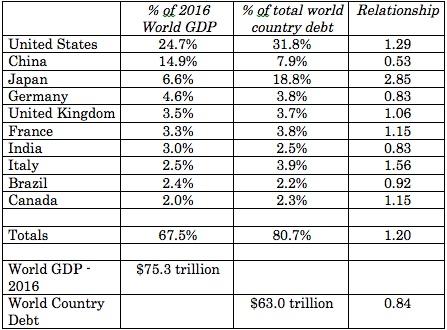
Comment: The ten largest countries in the world measured by comparative 2016 nominal (inflation included) gross domestic product (GDP) are listed in the following table. The table shows the % of world GDP generated by each of those countries, and the % of what the referenced infographic says is the of total world country debt for each. The infographic has a neat chart that shows the % of country debt for over 60 countries (GDP source: Wikipedia).
Assuming all country debt is included in the infographic consistent with that shown for the U.S. does not include federal government unfunded pension and social benefits liabilities. In the case of the U.S. those are consistently said to exceed recorded federal debt.
If one believes that eventually debt, like pigeons, comes home to roost the world's largest economy - irrespective of its currency currently being the world reserve currency - is in 2nd to last place in the country debt/country nominal GDP ratio when compared with the other nine largest world economies.
Comment: This article reports, in each case based on a survey of about 60 economists that:
1. 65% of them agree (about 57%) or strongly agree (about 8%) the world economy faces heightened risk from an excess of public and private debt and/or inflated asset prices. Another 15% said they neither agreed or disagreed. About 17% said they disagreed, and about 3% said they had no opinion.
2. percentages were broadly similar to a second question that asked if "the loose monetary policy of major central banks is responsible for the recent increase in global leverage or asset values".
One might wonder how - other than relying on debt/GDP or other ratios those economists teach or were taught in university economics classes - any of them can fail to equate ongoing rising debt with rising risk. Further, the survey failed to ask respondents to quantify "heightened risk". Without quantification and speaking generally of something that seems obvious isn't "fake news", it just isn't "useful" or "meaningful" news.
Consider whether it would be terrible idea to institute a rule that in order to hold oneself out to be an economist a person had to work in a middle or senior management position in a mid- to large sized privately-held company for a period of three years and then successfully pass a business school type test.
|
|
Financial Markets News
Comment: Do you hold financial equity market investments that are significant to you? If so, you might want to read this article and discuss its contents with your financial advisor. The article appears to be written in the context of the U.S. equity markets, and I have assumed that when writing the following paragraph.
The article's messaging is that the equity markets now have a "cash problem". Among other things, the article includes a chart dating back to December 2008 that shows (presumably U.S.) institutional investor cash holdings then being 8.5%, averaging about 5% over the period to June 2017, being at an eight year high of 7.5% in September 2016, and falling to an eight year low of just over 2% in June 2017.
|
|
Newsletter Contributors
Ian R. Campbell is the principal contributor to this Newsletter. He has given business valuation and transition advice to both public and private company owners for over 40 years. Other contributors are experts in business transition or specific disciplines relevant to business transition and valuation. They take part in Q&A sessions posted on BusinessTransitionSimplified.com.
|
|
Newsletter content ('Content') does not constitute individualized business transition, valuation, economic or investment advice. The ideas, views and opinions expressed in the Content are solely those of the authors/contributors. Provided 'as is', Content may change without prior notice, may be incomplete, inexact, incorrect or jurisdictionally specific. It is used at the reader's own risk.
|
|
|
|
|
Copyright © 2017 Transitus Publishing Inc. All Rights Reserved.
|
|
|
|