|
Before we examine the auction and play, let’s have a look at the results at other tables.
The Deal in the Field
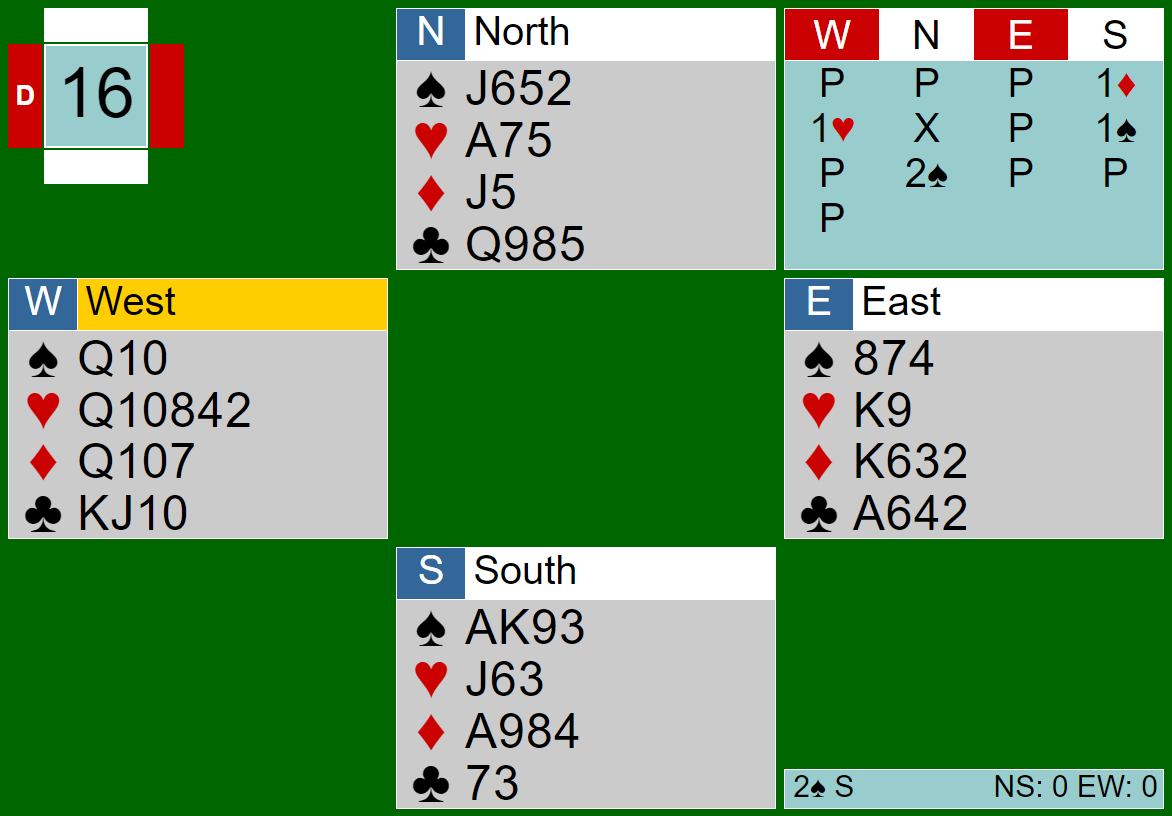
At six of seven tables, including our own, N/S landed in 2♠, all but one declared in the North. And at all but one, that contract was set by one or two tricks. One N/S pair played in 1NT by North, taking seven tricks for +90. Our N/S pair was the only one to declare in the South, and the only one to make 2♠.
The Auction
We suppose that every South opened 1♦ after hearing three consecutive passes. With silent opponents, North would have responded 1♠ and declared in 2♠ after a raise by South, and that is what appears to have happened at five of seven tables. One West likely overcalled 1♥, with North responding 1NT and the auction ending there. At our table, West did overcall 1♥, and North made a negative double, since bidding 1♠ would have showed a 5–card suit. South rebid 1♠, North raised to 2♠, and that was that. With a minimum responding hand, North might have passed 1♠ since South had not shown any extras. Perhaps she raised to make it harder for E/W to re–enter the auction?
Incidentally, your author would have been reluctant to overcall 1♥ holding West’s motley collection, especially red vs. white. The hand is balanced and the texture is horrible. On the other hand, the modern matchpoint game is highly aggressive, and there surely are some who would have overcalled as a matter of course.
The Play
West led a fourth–best heart, and declarer paused to assess his options. The loss of two hearts, a diamond, and two clubs seemed unavoidable, so how to avoid a spade loser as well? There are two plausible lines of play, both relying on a 3–2 trump split (occurring 68% of the time):
1) Push the ♠J through East, hoping to find Q 10 x there. Assuming East covers with the queen, win and try to return to dummy with a diamond ruff to lead a second spade toward the tenace in the closed hand, picking up the suit.
2) Cash the ♠AK and hope to drop the doubleton queen.
Let us “count the ways” to determine the probabilities of success.
1) East will hold three trumps 50% of the time, reducing our starting 68% to 34%. The queen will lie there 60% of the time (three places to put it vs. two in the West), so we are now down to 20.4%. The 10 will lie with the queen half of the time (two places remaining to put it either East or West), so the final probability of success is just 10.2%.
2) Similarly, beginning with the 68% 3–2 split, it doesn’t matter which opponent holds two, and the queen will lie doubleton 40% of that fraction for a whopping 27.2% chance of success.
Of course, very few of us, if any, could accomplish this calculation on the fly at the table. But surely it is useful to know that given a 3–2 split, the doubleton queen will fall somewhat less than 30% of the time, and that finding Q 10 x in a specific hand occurs only one time in ten. These statistics have at least some prospect of being recalled if needed again.
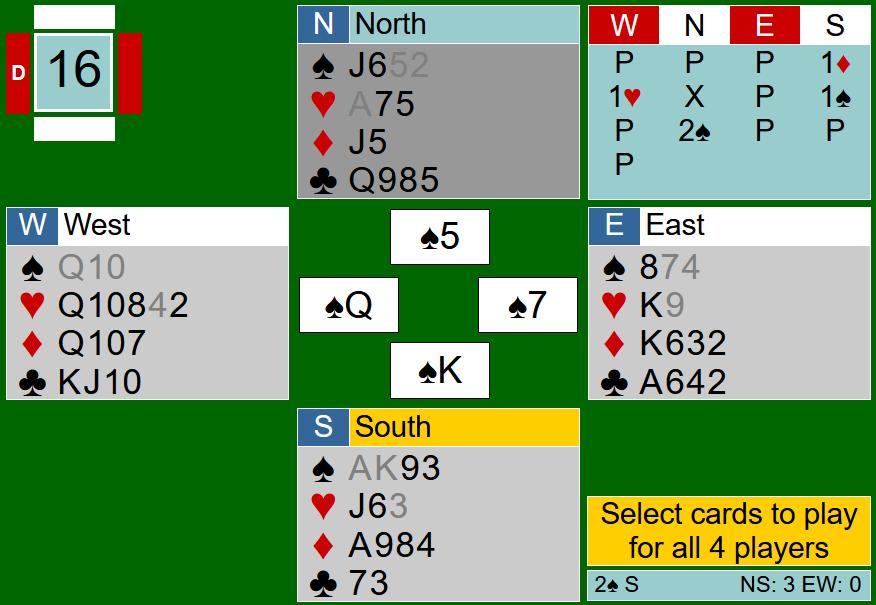
Declarer won the opening lead in dummy and banged down the ♠AK, dropping the queen. But hold on there – there is more work to do to bring the contract home. We are taught to count losers at suit contracts, but we should also count winners! Three rounds of spades, two red aces, and two trumps scored separately comes only to seven tricks. Dear Reader, can you find the winning line of play? This is the position:
|