March 2024

Dear friends,


My hope is to complete our Christopherus seventh grade curriculum this summer. Parents who are completing sixth grade this year are encouraged to enroll in our Take Hold grades webinars for seventh gradedetails here. 


New seventh grade history workbook


I thought you all might enjoy an excerpt from our seventh grade history workbook which I am currently completing. Like earth science (sixth grade) and astronomy (seventh/eighth grade), it is a hybrid workbook/text/main lesson book. There are sections I have written; assignments; and instruction on how to work with other texts. There are also audio recordings of me talking about the travels of Magellan; the French Revolution and Toussaint L’Overture; Leonardo Da Vinci; life during the industrial revolution; and much more. The period covered is about 15th through the first part of the 19th centuries.

It is important that when looking at the history of the Age of Exploration, a child nerver gets the idea that ‘there was nothing there’ before the Europeans arrived. This year’s geography focus is on sub-Saharan Africa, Asia and South America. This is the time for the student to find out a bit about the land, animals and peoples of those areas. Then during the history main lessons, she learns about the relationship between explorers—which include Muslim explorers as well as Chinese explorers—and those parts of the world.


Here is a short excerpt from the section on India with the blank pages for the student work left out. As with our other Workbooks, I speak directly to the student:


Your study of India during the period we are covering in this history main lesson will mainly be based on your readings from the book A Children’s History of India by Subhadra Sen Gupta. This book is rather long so please focus on the sections you need to read so you can complete your assignments. Of course, if you wish to read further---assuming you have the time---then why not? It could be best, though, to leave the last chapters for next year when we cover modern history.


Please read chapter five, Enter the Mughals.


Once you have read that, write two or three paragraphs about Babur. Think carefully before you start---what information do you need for a summary and what do you need to leave out? You might need to write this several times before you get it right. And once you have talked this through with your Teacher and the piece is mistake-free, copy it here.


Then read chapter six, Akbar Builds an Empire.


Copy the portrait of Akbar on page 187 here. Make sure you label it.


Now write out a list of 10 important things that Akbar did. Do this on scrap paper. Look at your list---is everything on it actually important? Are there any things listed which should be skipped? Dd you get to all the important points? Look this over with your Teacher and be prepared to tell her why you chose the points you did and what you thought was not so important. Once the list is all shipshape, copy it here.


Read chapter nine, Living in Mughal Times.


You will see that there are a number of subheadings in this chapter ( ‘Women’, ‘City and Village’, ‘Music’ and so on). For each of these sections decide what are the most important points covered. Copy the section heading here and then EITHER copy the most important paragraph for that section under the section heading OR make notes of the important points. Do this for each section: title, notes or paragraph for each. Think carefully before you write so you don’t run out of space.


And here is an excerpt from the section on art in Renaissance Europe. As above, it is condensed and the blank pages for the student’s work don’t appear here! As before, I am speaking to the student directly


In addition to portraits and religious themes, artists in Europe also portrayed everyday life. We can learn as much about how people lived by looking carefully at paintings of this time as by reading what people wrote.


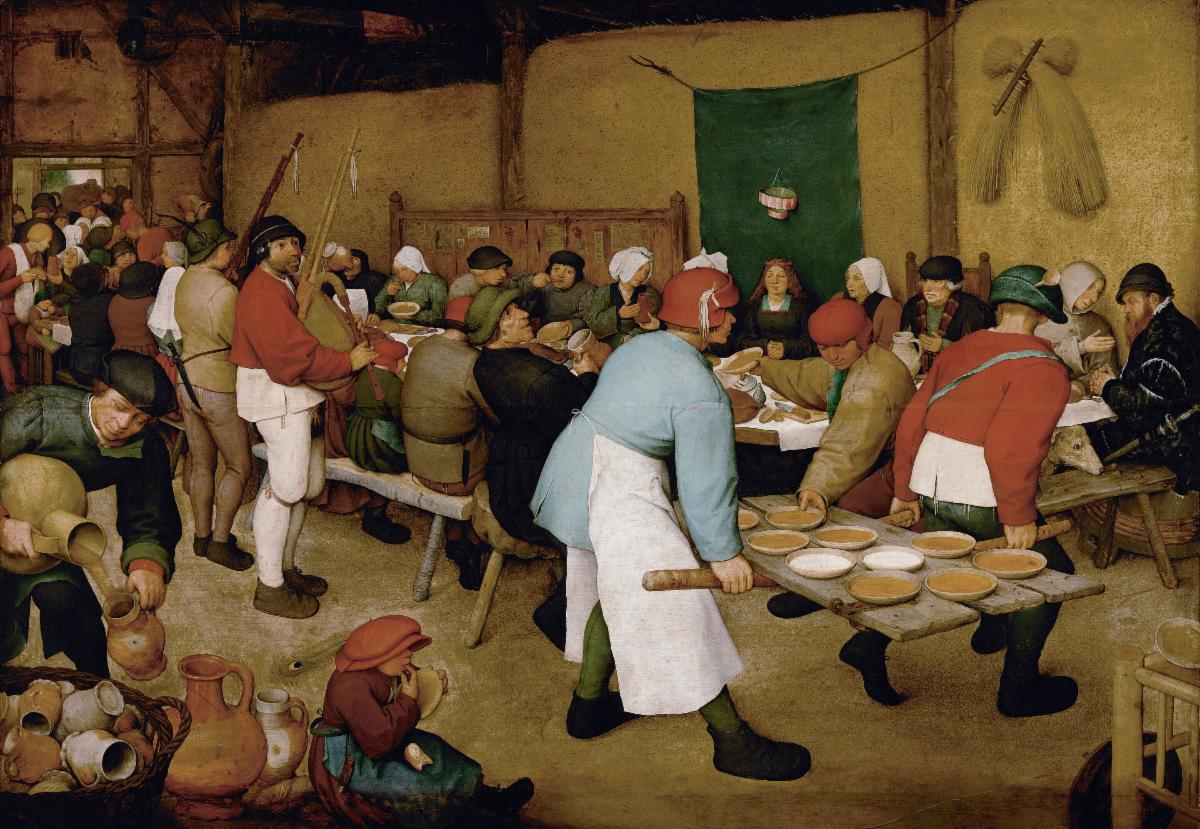
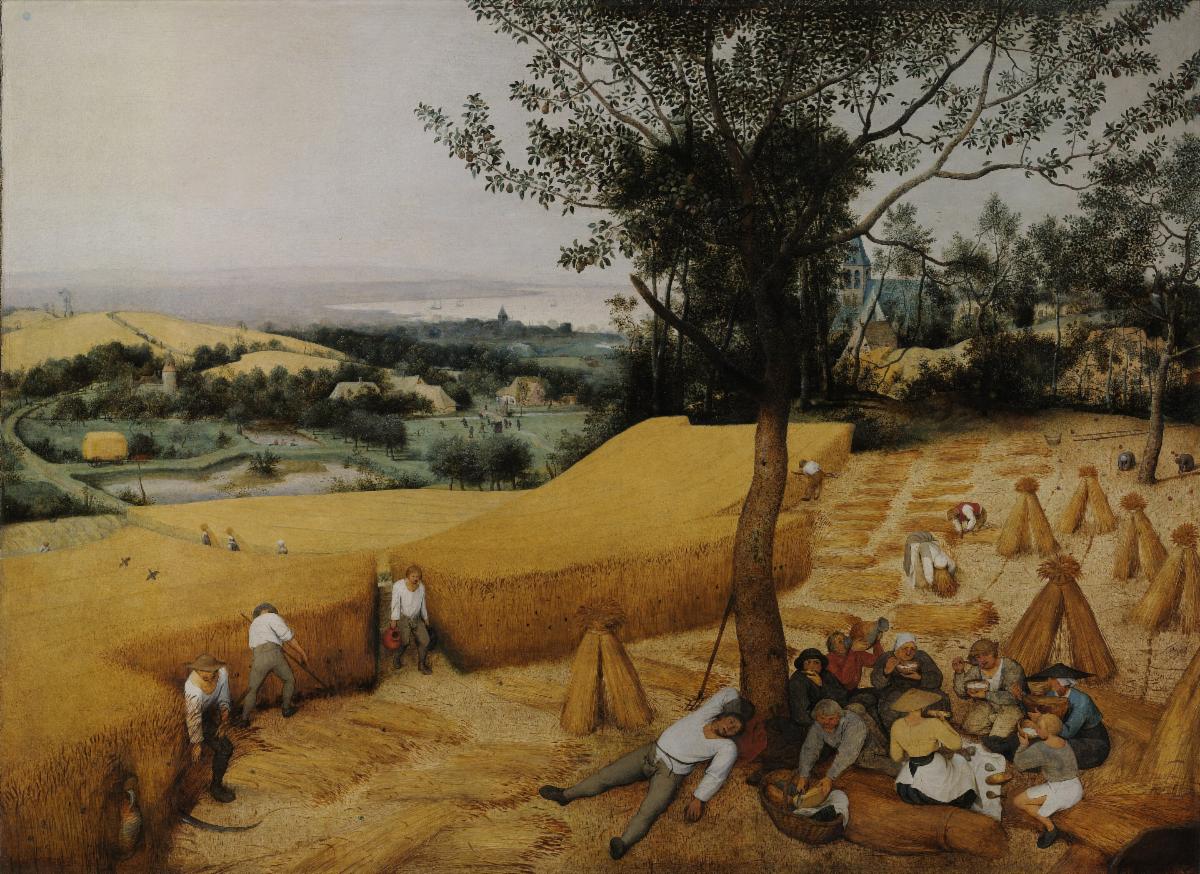
Pieter Breugal the Elder, in the middle of the 16th Century, painted many depictions of everyday life of the people around him. Two of his most famous paintings are Peasant Wedding and The Harvesters.


Spend some time looking carefully at these pictures. Let’s look at Peasant Wedding first.

Here we have a merry scene of people all dressed up in their best clothes crowded into a barn---can you see that the back wall is stacked hay? 


The people are feasting and drinking---look at the fellow carefully pouring out the drink (probably beer) and the two bringing in the huge tray of….bowls of something. They have reached the table and the fellow there is passing the bowls on---is he being careful?!


What other food do you see?


Look at the musicians---the one holding the bagpipe looks pretty hungry---maybe he’s wondering if there will be food left over for him and the other musicians once they have finished playing.


At the right end of the table you can see a monk dressed in gray talking to a very well dressed man---his clothes are very different than those of the peasants crowded into this barn for the wedding feast. He is probably the landowner. On the other side of the monk is another well dressed man---he doesn’t look particularly at home does he? He is probably the local government official who has to witness the wedding.


Further along the table sitting in front of a dark green cloth is the bride. She is sitting quietly, with her hands folded, not eating, not drinking, and not shouting and talking with her friends and neighbors. This is how the bride was meant to conduct herself at her wedding. You can see she sits under a paper crown hung on the cloth: she is queen during this wedding meal and you could say she has a very queenly look on her face!


Who else is there? What about the little boy in the front on the right? He’s gotten hold on some of that yummy food (whatever it is) and is stuffing it down. Look at his hat---I think a friendly uncle or a big brother put his own hat onto the head of the little boy to amuse him---can you see how it is too big for him and dips over his eyes? Can you see the fine peacock feather in the hat?


Now spend some time looking at the painting The Harvesters:

Pretend you are describing this painting to someone who has never seen it. What would you say? Write your observations here:


****


And so on. I have had a lot of positive feedback about our recordings for sixth grade (and the new fifth grade will have some as well). Students also like the workbooks as I strive to make challenging, enjoyable and comprehensive texts that never patronize the children nor dumb down the material. As a companion volume to the Student Workbook is the Teacher’s Guide, in which I explain how to approach the main lessons; give teaching advice and lay-out of schedules for the lessons; and talk about the goals of this study.


Special Subject Webinars


"The opportunity to be in the same “room” as Donna and other like-minded parents has been invaluable. There are so many times I have been reading the Christopherus text when questions pop up or I want to delve further into a subject – these webinars give me the chance to ask my questions and to hear other questions that I may not have thought to ask. I also love that we are sent replays so I can reference back or catch something I missed the first time." Monica W, Texas


"Thank you so much... I have been enjoying all of the webinars so much. You totally help us as mothers to stand firm in our beliefs. I’m so proud to be learning from you!" AK


More webinars for you all! The first takes place next week, so do sign up if you are interested---it is called Home, Not School, which is one of the defining features of Christopherus, eg that we enable homeschoolers to be home-focused and to learn from child development so as not to imitate what is done in Waldorf schools. ‘Not school at home’ could be our slogan. Read more about this webinar here.

home-not-school-768x432 image

We recorded another webinar, ‘Twelve Keys’ which you can purchase now. That session was focused on 12 of the ‘secrets’ of making homeschooling work, such as havig a sense of humor, being authentic, work well done being its own reward….and more.


An important webinar was the one on death. It is called ‘Death as a Part of Life’ and is possibly one of the most important webinars I have recorded. Death touches us all and it well worth thinking about before this occurs. This webinar is also now available.


And here is the link for the April/May webinars:


Early Years conversations


The Early Years conversations are going well---we had quite a lively session focused on babies (the protective power of the Madonna Cloak, slings, warmth, breastfeeding, the family bed and so on). You can purchase it here for the special reduced price of $15.


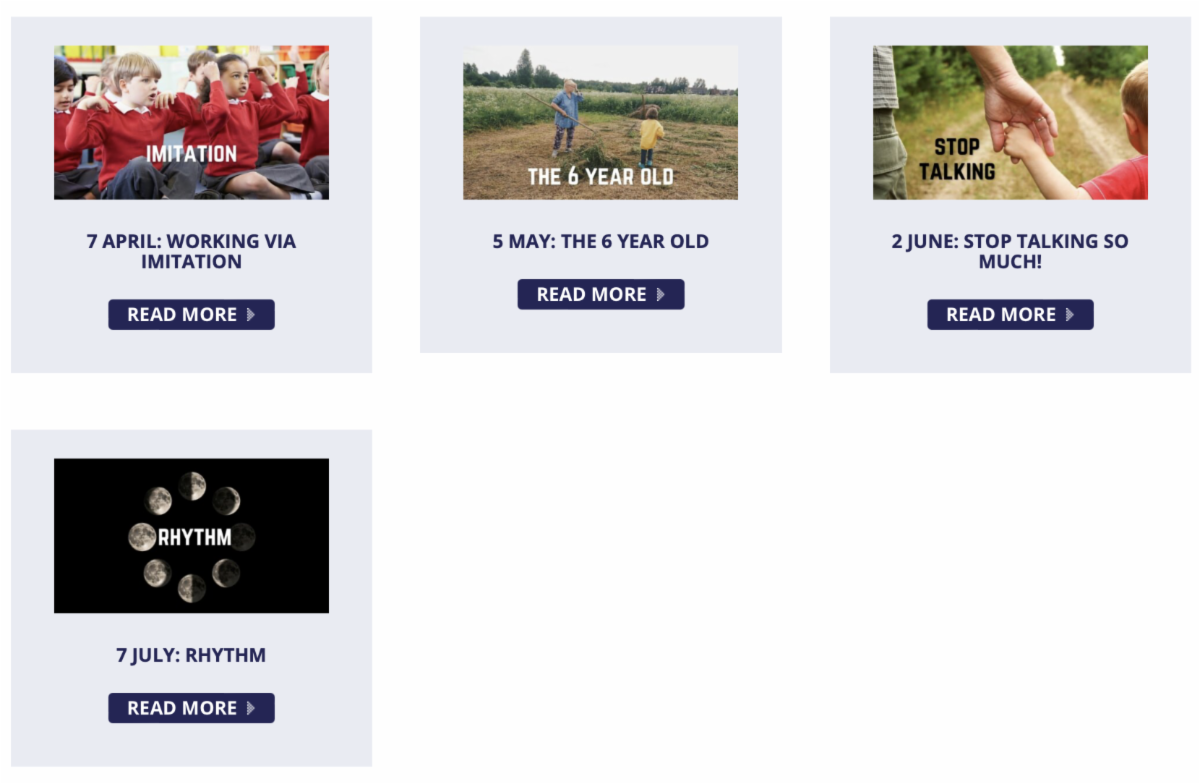
Details of upcoming Early Years conversations appear here. One of the sessions is focused on the Six Year Old kindergartner: at Christopherus, we insist that the healthiest time for children to begin first grade is when they are 7 or more than 6 ½. They should be 7 for most or all of first grade though they should not turn 8 in first grade. Here is our Age Guide where you can find out a bit more. Or attend this important conversation!

The Take Hold Grades Series


I won’t be holding any Special Subjects webinars or Early Years conversations in the summer as I will be totally focused on the Take Hold Grades webinars. There is one 3-session webinar series for each grade from first through seventh. They are intended to empower parents to really make the Christopherus curriculum their own to meet their unique circumstances. During the course of the lively and friendly sessions I will offer support, guidance, trouble-shooting and tuition for both new and experienced homeschoolers. Find out more here.


Free shipping!


Christopherus now does not charge for shipping orders in the USA. We really hope that this small gesture will help those who are struggling. Our books being printed by Lulu also means that in many parts of the world, shipping is calculated on the domestic rate as the books are printed in or near that countryagain, we hope this helps people.


We are also looking into ways of enabling those who can afford to do so to make donations which can subsidize costs for those of you who are hard up. Our software is not making this easy….more updates as we try to figure this out! I wonder if a gofundme kind of thing would work….? If anyone with an online business has built donations into their shopping carts, please contact us and tell us how you did it!


Til April!

Blessings on your homeschool journey,

Donna