Healthy Hits!

What is Health, Anyway?


This time of year, it can be hard to find time to make health a priority, especially when "health" is such a big, abstract concept. In this edition, we'll chat about some different ways of thinking about health, and how they can help us take better care of ourselves!


Friday: Finals are upon us! If you're at all like me, a good night of sleep is long overdue. How does stress impact our sleep, and vice versa? How can we sleep better, even when we're busy?

This Health Promotion and Wellness Office Newsletter is student-run and student-centered. We want you to be heard! What health-related questions do you have, and what topics do you want to read about? Click below to let us know!

Submit a Question or Topic

Ask a Pio


Unsure about Insurance?

Sorting out healthcare and appointments is hard, and, in my experience, figuring out insurance coverage can make it even harder. I feel like every appointment I make I have to re-google deductibles and in-network providers and have a mini crisis about dental insurance not being a universal thing.


That being said, there's no way to cover all the complexities of insurance and networks and plans and billing, even if that was what this edition was about. If you're looking for a good introduction that'll also make you smile (hard to do when we're talking about health insurance) check out this video:


A terrible guide to the terrible terminology of U.S. Health Insurance

For this edition, though, let's talk about L&C's student health insurance.

Unless you opted out (because you have existing insurance with "comparable" benefits (link)), you paid for student health insurance along with your tuition. Our carrier is PacificSource, and it can be used here in the Pacific Northwest and in the rest of the country. If you are seeking coverage, you should still check out these links, and contact student accounts to discuss your options!

Student Health Insurance:

  • Visit this link to read about the plan (copay, deductibles, coverage, etc.), print an ID card, create an InTouch account, and find a provider or medication. They also have info on healthcare benefits during study abroad, educational videos, FAQs, and contacts.
  • Once you create a PacificSource InTouch account through the previous link, you can use that account to see your ID card, check on claims, prior authorizations, and payment status of deductibles. You can also access CafeWell for "healthy lifestyle guidance"
  • You can get the app "Joyages" and signup using the unlock code "LCSTUDENT." The app has free mental health tools and digital therapy.
  • You can also download the myPacificSource App for 24hour nurse consulation and other account information
  • Here is another site for finding providers in Pacific Northwest or in the rest of the states (Aetna providers are eligible in the rest of the country)
  • Our plan includes some vision benefits (link), but only has routine dental benefits for folks under 19 (unless you purchase additionally). That being said, dental injury or widom tooth removal is 80% covered after you have met your deductible.
  • For college poicies and information about electing/declining coverage see this link


Student Health Center (On Campus):

  • The health center is available by appointment, and you can use it with or without school-sponsored insurance! Also, the visit itself is free! Tests or treatments provided may have an associated cost (see the SHC price list)
  • To see the hours, phone number, and afterhours resources, visit the health center home page
  • During orientation, I'm 99% sure you created an account in the health information portal, where you can complete forms for campus appointments, manage/obtain records and reciepts, and message the health and counseling centers securely.
  • Check this page for info on submitting an insurance claim from the health information portal
  • More resources on their Crisis Assistance page


Off-Campus:

Health Promo & Wellness Site

In This Edition:

  • Insurance Info
  • Defining "health"
  • Self-care and prioritizing health

Looking for a provider? Dislike phone calls? I use ZocDoc to filter providers for different appointment types, specialties, insurance networks, telemedicine / in-person format, etc. Often, you can even see availability and schedule the appointment right on the app/website! There are also reviews! Can't recommend this enough!!

Check Out Zocdoc

More Insurance + Healthcare Info:

I Emailed My Doctor 133 Times: The Crisis In the British Healthcare System

NPR Lifekit: Demystifying Your Health Insurance Plan

Top 10 health insurance myths

Guide to health care for college students

Insurance options, resources, terms, and the importance of health care!

Read More
 

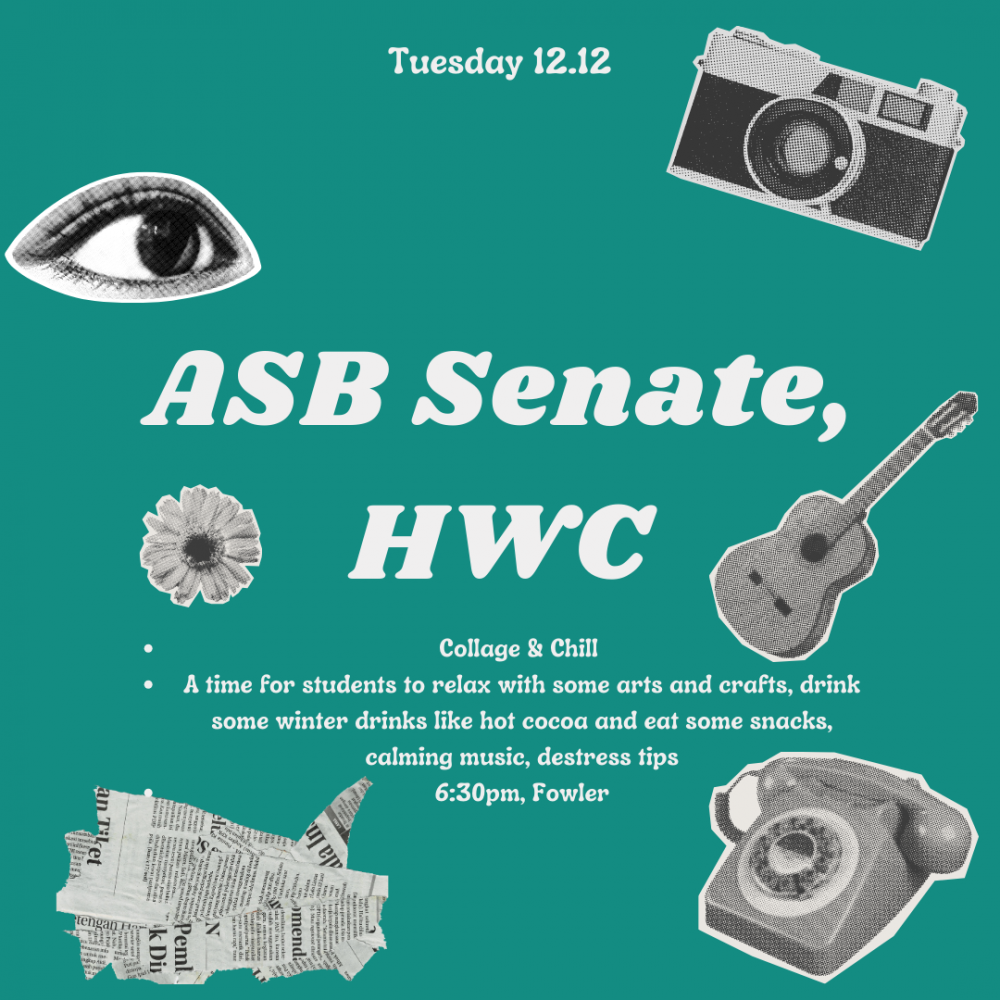
Event: Destress Fest - Collage & Chill

December 12, 6:30pm Fowler


Drop by for a relaxed collage session, and look for other Destress Fest events on the L&C calendar!

What is health? A triangle!

The World Health Organization defines health as "a state of complete physical, mental and social well-being and not merely the absence of disease or infirmity." (link) In other words, using this definition, healthy people are not sick or impaired, and they benefit from physical, mental, and social stability and function. (This differs from the "biomedical" model of health which aims for the absence of illness (usually physical)). There is also a social model which places us, as individuals, at the center of larger and larger circles, starting from our individual lifestyles all the way up to global cultural, political, and environmental factors.


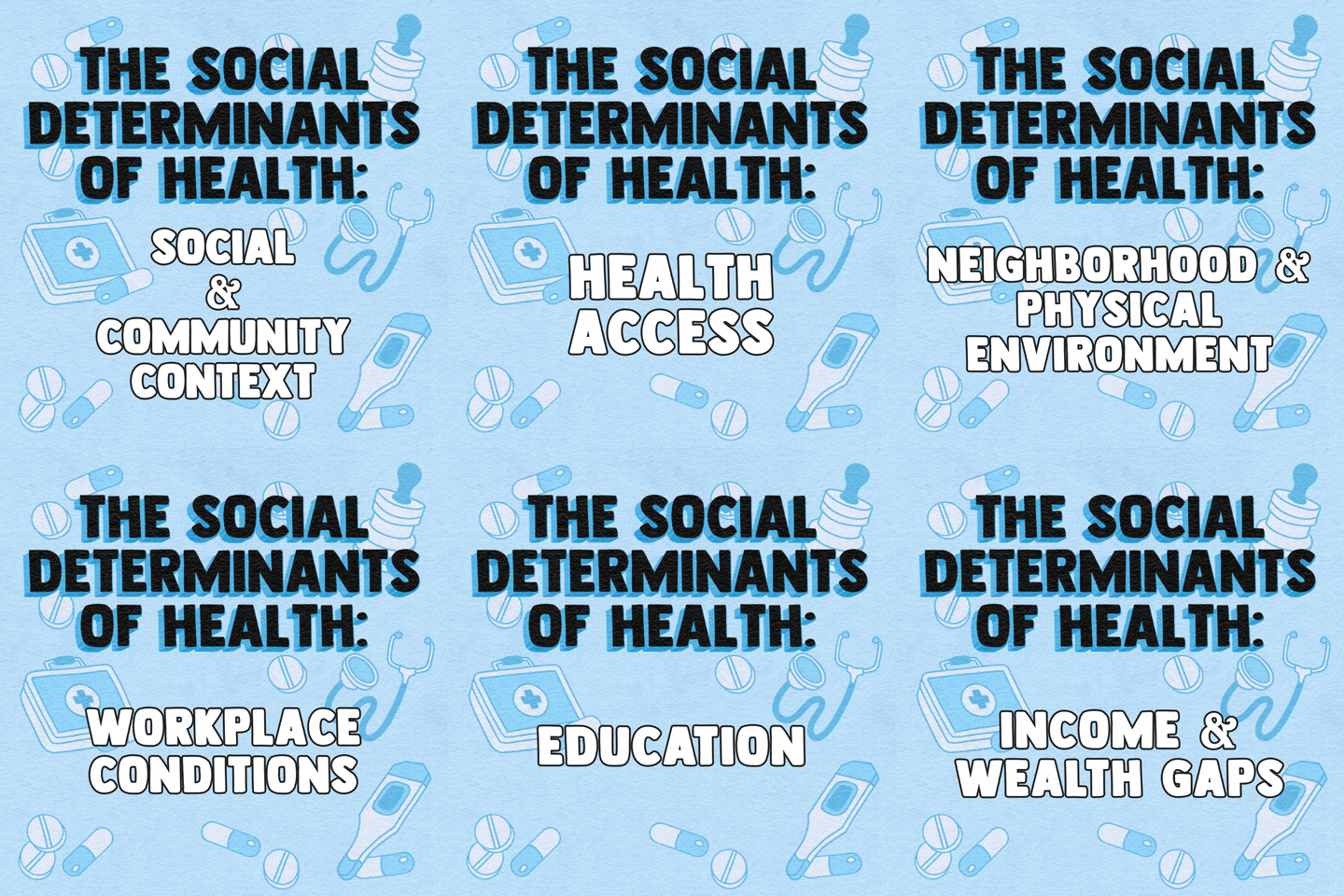
In public health classes, we use these models to try to predict, understand, and compare the health outcomes of people. As such, they're a little hard to apply to our own lives. For example, what if (like me) you have a chronic mental and/or physical condition? What if you are disabled? What if those social or financial factors keep you from accessing the resources you need to care for yourself, meaning you're never really at your best? What even is our "best"?


How do you think about health when you can't always be "healthy" (at least in the WHO's terms)?


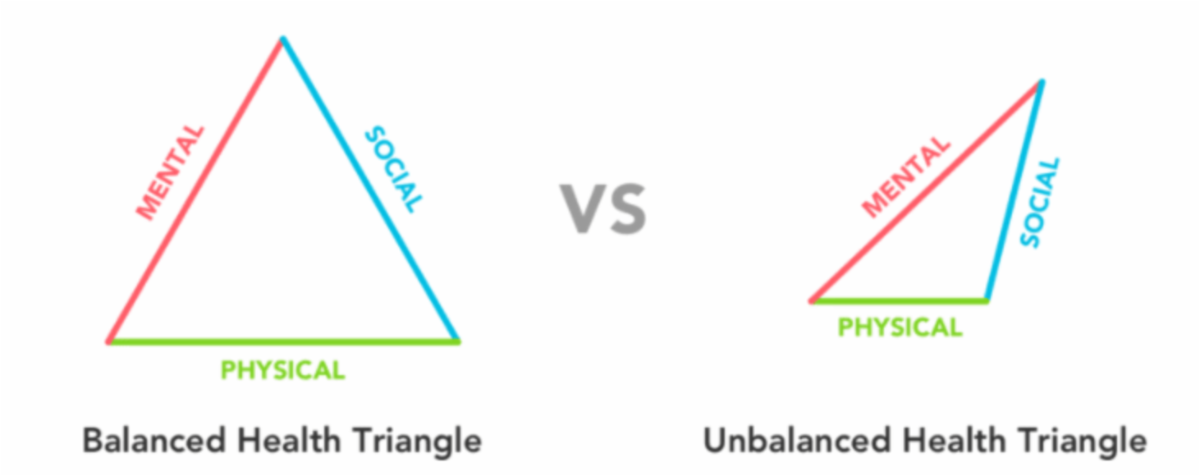
Here's where I'll bring in the triangle. The three parts of WHO's definition (physical, mental, and social) are also called the "biopsychosocial model" in public health. But, different terms can be used (e.g. emotional instead of mental) and some models include other parts (e.g. spiritual, financial, occupational, etc.)

But we can visualize the three main parts as the sides of a triangle.

The triangle is a good metaphor because if we remember one thing from that physics activity with the marshmallows and toothpicks, triangles are a strong shape! (Listen, it's been a while, just trust me on this one.) The idea, here, is that your relative "health" in each dimension works with the other dimensions. Rather than thinking in terms of healthy or unhealthy, we can think about how well each dimension is currently supporting us in our goals/needs.

  • Can I rely on my body to be able to get me between classes, see the board, digest ungodly amounts of coffee?
  • Am I connected to peer, family, professional, etc. networks that can be an ear to vent to or a resource as I study for a big exam?
  • Is my mental well-being at a place where I can weather the setbacks, criticisms, or bad news I encounter?

Importantly, each dimension is a spectrum, and they all influence eachother. You might feel like you're doing great physically, and your social connections are solid but not amazing, but mentally you are struggling. Maybe you haven't been able to sleep, or you are getting burnt out. Physical and social wellness can help hold that "side of the triangle" up to a certain extent, but they may also suffer if your mental wellbeing keeps you from taking care of your body or maintaining contact with friends.


This is where we (finally) get to how you can use this in your own life. Reflecting on your triangle (where it needs some extra support or where its strongest) can help you think about what kinds of self-care and/or healthcare to prioritise. You might make lists of things you can do to support your physical, social, and mental wellness, and try to make sure you are covering a few for each dimension each day. You can anticipate how these needs will change (e.g. during exams or flu season) and prepare some easy resources for that time.


The goal, here, is not to have a perfectly even, massive triangle. We will go in and out of balance. Our goals and needs will change, and our concept of "healthy" will shift based on how much those new goals require of us. The goal is to think about what areas in your life you need more support, and also what areas are providing a lot of support, or building resilience. Was that what the egg drop unit was all about, all along? Maybe I did learn something in physics!

What is Health?

Why You're Always Tired - Answer in Progress

Stop Chasing Purpose and Focus on Wellness - Chloe Hakim-Moore - TEDxMemphis

(What about wellness on social media?)

Wellness culture is making you feel unwell (?) : an analysis of toxic wellness

What to Eat and Drink to Boost Your Immune System


Read More
 

You don't always need to be "healthy"


It sounds cheesy, but it's okay to not be okay. Sometimes, we have to devote time and space to simply being as we are. Trying to keep up with everything when we aren't up to it can further worsen the situation, or make us feel guilty. If you find that you need to pause, reach out to your professors, friends, and resources on campus (e.g. office of student accessibility) or off campus.


Making Health a Priority... AKA Self-Care!

A History of Self-Care

Women and people of color have viewed controlling their health as a corrective to the failures of a white, patriarchal system.

Read More

Be sure to check out the Counseling Center Website to see if you might want to take part in individual sessions or one of their groups. The groups can be a great option especially if you're having trouble getting an appointment!

More to consider:


Audre Lorde's Poetry


Self-care is sometimes doing the hardest things

How to Cope When Everything's Awful and You're Not Okay (The Self-Care Checklist)

When you think about self-care, what are the first things that come to mind? Bath bombs? Face masks? A candle? The idea of self-care has been heavily commercialized, capitalizing on increasing recognition that we often don't feel "well," mentally or physically. Often times, these kinds of self-care are easier or more accesssable than what we might actually need. (Importantly, these things can still be part of your self-care process! But they aren't at the core of what self-care means.)


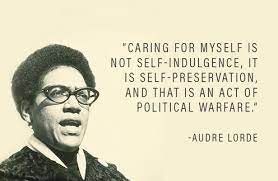
But self-care actually has its roots in the civil rights movement. Black activists like Audre Lorde argued that caring for oneself and helping those close to us care for themselves is not a distraction from activism, but a fundamental part of it. Self-care makes activism more sustainable, and directly works against systems that disproportionately harm the health and wellness of certain people, while prioritizing that of others. Remembering how this places self-care into a bigger picture may help us feel more comofrtable prioritizing ourselves when we need to and deserve to.

So what might self-care look like? This gets back to the dimensions of health we talked about--we use self-care to build resilience in deifferent areas of our life. Thus, a key part of self care can be self-reflection (e.g. journaling, meditation, art, therapy, etc.), where we think about how we feel strong and how we feel less so, and what we need for growth and support.


This can be more challenging for some of us than others. For example, part of ADHD for me is a struggle to identify needs or symptoms until they have gotten out of hand. Journaling helps me feel grounded, and setting up cues and incentives in my environment can help remind me to practice self-care. Most of my self-care work focuses on building routines and getting out of my head. And, often times, self-care requires exiting my comfort zone in my own best interest


For some examples, here are a few self-care practices try to use for different aspects of health:

  • Physical: Stretch or dance breaks during long work sessions, making a favorite hearty soup
  • Mental: Journaling out jumbled thoughts, creative activities (especially making something for someone I care about), changing scenery/sensory input (e.g. changing clothes, having a walk, or listening to books or music)
  • Social: Calling my mom or brother, giving to or supporting a stranger, visiting a new place in the city
  • Other: Learning or talking about a cause thats important to me (purpose), engaging with poetry and music that makes me feel like there's something beyond us (spiritual), etc.


Take some time to think about what self-care looks like for you! And, just because it's "self"care doesn't mean it has to be done alone! Starting conversations about this with others helps decrease the stigma or sense of individuality associated with health struggles!

Journal Prompts

This week, our journal prompt is a body scan, which you can work through on paper or through guided meditation. (Here is a short option, here is a longer one)


A body scan is a mindfulness exercise where we progressively move the attention to different parts of the body. The main goal is to connect with sensations in the body, like tension, pain, or discomfort, which we might not recognize and address when stressed or busy. On paper, you might:

  • List sensations as they occur
  • Pick one body part and write about how it feels, or how it has experienced the day
  • Write about what you are experiencing through each of your senses
  • Express gratitude for different parts of your body, writing about how they help you get through the day

Music Mix

Check out our Healthy Hits Playlist on Spotify!

  • Closer to Fine - Indigo Girls
  • Lost in my Mind - The Head and the heart
  • Sunshine on My Shoulders - John Denver
Healthy Hits Playlist
 

Thanks for Reading!

Check in Friday to chat about stress and sleep!

If you would like to chat about anything in this newsletter, you can reach out to me, Miri, at mrinehart@lclark.edu, or the Health Promotion and Wellness Office at healthed@lclark.edu, or you can utilize any of the resources throughout this email or below. You deserve to feel safe and well!


On Campus Resources

Office of Spiritual Life
Health Promotion & Wellness Office
Counseling Service

Off Campus Resources

Local Mental Health Resources
Suicide Prevention Resource Center
Loneliness Crisis Line
 
Instagram