| |
|
|
|
|
|
We encourage everyone receiving this newsletter to take five minutes and read the full article posted below: "The Brain Science Behind Student Trauma: stress and trauma inhibit students' ability to learn." In this brief, concise article, Dr. Perry clearly articulates one of the most common barriers towards learning - stress and trauma - and indicates how we can begin to understand and change this dynamic. One of his key points is this:
Children who have experienced trauma will be in a persistent state of alarm and less capable of concentrating when they enter classrooms. Because of this, they will pay more attention to the nonverbal cues of a teacher, such as tone of voice, body posture, and facial expressions. Unless teachers adopt some regulating practices for those students, such as meditative breathing or rhythmic motor activity, children will remain in the alarm state, impairing cognitive learning.
We also encourage - and challenge - you to share this piece with others. By building a knowledge base among educators, caregivers, and professionals, we can begin to make very positive changes for children and schools.
|
|
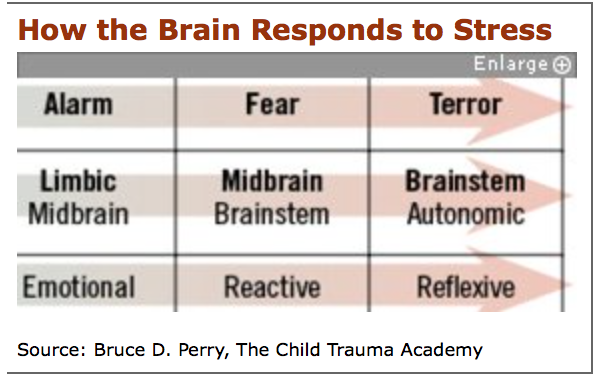 The Brain Science Behind Student Trauma:
Stress and trauma inhibit students' ability to learn
By
Bruce D. Perry
Excerpt taken from Education Week December 13, 2016
http://www.edweek.org/ew/articles/2016/12/14/the-brain-science-behind-student-trauma.html
The most remarkable feature of humankind is the flexibility of our brains. This neuroplasticity - or the brain's ability to adjust its activities in response to new situations-is what has allowed our species to make dramatic changes from generation to generation. Humans have evolved from small hunter-gatherer clans to urban, digitally connected, international communities. The most malleable part of our brain is the neocortex, which can absorb and store more bits of information than the brains of any other species. This capacity for cognitive thinking allowed us to create language, democracy, and thousands of other inventions.
In fact, our most remarkable invention is public education: a structured system to provide the social and cognitive stimulation children need to take advantage of their brain's malleability and develop knowledge and skills in mathematics, science, and history. By providing structured cognitive and social experiences, the U.S. public education system has expressed the potential of millions of children, which has, in turn, led to invention, creativity, and productivity that has transformed the world.
The key to the success of any educational experience is the capacity to "get to the cortex." Yet, each year, nearly one-third of all children attending U.S. public schools will have significantly impaired cortical functioning due to abuse, neglect, domestic violence, poverty, and other adversities. Understanding the effects of trauma on a child's brain and how these effects alter the ability to learn is essential to improving our public education system.
|
|

Ford Family Foundation Provides Free Copies of The Boy Who Was Raised as a Dog
The Ford Family Foundation is a private, non-profit foundation located in Roseburg, Oregon. Started in 1957, the Foundation now manages large, internal programs and offers scholarships. In addition, the Foundation makes grants to public charities predominantly benefiting communities in rural Oregon and Siskiyou County, Calif. The Foundation has six primary areas of focus, within which they have identified early childhood development, youth development and education, and child abuse prevention and intervention as particular points of concentration.
Through their Select Books Program, The Ford Family Foundation offers free copies of carefully chosen books and resources that provide practical approaches to community building, leadership and youth development. We are honored that they have selected The Boy Who Was Raised as a Dog as a Select Books program title.
For more information,
c
lick here.
|
NEW Caregiver Challenge Estimator Tool Available
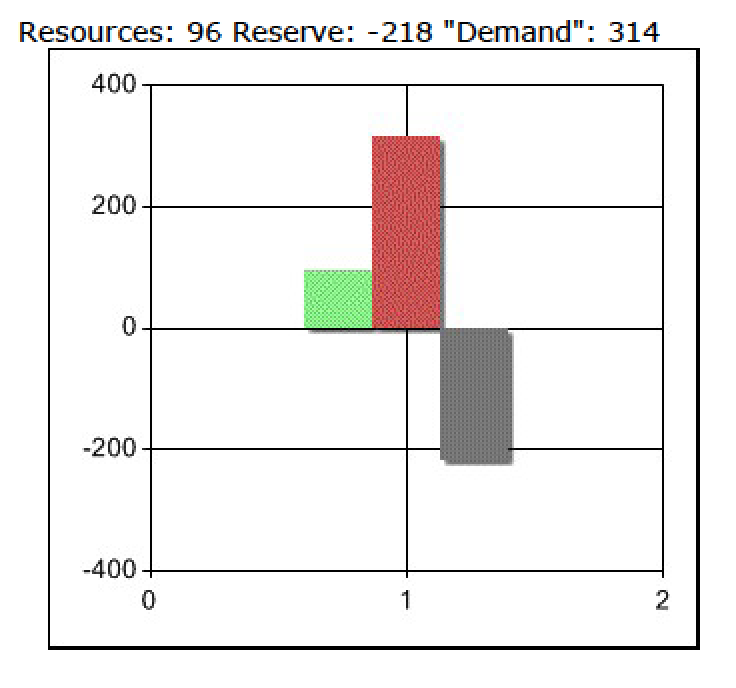
Caring for children creates physical and emotional demands that can be exhausting. The time, attention and energy of any caregiver is limited. When a caregiver is depleted, it is much more difficult to meet the needs of the child. There are a number of factors that influence the internal and external resources of any caregiver, and there are other factors that increase the caregiving 'burden' such as age of the child, as well as physical, emotional or behavioral problems.
CTA's Caregiving Challenge Estimator (CCE) is a tool that is intended to provide an estimate of the caregiving 'burden' facing a primary caregiver at a given moment in time. Available for anyone to purchase and use, this simple tool allows professionals to estimate the balance between resources and demands to determine the Caregiving Reserve score; in turn, this information can help in clinical decision-making and psychoeducation for the caregivers.
As with all metrics, this report is intended to supplement and not replace the clinical decision making process. Report packages are now available for purchase.
Click here for more information.
|
|
| |
REMINDER: For anyone planning to begin NMT Training Certification or the NME Trainers program this year, we are offering Boot Camps in Nashville, TN on October 24 and 25, 2017 and in The Hague, Netherlands on September 29 and 30, 2017 (NMT only). They will provide a
live, face-to-face start to your training experience. For more information, visit our website.
Bruce D. Perry, M.D., Ph.D.
The ChildTrauma Academy
|
|
|
|
|
|