|
|
|
Private Meetings and Events
Miles Franklin seeks creative ways to partner with its clients to market Precious Metals to nationwide audiences. If you are interested in hosting a private meeting - or sponsoring a Webinar presentation - with Andy Schectman, President of Miles Franklin, and "Ranting Andy" Hoffman, Marketing Director, please inquire via email to aschectman@milesfranklin.com or ahoffman@milesfranklin.com; or via telephone at 800-822-8080. |
 Quotes of the Day
As for gold, it's an item representing wealth. It should grow inversely as the dollar loses purchasing power. The only exception is -- if the desire for gold becomes frenzied and gold goes parabolic.
Nobody actually got rich holding gold over the last ten years. All they did was to retain their purchasing power. In 1974, I could buy seven loaves of 10-cent white bread with one gold one-ounce coin. Today I can buy the same number of loaves of bread with a one-ounce gold coin. Am I any richer today than I was in 1974?
- Richard Russell, Dow Theory Letters, January 8 2013
News today that the US Mint sold 3,937,000 of the 2013 Silver Eagles on the FIRST DAY OF 2013 SALES should send shivers down the spines of the silver shorts.
- Bix Weir, RoadtoRoota.com
Back to Table of Contents |
From David's Desk
 | | David, Susan and friends at a recent outing. |
 I was talking to a friend today and he happened to mention that he wished he could buy more gold now, but added he didn't have any extra money to spare. He makes a nice living at a Minneapolis manufacturing firm and his wife also works and brings in an additional $40,000. Together, they earn north of $100,000 a year. They only have one junior high school child to support. They are quite conservative and do not spend to an excess. They are doing very well, by middle class standards, yet they have NO extra money left at the end of the month to invest in precious metals. Now if these folks are having a hard time, what about most Americans who earn far less and have a larger family or have to deal with college tuition and weddings?
Things are worse than I thought. Inflation and rising taxes are taking their toll. The result will be a form of class warfare. Anger and envy will emerge out of a now silent background. We are living in the final days of the American Empire. Corruption, fading morality, lies, deception and greed are visible to an extreme, if you focus on Wall Street, the TBTF banks and our politicians. Sorry, I forgot to add the Fed to this illustrious list, but they should be there, standing in the front of the line. Hey, enjoy it, do the best you can. You are living in the most interesting of times - a time of great change is afoot. We'll make it through this mess, but we will emerge to a very different world than the one most of us grew up in. It will be a two-class system, those who are very wealthy and the rest of us. Set aside enough gold and silver and you may make it into the upper class.
To all of our friends who voted for Obama - well, you got him. Be careful what you wish for. Your wish may (did) come true. This administration may "help" the needy, but the food stamps, extended unemployment and tax breaks will not begin to cover the loss of purchasing power that the Fed and increased Liberal Government borrowing will create which further dilutes the dollar. Few new good paying jobs and rising commodity costs will drag down all but the affluent. The middle class is no longer immune from being short of cash. Obama did nothing in his first term to warrant a second term, but the Republicans came up way short of offering a solid alternative. Both parties are fighting for the "Best of the Worst" Award. Looks to me like it's a draw. The worst wins - they ain't no best!
Now, back to the everyday world, here is a T.A. chart that looks encouraging for you gold bulls out there... Gold held support above $1,626. Gold is $1,663.50 as I write this. Overhead resistance sits around $1,800. I say, let's go for it!
The following chart is from King World News and is by Tom Fitzpatrick. He believes gold could go lower from here, but his chart is still bullish and he expects gold to rise.
"(Gold) held the medium term channel base at $1,626 (now at $1,627). We also posted a weekly doji pattern reflecting indecision. Additional supports and pivots are in and around $1,520. Only a weekly close below there would suggest a more aggressive down move. For now the uptrend is still in place and higher levels are expected."

Sincerely, David Schectman Miles Franklin Back to Table of Contents |
The Holter Report
 Don't fight the Fed!.....?
Published: January 8th, 2013 I can remember the words way back at the beginning of my career in 1983, "Don't fight the Fed." In fact, I can remember my "Money and Banking" professor telling us this in 1981 during the depths of that recession. It made sense while I was a wet behind the ears college student. It made sense as to me as a "green" stockbroker just starting out but as the 80's progressed, some things just didn't make sense to me anymore. I saw people who couldn't rub two nickels together all of a sudden moving into big new houses with brand new cars and $100,000++ boats covered up in their backyards during the winter. I was thinking "What the heck?" I figured out early on that "debt" was the source of everything when it came to "the good life." I watched the '91 recession get aborted and again in '96-97 which then turned into the internet bubble. Then came the bust of the stock market and the 2001 recession which was also aborted by another reflation. At this point ('98-99), Gold was trading below $300 while the cost of production was around $335 per ounce, it just didn't make sense. But still in the back of my mind I was thinking about this phrase "Don't fight the Fed." "Value" took over and my decision was to go all in and "Fight the Fed!" Looking back, the choice was either buy Gold or short Treasury securities (bet on interest rates to go up). Either choice was equally "fighting the Fed," however, with shorting Treasuries you have already been taken out behind the woodshed and shot right between the eyes. Buying Gold? It worked, and quite well. But here we are with interest rates (at ridiculously low levels) finally beginning to rise and some calling "triple top" on the bond market. Should you now "short" the bond market? In my opinion there is very little risk to this strategy but... BUT, what is your upside? Without leverage all you can "win" is 100% AND guess what? You "win" Dollars! This is like going to a carnival and playing one of their games. Most people spend $10 and never win but you are excellent at the "ring toss" or whatever, you only spent $1 yet... you win a $2 teddy bear. "Fighting the Fed" by purchasing Gold is an entirely different game, here you spend $1 Dollar to "play the game" and you don't win some crummy teddy bear. You don't even win ALL the teddy bears behind the counter. No, you win the whole carnival! I am not being overly dramatic here, I assure you. When the system comes down, you could have MILLIONS in the bank and still be a complete loser. Your bank could (will) fail, FDIC will pay ($250,000) and you will be in financial tatters because $250,000 will not even buy a wheelbarrow by the time this whole episode is over. "Dramatic" on my part? No, The Fed is now at this point THE biggest buyer of Treasury securities in the world. Everyone else has stepped back either because they understand the game or because they don't have the "cash" to invest. Yet, the "game" by definition HAS TO keep getting bigger and BIGGER. If you don't or can't see the mechanics that the "game" is a Ponzi scheme, all you need to know is that the basic tenet of a Ponzi scheme is that it get bigger and bigger... which is exactly what the Fed is doing in support of the Treasury department's unending hunger (now by necessity) to borrow more at an exponentially greater rate. My point is this, you absolutely must for your own survival "fight the Fed." Yes, you can play along with their game and maybe (if you are good) "win Dollars" but at some point the game mathematically HAS TO END! Oh and by the way, when the game does finally end? You won't even be able to exchange your "winnings" for a simple teddy bear. On the other hand you could win "all the marbles" and be a part (have a real and true financial vote) in the upcoming new monetary system. If you are going to fight the Fed (which your financial survival depends on), do it right!
Regards,
Bill Holter
Associate Writer for Miles Franklin
Read more Bill Holter Articles on the Miles Franklin Blog
|
Gold Highlights
|
|
BFI Wealth, Zurich - Swiss Annuities and Managed Accounts
Miles Franklin and BFI Consulting of Zurich, Switzerland, have partnered for the past two decades in offering access to offshore annuities and managed accounts. Born at roughly the same time in the early 1990s, both firms have successfully PROTECTED clients via quality, secure, private accounts holding PHYSICAL Precious Metals, annuities, and other managed products. BFI is a global leader in the sale and maintenance of Swiss annuities and privately managed accounts - particularly to U.S.-based clients; and through its Global Gold subsidiary - utilizing worldwide storage leader Via Mat - offers international Precious Metal storage services in Switzerland, Hong Kong, and Singapore. As with Miles Franklin's Canadian offshore storage program, Global Gold offers allocated storage OUTSIDE the banking system.
|
January 8, 2013
Bill Gross is one of the smartest guys in this industry. Thus, I suggest that we all take the headline below seriously.
Bill Gross: Inflation Coming Soon to a Country Near You
In a recent, rather scary piece, bond king, William Hunt Gross, better known as Bill Gross, stated that investors can expect inflation to play significantly into their returns in coming years. Actually, Gross stated that he believes the average return on a nominal basis will fall around zero. Gross's argument covers a long history of both stocks and bonds and compares the past to the present." (From www.pimco.com).
***
I note that gold is hovering just above 1600. My take on this is that the sovereign buyers and central bank accumulators of gold are happy to have gold stay right where it is. They don't want it any lower because they already have large positions in gold, and if gold goes lower, it will affect the value of their holdings. They don't want gold any higher, since a higher price for gold will simply cost them more. Thus, I expect the price of gold in terms of most currencies to remain pretty much where it is. But gold accumulators will continue to warn of the danger of "a big correction in gold" -- this to keep newcomers out.
Distant drums? I find it interesting that little or nothing is coming out of Washington regarding the China situation. I predict that within the year, we will be hearing more and more about "the growing Chinese menace," plus the Chinese build-up of their military, particularly their submarine fleet. Gold bugs already know that China is the world's leader in the production of gold, and that China's leaders have openly encouraged Chinese citizens to accumulate gold.
Note -- it's fascinating to realize that the Chinese were the originators of two of the world's most dangerous inventions -- gunpowder and fiat money.
I've been studying the finances of the US government, and I can only describe the finances in two words -- frighteningly insane.
The US government reported fiscal 2012 ending Sept. 12 with a deficit of $1.089 trillion. But this omits the unfunded liabilities of social programs. If GAAP-based accounting was employed, as all businesses are required to do, the true deficit was in excess of $7 trillion, this according to John Williams of Shadow Government Statistics fame (www.shadowstats.com).
In fiscal 2012, Social Security tax receipts of $488 billion fell short by over $100 billion on the $627.2 billion that was paid out. The actual liabilities of the federal government --including Social Security, Medicare and federal employees retirement benefits -- already exceed $86.8 trillion or 550% of Gross Domestic Product.
And the question I ask myself is -- "How is all this going to work out, if indeed it is ever going to work out? My only answer is devaluation. These unimaginable unfunded liabilities will have to be paid off in "mini Federal Reserve notes," currencies that won't have any real purchasing power.
Question -- When the American people see how they have been hoodwinked, won't there be a revolution or at least riots?
Answer -- I honestly don't know. It depends very much on the mood of the nation in coming years. Twenty years from now, we may live in a more lawless nation. Actually, I believe there will be enormous pressure to get rid of the Federal Reserve and its fiat money. I also believe that there will be pressure for far more honesty in government. I believe Bill Gross's "new normal" will segue into something called the "new abnormal." We will live in a far different world than the one we live in today. The thinking will be different, the finances will be different, problems will be different, the economy will be different, world leadership will be different, and the weather will be different.
Russell prediction -- (1) one hundred years from today, gold will possess purchasing power -- about the same relative amount of purchasing power that it enjoys today. (2) There will be no fiat money. Investors will finally become smart.
Subscribe to the Dow Theory Letters for the full article.
Back to Table of Contents |
|
Reliable Financial Advisors
In a world of heightened speculative and counterparty risks, finding someone you can trust may be the most important research you do. Miles Franklin does not sell stocks, but is frequently asked if we know of reputable, full-service brokers. WE DO NOT CONDEMN OR CONDONE EQUITY INVESTMENTS, but want investors with such interest to be honestly and competently handled.
In resource stocks, the folks at Sprott Global Resource Investments - managed by Eric Sprott and Rick Rule - are the best in the business. In various capacities, we have worked with Eric Angeli, Jeff Howard, Kenton Toews, Mishka vom Dorp, Jason Stevens, Anthony Marsh, and Andrew Jackson - all of whom are diligent, ethical, and knowledgeable. That style of business is indicative of the reputation Global has built over the past 25 years. You can feel comfortable with any of their brokers, reachable at 800-477-7853.
For all other stocks - including large cap gold, silver and other resource equities - Nick Shermeta, from Northland Securities here in Minneapolis, is as trustworthy and knowledgeable as they come. Nick is a Senior Vice President with more than 20 years experience, but will treat you as if you were his only client. You can reach Nick at 612-851-5908, or by email at nshermeta@northlandsecurities.com.
The common denominator is decades of Wall Street experience, which should give you comfort that well-seasoned and weathered hands are helping manage your portfolio. Notably, we do not receive compensation for these recommendations. We just want you to know that if they are good enough for us, they should be good enough for you too.
|
Silver Eagle Sales Kicking Riggers Ass!
by Bix Weir
News today that the US Mint sold 3,937,000 of the 2013 Silver Eagles on the FIRST DAY OF 2013 SALES should send shivers down the spines of the silver shorts.
Highest Ever One-Day Sales for American Silver Eagles
http://news.coinupdate.com/highest-ever-one-day-sales-for-american-silver-eagles-1796/
The best thing about this news is that people are waking up that NOT all forms of silver will be dealt with in the same manner in the future. US Silver Eagles and pre-1965 silver coins are the coinage of the United States and when the inevitable crash of fiat paper and electronic Federal Reserve Notes finally happens these silver and gold coins will be all we have left to be used as our official money. Other forms of silver will NOT be accepted as money and may even be taxed so heavily that all the hoped for investment gains may be swallowed by Uncle Sam. It is possible that our Congress and We the People will be so pissed off at "those lucky silver investors" that they impose 60-80% tax on precious metal gains. Life ain't fair when it comes to the destruction of our monetary system and the redistribution of wealth. Those kind of windfall taxes would be difficult to attach to a form of coinage we use as money in the future. Not impossible but difficult.
Now is NOT the time to save a couple bucks on the SE premium for two simple reasons:
1) Although you buy them at a premium you can sell them at a premium as well.
2) American Silver Eagles are US Mint coins denominated as $1 according to law and when the derivative bubble destroys all other forms of Federal Reserve created money the value of a REAL $1 coin will be astronomical!
So get in line and by your $1 US Silver Eagles TODAY. You will not only save your financial future but you just may help SAVE OUR COUNTRY!
May the Road to you choose be the Right Road.
Bix Weir
www.RoadtoRoota.com
Back to Table of Contents
|
In The News Today
January 8, 2013, at 10:12 am
by Jim Sinclair
Jim Sinclair's Commentary
Every bit, not as little as anticipated, helps and hurts depending on what side of the two lions fighting (dollar and euro) you are on.
Japan to Buy European Debt With Currency Reserves to Weaken Yen
By Mayumi Otsuma - Jan 8, 2013 7:17 AM ET
Japan plans to use its foreign- exchange reserves to buy bonds issued by the European Stability Mechanism and euro-area sovereigns, as the nation seeks to weaken its currency, Finance Minister Taro Aso said.
"The financial stability of Europe will help the stability of foreign-exchange rates, including the yen," Aso told reporters today at a briefing in Tokyo. "From this perspective, Japan plans to buy ESM bonds," he said. The purchase amount is undecided, Aso said.
One hundred euro, from top, U.S. one hundred dollar, and ten thousand yen banknotes. Photographer: Kiyoshi Ota/Bloomberg
The move may help Prime Minister Shinzo Abe temper criticism of Japan's currency policies from trading partners such as the U.S. The yen has fallen around 8 percent against the dollar since mid-November on Abe's pledge to reverse more than a decade of deflation as his Liberal Democratic Party won an election victory last month.
"The Europeans would be happy to see Japan buy ESM bonds, so Japan can avoid criticism from abroad and at the same time achieve its objective," said Masaaki Kanno, chief economist at JPMorgan Securities Japan Co. and a former central bank official.
The yen erased gains after Aso's comments, reaching 87.81 per dollar, before appreciating again to 87.51 as of 7:14 a.m. New York time. The Japanese currency appreciated 0.3 percent to 114.86 per euro.
More...
_______________________________________
Jim's Mailbox
January 8, 2013, at 10:06 am
by Jim Sinclair
From our CIGA businessman in the trenches. He has direct contact with the public as the middleman for basic consumer needs. I read "no" to both premises upon which the establishment is publishing negative MSM MOPE.
Dear Jim,
As you know I run businesses both in New York and Florida. There are few if any business owners I know of that are thriving in the current environment. There are business owners in the United States who are very adept at running their companies. They remain nimble and adjust to the market to the best of their abilities. Many have downsized or shifted business initiatives; employees have foregone raises, vacations and bonuses in order to keep their jobs in the hope that the economy will turn around.
In my opinion, most of any growth posted in GDP in recent years is due to cost-push inflation. Year after year we see increased prices, which result in what appears to be stable or mildly increasing sales, but on a unit basis sales are well below that in the late 90's or early 2000's. Business owners are uncertain, treading lightly just trying to maintain their businesses. Legislation, mostly based on environmental initiatives has also pushed increased prices. For instance, an item such as a light bulb where the push toward compact florescent lighting has dramatically increased the consumer cost of purchasing lighting. Paints have also risen dramatically in price as low and zero VOC products push out more traditional paints and the advent of "paint and primer" in one has allowed for paint companies to suggest they are offering two products in one when nearly any paint above a certain quality level has always had priming qualities.
If I see business changing to the tune of unit sales increasing, sustained margins and most importantly increasing confidence among customers, vendors and businesses, I will be certain to let you know.
Best,
CIGA Marc
Back to Table of Contents |
India's Gold Mania
Douglas French � January 8, 2013
Less than 1% of the world's gold is mined in India. The rest comes from somewhere else. Still, India can't get enough. It is the largest consumer of gold in the world, buying nearly a third of production in recent years. Some estimates say that 10% of all gold is held in India.
Indians save roughly 30% of their income, as opposed Americans, who save 5%. Plus, Indians are getting richer all the time. Once a very poor country, the rich and middle classes now outnumber the poor in this nation of 1.2 billion. The country has the sixth-largest economy in the world.
If people are left alone, high gold demand going forward is a lock.
Yet India's policymakers are disturbed. Yellow metal purchases have widened the country's current account deficit to 5.4% of GDP.
The Reserve Bank of India (RBI) has produced a report indicating, "a need to moderate gold import, as the insatiable appetite for the yellow metal could jeopardize economic stability," reports BullionStreet.com.
So the Indian government and its central bank are trying to get people to buy other financial products. "There is a need for banks to introduce new gold-backed financial products that may reduce or postpone the demand for gold imports," the RBI report said.
The central banking wonks are thinking that if the Indian public can be made aware of financial paper instruments such as gold accumulation plans, gold pensions, and gold-linked accounts, it will drop its obsession with the barbarous relic.
A leading Indian trade body said country's gold imports could fall to just 550 tonnes next year, little more than half of the peak of 967 tonnes in 2011.
Well, good luck with that. The people of India have cultural, historical, and traditional reasons to buy gold. They consider it the most valuable asset there is. Indians want to own gold like Americans want to own houses.
Ganesh Rathnam related a story that explains India's gold obsession. When his father, a pediatric surgeon, wanted to buy land to build a new clinic, he mortgaged his wife's jewelry to raise the purchase money. "Similarly, millions of people in India have capitalized their businesses or farms, or secured their basic necessities after severe business reversals, by pledging their gold jewelry," he writes.
Last year, 60 Minutes ran a segment, "India's Love Affair With Gold." Correspondent Byron Pitts was stunned that the Indian people consider gold purchases as savings. Indians do not believe that they are spending when they buy gold, but, instead, that they are putting their money in a savings account. Oftentimes, a savings account that is worn around the neck or wrist.
There are 22 official languages in India, so there are 22 ways to say gold. And nothing says gold in India like a wedding. Half the country's gold purchases are for wedding jewelry. It is said in India, "If there is no gold, there will be no wedding." Gold must be widely owned, because there are 10 million weddings a year. Some are extravagant affairs that last for days on end.
Parents start accumulating gold for their daughter's wedding day as soon as she is born. This gold represents some financial security that the bride brings to the union. It also gives the bride some economic status in the relationship. And while it provides security, gold is hardly ever sold, but instead passed on for generations. But it can be mortgaged if needed.
Gold is a symbol of purity and is considered sacred, but also signals prosperity. Jewelry does the talking and gold speaks loud and clear. Not for vanity's sake, however, as gold is considered honorable. You can't have a family without gold. The yellow metal is a way of life.
A gold analyst told Pitts that it's impossible to explain to an Indian that gold might go down in price. Indian society has been around a few thousand years. People learn a thing or two in that time. First, save money for the unexpected. Second, don't trust banks. And third, don't trust the government's paper money. They're not interested in mutual funds and other financial products.
Even the poorest people in India buy gold, saving a little each week to buy a gram at a time.
"Gold has a rich tradition in the Hindu epics, the Ramayana and the Mahabharata," writes Rathnam. "It was associated with the pomp and splendor of the gods and kings who appear in these mythological stories."
He explains that silver coins were widely used in India during the reign of the Mauryas circa 250 B.C., and the first gold coins were issued widely during the Gupta dynasty around A.D. 250. India has been a collection of kingdoms and fiefdoms often at odds. Gold was easily hidden, "enabling ordinary citizens to avoid being looted by marauding armies," Rathnam writes. The kings changed, as did the coins, and thus gold became the preferred medium of exchange and store of wealth.
After India's foreign reserves were decimated by its war with China, the government instituted the Gold Control Act of 1962, which forbade private ownership of gold bullion and forced all bullion to be turned into jewelry.
In the 1970s, tax rates reached 95%, and the Indian currency, the rupee, plunged in value. Indians took to not only hiding assets from the taxman, but also trying to survive inflation. Gold and real estate were the chosen vehicles. Rathnam also points out that bank deposit insurance in India is the equivalent of just over $2,000, making bank deposits a risky asset.
But finance minister Chidambaram Palaniappan doesn't care about tradition or prudence. He sees gold purchases as consumption that has contributed $64 billion to the country's widening current account deficit.
While the average Indian loves gold, the country's bureaucrats do not. The numbers tell the story. The Indian government owns only 360 metric tons, while private gold holdings are estimated to be 15,000 metric tons. It is, indeed, the people's money.
An Indian gold expert told 60 Minutes' Pitts, "If India sneezes, the gold industry will catch a cold."
The government is trying to make it sneeze, but the people are wise. Thousands of years of tradition will likely keep the gold market healthy, no matter how much the politicians hate it.
Sincerely,
Doug French
Back to Table of Contents |
Here's How to Profit Off Last Month's Fed Minutes
By Jeff Clark
Tuesday, January 8, 2013
Gold got smacked hard last Thursday.
The precious metal dropped $22 an ounce right after the Federal Open Market Committee (FOMC) released its minutes for last month's meeting. It fell another $25 in overnight trading.
It seems a few members of the Fed thought that if everything worked out, they might be able to ease off the quantitative easing (QE) gas pedal sometime later this year.
Now that's funny...
I guess some people can't take a joke. Instead of laughing, some people sold their gold... They're thinking that if the Fed is serious about stopping all the QE, there will be less inflationary pressure and fewer reasons to own gold.
But here's the thing... Fed members talking about cutting back on QE is like senators and congresspersons talking about cutting the deficit. It's not going to happen. They can talk about it. And all that debate makes for fun political theater. But once a country starts down the road of debt monetization, it doesn't turn back... ever.
Sure, the Fed can set targets - like 6.5% unemployment, 2% inflation, or some acceptable rate of economic growth - for when it's time to ease off the QE accelerator. But it's just a show to convince the masses that the Fed knows what it's doing and is in control of the situation. Just like the show Congress puts on whenever the issue of "spending cuts" is put on the table. Yet, the national debt time bomb just keeps ticking away.
And the QE pedal will remain pressed to the floor.
Congress is going to continue spending money it doesn't have... The Treasury is going to continue issuing bonds to borrow the money to pay for the deficit spending... The Fed is going to continue printing money to buy the bonds the Treasury issues to keep interest rates low... And all that new money is going to continue pushing down the value of the dollar and pushing up the price of gold.
Now, consider that the central banks of Europe and Japan are doing the exact same thing, and ask yourself if it makes more sense to sell gold or to buy it.
Take a look at the following chart...
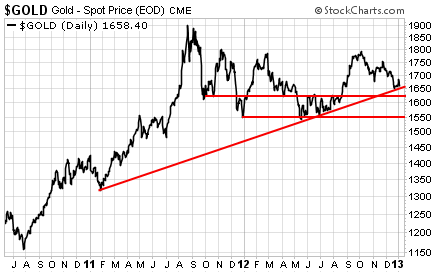
At just over $1,650 per ounce, gold is resting right on its longer-term support line going all the way back to January 2011. There's additional support just below at $1,620, followed by even more support at $1,550.
Last week's drop in the gold price looks like a good buying opportunity for the metal - especially if you missed the chance to buy it the last time it was down at this level.
Best regards and good trading,
Jeff Clark
Back to Table of Contents |
Bullion vs. the Dollar: Three Scenarios
by Rick Ackerman on January 9, 2013 12:01 am
The U.S. dollar showed its first sign of life in nearly a month last week when it rallied above some distinctive price peaks on the daily chart. The trend bears watching, since any significant upside progress from here would put pressure on gold and silver quotes. How likely is this to occur? The chart below leaves the matter unsettled, at least for now. Traditional chartists will see a bearish head-and-shoulders formation in the making. If it pans out in textbook fashion, that would of course be bullish for precious metals. We think this is the least likely of several scenarios for two reasons: 1) head-and-shoulders patterns are everywhere we want to find them, too popular for their own good; and, 2) this particular one looks too fetching to do what we expect it to do.
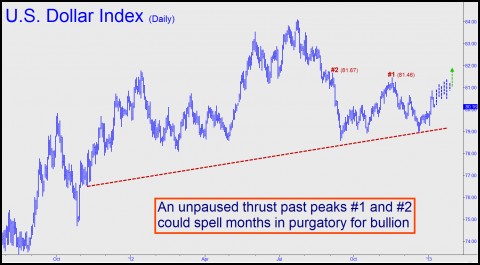
More likely, in our opinion, is a prolonged slog higher for the dollar over the next 6-8 weeks, with a modest upward slope that hugs the dotted red trendline. This would be congruent with a forecast we aired a couple of months ago calling for range-trading in gold from around $1480 to $1800 between now and early 2014.
Most Bullish for USD
Which brings us to the scenario most bullish for the dollar, and therefore least bullish for precious metals. According to our Hidden Pivot Method of analysis, sustainable rallies nearly always begin with an up thrust exceeding two prior peaks, an "internal" and an "external." In the chart above, these peaks are labeled, respectively, #1 and #2. However, more than merely exceeding both highs, the rally would have to do so without pulling back significantly after the first high is surpassed. Another way of saying it is that if bulls can get past peak #1, they must top #2 as well without pausing for breath. Were this to occur, you could kiss the head-and-shoulders pattern good-bye, and with it the prospect of a strong uptrend in bullion prices for perhaps another month or two.
Back to Table of Contents |

Obama's $264 Billion Tax for 2013 May Spark New Recession
Monday, 07 Jan 2013 10:18 PM
By David A. Patten
With the fiscal cliff deal and many Obamacare taxes taking effect, Americans will be slammed with an estimated $264 billion in new taxes this year alone - making 2013 memorable for delivering one of the largest one-year tax increases in American history.
The math breakdown of the new taxes is simple: Key parts of the Bush tax cuts will expire as a result of the new fiscal cliff legislation, hitting American taxpayers with taxes of about $39.5 billion each year for the next decade.
In addition, the expiration of the so-called "payroll-tax holiday" will fill federal coffers with another $160 billion each year, on average, over the next 10 years.
And finally, several new Obamacare taxes begin this year, costing Americans an estimated $41.8 billion of additional taxes.
In the wake of this tax tsunami, a growing chorus of economists is warning that Congress's last-minute effort to dodge the fiscal cliff - which added some $2.2 trillion in new revenue over 10 years, could function as a massive "anti-stimulus" - pushing a teetering economy into a full-blown recession within the next 12 to 18 months.
While the number crunching continues in earnest, the tax wallop of the 157-page American Taxpayer Relief Tax Act of 2012 that Congress passed last week is gradually emerging.
In 2013 alone, the new tax revenues would include:
- $160 Billion Hike in Payroll Taxes. This is due to the expiration of the payroll tax "holiday," which increases the payroll tax that helps fund Social Security from 4.2 percent to 6.2 percent. According to the Tax Policy Center, this increase will actually hit lower- and middle-income taxpayers harder, in percentage terms, than the wealthy. Commentators often say "it's just a 2 percent increase" - it's actually a 48 percent increase over the tax rate wage earners paid for each of the past two years.
- $39.5 Billion in Income-Tax Rate Hikes. President Obama and the Democratic Senate insisted on letting the Bush tax cuts lapse on high-income earners. Such earners making more than $400,000 ($450,000 for married couples) will see their marginal income-tax rates rise from 35 percent to 39.6 percent. That shift is projected to garner $395 billion in taxes over the next 10 years. The tax affects less than 1 percent of American households - but also impacts many high-spending professionals and successful small business owners who pay taxes on the personal returns.
- $15 Billion from Limiting Deductions. The new law calls for a "personal exemption phase out," or PEP, affecting the exemptions and deductions that wealthier families can claim. It affects individual filers at $250,000, and $300,000 for joint filers. The tax bill for a couple earning $400,000 averaging about $50,000 in deductions each year will rise by about $1,000 according to a Wall Street Journal calculation.
- $5.5 Billion in Capital Gain and Dividend Taxes. The new tax rate for capital gains and dividends will rise from 15 percent to 20 percent (this figure doesn't include an additional 3.8 percent surcharge on investment income for high-income earners, which will kick in during 2013 to help defray the cost of Obamacare).
- $2 Billion in Estate Taxes. The law increases the top rate for gift and estate taxes from 35 to 40 percent.
Despite President Obama's promise during both of his campaigns not to raise taxes on middle-income wage earners, The Tax Policy Center reports taxes will go up for over 77 percent of American households.
The bottom line of the new taxation: Economists predict less economic growth as cash is sucked out of the economy to cover the burgeoning federal deficit. And some see a worse scenario: greater likelihood of a new recession.
Many news outlets are reporting the tax impact of the fiscal cliff deal to be in the neighborhood of $620 billion over 10 years. This overlooks the larger impact, however, of the expiration of the payroll tax holiday, which will rise from 4.2 to 6.2 percent - a one-year increase in that tax of 48 percent.
The payroll tax reduction was originally expected to last for one year, but it was extended for a second year. Some economists have questioned the wisdom of allowing the payroll tax to increase in the middle of a sluggish economy.
Moody's chief economist Mark Zandi issued a projection that the tax burden will cut GDP growth by three-quarters of 1 percent, causing the creation of 600,000 fewer jobs in 2013. But the general consensus among economists is that the impact will be much worse - about a 1.5 percent loss of GDP growth. Such a serious dip could push an already lackluster economy close to the brink of actual contraction.
But the impact of the fiscal-cliff taxes are only part of the story. That's because several of the taxes that Congress approved as part of the Patient Protection and Affordable Care Act, dubbed Obamacare, are also kicking in this year.
Based on the average per-year cost of those taxes, they will net the federal government an additional $41.8 billion in new tax revenue in 2013.
The cost of the new Obamacare tax hikes coming in 2013:
- $21 Billion in Medicare Taxes. The healthcare law calls for a nine-tenths of 1 percent increase in the hospital-insurance (Medicare) payroll tax paid by couples earning more than $250,000 a year, or $200,000 per year for single filers.
- $11 Billion from Surcharge on Capital Gains and Dividends. Married couples earning more than $250,000 per year, or single filers earning $200,000 will be slapped with a 3.8 percent surcharge in the tax rate for capital gains and dividends - in addition to the "fiscal cliff" compromise that hiked taxes on capital gains and dividends from 15 to 20 percent.
- $4.5 Billion in Limiting Deductions. Obamacare eliminates corporate deductions for retirees' prescriptions, raising tax costs to employers.
- $2 Billion in Excise Fees. A 2.3 percent excise tax on manufacturers and importers of medical devices, which is expected to be passed along in higher costs to consumers.
- $2 Billion in Limiting Healthcare Itemized Deductions. This reflects a reduction in the amount that middle-class families facing high medical expenses can deduct from their income taxes if they incur high medical expenses.
- $1.3 Billion from Limiting Flexible Savings Accounts. A $2,500 limit will go into effect on tax-free flexible spending accounts, which employees use to help defray medical expenses.
The tax burden associated with healthcare reform will climb even higher next year, when the tax penalty for not complying with the mandate to purchase healthcare insurance begins to kick in.
Some experts predict millions of Americans may opt to pay the tax penalty, rather than comply with the mandate.
The CBO estimates the U.S. Treasury will get $167 billion in such fines over the next 10 years.
Some observers also argue that the rising private insurance premiums due to Obamacare mandate are a hidden tax that will directly hit insured individuals and companies.
Overall, the House Ways and Means Committee has estimated that all 21 tax increases associated with the healthcare law will bring in over $675 billion over the next decade - an average of over $67 billion each year.
Small Business Targeted
One big unknown is how the nation's most prosperous taxpayers, notably small business owners, will respond to the spike in taxes.
A 2011 Treasury department report found that 750,000 small businesses would be impacted if taxes were raised on individuals making more than $500,000.
Many small-business owners, who account for most job creation in the United States, often organize their businesses as "Chapter S" corporations, or S-corps.
These entities do not pay corporate taxes, but rather distribute their profits each year to partners who then declare income directly through the partners' individual tax returns. Those returns are now vulnerable to the high marginal tax rates of 39.6 percent, limitations on deductions, and the Obamacare surcharge on capital gains and dividends. Those earning more than $450,000 would see their tax rates rise to close to 45 percent. That would mean high-income earners could see close to a 20 percent increase in their tax rates starting in 2013.
NFIB President and CEO Dan Danner welcomed some aspects of the fiscal cliff deal. But he added: "It's hugely disappointing to the small-business community that the legislative bridge to avert the 'cliff' did not address our country's most pressing economic issue: unchecked spending that leads to crushing deficits and debt."
Heritage Foundation economist Romina Boccia tells Newsmax the higher taxes on capital gains and dividends will make start-up capital harder to find.
"The large tax increase on dividends and capital gains makes it more difficult for startup firms to get financing," she says. "This means fewer opportunities for innovation and increases in productivity - the engines of economic growth. . . . . it will dampen job creation from new and existing businesses."
Recession Risk
"In isolation, it poses a major risk of putting us in a recession," says Robert A. Wiedemer, economist and co-author of the best-selling "Aftershock." Wiedemer predicted the housing and subprime meltdown of 2007 and '08.
With GDP growth hovering around only 2 percent, and with consumers already skittish about the economy, Wiedemer predicts that the post-cliff tax jolt will "have a negative effect on the stock market, on real estate markets, and on consumer spending."
Wiedemer emphasized that ax jolt may be mitigated by the Federal Reserve which could offset the fiscal contraction from the new taxes by further increasing the money supply, which he argues will create a new set of problems.
Economist Chris Edwards, director of tax policy studies at the CATO Institute, says the short-term impact of the tax hikes will be negative, but warns the long-term impact will be even more negative.
"The more regulation, and the higher the tax rates we have," he says, "the less flexible the economy becomes, and the longer it will take to recover from any negative blow."
"Compared to what the economy would have been had we extended all tax policies," Heritage Foundation Senior Policy Analyst and tax expert Curtis S. Dubay tells Newsmax, "we're going to have a slower-growing economy, we're going to have fewer jobs, less opportunity for Americans of all income levels."
Edward Leamer, a UCLA professor of economics who serves as director of the UCLA Anderson Forecast, tells Newsmax that the real concern in targeting the wealthy with additional taxes is the economic drag it causes over the long term.
Leamer believes estimates that the increased taxation will hurt GDP by as much as 1.5 percent next year are greatly exaggerated, because they are based on flawed Keynesian economic models. The real impact will come later, he says.
Leamer rates the current chance of recession as "very small."
Traditionally, he says, U.S. recessions stem from weak consumer demand for automobiles and homes. With strong liquidity and low rates provided by the Federal Reserve, there is no indication any such recession is on the horizon, he says.
But he warns the fiscal-cliff deal, by giving taxpayers the erroneous impression that higher taxes on the wealthy can solve the nation's financial problems, make another, more serious type of economic downturn more likely: that the bond market will say "enough is enough" in response to spiraling U.S. debt.
"That would be a very severe recession," he says, warning that no one can predict when that day might come.
Britain's Tax Example
President Obama and congressional Democrats pressed for the new taxes to close the nation's $1.1 trillion deficit.
But some analysts contend that increasing taxes on high-income earners could actually yield far less revenue for government coffers, and, if a recession hits, actually widen the deficit.
After the financial crisis hit Europe, Britain raised tax rates in 2009 from 40 to 50 percent on its highest-income earners.
But the new taxes raised much less revenue than officials hoped, in part because British citizens voted with their feet and relocated to other countries. The Daily Mail reported that after the tax hike, government revenues from high-income earners actually fell by about 50 percent, from 13.4 billion pounds to 6.5 billion pounds in 2010/11.
Faced with a massive decline in revenues, Britain decided to drop the top tax rate back down to 45 percent in March 2012.
High tax policies have also kept Britain bogged down in its longest double-dip recession since at least 1955. Germany's economy, by contrast, grew by 4.2 percent in 2010, and 3 percent in 2011. Britain's economic growth slowed to 0.75 percent last year.
Britain's example demonstrates that president's realized goal of hiking taxes on the top 1 percent could carry a steep price indeed for the entire U.S. economy.
Back to Table of Contents |
Appetite for gold is soaring in Asia...
According to the World Gold Council, Japanese pension funds, the second-largest pool of retirement assets ($3.36 trillion) behind the U.S., will more than double their gold holdings over the next two years.
Historically, Japanese investors don't view gold as an inflation hedge. But Japan's new Prime Minister, Shinzo Abe, is forcing them to reconsider... Abe pledged to spur inflation to 2%.
"Bullion's role as an inflation hedge, long ignored by Japanese fund operators, has come under the spotlight thanks to Abe's economic policy," Itsuo Toshima, a former 23-year representative of the Tokyo office of the World Gold Council, told Bloomberg. "Gold may be a standard asset-class in the portfolio of Japanese pension funds as Abe's target is realized."
Japanese pensions could increase their holdings of gold-backed exchange traded funds to 100 billion yen ($1.1 billion) by 2015 from less than 45 billion yen today.
Reuters also reported the market for physical gold is booming in Asia this year... Buyers are tempted by the precious metal's recent selloff. (Gold recently fell as low as $1,626 an ounce, down from nearly $1,800 an ounce in October.)
Trading on the Shanghai Gold Exchange's 99.99, gold physical contracts hit a record 19,504.8 kilograms on Monday.
"Physical demand is very strong," said a trader in Beijing. "It's a combination of the attraction of lower prices as well as pre-holiday [Lunar New Year] demand." The trader believes demand could fall if prices recover to $1,700.
And U.S. gold demand is booming so far this year... The U.S. Mint reports it sold 50,000 ounces of gold on the first day of 2013. It sold another 7,000 ounces on the second - almost the entire amount sold in December... and nearly half the amount in January 2012.
Investors are buying gold because they know how global central banks' money printing (and subsequent currency devaluing) will end... It will send gold soaring. Even PIMCO's Bill Gross, who made his fortune in bonds, is advising folks to buy gold.
Subscribe to the S&A Digest for the full article.
Back to Table of Contents |
David's Mail Box
David;
First of all-HAPPY NEW YEAR and GOD BLESS! Next, I read the Mogambo Guru daily for months and realize what an excellent writer, and wit, he is. He would be an excellent addition to your "Daily" if he is available. Also, the people that bad-mouth you because they bought gold/silver and the price went down, drastically, owe you an apology. Their eyes were wide open when they bought, and if they didn't realize that the metals markets are being controlled by outside forces, it wasn't because they weren't being told the truth. I first bought gold about 20 years ago, during the last boom, watched it go bust but never sold it. The price I paid for it has more than tripled and I still wouldn't consider selling. In fact, I have added several more ounces to my stockpile, and have switched to buying silver. I will soon be in my 75th year and plan on leaving metal, not dollars, to my kids. Keep up the good work of trying to make people realize that paper is only good for starting the fire necessary to refine precious metals. Again, God bless.
Let us walk softly on the Earth with all living beings great and small, remembering as we go that one GOD, kind as wise, created all.
Joe
_____________________________________________
Hi Andy,
David's blog of today raises an important question that I feel only you will answer to my satisfaction.
The inclusion of the "confiscation" article by Julian Phillips is directly in opposition to the MF stand that gold confiscation is highly unlikely and, even if attempted, could be dealt with via off shore storage. Listing his opinion piece is the kind of honest and responsible action that I have come to admire and count on from everyone at MF. However, Phillips does make a strong and logical case that the government can, and may, do whatever it needs to do to survive - including gold confiscation.
I believe in your "All In" philosophy and have purchased from MF both gold and silver coins resulting in a 90% commitment toward 100% ownership of PM - mostly stored in your Canadian vaults. I will be contacting Joel within a few days to round out my holdings with a bag of junk silver for emergency use. I feel I am ready for the impending fiscal disaster and I "sleep well". What I am not ready for is the scenario proposed by Phillips. Please realize that I believe David and your belief that confiscation will not happen, but, you must admit that the Phillip's logic is compelling and should be considered.
I must believe that you have considered the "Phillip's Possibility" and have a plan. You could allow me to again sleep well if you would share your contingency plan with me. If your response would be too complicated - could we discuss this via phone?
MY best regards,
Bob K.
Bob,
I have absolutely considered this possibility; and noted many times that ANYTHING can happen, and likely will during such an historic calamity.
Each day, I consider how to best PROTECT myself, gauging the pros and cons. There is no "correct" answer, which is why David says to diversify - via silver/platinum, storage options (home vs. Canada/Switzerland/Hong Kong), having some junk on hand, etc.
Sure, they may "confiscate"; but what Julian says is pure speculation, not fact as is tries to imply. Conversely, there is no "official MF view" about confiscation, just David, Bill, Andy, and my personal opinions. It makes no "sense" to confiscate, but governments never make sense.
And what if they did? I ASSURE you that if "confiscation" is announced, the dollar will have already crashed; in which case, I ask you what I ask everyone when they ask about confiscation - Would you rather have "PRICELESS PRECIOUS METALS OR WORTHLESS DOLLARS?"
Also, keep in mind that ZERO gold was actually "confiscated" in 1933; and if they announced it today, just how would they get it out of Brink's. Think of the HORROR our world would be if they resorted to strong arming the handful of citizens that own a piddling few dozen or hundred ounces of gold, when they need BILLIONS of ounces (that don't exist) to become solvent.
Don't worry about fear mongers; just make your own educated decisions - which you certainly have been doing!
I assure you, you are already ahead of 99% of Americans.
Andy Hoffman
Back to Table of Contents |
About Miles Franklin
Miles Franklin was founded in January, 1990 by David MILES Schectman. David's son, Andy Schectman, our CEO, joined Miles Franklin in 1991. Miles Franklin's primary focus from 1990 through 1998 was the Swiss Annuity and we were one of the two top firms in the industry. In November, 2000, we decided to de-emphasize our focus on off-shore investing and moved primarily into gold and silver, which we felt were about to enter into a long-term bull market cycle. Our timing and our new direction proved to be the right thing to do.
We are approaching $200 million a year in precious metals sales. We are rated A+ by the BBB. We are recommended by many prominent newsletter writers including Doug Casey, David Morgan, Ron Hera and LeMetropole Caf�. Our reputation for service, education, quality product and pricing is outstanding. 
Back to Table of Contents |
|
Miles Franklin | 801 Twelve Oaks Center Drive | Suite 834 | Wayzata | Minnesota | 55391
1-800-822-8080 |
|
Readers are advised that the material contained herein is solely for informational purposes. The author and publisher of this letter are not qualified financial advisors and are not acting as such in this publication. The Miles Franklin Report is not a registered financial advisory and Miles Franklin, Ltd., a Minnesota corporation, is not a registered financial advisor. Readers should not view this publication as offering personalized legal, tax, accounting, or investment-related advice. All forecasts and recommendations are based on opinion. Markets change direction with consensus beliefs, which may change at any time and without notice. The information and data contained herein were obtained from sources believed to be reliable, but no representation, warranty or guarantee is made that it is complete, accurate, valid or suitable. Further, the author, publisher and Miles Franklin, Ltd. disclaims all warranties, express, implied or statutory, including, but not limited to, implied warranties of merchantability, fitness for a particular purpose, accuracy and non-infringement, and warranties implied from a course of performance or course of dealing. The reader accepts information on the condition that errors or omissions shall not be made the basis for any claim, demand or cause for action. Past results are not necessarily indicative of future results. Any statements non-factual in nature constitute only current opinions, which are subject to change. The author, publisher, Miles Franklin, Ltd, and their respective officers, directors, owners, employees and agents are not responsible for errors or omissions or any damages arising from the display or use of such information. The author, publisher, Miles Franklin, Ltd, and their respective officers, directors, owners, employees and agents may or may not have a position in the commodities, securities and/or options relating thereto, and may make purchases and/or sales of these commodities and securities relating thereto from time to time in the open market or otherwise. Authors of articles or special reports contained herein may have been compensated for their services in preparing such articles. Miles Franklin, Ltd. and/or its officers, directors, owners, employees and agents do not receive compensation for information presented on mining shares or any other commodity, security or product described herein. Nothing contained herein constitutes a representation, nor a solicitation for the purchase or sale of commodities or securities and therefore no information, nor opinions expressed, shall be construed as a solicitation to buy or sell any commodities or securities mentioned herein. Investors are advised to obtain the advice of a qualified financial, legal and investment advisor before entering any financial transaction.
IN NO EVENT SHALL AUTHOR, PUBLISHER, MILES FRANKLIN, LTD, AND THEIR RESPECTIVE DIRECTORS, OFFICERS, EMPLOYEES AND AGENTS BE LIABLE FOR ANY DIRECT, INDIRECT, PUNITIVE, INCIDENTAL, SPECIAL, CONSEQUENTIAL, EXEMPLARY OR OTHER DAMAGES ARISING OUT OF OR IN ANY WAY CONNECTED WITH ANY INFORMATION CONTAINED HEREIN OR IN ANY LINK PROVIDED HEREIN, PRODUCTS AND SERVICES ADVERTISED IN OR OBTAINED HEREIN, OR OTHERWISE ARISING OUT OF THE USE OF SUCH INFORMATION, WHETHER BASED ON CONTRACT, TORT, NEGLIGENCE, STRICT LIABILITY OR OTHERWISE.
|
|
|


