|
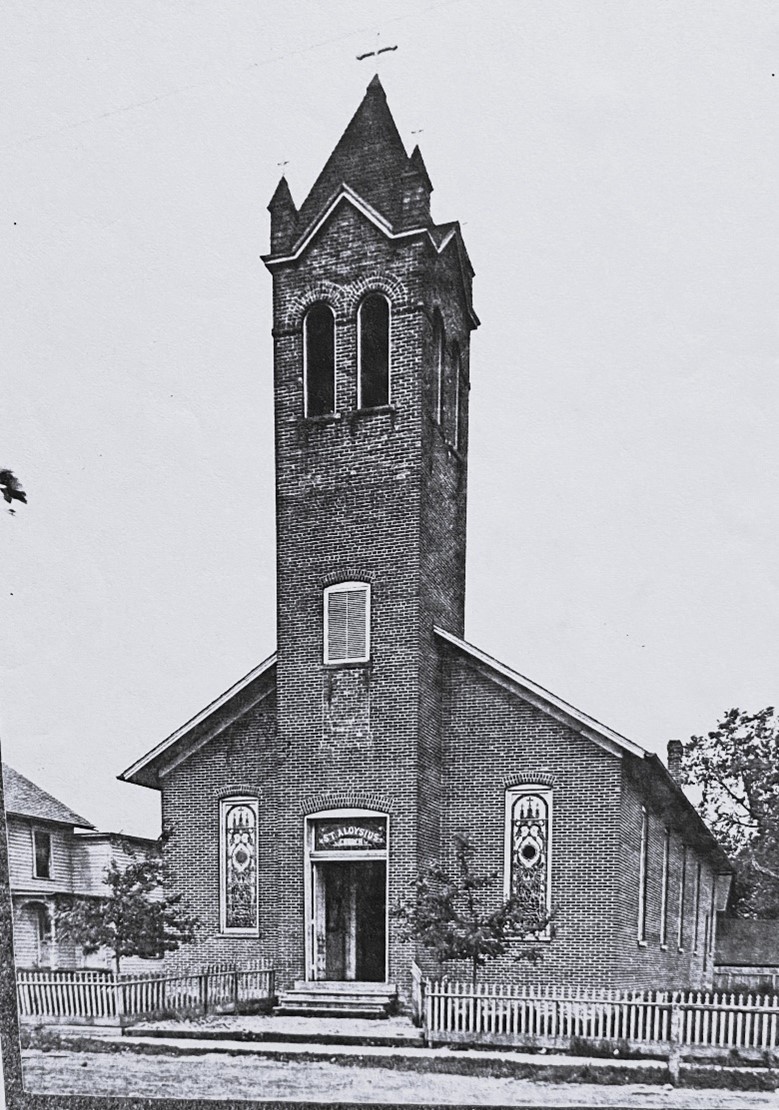
The Historic Preservation Commission of Bowling Green has selected St. Aloysius Catholic Church, at the northwest corner of Clough and South Summit Streets, as its Historic Building of the Month for April to mark the 100th anniversary of the laying of the cornerstone of the church on June 29, 1924.
In the 1860s, the Catholic population in Bowling Green was so small it could not afford to build its own church. For many years, the congregation was a satellite of the churches in Maumee and Perrysburg. A few Saturdays a month, a priest would ride four hours on horseback to Bowling Green. After celebrating mass on Sunday at the home of one of the Catholic families, he would ride back to his own parish.
The numbers of Catholics in and around Bowling Green increased as Irish and German workers came to the area to help build canals (1820s-1850s) and then railroads (1840s-1890s). Young Catholics in Bowling Green prepared for first communion while boarding with families in St. Patrick’s parish at Providence, Ohio, across the Maumee from Grand Rapids. By the late 1870s, Catholics in Bowling Green had gone two years without a visit from a priest. In 1880, however, Father Hyacinthe Kolopp of St. Patrick’s decided it was finally time to build a Catholic church in Bowling Green.
This church was built on South Enterprise just north of Clough, using wood from the Bigelow Sawmill, which was on the land where the present-day church stands at the corner of Clough and South Summit. The bricks were also locally produced. Local farmers donated hundreds of hours of labor, cutting timber and transporting it to the sawmill, and hauling all the bricks on horse-drawn wagons.
The new church received its name when the farmers who helped build it put their first names into a hat for a drawing. Aloysius Pfeiffer’s name was drawn, and thus St. Aloysius Gonzaga (1568-1591) became the patron saint of the new church....Continue Reading St. Aloysius
|