A Week in Dialogue with
the Authors
Kristin Bodiford, Ph.D. and Peter Whitehouse, MD
|
|
October 5 - 9, 2015
We hope you will join us to share your own stories and participate with us in an online global conversation about
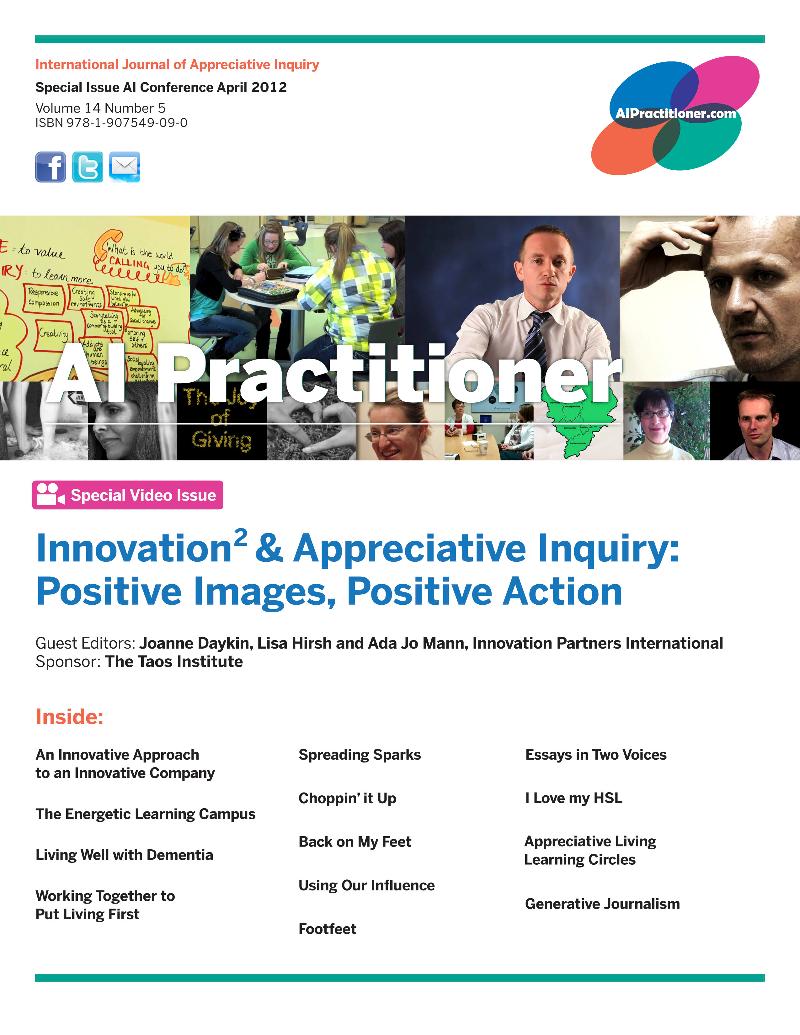
In preparation for the global conversation, you are invited to read more about intergenerational learning in the May 2015 issue of
AI Practitioner, Intergenerational Appreciative Inquiry in Conversation and in Action edited by Matt Moehle, Marge Schiller, and Peter Whitehouse. This issue of the
AI Practitioner focuses on the connection between intergenerational interactions and Appreciative Inquiry, and how this connection can be reflected in conversations, in actions and in the stance we take in everyday situations.
http://www.aipractitioner.com/appreciative-inquiry-practitioner-may-2015
|
By focusing on the positive aspects of aging, and the availability of resources, skills, and resiliencies, research not only brings useful insights into the realm of practice but creates hope and empowers action among older people. By moving beyond practices of repair and prevention, to emphasize growth-enhancing activities, practitioners also contribute more effectively to the societal reconstruction of aging.
|
www.positiveaging.net
|
Sign up for this free newsletter in the following languages:
- English
- Spanish
- Danish
- German
- French
- Chinese
- Portuguese
|
|
|
Ideas, News and Resources
August 2015
|
|
We hope you enjoy receiving our newsletter which includes constructionist ideas and practices as well as news and resources from the Taos Institute.
|
|
|
Brief Encounters with the Taos Institute
This month we welcome
Kristin Bodiford and Peter Whitehouse as they share thoughts on
Intergenerativity...
Creating Global Conversations about "Intergenerativity" to Foster Innovation
by Kristin Bodiford and Peter Whitehouse
We have been drawn together about a concept we are calling intergenerativity, which to us means fostering a meaningful fusion of conversations and experiences among often disconnected sources of human creativity like generations, disciplines or nations that inspires new possibilities and innovative actions. It is based upon concepts of generativity that Gervase Bushe, Ken Gergen and Donald Schon (2013, pp. 91-92) propose as "processes and capacities that help people see old things in new ways, reconsidering that which is taken for granted and furnishing new alternatives for social actions." Bush offers a description of generativity as "occurring through the creation of new images, metaphors, and representations that have two qualities: they change how people think so that new options [...] and/or actions become available to them (in ways that) people want to act upon them." Intergenerativity builds on these ideas through intentionally engaging diversity with a specific focus on the relational space-in-between. It embraces differences as a relational resource for transformative potential. Intergenerativity can be applied to fields of endeavor from learning to health to community development.
In this article, we offer snippets of stories we have shared with each other over the years related to this concept and how we see intergenerativity connected to social construction.
Kristin: Peter, I love the story you told me about Ms. Kelsey. Can you share that with us?
Peter: I love this story too and sharing it with you Kristin, just as Ms. Kelsey shared her love of stories and love of learning with our children in The Intergenerational School. In fact, she received our Volunteer of the Year Award a few years ago, but needed to be reminded by her daughter why. She had such a severe memory problem she could not remember she volunteered every week! But boy was she present in the moment. So this is a story that bridges the often negative, falsely hopeful world of dementia medicine with the positive aspirations we have for developing inclusive, diversity celebrating learning communities. This story demonstrates the power of intergenerativity bridging disciplines and generations.
Kristin: What I found powerful about this story, is Ms. Kelsey's level of social construction as a volunteer compared to the increasing social isolation that can result from dominant discourses and stigma about dementia. In your story, Ms. Kelsey is highly valued, and her experience in each moment is significant, regardless if she remembers it the next day. It is almost a magnification of relational responsibility - in which we are focusing on and responsible to the process of relating and the meaning we are making,
in each moment. (1)
Peter: When you talk about a focus on the process of relating, it reminds me of Ms. Mary Peery and Larry and Deshaun. Can you share this story with us?
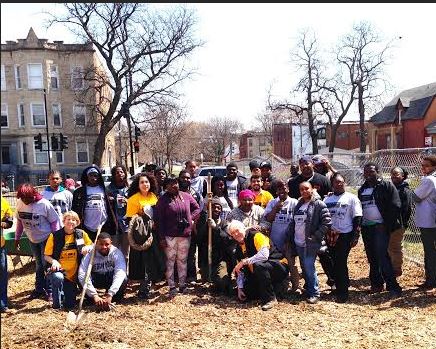 Kristin:
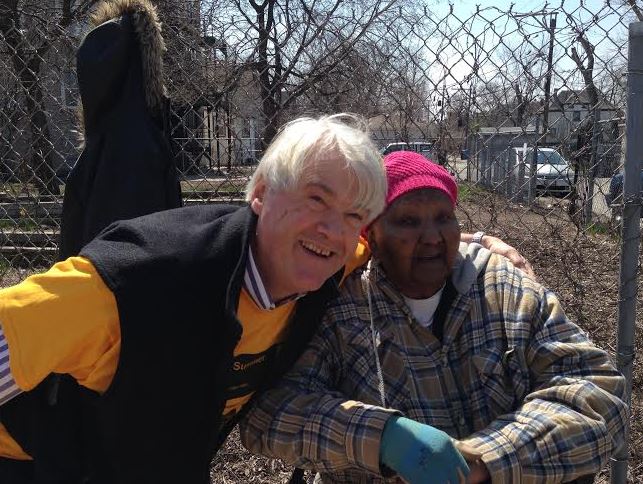
 This story is very close to my heart. Ms. Peery, Deshaun and Larry met at an intergenerational peace circle in the Austin neighborhood of west side Chicago. Deshaun and Larry decided to make a change in their community after hearing Ms. Peery talk about her community gardens and about her dream of youth and senior citizens coming together to stop the negativity in the Austin community. From this intergenerational peace circle, relationships were sparked that led to collaborative social action between generations.
 Peter:
 Yes! I particularly love this story because of being able to meet this intergenerational team and see their work. What inspires me about this story is that when are able to tap into this kind of intergenerativity, we uproot limitations created by socially constructed labels, often influenced by negative discourses, in order to construct new possible futures.
Kristin: I agree! I think we have all heard certain young people being labeled as thugs or delinquent, which gets in the way of us being able to see their strengths, hopes, and abilities to contribute to schools, families and communities. Intergenerativity, to me, helps us to see new possibilities, when the glue that makes labels stick dissolves in our processes of relating.
Kristin: Can you share the story about theater-based storytelling as another way to bring different disciplines together to foster innovation?
Peter: On the 15th anniversary of Intergenerational Schools we began an initiative called "The Intergenerativity Project". This fall, we will be collecting stories and next year we will perform a community play based around those stories. Art, music, and dance are some of the most intergenerative activities we can engage in together.
Kristin: This reminds me of all of the forms of language we engage in as we socially construct meaning. These many different ways we perform together help to destabilize what we take as certain, increasing mystery and creativity for emergence.
Peter: I loved when you shared with me about your partnerships in Uganda, bringing youth and older persons together to address community issues. These stories also help me to see the possibilities for international collaboration.
Kristin: I can share a story that connects to your storytelling project and will also bring another Taos Associate into our conversation. Celiane Camargo Borges and I visited our partners in Uganda and participated in a Photovoice project. This project also demonstrated the potential for using arts and narrative to develop shared and coordinated meaning. Young people from two villages developed stories from their experiences in Uganda. They invited people from the community to visit their Photovoice exhibit. Older persons joined in the storytelling, both from a curiosity standpoint, to better understand the experiences of the young people, and to also share their own experiences. These shared stories began a rich weaving of meaning and a strengthening of relationships.
Peter/Kristin: Connected to what Gergen, McNamee, and Barrett (2001) propose, intergenerativity is a resource for "how we create our worlds in what we do together", in which new transformative meanings and actions are sparked by bringing together different generations, disciplines, or nations into interdependent relations.
Citations:
Bushe, G. R. (2013). Generative Process, Generative Outcome: The Transformational Potential of Appreciative Inquiry. Organizational Generativity: The Appreciative Inquiry Summit and a Scholarship of Transformation Advances in Appreciative Inquiry, 89-113.
Gergen, K., McNamee, S., & Barrett, F. (2001). Toward a vocabulary of transformative dialogue. International Journal of Public Administration, 24, 697-707.
|
- Social Construction: Premises and Practices, an Online Workshop | Oct. 26 - Nov. 30, with Celiane Camargo-Borges and Dawn Dole. Participants can join in from anywhere in the world.
For information visit:
http://www.taosinstitute.net/upcoming-workshops
More workshops will be listed soon.
|
|
********************************
|
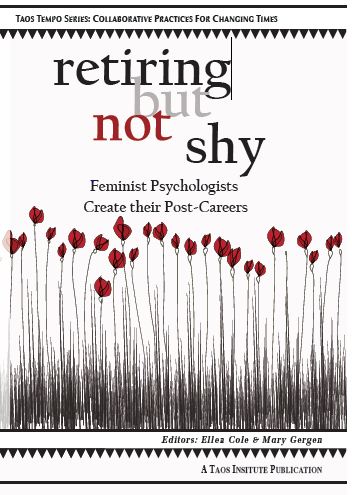
New Book 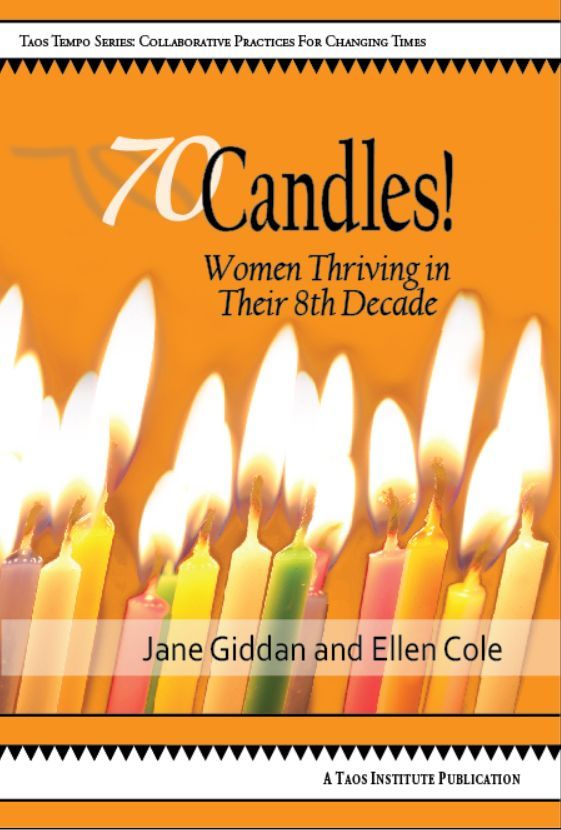
by Jane Giddan and Ellen Cole
Taos Institute Publications, 2015
Price: $19.00 US plus shipping and handling
ISBN: 13-digit: 978-1-938552-35-9
See more at:
http://www.taosinstitute.net/70candles
|
WorldShare Books

Free Download Books - Check it out - More free books are available all the time!
www.taosinstitute.net/worldshare-books
Sharing Ideas and Practices From Around the World
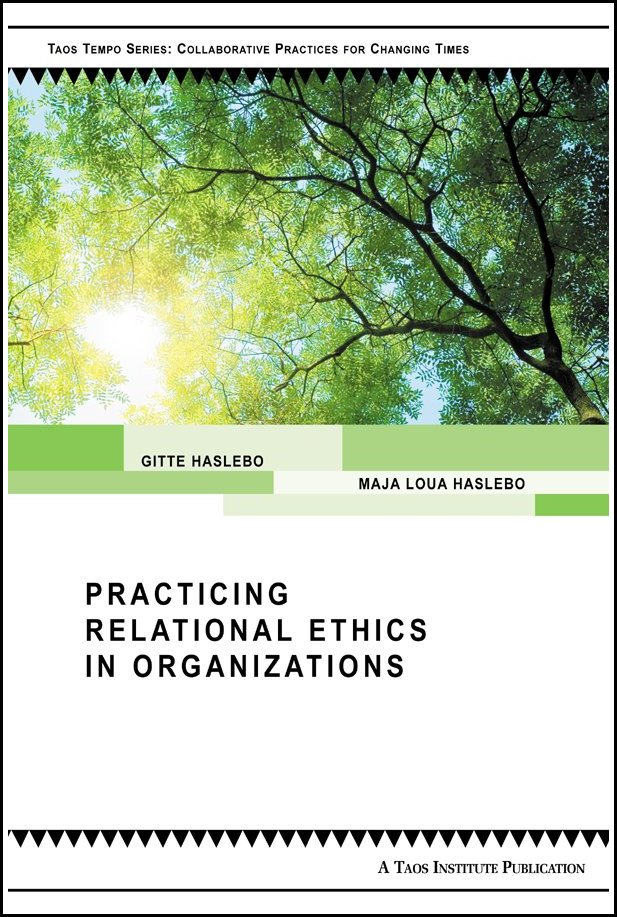
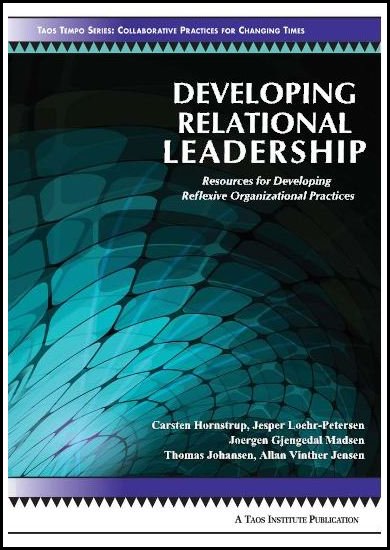
The Taos Institute offers free-of-charge books for downloading to your computer or favorite reader. Our ultimate aim is to offer books in all languages. Like all the Taos Institute Publications, WorldShare Books represent significant contributions relevant to social constructionist theory and practice. More books are being added all the time.
NEW and ready for you to download:
SOCIAL ACCOUNTABILITY& SELFHOOD
by John Shotter (original publication date 1984)
[In]Credible Leadership: A Guide for Shared Understanding and Application by Yuzanne Mare, Isabel Meyer, Elonya Niehaus-Coetzee, and Johann Roux
NEW In Spanish:
Etnia Terapeuticia: Integrando, by Jeannette Samper A. and Jose Antonio Gardiandia I.
Construccionismo Social y Discusion de Paradrigmas en Psycologia: Interminacion, Holismo y Juegos de Lenguaje vs. La Teoria Pictorica del Lenguaje, by Roberto Aristequi
All books are available in PDF format. Visit WorldShare Books
|
 International Certificate Collaborative Practices is an international learning community and network. Sponsored by Taos Institute and Houston Galveston Institute To find a program in your part of the world, take a look at: Collaborativepractices.ning.com |
|
|
The Taos Institute's mission is to bring together scholars and practitioners concerned with the social processes essential for the construction of reason, knowledge, and human value.
We are committed to exploring, developing and disseminating ideas and practices that promote creative, appreciative and collaborative processes in families, communities and organizations around the world through a social constructionist lens.
We look forward to your participation in the dialogue.
Dawn Dole, Executive Director
The Taos Institute
info@taosinstitute.net
Keep Up with Our Updates!



|
|
|