Quick, Timely Reads
On the Waterfront
| |
|
Sounds in the Night:
Offshore Breezes, Rattling Leaves, Train Whistles
| |
|
By David Frew
December 2022
| |
|
Locomotives and steam whistles from my boyhood imagination were from the 1940s,
like my electric train.
To relieve housing pressure created by having only two bedrooms I was encouraged to convert an uninsulated shed behind our kitchen into a tiny summer bedroom. The space was barely wide enough to squeeze a portable cot against the back wall, where there was a crude sliding window that could be opened to provide fresh air. It was crude but it was my very own “place” and when I opened the big window that was next to my bed (a vintage army cot), I was virtually sleeping outdoors. As summer progressed, sounds from the large, tree-lined yard behind me increased from a low level of random insect and traffic sounds to a loud din of various tones.
I had secreted my trusty crystal radio in the tiny room where I enjoyed listening to favorite mystery and detective programs on the down-low until the very late hours on most nights, but as summer progressed backyard noises eventually began to drown out my tiny receiver with its crude, crackling headphone. The mid-summer noises were created by a strange, but predictable nightly wind.
By late July, this new wind would arrive almost every evening. It was a strong wind that would seemingly come from nowhere and increase steadily. The evening summer winds seemed to have no relationship to the weather from earlier in the day. They always came from the southeast as opposed to from the usual (prevailing) southwesterly direction and when they arrived, they crashed through the trees behind the house, rattling branches and leaves that had been accustomed to a significantly different wind direction. The nightly breezes would begin at about 10 p.m. and accelerate for several hours until they quieted in the early morning.
I did not understand it at the time, but I was listening to offshore winds that were blowing from the land bordering Lake Erie toward the water. The proximity of the bayfront neighborhood to Lake Erie made it a nightly launching pad for that warm wind, which rushed from rapidly cooling land near the lakeshore toward the water. Those offshores totally shifted the neighborhood soundscape. Earlier traffic and insect sounds were drowned out by the din of wind crashing through tree branches and leaves. But the most amazing passengers of those offshore evenings came from the (east-west) train tracks that were about a mile south of the bayfront.
Sounds from the trains south of West 12th Street (today’s Conrail tracks) were brought into sharp focus by the offshore winds. And the most striking of those evening railroad sounds came from the piercing whistles that each train screeched as it entered the city, worked its way through town, and then passed the city limits. Whistles that were barely audible during the day were suddenly amplified and carried along by the offshores, making it seem like the neighborhood was immediately adjacent to the train tracks.
Railroad tracks and trains were very familiar to us kids. They were a regular part of the bayfront docks that were only a few hundred yards to our north. The trains there were perpetually moving coal and other bulk materials. But the familiar dockside trains that we knew were slow-moving, materials delivery systems. They were engaged in pushing railroad cars back and forth on sidings that were defined by rows of tracks along the Cascade Docks. The summertime night whistles were different. They were connected to the romantic, high-speed trains that sped east and west, heading to and from exciting, faraway cities like New York and Chicago. And their whistles (or electric horns) were a part of railroading tradition. In the early days of railroading, before sophisticated communications systems, which were not all that impressive during the 1950s, steam whistles were important safety/communication tools. More interestingly, each individual whistle was configured in such a way that an engineer could add his own individual touch to the sound. It was said that railroad people, both engineers on the moving trains and stationary crews, could recognize the train and its engineer by the unique sound and “style” of the whistle.
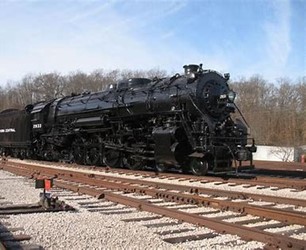
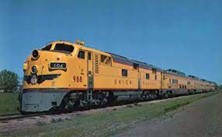
For those of us who had electric train sets – most of us – we imagined the fast-moving trains that sped along the tracks south of 12th Street to be much like the model trains that circled Christmas trees each December. In our minds, they resembled either the classic 1940s-style jet black locomotives followed by working cars and a caboose, or they were colorful, modern passenger trains with romantic names of far-off places like Union Pacific or Santa Fe.
| |
|
A bright yellow, Union Pacific passenger liner
We had heard legends, describing the fast trains that raced along the tracks between New York City (Albany) and Chicago, and of the competition between railroad companies to create the fastest and most reliable engines. Of all the mythical stories, the most familiar was the legend of Nickel Plate Locomotive #999. Several neighborhood kids had Lionel model train sets that featured that particular engine.
The famous Engine #999 was placed into service in 1893 and worked the Albany to Chicago route that passed through Erie. Number 999 was designed to set speed records. It had oversized wheels, a souped-up steam engine, and other enhancements that allowed it to be extraordinarily fast. And it was designed to work the relatively flat, lake-level route that followed Lakes Ontario, Erie, and Michigan. During its first year of service, it was clocked at 112.5 miles per hour, a train speed record that stood for decades. In fact, Engine 999 was the fastest machine on the planet at the time. The realities of that train were somewhat disappointing, however. New York Central’s “rocket train” was not particularly good at hauling large numbers of railroad cars. With more than five cars in tow – the number that had been hooked on for the speed trials – the wheels spun at relatively modest surface grades, which proved to be impractical even for the shorter passenger trains. But we did not know or care about the “alleged downsides” of Engine 999. We preferred to imagine the fabled New York Central train racing along the tracks south of 12th Street at 100 miles per hour or more.
| |
|
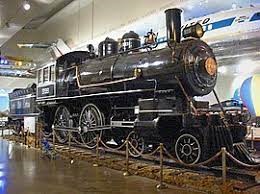
Engine 999 on display in Chicago
When Engine 999 was finally retired during the 1950s after the general conversion from steam to diesel electric power after World War II, it was not scrapped. New York Central’s rocket train was restored, moved to Chicago, and put on display at the Museum of Science and Industry on the city’s south side. The famous engine is still there at the museum.
Unlike the ponderous trains that carried coal and other bulk goods back and forth on the bayfront, the high-speed locomotives on the tracks south of 12th Street presented several very real dangers. When railroads began to displace traditional water-based shipping as the most important form of bulk, package, and passenger transportation, there was an implied “promise” of safety. Advocates suggested that trains would eliminate the frightening prospects of storms and ships sinking on the lakes. Experts also touted the year-round capability of railroads as compared to ships, which could not function once the Great Lakes froze. The most important factor was speed.
As it turned out, however, the speeds of the new locomotives in combination with their extreme weight posed unanticipated dangers. Derailments, head-on collisions and bridge collapses were the early dangers. They were generally caused by the rush to lay new tracks, which sometimes underestimated the extreme forces involved when trains had to traverse curves to get around natural obstacles. There were also miscommunications that naturally occurred when two trains were using the same tracks and traveling in opposite directions, as well as improperly built bridges that had been hastily constructed to allow trains to cross rivers and creeks.
| |
|
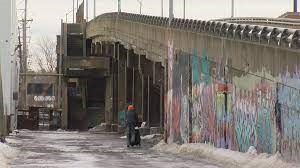
The base of the former McBride Viaduct off East Avenue in Erie
One of the most disastrous accidents in railroading history occurred in 1876 just west of Erie. A Lake Shore & Michigan train, approaching Ashtabula during the winter, was slowing to stop at the town station when the bridge over the Ashtabula River collapsed, sending almost all of the cars crashing into the steep gorge under the trestle and into the water. The disaster was made worse when stoves that had been heating several of the passenger cars broke apart and ignited fires in several individual cars. Even though there was fast response by locals who rushed to the scene to rescue passengers, 92 people were killed or injured as they had to be pulled from cars that were filling with water.
A derailment caused a major accident just west of Erie at the state line in 1953. A westbound New York Central train lost a load of improperly secured pipes that tumbled into the opposite tracks, destroying them and at the same time tearing up the westbound tracks. Moments later an eastbound passenger train ran into the damaged tracks and derailed. Because of the high rate of speed that the passenger train was traveling along the almost level, lake shore routes, the crash was disastrous. A total of 21 people were kicked and another 49 were seriously injured. Two additional trains piled into the derailment within a short time, one freight train and one passenger train.
A second and potentially more disastrous general type of railroad danger presented itself in Erie (and other locations) in the form of pedestrian accidents. The issue was particularly acute in Erie because of the town’s many at-grade track crossings. Famed urban planner John Nolen pointed to the problem in his 1913 study of the city, “Greater Erie 1913.” With the city’s population rapidly expanding to the south the only way that citizens could move back and forth to the city core was to cross the busy railroad tracks that carried the high-speed trains south of 12th Street. And prior to 1913, all of these crossings were “at grade,” meaning that cars and, more importantly, pedestrians were forced to stop and wait for trains to pass. As of 1913, there were few if any warning signals, and pedestrians, including children, were regularly hit by speeding trains and or having very close calls. With hundreds of trains each day and the city rapidly expanding to the south, Nolen predicted that the toll to human life and limb would become unacceptable. He suggested creating bridge crossings that were not at grade so that people could safely move north and south without encountering trains.
Even though several railroad bridges were added after Nolen’s report was made public, there were still dozens of dangerous and inconvenient at-grade crossings in Erie and the toll on pedestrians continued. In one of Erie’s most infamous examples, an eastside Roman Catholic pastor, Monsignor Lawrence McBride, from St. Ann Church, fought to have a bridge built to carry cars and pedestrians over the railroad tracks near East Avenue. Monsignor McBride was responding to a neighborhood need after a child had been killed while crossing the tracks on his way to school, which was located on the north side of the railroad crossing.
Through the work of Mayor Charles Barber and his attorney brother Thomas, the McBride Viaduct was funded by the state and completed in 1938 and continued in service until after the Bayfront Parkway (Route 290) was completed on the east side. Even though citizens fought to preserve the old structure, it was eventually demolished. The creation of the Bayfront Connector to Interstate 90 (and completing the arch back to I-90 with Interstate 79 on the west side was followed by the demolition of the viaduct and served as an example of the isolation of a neighborhood by road building that has become common in the United States. As the fight to save the old bridge continued, the community controversy was covered by the New York Times and other national media.
| |
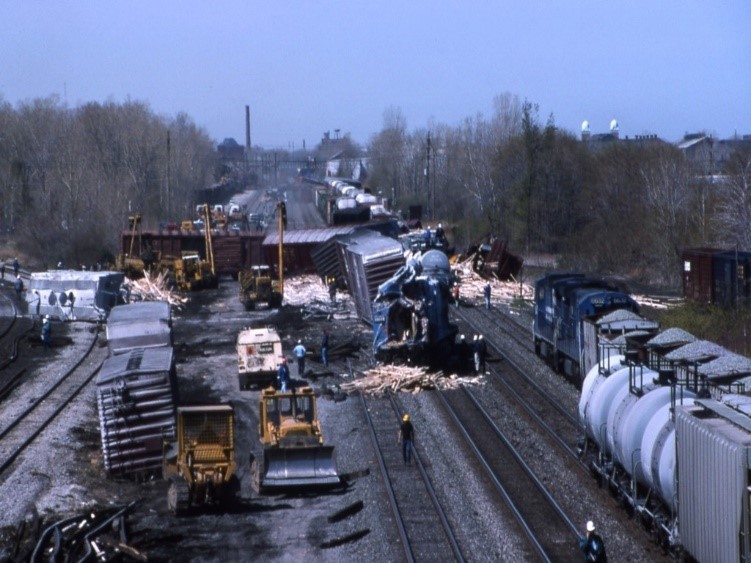
This 1995 derailment in eastside Erie (the twin peaks of St. Stanislaus Church can be seen at upper right) symbolizes the continuing problem that trains face with out-of-date tracks. | |
Accidental Paradise Available at TRECF!
Accidental Paradise
by Dr. David Frew and Jerry Skrypzak
| |
The beautiful book on Presque Isle published by authors David Frew and Jerry Skrypzak – “Accidental Paradise: 13,000-Year History of Presque Isle” – is on sale at the Tom Ridge Environmental Center’s gift shop and through a special website, AccidentalParadise.com.
The book, priced at $35 plus tax and shipping, can be ordered now through the website sponsored by the TREC Foundation, AccidentalParadise.com.
Presque Isle Gallery and Gifts on the main floor of TREC, located at 301 Peninsula Drive, Suite #2, Erie, PA 16505 will also handle sales daily from 10 a.m. to 4 p.m.
For more information, send an email to aperino@TRECF.org.
To watch "Accidental Paradise: Stories Behind The Stories" click here.
| |
ABOUT THE AUTHOR
Historian and author David Frew, Ph.D., is a Scholar-in-Residence at the JES. An emeritus professor at Gannon University, he held a variety of administrative positions during a 33-year career. He is also emeritus director of the Erie County Historical Society/Hagen History Center and is president of his own management consulting business. Frew has written or co-written 35 books and more than 100 articles, cases, and papers.
| | | | | |