| |
|
| |
Volume 15. Issue 3. April 2017 |
|
|
|
|
Domestic violence often includes some form of sexual violence. Recent statistics are both revealing and astounding:
- On average, there is one sexual assault every 90 seconds in the United States.
- 1 out 10 people has been raped by an intimate partner.
- 60% of women who are survivors of domestic violence have been sexually assaulted by their
abusers.
There are many ways you can take action:
Start by Believing
Anyone can experience sexual violence, and the perpetrators are usually someone known to the victim. Most likely it's a friend, acquaintance, coworker, or family member.
Be a Voice
Speak up when you hear people making excuses for abusers and perpetrators or discounting the experiences of survivors.
Get Involved
Advocate for safety and equality. Hold elected officials and policymakers accountable when they do not take domestic and sexual violence seriously. And, support programs working to end domestic and sexual violence.
As we recognize April as Sexual Assault Awareness Month, the time has come for us all to take action!
All the best,
Connie
|
|


Thousands of New Yorkers are impacted by abuse - in fact, for the second consecutive year New York has the highest reported demand for domestic violence services in the country. Our state must respond with solutions that meet the diverse needs of survivors and their families, and that work to prevent domestic violence from occurring in the first place.
As a coalition representing domestic violence programs and the survivors they serve across New York State, NYSCADV knows that the best legislation comes when the voices of survivors and advocates are heard. And this is what NYSCADV's annual Day of Action is for: to convey a unified message, representative of the unique needs of a diverse range of survivors, to our state government that will protect rights, promote justice, and prevent domestic violence.
NYSCADV is pleased to announce that for the second year, Mary Kay, Inc. is serving as the primary sponsor for our 2017 Day of Action! Through their Lobbying For Good program, Mary Kay staff and members of their independent sales force work in collaboration with state domestic violence coalitions to lobby Congress and state legislatures on issues including the Violence Against Women Act and, most recently, teen dating violence awareness and prevention. We are excited that Mary Kay will be sponsoring a lunch for Day of Action participants and will be joining advocates from across the state to support our legislative advocacy efforts.
On May 8th, join a vibrant, diverse and innovative group of advocates and allies from across New York State to raise our voices and relay a unified message to the legislature and governor: it's time to pass meaningful legislation to protect survivors of domestic violence in New York State!
DATE
May 8, 2017
TIME
10:00 AM - 4:00 PM
WHERE
Empire State Plaza-Meeting Room 6
Concourse Level
Albany, NY 12242
We encourage everyone to wear PURPLE!
Our goal is to turn the legislative Chamber purple in support of domestic violence response and prevention!
|
|
NYSCADV & Partners Participate in SUNY's Got Your Back Event
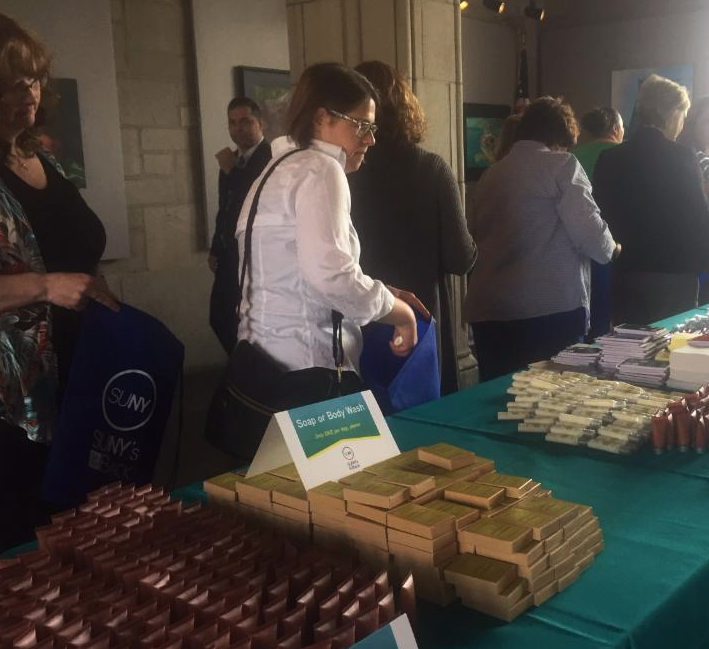
In recognition of Sexual Assault Awareness Month, the State University of New York (SUNY) hosted a special "SUNY's Got Your Back" Event on April 10, 2017 in Albany, NY. NYSCADV along with SUNY staff and other partners in prevention helped pack 500 comfort bags for domestic violence and sexual assault survivors. The assembled bags will be distributed to local domestic violence and sexual assault service providers.
SUNY's Got Your Back is a program to assemble and distribute bags for survivors who are seeking help from local domestic violence and sexual assault programs, and New York State Coalition Against Domestic Violence is a partner in this initiative.
To date, 64 SUNY campuses have held "SUNY's Got Your Back" events resulting in the assembly of over 10,000 backpacks for victims of sexual assault and domestic violence.
|
|
NYSCADV's Lorien Castelle Named
Recipient of RESOLVE's Resolutionary Award
On April 6, 2017, Lorien Castelle, NYSCADV's Director of Prevention received RESOLVE's Resolutionary Award for her work to prevent domestic violence.
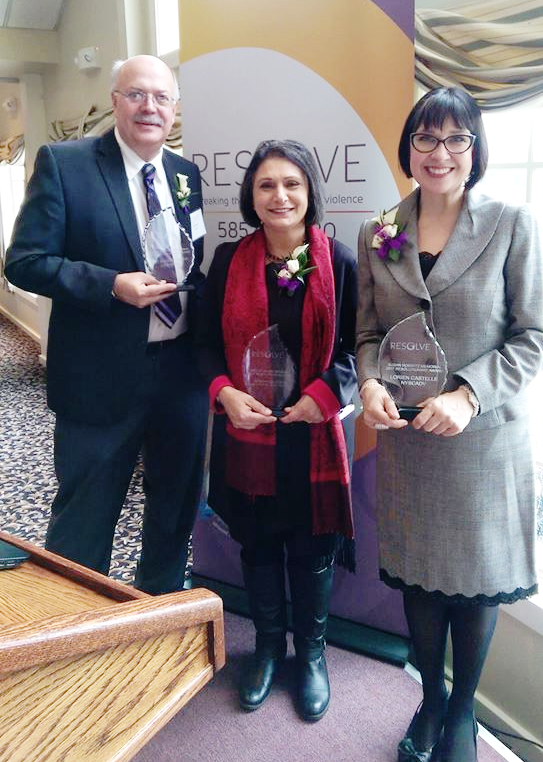
The Susan H. Horwitz Memorial Resolutionary Award recognizes professionals who demonstrate exemplary vision, leadership and determination while working in fields related to intimate partner, family, and sexual violence prevention. Castelle received this award on April 6, 2017 at RESOLVE of Greater Rochester's Fourth Annual Resolutionary Awards Breakfast at Eagle Vale Golf Club.
As NYSCADV's Director of Prevention, Castelle is responsible for overseeing statewide training and technical assistance, capacity building, and the development of community-based prevention initiatives. She also convenes a statewide advisory committee of allies and partners to collaboratively implement a statewide plan to prevent domestic violence in New York.
"This is a well-deserved honor for Lorien," said New York State Coalition Against Domestic Violence Executive Director, Connie Neal. "Since joining the staff of NYSCADV in 1998, she has done tremendous work on local, statewide, and national initiatives to prevent domestic violence, and I am incredibly pleased that she is being recognized at this year's Resolutionary Awards Breakfast."
|
For New York Families in Custody Fights,
a 'Black Hole' of Oversight
Critics say a state office's professed inability to review the work of mental health experts in Family and Matrimonial Court leaves children at risk.
When Anna Frank lost custody of her 9-year-old son, she blamed her husband and the judge who decided the case in his favor.
She also faulted Barbara Burkhard, a psychologist appointed to evaluate the family and advise the court on the matter. According to Frank, Burkhard concluded - after meeting Frank once and without interviewing her son - that their claims of abuse were invented and that Frank had poisoned her child against his father.
Frank ultimately regained custody of her son, based partly on testimony from other psychologists who disputed Burkhard's contentions. But before she did, she sought sanctions against Burkhard from the agency that oversees licensed psychologists in New York.
Frank's densely detailed, 12-page complaint to the Office of Professional Discipline was never investigated, let alone acted upon.
Click here and read the full article "For New York Families in Custody Fights, a "Black Hole" of Oversight."
|
New York Looks To Teens In Effort To
Prevent Domestic Violence
A task force assembled by Mayor Bill de Blasio to tackle New York City's stubborn domestic violence problem plans to ramp up its teenage outreach efforts- hoping to stop violence before it even starts.
While most violent crime has dropped over the past decade in New York City, domestic violence hasn't budged, frustrating public safety officials and victim advocates. The task force, created in 2016, has been charged with developing a road map for reducing domestic violence across the city. It recently finished its initial fact-gathering phase, with the focus on teens as one of the major takeaways.
Prevention efforts must include educating young people about healthy relationships, said Bea Hanson, who ran the Justice Department's Office on Violence Against Women before being brought on as Executive Director of the task force. She said there is currently no standardized curriculum on teen dating abuse for students in New York City.
The task force plans to release a comprehensive blueprint on reducing domestic violence in the spring.
Click here and read the full article "New York Looks To Teens In Effort To Prevent Domestic Violence."
|
The Biggest Little Lie Of All: What Actually Happens When You Kill Your Abuser
In May 2012, mother of three Marissa Alexander was prosecuted for aggravated assault with a deadly weapon, a crime for which she received a minimum sentence of 20 years in prison. Except, she never actually hurt anyone. Under the defense of Florida's "Stand Your Ground" law, the woman aimed a warning shot at the ceiling of her home in Jacksonville, after her ex-husband allegedly threatened to kill her. Following a plea deal, Alexander ultimately spent three years in prison. She then served the remainder of her sentence in house arrest. In February, she was finally able to remove her ankle bracelet for the first time in four years.
In an interview with The Cut, the newly free woman said she was aware of Florida's minimum 20-year sentence for firing a gun, but she never thought this law would apply to her case.
The Domestic Violence Survivors Justice Act, which the New York State Assembly passed last year, aims to change this broken system. Under this legislation, incidents of domestic abuse could be entered into these cases as evidence, and judges could bypass mandatory minimums set by the state. They could also choose to give survivors shorter sentences, or even let them avoid prison by sentencing them to alternative programs.
The New York State Coalition Against Domestic Violence's Policy Director Saima Anjam told Elite Daily the bill is currently in the "third reading." Sponsored by New York State Senator Ruth Hassell-Thompson and Assemblyman Jeffrion Aubry, the bill is primed and could technically be voted on any day now. Anjam would "like to see the bill voted on by the end of 2017."
|
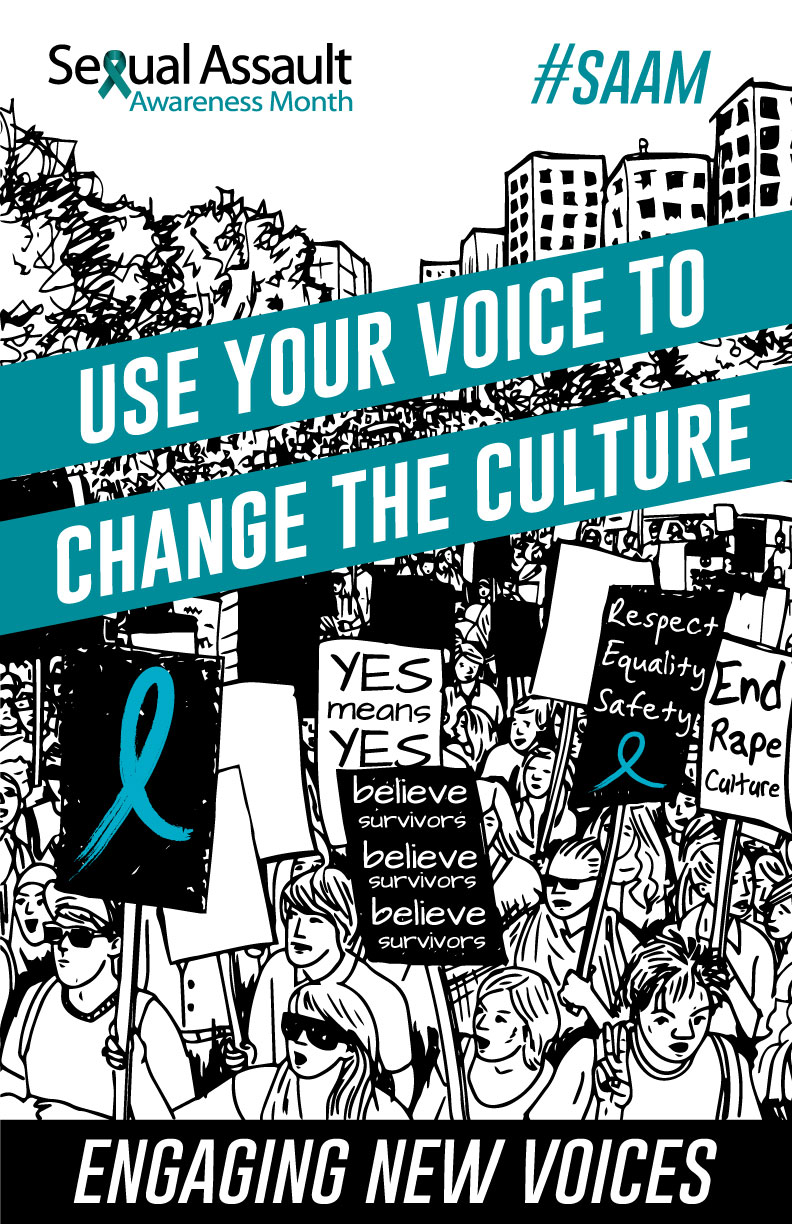
April is Sexual Assault Awareness Month
April is Sexual Assault Awareness Month (SAAM). This year, the SAAM campaign is Engaging New Voices. The focus will be on involving coaches, faith leaders, parents, Greek Life, and bystanders with preventing sexual assault. Many groups know about sexual assault and believe it is a problem, but they don't know how they can help.
Sexual violence undermines the values of strong communities. Online comments that blame victims contribute to a broader climate in which sexual violence is tolerated and not taken seriously. Ending culture of sexual assault is only possible with contributions of different groups and communities.
The SAAM 2017 campaign toolkit provides resources on engaging new voices to talk about preventing sexual assault. This is a toolkit for advocates, campus personnel, students and allies. These materials can be used to engage the entire community to take action to end sexual assault.
|
|
NNEDV Urges Rejection of Proposed Federal Budget Cuts
In March, the President released the framework for his proposed FY18 budget (known as the skinny budget), with a more detailed budget to be released in May. The proposed framework, though scarce on details, includes proposed topline cuts that could impact programs that serve survivors, such as the Violence Against Women Act (VAWA) and the Family Violence Prevention and Services Act (FVPSA). Additionally, the budget calls for the elimination of key programs that are critical to victims of domestic violence, and reductions in other important programs.
The skinny budget framework proposes a topline cut of 18% to programs at the U.S. Department of Health and Human Services (HHS) and a 4% cut to the U.S. Department of Justice (DOJ). If these cuts were applied across the board to all programs at HHS and DOJ, approximately 260,000 fewer victims would be able to access shelters and supportive services provided by VAWA and FVPSA. "Even with current funding levels, although nearly 70,000 adults and children were served by domestic violence programs on a single day (24 hours) in 2015, there were nearly 12,000 requests for help on that same day that went unmet because programs lacked resources," [1] said Gandy. "Our nation is in no position to cut funding for these vital programs. Programs need more funding, not less."
The budget framework would eliminate programs that help victims fleeing domestic violence achieve safety and stability, such as the Legal Services Corporation, the Low-Income Home Energy Assistance Program (LIHEAP), the HOME affordable housing program, and the Community Development Block Grants that fund shelter, housing, economic opportunities and supportive services in communities across the nation. It reduces funding for the important Women's, Infants, and Children Food and Nutrition Service (WIC) program, and would eliminate the U.S. Interagency Council on Homelessness which has brought federal agencies together to address the strong connection between domestic violence and homelessness.
In addition to specific cuts and eliminations noted above, the overall reduction in "non-defense discretionary" investments would have a compounding negative impact. Together, these cuts would reduce the social safety net and expose low-income and vulnerable populations, including victims of domestic violence, to greater insecurity.
|
'Nuisance Laws' Discourage Domestic Violence Victims From Calling the Police
From September 2011 to February 2012, Missouri woman Rosetta Watson reportedly called the police multiple times to report abuse from her ex-boyfriend, once after he kicked through her front door and punched her in the face while she was in bed. According to the ACLU, doing so lost her home.
This is because of something called a "nuisance law" that considers more than two calls to
the police from the same address about domestic violence within a 180-day period to be a nuisance, and legally condones kicking that nuisance caller out of their house and banning them from the city for six months. Watson eventually moved to St. Louis, where the same ex-boyfriend broke into her house and stabbed her legs.
On Friday, the organization filed a lawsuit against the city of Maplewood, Missouri, on behalf of Watson. "The city of Maplewood violated Ms. Watson's fundamental constitutional rights by enacting and enforcing a law that punishes crime victims merely because they ask for help," said Tony Rothert, legal director of the Missouri ACLU in a statement. "Banishment from one's home should never be the result of calling law enforcement for assistance."
Similar nuisance laws are being passed across the country, in states like New York, Arizona and Wisconsin, with the alleged intention of encouraging landlords to take care of problems on their properties. But they increasingly force victims-largely of domestic violence-to choose between reporting their crimes at the risk of eviction, and staying quiet.
|
|
Hotline for American Indian Survivors of Domestic Violence
More than 84 percent of American Indian and Alaska Native women have experienced violence in their lifetime. More than half have experienced physical violence by an intimate partner.
Now, Native survivors of domestic and dating violence can use the nation's first crisis line dedicated for tribal communities. The StrongHearts Native Helpline, which seeks to offer culturally relevant, safe and confidential resources, was created by The National Indigenous Women's Resource Center and the National Domestic Violence Hotline.
The first region of service is Kansas, Oklahoma and Nebraska. Callers outside the three-state area can call StrongHearts as the helpline develops its services.
The helpline was created by and for American Indians. Advocates at StrongHearts are trained to navigate each caller's abuse situation with a strong understanding of Native cultures and issues of tribal sovereignty and law in a safe and accepting environment.
|
|
The Latest San Bernardino Shooting Reveals A Far More Common Form Of Terror; A rage-filled man taking his wife's life
On April 10, 2017, Karen Elaine Smith was doing what she loved best - teaching students with intellectual disabilities - when her estranged husband walked into her classroom armed with a .357 handgun, police say.
Cedric Anderson didn't say a word. He "
just shot everywhere" before reloading and killing himself, a child who witnessed the scene told the Los Angeles Times. Smith died. Two of her students were hit by errant bullets. One, 8-year-old Jonathan Martinez, died later that day.
An 8-year-old and his teacher were dead. But the public breathed a sigh of relief: At least the shooting was not an act of terrorism.
That reaction - or lack of one - is misguided. The latest San Bernardino shooting was also an act of terror - a much more common kind, with a much higher death toll: The kind women face when trapped in abusive relationships.
"Multiple murders by a stranger stay in the news for weeks, often carrying demands for change. But for victims of domestic violence like Karen Elaine Smith, their stories make headlines for a day or two, and then vanish," said Kim Gandy, CEO of the National Network To End Domestic Violence.
Women are in the most danger when trying to leave relationships, experts say. And black women have historically experienced disproportionately high rates of fatal domestic violence. In 2013, black women were murdered at a rate
two and a half times
that of white women, according to a study that examined incidents in which men killed women. Smith was black.
|
Rape Costs Survivors Stress, Trust, Sleep, & About $122,000
In the year since the last Sexual Assault Awareness Month, the public may have become more "aware" of the issue than ever before, due in part to several watershed moments that have sparked national dialogue.
"In the past year it was a topic that came up in so many ways and forms, and there was a lot of public awareness and outrage, ranging from the Stanford rape case all the way to our own national election," said Laura Palumbo of the
National Sexual Violence Resource Center. A
survey released Monday by the center found that 84% of U.S. adults recognize acts such as sexual intercourse without a partner's consent as sexual assault and 83% identify unwanted touching, groping or fondling as such. These percentages may seem low to some people, but Palumbo says that "given long-standing cultural perceptions of sexual assault this is actually a strong level of awareness."
|
Human Trafficking In Hotels
The first time Anneke Lucas heard about legislation designed to rescue human trafficking victims in hotels, she couldn't help but think about how something like that could have helped her as a child.
Lucas, 53, began an online petition, asking that legislators work toward a similar bill in New York - a Mecca of tourism and the hotel industry - following Connecticut's lead.
After receiving more than 54,000 signatures, she teamed up with New York State Assemblywoman Amy Paulin, who began drafting legislation that would make the signs mandatory in hotels, and would training hotel staff how to spot victims.
Paulin has been a longtime advocate for human trafficking awareness and has already helped to pass legislation that trained hospital staff in New York to recognize and report potential victims.
She told NBC News her passion for the issue came from years of advocating for victims of domestic violence. Paulin recalled how she had been in salons when hairdressers noticed
bruises on the hairlines of their clients.
Paulin's legislation, which is still in the works, would include mandatory training of staff members as well as informative signs in hotels, motels and inns in New York state.
|
|
Survivors Allowed To Register to Vote Anonymously
In Britain, Survivors of domestic abuse will be protected from their attackers when they register to vote, under new Government
plans.
The rules will be relaxed to make it far easier for victims of abuse to register anonymously, in a victory for a
campaign by charities including Women's Aid.
Ministers say the move will also prevent people using the electoral rolls to track down victims of stalking, as well as protect some witnesses in criminal court cases.
The current
law has been fiercely criticized because anonymity is only granted with a court order, or with the agreement of a senior police officer.
Many survivors of domestic abuse are unable to pass those tests and - if they are too scared to register openly - lose their right to vote.
|
|
The New York Asian Women's Center to WomanKind
In January 2017, NYSCADV member program the New York Asian Women's Center officially became WomanKind. "We are strengthening our focus on advocacy and policy work, alongside our direct service provision" stated WomanKind Executive Director Larry Lee. "Though our plans to expand our advocacy efforts were initiated before the presidential election, advocacy takes on greater urgency and carries more profound, life-changing implications. The survivors we serve, along with their communities, are frightened because of immigration concerns, hate crimes, the potential of widening gaps in the social welfare safety net, loss of health insurance, and the decline of affordable housing, among other concerns."
|
|
NYC Anti-Violence Project Hosting
Immigration Legal Clinics in NYC Area
The NYC Anti-Violence Project (AVP), a NYSCADV member program, is hosting legal clinics in the NYC area for LGBTQ individuals. These clinics will provide brief legal advice, referrals or representation. Issues that can be addressed include legal name change, identification document change (passport, etc.), immigration, advance directives, wills, family law, intimate partner violence, and legal support for survivors of hate violence.
Walk-ins are welcome, but those who register will be ensured an interview. Translators are available upon request.
|
|
Orange Flags, Pinwheels Support Survivors, Raise Awareness
NYSCADV member programs RESTORE & Chances and Changes worked together to place orange flags and colorful pinwheels.
Seven hundred twenty. That's the number of small orange flags placed at the intersection of Route 20A and Volunteer Road, across from Genesee Valley Plaza in Geneseo.
Lauren Berger, outreach and education specialist at RESTORE, said the 720 flags represent the number of people - one every 2 minutes - who are sexually assaulted every day in the United States.
The flags will be on display through the entire month of April, which is "Sexual Assault Awareness Month."
This is the third year of the flag campaign and for this first time RESTORE is pairing with other agencies as part of the month's theme of "Engaging New Voices."
Berger was joined in placing flags Monday morning by Alicia Ransom, a caseworker with Livingston County Child Protective Services, and Candice Murphy, a family safety advocate with Chances and Changes Inc., who works through Child Protective Services.
Ransom and Murphy had placed numerous metallic pinwheels at the intersection to represent "National Child Abuse Prevention Month," which is also recognized during April.
|
|
Safe Horizon's 22nd Annual Champion Awards
On April 6, 2017, NYSCADV Member Program Safe Horizon hosted its 22nd Annual Champion Awards. The gala focused on the children and young people harmed by violence and abuse, raising $1.4 million to support Safe Horizon's life-saving services and programs. Hosted by Alan Cumming, a survivor of child abuse himself, the event honored country music artist and actress Jana Kramer, and Chief Marketing Officer of Commercial Banking at JPMorgan Chase and Safe Horizon Board Member Samantha Saperstein. Notable attendees included journalist and host of Deadline Crime Tamron Hall, co-host of ABC's The Chew Clinton Kelly and Grammy Award winning India Arie.
|
THRIVE: A Framework for Understanding the Community Determinants of Intimate Partner Violence
Prevent Intimate Partner Violence (IPV), a project of the National Resource Center on Domestic Violence has released a
new resource to support local IPV prevention efforts in diverse communities.
THRIVE: A Framework for Understanding the Community Determinants of Intimate Partner Violence presented by Lisa Fujie Parks and Ashley Crawford, hosted by the PreventIPV Project of the National Resource Center on Domestic Violence (August 2, 2016)
There is growing understanding that social determinants of health (SDOH) need to be addressed in order to promote health, safety, and health equity. But there are few frameworks and tools that specifically focus on how to address issues like intimate partner violence (IPV) through a SDOH approach. Prevention practitioners working at the community level are asking questions such as: What factors need to be addressed to promote community environments that support safe relationships and decrease rates of IPV? And how can efforts to address these factors decrease inequities in rates of IPV rather than exacerbate them?
In this webinar, Prevention Institute provided an overview of THRIVE, a framework and tool that can help prevention practitioners explore these questions. PI shared work completed in 2016 with support from the Blue Shield of California Foundation to map the community determinants of IPV onto THRIVE. Presenters explored how THRIVE can be used as a practical framework and tool to support local IPV prevention efforts in diverse community contexts.
Objectives:
- Provide an overview of THRIVE, a framework and tool to address the social determinants of health at the community level;
- Discuss the community determinants of IPV using THRIVE; and,
- Explore how THRIVE can be used as a framework and tool to support local IPV prevention efforts in diverse community contexts.
Click here to watch the recorded THRIVE webinar and view additional materials.
|
|
|
Study Finds Communities Can Prevent Sexual and Dating Violence in Schools
Green Dot teaches individuals how to speak up or step in when they see harassment, bullying, or abuse. Over five years, the study looked at the impact of Green Dot in 26 Kentucky High Schools. Researchers found a reduction in sexual violence and dating violence among students following program implementation.
These findings are among the first to identify an effective bystander intervention for preventing sexual and dating violence among teens.
Implications for Prevention
Giving educators extensive training and continuous feedback throughout program implementation, as well as training Rape Crisis Center educators as both advocates and prevention educators, may strengthen the effectiveness of approaches to prevent sexual and dating violence.
|
Facebook Launches Tools To Combat Revenge Porn
Revenge porn is pervasive, and Facebook wants to do its part to stop it from spreading on its platforms.
The term refers to non-consensual pornography that's distributed online to shame, exploit or extort its victims.
The company said it would apply photo-matching to ensure intimate, nonconsensual images that are reported once aren't able to be uploaded again through Facebook's properties, including Messenger and Instagram.
Facebook
(FB, Tech30) said once an image is reported, it is reviewed by the company's community operations team and then photo-matching will be applied.
From there, "if someone tries to share the image after it's been reported and removed, we will alert them that it violates our policies and that we have stopped their attempt to share it," Facebook head of global safety Antigone Davis said in a company blog post.
A study from Data & Society Research Institute found that one in 25 people has been a victim of either threats, or actual posts, of revenge porn. The phenomenon is emotionally distressing, even resulting in some publicized suicides as a result of the shame and bullying that often results.
Since 2009, Safety Net project of NNEDV has worked with Facebook to help improve safety considerations and increase survivor's ability to safely utilize the platform.
|
|
Apps Help Survivors' Messages Stay Secret
Pros and cons of Telegram, Whatsapp and Threema for survivors
Texting is a great way to communicate, especially since it can be more private than a phone call and quicker than an email.
But it comes with its own security pitfalls mainly, that text messages can stay on your phone indefinitely and often show up on other devices linked to that phone. For survivors of domestic violence who are used to having their every move tracked by an abuser, leaving behind a trail of who they're communicating with can give their abusers yet another way to stalk them, or may enrage an abusive partner.
A bevy of new instant messaging apps that promise top-notch encryption may be a better option than the standard text; One such app is called
Telegram and allows "secret chats." The developers also promise "end-to-end encryption." As an alternative, other tech gurus recommend Whatsapp instead, the most widely used mobile messaging app out there. It allows private individual and group chats and calls, and also offers end-to-end encryption so no third party can view the messages, and promises this security is automatic without turning on any additional settings. There is also a way to enable self-destructing messages.
However, critics slammed this app recently when it was revealed it would share some information with Facebook, after the company bought out the app in 2014.
Enter Threema, whose main selling point is that they do not collect any data. Your messages and contacts are not shared with the app, are protected against hackers, and messages are deleted after delivery.
While all of these messaging apps may be useful for survivors who are trying to communicate with support persons about their situation without their abusers catching on, the flip side is that survivors should also be aware these apps can be used by their abusers, too.
"Abusers often use apps like these to cover their tracks, in an effort to keep their harassing and threatening messages from being saved by the victim and potentially used as evidence against them," says Corbin Streett, LMSW, technology safety specialist with the National Network to End Domestic Violence's Safety Net Project.
|
|
Defining Trauma Informed Services
More and more professionals working with survivors of violence use the terms "trauma-informed services" and "trauma-informed care." These concepts grew out of findings about trauma's effects on war veterans. Today, the terms are commonly considered effective approaches for working with people who have experienced other types of trauma, including domestic and sexual violence.
Some domestic and sexual violence victim advocates are concerned, however, about how a trauma-informed approach fits into the grassroots, survivor-centered model that grounds the movement to end domestic and sexual violence.
To understand how the concept of a trauma-informed approach is both viewed and applied in addressing sexual assault, domestic violence, dating violence and stalking, the Office on Violence Against Women (OVW) commissioned a project to capture the national landscape of understanding about trauma-informed policies and practices for OVW stakeholders.
|
|
SUNY Resource for Victims of Sexual Assault & Violence Now Translated Into More Than 100 Languages
The State University of New York announced an expanded offering of its Sexual Assault and Violence Response (SAVR) resources for victims and survivors of sexual and interpersonal violence. In addition to the local contacts and information previously available, SUNY has translated the Affirmative Consent, Amnesty, and Bill of Rights provisions of Enough is Enough legislation into more than 100 languages, developed a visa and immigration resource specific to international and immigrant victims and survivors of violence, and will be making all of its resources publicly available so that any college, State agency, or community organization can access them for free.
|
Spouses Battered or Subjected to Extreme Cruelty by A, E(3), H or G Visa Holders Are Eligible to Apply for Work Authorization
USCIS is now accepting employment authorization applications from abused immigrant spouses of H, G, A and E (3) visa holders.
The Violence Against Women Act of 2005 amended Section 106 of the Immigration and Nationality Act to provide access to legal work authorization for abused spouses of certain work visa holders. The implementation of this law will offer much needed protection to immigrant spouses of work, diplomatic and foreign government employee visa holders. This will also apply to abused spouses on visas obtained based on their marriage to a visa holder who is an abusive spouse.
This work authorization will promote greater reporting of domestic violence, child abuse and sexual violence crimes perpetrated against dependent visa holder spouses and children living in visa holder families. Survivors will be able to flee abusers with their children and work while they pursue avenues available to them to transfer from legal immigration status dependent on their abusers to other forms of legal immigration status that they are eligible to receive. Most will qualify for U visas based on the battering or extreme cruelty they have suffered.
|
|
Immigration Financial Support- Using the I-864 to Transition to Self-Sufficiency
End Violence Against Women International (EVAWI) has released a pre-recorded webinar title,
Immigration Financial Support - Using the I-864 to Transition to Self-sufficiency.
The recording is now available free of charge in EVAWI's webinar archive.
This training will help advocates, law enforcement and other professionals identify clients/survivors who might be able to benefit from the Form I-864. Learn easy questions that can be added to your intake procedure to screen for potential eligibility, and learn to better asses the scope of support to which an individual might be eligible, and what steps may be taken to enforce the support obligation.
|
|
Resources For Protecting Domestic Violence Immigrant Survivors
The Immigrant Defense Project has several community resources including a 2 page Know Your Rights flyer (available in eight languages), ICE Raid Toolkits and planning guides for those at risk of deportation. In addition to community resources, they also operate a Criminal Immigration hotline and have additional resource guides for criminal defenders, immigration attorneys, judges, and prosecutors.
Click here to view the Immigrant Defense Project'
s Resource Guides.
The National Latin@ Network, a project of Casa de Esperanza, has put together a Question & Answer (Q&A) document for advocates and attorneys serving immigrant survivors of gender-based violence. The Q&A on immigrant survivors of gender-based violence includes information for undocumented survivors and survivors who may be eligible for VAWA self-petitions, U visas, T visas or those applying for gender-based asylum.
|
|
National Resource Center on Domestic Violence
Special collection Highlighting The Earned Income Tax Credit (EITC) And Other Tax Credits For Survivors
Since its inception, the EITC has been heralded as one of the most successful anti-poverty strategies in the United States, and numerous other tax credit programs have followed. Today there are tax credit programs for low-income workers with children and other dependents and for individuals seeking higher education, as well as outreach efforts designed specifically for underserved populations.
This collection highlights key resources for the EITC, the Child Tax Credit, Health Coverage Tax Credits, and others. It includes general information and fact sheets, reports and research, information about how tax credits affect eligibility for other federal benefits, resources to access state specific statistics and contact information, and resources specific to three underserved populations (Native Americans, workers who are immigrants, and workers with disabilities). It also provides information on free tax preparation services across the country and ways to avoid predatory lending and tax services.
|
|
Center for Survivor Agency & Justice Releases
Accounting for Economic Security Atlas
There is no safety for survivors of domestic violence without economic security, and there is no economic security without social equality. Domestic violence can only be meaningfully addressed with a paradigmatic shift in the way in which individuals and institutions respond to survivors' economic needs. This Atlas sets forth an approach to advocacy for survivors, which shifts the underlying goal from economic self-sufficiency to economic agency and places the intersecting identities of survivors at the center of our work.
|
|
Your Money, Your Goals: Focus on Reentry
This is a new guide that provides information and tools specific to the financial challenges justice-involved individuals face. Consumer financial issues are a key concern for many people transitioning from incarceration, and Your Money, Your Goals: Focus on Reentry has tools to help people prioritize and manage their debt, know their rights around background reports, and access and fix their credit reports.
There are an estimated 70 to 100 million individuals in the US with criminal records. These individuals face unique challenges transitioning back to society, many of which are financial. We want to make sure that all consumers get access to the financial products and services they need to achieve their fin
ancial goals.
|
Queering Reproductive Justice Toolkit
Many within the LGBTQ community-including cisgender women, transgender men, intersex people and gender non-conforming people-are still fighting for fair access to reproductive health, rights, and justice. The President and his administration have been working to cut access to sexual and reproductive health services. These services include important transgender health care and HIV prevention care, and are integral to community health and bodily autonomy.
That is why the National LGBTQ Task Force developed Queering Reproductive Justice: A Toolkit to support an intersectional approach to reproductive health, rights and justice and LGBTQ advocacy.
This first-of-its-kind toolkit covers some of the fundamentals of reproductive justice and LGBTQ liberation.
|
|
Firearms and Domestic Violence: A Deadly Combination
Firearms and domestic violence are a lethal mix. Looking at homicides that occurred in 2011, a recent study showed that nearly two-thirds of women killed with guns were killed by their intimate partners.(1)
It is clear from this data that removing guns from domestic abusers saves lives.
It is important for all disciplines to understand the federal firearm laws and their relationship to any state laws. The complexity of firearm legislation and case law make it difficult and confusing to determine what laws apply and to whom. Federal law prohibits abusers who have been convicted of misdemeanor crimes of domestic violence and persons subject to certain protection orders from purchasing or possessing guns and ammunition. Some states have enacted legislation that mirrors the federal firearm prohibitions. Other jurisdictions have adopted broader laws to address issues that the federal law does not address such as including dating relationships and stalking crimes. To assist practitioners, The National Center of Protection Orders and Full Faith & Credit (NCPOFFC) has compiled
a matrix of domestic violence-related firearm prohibitions.
All disciplines that deal with intimate partner violence have a unique responsibility to address the presence and use of weapons to ensure survivor safety. NCPOFFC has created firearms checklists so practitioners can be better prepared to deal with weapons possession. Please click the following link to access the appropriate firearms checklist:
Law enforcement checklist:
This checklist for law enforcement provides information on two classes of persons prohibited under the domestic violence related provisions of the federal Gun Control Act. Those subject to a protection order (18 USC 922 (g)(8)) and those convicted of a misdemeanor crime of domestic violence (MCDV) (18 USC 922 (g)(9)) are prohibited from purchasing or possessing firearms. This document also provides tips on seizure and safe return of firearms as well as responding to information requests and incidents of officer-involved domestic violence. It is important for all disciplines to understand the federal firearm laws and their relationship to any state laws
This checklist for judges provides key information on the federal Gun Control Act provisions prohibiting purchase or possession of firearms by those subject to a protection order (18 USC 922 (g)(8)) or those convicted of a misdemeanor crime of domestic violence (MCDV) (18 USC 922 (g)(9)). Detailed information on who is prohibited, as well as surrender, transfer, and return of firearms, and requirements of judicial notification are provided.
This checklist provides information for advocates facilitating a discussion with survivors about firearms. It also provides key information on the federal Gun Control Act provisions prohibiting the purchase or possession of firearms by those subject to a protection order (18 USC 922 (g)(8)) or those convicted of a misdemeanor crime of domestic violence (MCDV) (18 USC 922 (g)(9)).
This checklist for prosecutors provides key information on the federal Gun Control Act prohibiting those subject to a protection order (18 USC 922 (g)(8)) or those convicted of a misdemeanor crime of domestic violence (MCDV) (18 USC 922 (g)(9)) from possessing a firearm or ammunition. This tool provides tips from charging decisions to documenting the conviction, as well as facilitating a community response to aid in convicting dangerous abusers.
|
|
Risk Reduction Enhanced Response Pilot Program Grants, OPDV
The Office for the Prevention of Domestic Violence is accepting proposals from NYS domestic violence service providers that are licensed and/or approved by the Office of Children and Family Services (OCFS) to coordinate and implement the RRER Pilot Program. Award preference will be given to applications with the greatest need, best potential for collaboration, and most thorough Program strategy.
OPDV will fund up to four grants to NYS domestic violence programs that are licensed and/or approved by OCFS, for up to a total of $200,000, with a maximum of $100,000 annually per award. OPDV is requiring a 20% match for
this Request for Proposals (RFP)
, resulting in a total of state-local investment of $120,000 per year of the pilot project.
Due Date: May 17, 2017 12:00 PM EST
|
Webinars, Events & Trainings
(descriptions are taken directly from the host's event announcements)
|
NYSCADV
Day of Action 2017
May 8, 2017
10:00 AM - 4:00 PM
Albany, NY
Thousands of New Yorkers are impacted by abuse - in fact, for the second consecutive year New York has the highest demand for domestic violence services in the country. Our state must respond with solutions that meet the diverse needs of survivors and their families, and that work to prevent domestic violence from occurring in the first place.
As a coalition representing domestic violence programs and the survivors they serve across New York State, NYSCADV knows that the best legislation comes when the voices of survivors and advocates are heard. And this is what NYSCADV's annual Day of Action is for: to convey a unified message, representative of the unique needs of a diverse range of survivors, to our state government that will protect rights, promote justice, and prevent domestic violence.
NYSCADV is pleased to announce that for the second year, Mary Kay, Inc. is serving as the primary sponsor for our 2017 Day of Action! Through their Lobbying For Good program, Mary Kay staff and members of their independent sales force work in collaboration with state domestic violence coalitions to lobby Congress and state legislatures on issues including the Violence Against Women Act and, most recently, teen dating violence awareness and prevention. We are excited that Mary Kay will be sponsoring a lunch for Day of Action participants and will be joining advocates from across the state to support our legislative advocacy efforts.
On May 8th, join a vibrant, diverse and innovative group of advocates and allies from across New York State to raise our voices and relay a unified message to the legislature and governor: it's time to pass meaningful legislation to protect survivors of domestic violence in New York State!
Who Should Attend: Staff and volunteers from organizations that provide services to those affected by intimate partner violence and their families, as well as organizations, programs, or entities in New York that are concerned with domestic violence and intimate partner sexual violence. We encourage and support survivors, their families, allies and community members to attend.
|
|
NYSCADV
Best Practices for Conducting Participant Satisfactions Surveys
May 16, 2017 10:00 AM - 11:00 AM EST
OR
May 18, 2017 2:00 PM - 3:00 PM EST
Cris Sullivan will provide concrete tips and tools to help you think through the nuts and bolts of collecting outcome surveys from those using your services: when do you collect the information? How? How often? From whom?
About Cris Sullivan:
Cris M. Sullivan is the Director of the Research Consortium on Gender-based Violence and Professor of Ecological/Community Psychology at Michigan State University (MSU). In addition to her MSU appointments, Dr. Sullivan was appointed by Governor Rick Snyder to chair the Michigan Domestic & Sexual Violence Prevention & Treatment Board, and she is Senior Research Advisor to the National Resource Center on Domestic Violence. Dr. Sullivan is internationally recognized for her expertise in evaluating domestic violence and sexual assault programs. Her reputation led the Family Violence Prevention & Services Administration (FVPSA) to enlist her help in 2006 in creating two outcomes that are now used by all FVPSA grantees across the county. In 2012, she developed a Theory of Change describing the process through which domestic violence programs improve the lives of survivors and their children (http://www.dvevidenceproject.org), and this model has been enthusiastically adopted nationally. She has written evaluation manuals for programs and provides trainings on this topic that are well-received, and her work is highly regarded by policy makers, academics and advocates.
*Content delivered will be the same in both webinars. Please register for only one session.
|
|
Safe Harbors of the Finger Lakes
Darkness To Light, Stewards of Children
April 20, 2017
6:00 PM- 8:00 PM
Penn Yan, NY
OR
April 25, 2017,
6:00 PM - 8:00 PM
Seneca Falls, NY
The Stewards of Children is a prevention training program that teaches adults how to prevent, recognize, and react responsibly to child sexual abuse. It will increase knowledge, improve attitudes and change child-protective behaviors. This program is for any responsible adult who cares about the welfare of children. It is also appropriate for youth-serving organizations and personnel. Click here for more information on the Darkness to Light Program.
This training is being offered free of charge.
|
|
The Northwest Network
Thriving While Healing: Skills-based Support for LGBTQ Survivors of Sexual Violence
April 25, 2017
3:00 PM - 4:30 PM EST
This webinar will discuss highlights and lessons learned from the NW Network's unique, strengths-based sexual assault support group, Thriving While Healing: Finding Joy, Resilience and Support in the Aftermath of Sexual Assault. This all-gender support group, specifically oriented to LGBTQ survivors offers skills, education, and tools to name and confront the silence, isolation, and shame which so many survivors experience, regardless of sexual orientation or gender identity. Themes and interactive activities from the group such as cultivating resilience, normalizing the process of healing, trigger planning, positive sexuality, and self-trust will be discussed during this webinar.
Presenters:
Amarinthia Torres and Sydney Pk, the Northwest Network
|
|
Tort Suits & Financial Compensation for Domestic Violence Survivors: A Webinar for Advocates
April 18, 2017
2:00 PM - 3:30 PM EST
Survivors of domestic violence are eligible to pursue tort claims against their abusers, which could result in life-changing compensatory and punitive awards. However, survivors often have very little information about this option and no legal representation for these cases. As a result, they do not pursue these claims, are saddled with the financial burden of the abuse and struggle to rebuild safe lives for themselves and their children. FreeFrom is on a mission to change this. We hold abusers financially accountable for the abuse they have perpetrated and help survivors obtain the relief they are entitled to. Our webinar will provide an overview of tort law and the timeline of a case with a focus on how to manage client expectations and support them throughout the process. We will explain how to screen for eligibility and what you can do to help your client prepare for the case. Join us!
Presenters: Sonya Passi, Founder and CEO, Free From and Amira Samuel, Legal Director, Free From.
Tort Suits & Financial Compensation for Domestic Violence Survivors: A Webinar for Attorneys
April 25, 2017
2:00 PM -3:30 PM EST
Survivors of domestic violence are eligible to pursue tort claims against their abusers, which could result in life-changing compensatory and punitive awards. However, survivors often have very little information about this option and no legal representation for these cases. As a result, they do not pursue these claims, are saddled with the financial burden of the abuse and struggle to rebuild safe lives for themselves and their children. FreeFrom is on a mission to change this. We hold abusers financially accountable for the abuse they have perpetrated and help survivors obtain the relief they are entitled to. Our webinar will provide an overview of tort law, including case law interpreting torts in domestic violence cases, an outline of the relief available, an outline of the hurdles presented in these cases and the need for a domestic violence tort in every state, and more information on how we can help your clients. Join us!
Presenters: Sonya Passi, Founder and CEO, Free From and Amira Samuel, Legal Director, Free From.
What Advocates Need to Know About Law Enforcement's Role (Part 1: CCR Problem-Solving Series: The Role of Law Enforcement)
May 4, 2017
3:00 PM - 4:30 PM EST
Law enforcement plays a critical role in the current legal system response to domestic violence. As first responders to calls of domestic violence, much of the system's ability to keep victims safe and hold offenders accountable relies upon the initial response and investigations done by law enforcement officers. Advocates with detailed knowledge of the daily work of police officers can provide valuable information to victims of crime. Join BWJP for a discussion with experienced advocate and executive director, Mary Ingham (Mason City, IA), and Chief Deputy David Hepperly from the Cerro Gordo County Sheriff's Office (Iowa) on the role of law enforcement in the response to intimate partner violence crimes. The presenters will: discuss the building blocks of a good relationship between law enforcement and advocacy, illuminate the vocabulary and jargon commonly used by police officers, discuss police culture, and share how police implement their many directives. In addition, our presenters will highlight common challenges and solutions involving information-sharing that occur between advocates and police and also give helpful suggestions for building and maintaining the vital relationships between these critical first responders to gender-based violence.
Presenter: Mary Ingham, Crisis Intervention Service, Mason City, IA and Chief Deputy David Hepperly, Cerro Gordo County Sheriff's Office, IA. Host, Sandra Tibbetts Murphy, BWJP
Where Do We Go From Here? Unfinished Business
May 9, 2017
3:00 PM -4:30 PM EST
Content: Andrew and Jessica Klein's book, Abetting Batterers: What Police, Prosecutors, and Courts Aren't Doing to Protect America's Women, reveals a pattern of incompetence and inattention in how the criminal justice system responds to domestic violence. Their first webinar discussed the evolution of system responses leading to criminalizing domestic violence, encouraging arrests, and prosecuting and sentencing abusers. The authors' research points to a problem in commitment rather than the ability to do the job. In this second part, the Klein's focus more on the future, suggesting strategies to ensure that good practices and policies are replicated throughout the country.
Presenters: Andrew Klein and Jessica Klein, authors of Abetting Batterers: What Police, Prosecutors and Courts Aren't Doing to Protect America's Women.
Click here to
register for Where Do We Go From Here? Unfinished Business.
Using the National Crime Information Center to Spread the Word About Protection Orders
May 17, 2017
2:00 PM - 3:30 PM EST
The NCIC Protection Order File (POF) contains information on court orders which are issued to prevent acts of domestic violence against a person or to prevent a person from stalking, intimidating, or harassing another person. This presentation will thoroughly examine this NCIC file and how it can be used effectively by Criminal Justice Agencies all across the United States and its territories.
Presenters: Harry E. Carlile Jr., Training Specialist, Federal Bureau of Investigation
Advocate Lessons: How Law Enforcement Responds to and Investigates Sexual Assault Cases (Part 3: CCR Problem-Solving Series: The Role of Law Enforcement)
June 1, 2017
3:00 PM - 4:30 EST
Although the crimes of domestic violence and sexual assault share many common issues and are similarly traumatizing to victims in impact, the response to sexual assault crimes by law enforcement and advocates implicates other tasks and responsibilities. In this webinar, our presenters will discuss how police officers respond to sexual assault cases initially and through the investigation and how advocates who understand these law enforcement responsibilities and requirements can better support victims of sexual assault through a legal process that may compound the initial impact of the crime itself. Join BWJP for the third session in this CCR Problem-Solving Series to discuss law enforcement's response to and investigation of sexual assault cases, including effective interviewing of both victims and suspects. Learn about the medical forensic components of sexual assault investigations and how advocates can support victims during this often difficult process. Our presenters will also share privacy concerns that may be unique to sexual assault cases and how law enforcement and advocates can address these issues. We will also discuss intimate partner sexual assault and the issues that are unique to those cases.
Presenters:
Mary Ingham, Crisis Intervention Service, Mason City, IA and Dave Markel, Owner/Director, Markel Consulting, LLC., Host, Sandra Tibbetts Murphy, BWJP
|
National Clearinghouse for the Defense of Battered Women.
Centering Our Work on Historically Marginalized Communities
May 2, 2017
3:00 PM - 4:30 PM EST
WEBINAR DESCRIPTION
The Idaho Coalition Against Sexual & Domestic Violence has been on a transformational journey-from an inward-facing individual and organizational transformation to an outward-facing journey. Idaho Coalition staff members Kelly Miller and Jennifer Martinez will describe what inspired the transformation and what the internal individual and organizational changes look like. They will also discuss the external changes and how these changes will impact their future work. Kelly and Jennifer will talk about their organization's process as they shifted their work to focus on historically marginalized communities, and will share the successes as well as challenges they have experienced during this journey. They will discuss their theory of change that serves as a foundation for the organization, and will share key organizational documents they have utilized during their transformation. Kelly and Jennifer invite you to "join this messy conversation on what ending gender violence fueled by multiple, systemic oppressions can look like!"
SUGGESTED PARTICIPANTS
Anyone interested in learning more about how an organization - in this case a state coalition - transformed not only the focus of their work, but also how they do their work, will benefit from this webinar. This may include community- and system-based advocates, criminal justice professionals, and other practitioners.
REGISTRATION DETAILS:
This webinar is open to OVW and FVPSA Grantees and to the general public.
The webinar is free of charge (but you will have to pay for the phone call if you dial in).
|
|
New York Model for Batterer Programs
Domestic Violence Offender Accountability & Court Mandated Batterer Programs
May 18-19, 2017
New City, NY
Special Guest
: Dr. Evan Stark is a sociologist, forensic social worker and award-winning researcher. Dr. Stark's book, Coercive Control: The Entrapment of Women in Personal Life (Oxford, 2007), has strengthened the definition of domestic violence and deepened our understanding of the scope of work with men who batter.
Background & Focus of the NY Model for Batterer Programs
In 1978, VCS Inc. developed the first batterer program in New York. Ten years later, VCS partnered with Catholic Charities of Buffalo NY to best resolve controversy generated by batterer programs regarding their purpose. Are programs appropriate as treatment and rehabilitation or best used for accountability and monitoring? Can they achieve both? By listening to the collective wisdom of battered women's advocates across the country, the NY Model for Batterer Programs was developed. This clear and replicable design, consistently updated, contributes to the efforts to eliminate and prevent domestic violence. Measurable outcomes support the efficacy of NY Model Batterer Programs.
Who Should Attend
The training is designed for judges, court clerks and other court personnel, probation and parole officers, prosecutors, defense bar, and domestic violence advocates. This training is also useful for those who work in batterer programs and with domestic violence offenders in other venues. Social Workers and CASAC and CPP professionals are especially invited and will hear invaluable information that will inform their practice.
|
Employment Opportunities
(descriptions are taken directly from the host's employment announcements)
|
|
|
|
| |
|